
When Trades Don’t Know Where Their Zone Ends, the Project Pays the Price
Here’s the deal: most coordination failures on construction projects don’t start in the schedule. They start on the floor the moment one trade steps into work they didn’t know another trade was still finishing, or the moment a crew is asked why their zone isn’t done and nobody can define where done actually ends. Ambiguous boundaries are the invisible driver of rework, finger-pointing, and handoff delays that cost projects weeks of schedule and thousands in corrective work that was never budgeted for and never needed to happen.
This is not a communication problem in the traditional sense. It’s a visual management problem. When zone boundaries exist only in meeting notes, conversations, and the shared memory of the coordination team when they aren’t marked on the floor, signed off by each trade, and made visible to every worker entering the area the floor will be managed by assumption. And assumption in construction produces outcomes nobody planned for.
What Happens Without a Delineation System
Walk a project without a formal zone delineation system and the pattern is consistent. The drywall crew is hanging in what the electrician’s foreman thought was still an active work area. The flooring subcontractor begins prep work in a room that hasn’t been handed over because there was no formal handover process just a verbal conversation two days ago that may or may not have reflected current conditions. The superintendent is mediating a dispute between two trades about who is responsible for the damage in room 218, and nobody has documentation of what the room looked like when each trade left it.
None of those workers did anything wrong individually. Each one acted on the information they had. The system gave them no structured way to know where their ownership ended and another trade’s began. The system failed them. They didn’t fail the system.
I remember on a large interior fit-out project watching a coordination crisis develop zone by zone as the project entered its most compressed phase. Two trades were working in adjacent rooms with no physical boundary between them. Noise, dust, and tool access conflicts were daily events. Quality issues couldn’t be attributed because nobody had documented the condition of any space when it changed hands. By the time the project team mapped zones, marked handover checkpoints, and established a sign-off process, they had already lost three weeks to rework and conflict resolution that a delineation system would have prevented from day one.
What the Zone Delineation System Is Built Around
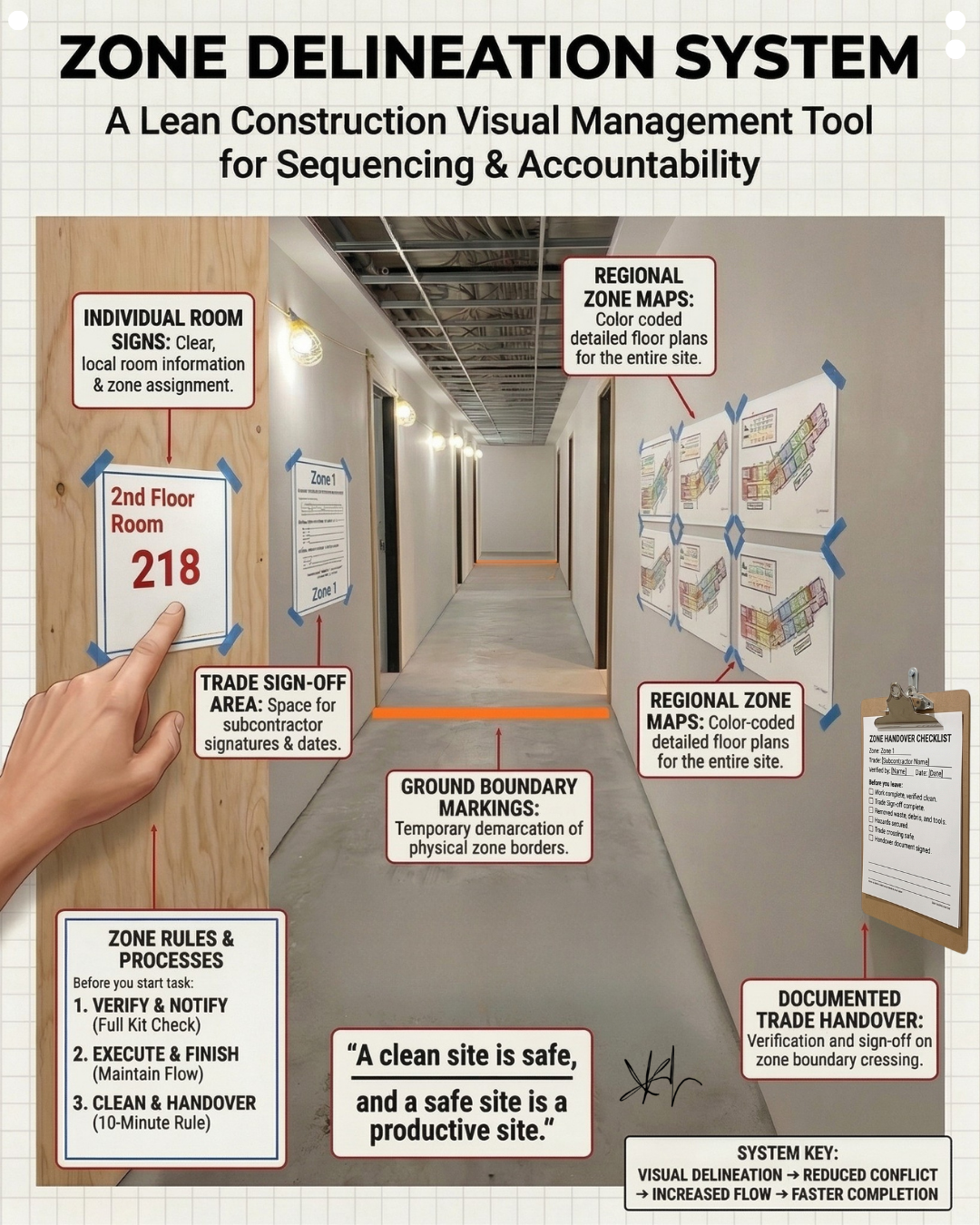
The image in this post shows what a fully implemented Zone Delineation System looks like on an active construction floor. Each element has a specific role, and together they make zone ownership and handover impossible to miss.
Individual room signs at each entrance display the floor, room number, zone assignment, and local information relevant to that space. Every worker entering the room knows instantly what zone they’re in, what the zone assignment is, and who owns the work being done there. This is not information that requires a conversation or a trip to the trailer. It is visible at the door, from the moment someone enters. The room sign is the local node of the visual management network the most immediate answer to the question “is this my zone?”
Ground boundary markings on the floor physically demarcate zone borders. Tape lines, painted marks, or temporary floor indicators make the zone boundary a physical reality rather than an administrative concept. When the floor tells you where Zone 1 ends and Zone 2 begins, the ambiguity that drives coordination conflict disappears. Workers, foremen, and zone managers can all orient to the same physical reference simultaneously without any explanation required.
Watch for these signals that zone delineation is absent or inadequate on your project:
- Trades entering each other’s active work areas without any awareness of whose zone they’re entering
- No documented handover process when work transitions from one trade to the next
- Rework disputes where neither trade can prove the condition of the space when they received it
- Workers unable to identify their zone assignment when asked during a zone control walk
- Regional zone maps exist on a board in the trailer but are not accessible to workers on the floor
Regional Zone Maps and the Trade Sign-Off Area
Color-coded regional zone maps posted at decision points throughout the floor give every worker access to the full zone layout for the site. Not just their corridor the entire floor, with each zone color-coded by trade assignment, phase sequence, and completion status. These maps do for the floor what the Visual Area Board does for the zone: they make the plan visible at the place of work, readable by anyone who needs to orient themselves, without requiring a conversation or a trip to the office.
The trade sign-off area on each zone is where ownership becomes documented. Before a trade leaves a zone, the foreman signs off with a date confirming that the zone is complete, clean, and ready for handover. Before the next trade enters, the receiving trade signs in, verifying the condition of the zone as accepted. This documented handover with signatures, dates, and verification of zone boundary crossing is the quality gate that eliminates the he-said, she-said disputes that otherwise consume project team time and trade relationships.
The ten-minute rule in the zone standards requires that before any handover, the leaving trade cleans the zone to the standard required by the receiving trade. Not a general cleanup a specific standard: clear of tools, clear of debris, clear of materials that don’t belong, documented with a full kit check. This standard applies equally to every trade every time, which means the culture of the zone is self-reinforcing. No trade crosses a boundary without leaving a clean space behind them.
The Three Zone Rules: Verify and Notify, Execute and Finish, Clean and Handover
The three zone rules printed at each zone entry represent the behavioral standard for everyone working in the zone. They are not aspirational guidelines they are operating requirements with visible, physical checkpoints to confirm compliance.
Verify and Notify means before any work begins, the crew verifies the kit is complete and notifies the zone manager of any constraints or gaps that would prevent execution. This is the make-ready check applied at the moment of task initiation. It catches problems when they’re still cheap to fix before the crew has already begun work around a missing element or proceeded on an assumption that turns out to be wrong.
Execute and Finish means the crew maintains flow throughout the zone without partial completions, without leaving tools and materials scattered, and without creating obstacles for the trade coming behind them. Partial completions are the primary driver of coordination failure and rework in multi-trade environments. A zone that is 80% done creates a coordination problem for every subsequent trade. A zone that is 100% done, documented, and handed over creates a clean starting point for the next crew.
Clean and Handover is the ten-minute rule a specific standard applied at the end of every task and every zone transition that ensures the next trade inherits a clean, ready space. The zone was received clean. It will be handed over clean. That is not optional. It is the foundation of the mutual respect that makes multi-trade coordination work as a system rather than a series of ongoing negotiations.
Why Zone Delineation Directly Supports Takt Production
Jason Schroeder’s teaching on zone control is precise: zone control is the process of controlling flow within the parameters of zone boundary and according to the Takt time. Zone managers, zone leaders, supers, and field engineers help trades prepare for and finish work within zones for the purpose of finishing on time according to handoff deadlines. All of that depends on one precondition the zone boundaries are visible, understood, and honored. Without the delineation system, zone control is an administrative concept without physical expression. With it, zone control becomes a daily operational reality that every worker on the floor participates in.
The Takt Production System moves trades through zones in a defined rhythm. That rhythm is only possible when each zone has a clean, documented completion before the next trade arrives. A zone delineation system with a formal sign-off process is the physical infrastructure that makes clean handoffs possible at the Takt pace. It protects the rhythm by removing the ambiguity that would otherwise cause the train to stall at every boundary crossing.
If your project needs superintendent coaching, project support, or leadership development, Elevate Construction can help your field teams stabilize, schedule, and flow. Zone delineation is one of the most practical and immediately impactful systems a project can implement to make that flow visible, documented, and sustained.
Implement the System Before the Train Starts Moving
Here is the challenge. Before your next phase of interior work begins, put the six elements of the Zone Delineation System in place: individual room signs, trade sign-off areas, ground boundary markings, regional zone maps at decision points, documented handover checklists, and posted zone rules at each zone entry. Do it before the first trade mobilizes into the interior phase. Train every foreman on the three zone rules. Establish the ten-minute handover standard as a project requirement, not a preference.
Walk the floor at the end of the first week and look at every zone boundary. Ask whether every worker on every crew could describe where their zone begins and ends, who receives the work next, and what condition the zone must be in before they leave it. If the answers are clear and consistent, the system is working. If the answers are vague, you’ve identified exactly where the next coordination failure is going to come from.
A clean site is safe. A safe site is a productive site. And a delineated, documented, signed-off site is the environment where that productivity becomes repeatable.
As Jason Schroeder teaches: “Zone control is the process of controlling flow within the parameters of zone boundary.” Design those parameters. Make them visible. Let the floor speak for itself.
On we go.
Frequently Asked Questions
What is the Zone Delineation System and what problem does it solve?
It’s a set of six visual management tools room signs, boundary markings, zone maps, sign-off areas, handover documentation, and zone rules that make zone ownership and handover physically visible on the floor, eliminating the ambiguity that drives rework and coordination conflict.
What are the three zone rules and why do they matter?
Verify and Notify (pre-task kit check), Execute and Finish (maintain flow and complete the zone fully), and Clean and Handover (ten-minute rule before boundary crossing). Together they create a behavioral standard that makes every zone transition clean, documented, and repeatable.
Why is the documented trade handover more important than a verbal one?
Documentation with signatures and dates creates accountability and an evidentiary record of zone condition at each transition. Verbal handovers produce disputes when quality issues emerge later neither trade can prove what the space looked like when they received it.
How does zone delineation support the Takt Production System?
Takt requires trades to move through zones on a defined rhythm with clean handoffs at each boundary. Zone delineation makes those boundaries physical and documented, protecting the Takt rhythm by removing the ambiguity that causes trades to stall at boundary crossings.
When should the Zone Delineation System be set up on a project?
Before the first trade mobilizes into the interior phase not after coordination problems emerge. The system’s value is preventive: it eliminates the conditions that produce conflict, rework, and disputed handoffs before any of them have the chance to develop.
If you want to learn more we have:
-Takt Virtual Training: (Click here)
-Check out our Youtube channel for more info: (Click here)
-Listen to the Elevate Construction podcast: (Click here)
-Check out our training programs and certifications: (Click here)
-The Takt Book: (Click here)
Discover Jason’s Expertise:
Meet Jason Schroeder, the driving force behind Elevate Construction IST. As the company’s owner and principal consultant, he’s dedicated to taking construction to new heights. With a wealth of industry experience, he’s crafted the Field Engineer Boot Camp and Superintendent Boot Camp – intensive training programs engineered to cultivate top-tier leaders capable of steering their teams towards success. Jason’s vision? To expand his training initiatives across the nation, empowering construction firms to soar to unprecedented levels of excellence.
On we go