
What Is Psychological Safety and Why Every Construction Project Depends on It
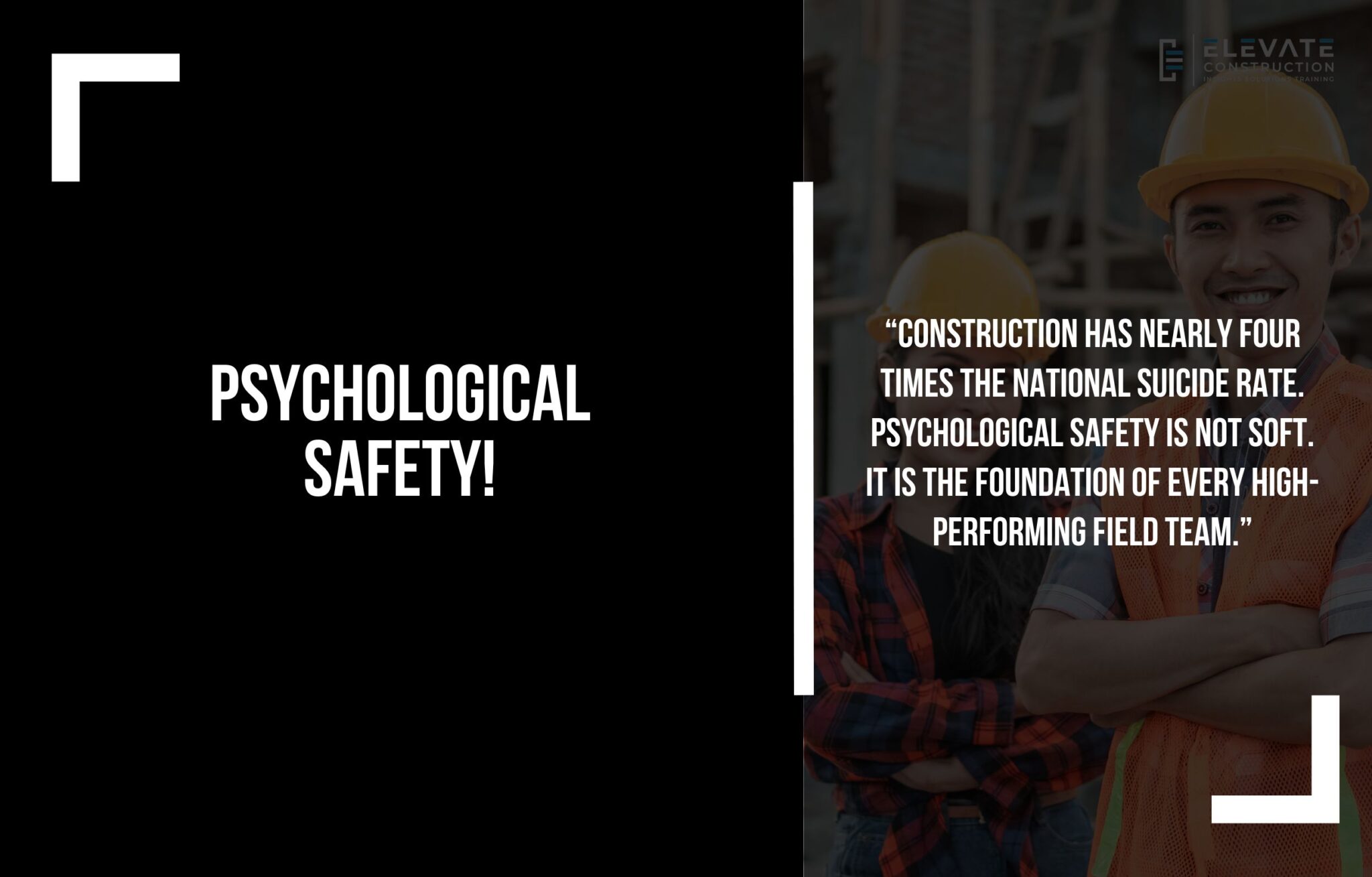
There is a number that should stop every leader in construction cold: the industry’s suicide rate is nearly four times the national average. That statistic does not exist because construction work is physically hard. Physical hard work, done in a safe environment, with people who feel valued and connected, is not what produces that number. What produces it is the accumulated weight of environments where people do not feel safe to speak up, to make mistakes, to belong, or to challenge the way things are done. Psychological safety is not a soft concept invented by people who have never worked in the field. It is the measurable, research-backed condition that separates teams that perform from teams that survive. And construction cannot afford to keep confusing the two.
The Misconception That Costs Lives
The most common objection to discussions about psychological safety in construction sounds like this: we do not need to be worrying about feelings on a jobsite. We need to be worrying about getting the work done. That objection is based on a false choice. Psychological safety is not about reducing standards or making work comfortable. It is not about eliminating stress or removing accountability. The research is clear on this point: stress is not inherently harmful. Hard work is not inherently harmful. The condition that becomes harmful is an environment where a person’s stress response triggers a survival mode rather than a challenge mode. One of those states produces connection, focus, and performance. The other produces disconnection, fear, and decline. The environment determines which one a person experiences, not the difficulty of the work.
The Personal Experience That Changed Everything
Jason Schroeder was suspended once for failing to speak up when someone was being harassed. He did not know he should have at the time. He came from a culture where that was not the expectation. He could have blamed the culture, explained away the situation, or minimized what happened. He has chosen instead to own it fully and to use it. That experience gave him a level of sensitivity to inclusion and conduct that he has carried into every project and every leadership role since. And the reason he shares it publicly is straightforward: the people listening to this podcast deserve to understand the standard before they find out the hard way what happens when they do not meet it. Getting suspended, fired, sued, or facing criminal charges are outcomes nobody needs to experience personally in order to understand the principle. The principle is available now. The cost of ignoring it is real and documented.
The Four Conditions That Create Psychological Safety
Research from Cabrie Lerman-Schmidt on crew performance identifies four levels of psychological safety that, when present, enable crews to do their best work. Each one addresses a fundamental human need.
Inclusion safety is the foundation. It satisfies the human need to connect and belong. On a construction site, this means the superintendent actively establishes and maintains expectations for how people are treated. It means that bias, harassment, and conduct that makes any crew member feel less than welcome are addressed immediately and personally by field leadership. The superintendent’s response time and directness set the standard more powerfully than any posted policy. When inclusion safety is present, people show up fully. When it is absent, they show up in survival mode.
Learner safety satisfies the need to grow. It means that anyone on the crew can engage in the learning process without fear of humiliation when they ask a question or make a mistake. Cabrie Lerman-Schmidt highlights the problem of presenteeism, being physically present but mentally absent due to anxiety or disengagement, as a direct outcome of environments where learning is not safe. When apprentices are treated with respect rather than condescension, it demonstrates something to every experienced worker watching: that the organization values growth and is committed to investing in people. That message changes behavior at every level.
Contributor safety satisfies the need to make a difference. It speaks to the deep pride of the building trades directly. The best crews have what Lerman-Schmidt describes as a crew family mentality, a sense that the individual’s contribution matters to the whole and is recognized as meaningful. When people feel that what they do matters, they bring discretionary effort. They look out for each other. The data shows that tapping into this sense of belonging and contribution is a critical factor in addressing the mental health crisis in the trades.
Challenger safety is the highest level. It satisfies the need to make things better. An environment with challenger safety allows any crew member to surface a problem, question a process, or suggest an improvement without fear of being shut down or punished for speaking up. Programs like RISE UP, a pre-apprenticeship initiative in the Pacific Northwest, are built around this principle: challenging the stigmas and hierarchies that prevent people from raising their hands. When people feel safe to challenge, the system improves. When they do not, problems get buried until they become crises.
The Performance Quadrant That Every Leader Needs to Understand
O’Shea Builders has made visible a framework that captures the relationship between psychological safety and performance standards in four categories. When psychological safety is high and standards are also high, teams operate in the zone of learning and high performance. That is where the work gets done at the highest level and where people grow. When standards are high but psychological safety is low, the result is anxiety. People feel evaluated and threatened rather than challenged and supported. Performance suffers even when capability is present. When psychological safety is high but standards are low, the result is the comfort zone. People feel safe but are not being stretched. When both are low, the result is apathy. Nobody cares, and the project shows it.
The target is clear: high standards and high psychological safety together. Not one at the expense of the other. Leadership that drives high standards in a low safety environment will produce an anxious, disconnected team that eventually fails. Leadership that maintains high safety with low standards will produce a comfortable, underdeveloped team that also fails. The difficult work is holding both at the same time.
What Healthy Conflict Requires
The five dysfunctions of a team, as Patrick Lencioni frames them, describe a sequence: trust, healthy conflict, commitment to goals, accountability, and results. Each step depends on the one before it. A team that cannot have healthy conflict cannot make genuine commitments. A team that cannot make genuine commitments cannot hold each other accountable. A team without accountability cannot perform. And a team cannot have healthy conflict without psychological safety. These are not separate conversations. The psychological safety work is the trust-building foundation that makes everything else possible. Skipping it and trying to drive performance directly produces performance theater: people performing compliance rather than genuine commitment.
Healthy conflict means that team members can disagree directly, surface problems honestly, challenge each other’s thinking, and work through tension without anyone feeling their belonging or their job security is at stake for doing so. That kind of conflict is not comfortable. It is productive. And it only happens in environments where people trust that speaking honestly is safe.
Here Is What Leaders Can Do Starting This Week
Before the next project kickoff or team meeting, consider how the environment is being designed:
- Is there a clear, specific, and consistently enforced standard for how people are treated on this site, and does field leadership know they are responsible for upholding it personally?
- Are crew members who ask questions or admit mistakes treated as people learning, or as problems to manage?
- Is the individual contribution of every worker, from the newest apprentice to the most experienced journeyman, recognized in a way that makes it clear their work matters?
- Is there a genuine channel through which anyone on the crew can raise a concern, suggest an improvement, or surface a problem without fear of the response?
- Does the leadership team model the vulnerability, directness, and inclusion that psychological safety requires?
Built for Teams That Want to Win Together
The goal of this work is not to make construction feel like a therapy session. The goal is to build environments where hard work and high standards are embraced because the people doing the work feel genuinely connected, genuinely valued, and genuinely safe to bring their full capability to the project every day. We work to live, not the other way around. The project and the work exist to support the lives of the people doing it. When the environment honors that, productivity follows. When it does not, the costs show up in absenteeism, turnover, poor quality, and in the worst cases, in the statistic that the construction industry’s suicide rate continues to reflect. If your project needs superintendent coaching, project support, or leadership development, Elevate Construction can help your field teams stabilize, schedule, and flow.
Build the Environment First, Then Build the Project
Amy Edmondson, whose book The Fearless Organization is foundational to this conversation, describes psychological safety as the condition that allows people to share concerns and mistakes without fear of embarrassment or retribution. When crews are burdened by fear, the team loses buy-in, innovation, and safety practices. Jason Schroeder would add one more thing: when people operate in fearful environments, the body programs itself to disconnect from others, and a disconnected team is not a team at all. It is a group of individuals surviving in the same space. Build the environment where people can connect, contribute, challenge, and learn. Build it before anything else. The project will follow.
On we go.
FAQ
What is psychological safety and why does it matter in construction specifically?
Psychological safety is the condition in which team members feel safe to speak up, make mistakes, ask questions, and challenge the way things are done without fear of negative consequences. In construction, it matters because the industry has nearly four times the national average suicide rate, because crews that lack psychological safety underperform on quality, safety, and production, and because the nature of construction work, which requires coordination across multiple trades, constant problem-solving, and genuine commitment to safety practices, depends on people being willing to communicate honestly. A crew that cannot speak up about a problem or a concern is a crew that is hiding the information the project needs to stay on track and protect its people.
Is psychological safety about reducing stress and hard work?
No, and this is one of the most important distinctions to make clearly. Research cited in The Upside of Stress shows that stress is not inherently harmful. Hard work and high standards are not harmful. What is harmful is the combination of high stress with an environment that triggers a survival response rather than a challenge response. When people feel that their belonging, their livelihood, or their safety is under threat, the body releases chemicals that produce disconnection rather than connection. When people feel challenged in a safe environment, the body releases chemicals that support focus, connection, and performance. Psychological safety is what determines which of those two states a person experiences. It does not eliminate stress. It determines whether stress is productive or destructive.
What are the four levels of psychological safety and how do they apply to construction crews?
The four levels, as described by Cabrie Lerman-Schmidt, are inclusion safety, learner safety, contributor safety, and challenger safety. Inclusion safety means every person on the crew belongs and is accepted. Learner safety means anyone can ask questions, make mistakes, and engage in the learning process without fear of humiliation. Contributor safety means the individual’s contribution is recognized and valued as meaningful to the team. Challenger safety means anyone can surface a problem, question a process, or suggest an improvement. In construction, each of these levels maps directly to crew dynamics: an apprentice who is afraid to ask a question will make errors they could have avoided; a worker who feels their contribution is invisible will not bring discretionary effort; a foreman who cannot challenge an unsafe condition without fear of pushback is a foreman who will eventually stop raising concerns.
What is the relationship between psychological safety and team performance?
The framework shared in this episode, based on research applied by O’Shea Builders, describes four outcomes based on the combination of psychological safety and standards. High safety and high standards produce learning and high performance. High standards and low safety produce anxiety and disconnection. High safety and low standards produce comfort zone behavior. Low safety and low standards produce apathy. High performance requires both high standards and high psychological safety simultaneously. Neither alone is sufficient. Leadership that demands high standards in a low-safety environment will get performance theater rather than genuine results. Leadership that maintains safety without demanding high standards will produce a team that feels good but does not grow.
How does a superintendent create psychological safety on a project site?
Through consistent personal behavior, not through policies or programs. The superintendent who addresses a harassing comment the moment it occurs, regardless of who made it or whether anyone said they were bothered, is building inclusion safety in real time. The superintendent who responds to a worker’s question with patience rather than condescension is building learner safety. The superintendent who recognizes specific contributions in the morning huddle, names people, and thanks them genuinely is building contributor safety. The superintendent who responds to a foreman’s concern about an unsafe sequence by taking it seriously and investigating rather than dismissing it is building challenger safety. All of that happens through the daily, personal choices of the field leader. Policy can set the expectation. Only behavior can build the culture.
If you want to learn more we have:
-Takt Virtual Training: (Click here)
-Check out our Youtube channel for more info: (Click here)
-Listen to the Elevate Construction podcast: (Click here)
-Check out our training programs and certifications: (Click here)
-The Takt Book: (Click here)
Discover Jason’s Expertise:
Meet Jason Schroeder, the driving force behind Elevate Construction IST. As the company’s owner and principal consultant, he’s dedicated to taking construction to new heights. With a wealth of industry experience, he’s crafted the Field Engineer Boot Camp and Superintendent Boot Camp – intensive training programs engineered to cultivate top-tier leaders capable of steering their teams towards success. Jason’s vision? To expand his training initiatives across the nation, empowering construction firms to soar to unprecedented levels of excellence.