
Advanced Work Packaging should not be complicated.
At its best, AWP is simple:
Give the field the right work,
in the right sequence,
with the right materials,
at the right time,
with the roadblocks removed before the crew arrives.
That’s the whole game.
The problem is that AWP often gets buried under acronyms, oversized packages, disconnected planners, CPM logic, and beautiful documentation that still does not help the foreman on Monday morning.
AWP was never meant to be paperwork.
It was meant to create flow.
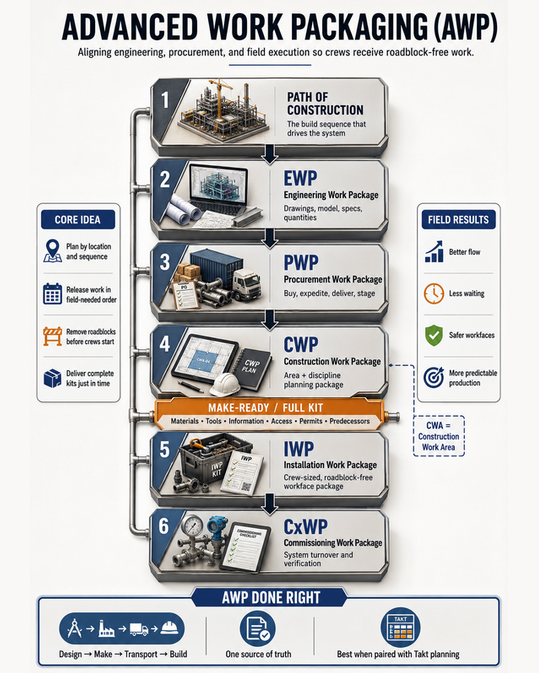
That starts with the Path of Construction — the real order the work wants to be built in.
From there, the system should align:
What are we building?
PWP — Procurement Work Package
What needs to be bought, delivered, and staged?
CWP — Construction Work Package
How is the field scope divided by area and discipline?
IWP — Installation Work Package
What does one crew need to install, safely and completely?
CxWP — Commissioning Work Package
Does the finished system actually work?
But here is the key:
The package is only valuable if it is ready.
Not mostly ready.
Not “we’ll figure it out in the field” ready.
Not “the material is somewhere onsite” ready.
Ready means full kit.
Tools.
Information.
Access.
Permits.
Predecessors complete.
Roadblocks removed.
That is what makes AWP powerful.
And when you pair AWP with Takt planning, the whole system finally gets its rhythm.
The work is not just packaged.
It is packaged to the beat of production, by location, in the order the field actually needs it.
That is when AWP stops being a megaproject bureaucracy and starts becoming a practical field system.
Design → Make → Transport → Build.
One source of truth.
One clear path.
One prepared package at a time.
That is Advanced Work Packaging done right.