
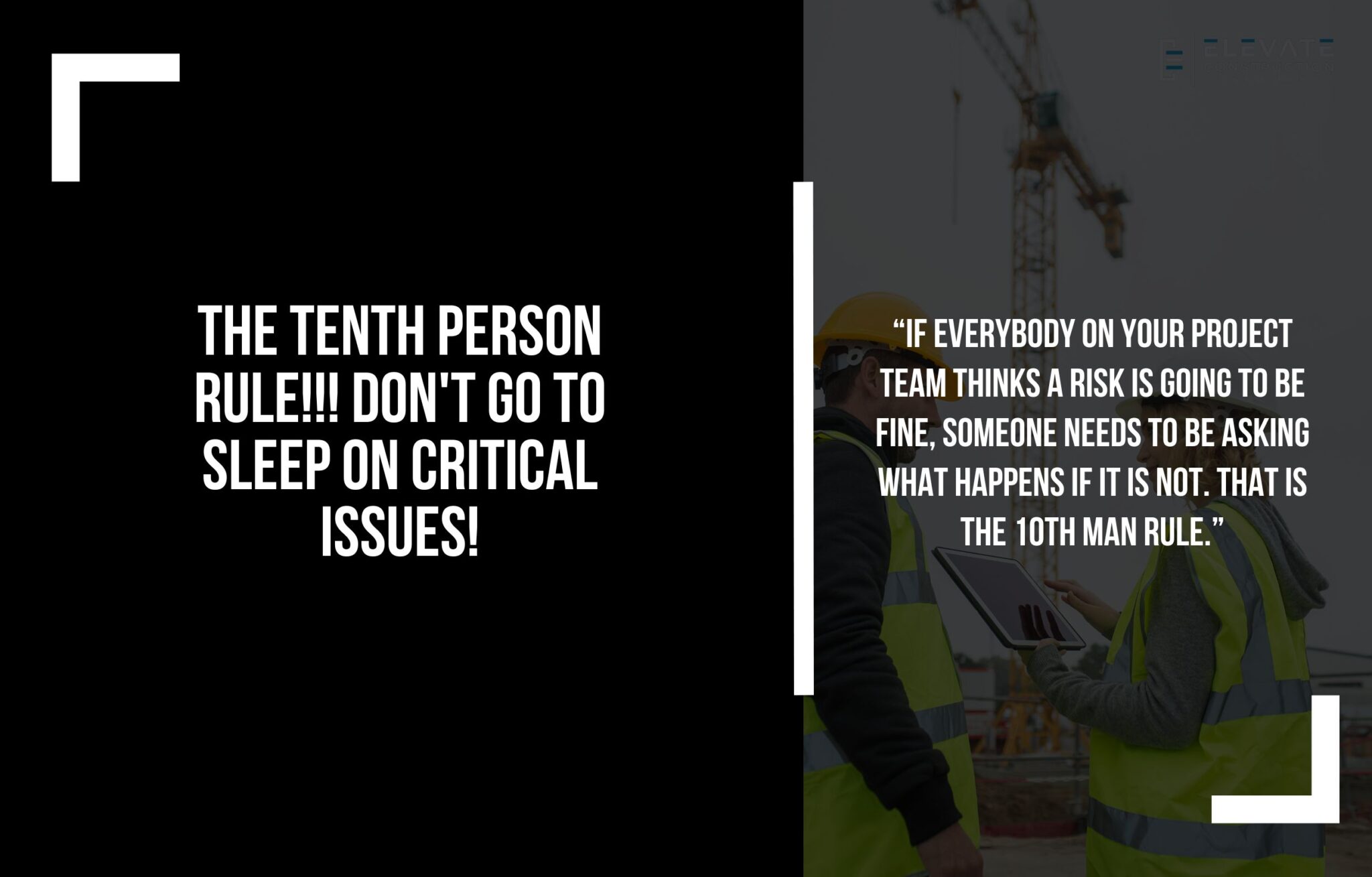
Don’t Go to Sleep on Critical Items: The 10th Man Rule Every Construction Team Needs
Fred Strauser, one of the most effective builders Jason Schroeder has encountered in his career, had a phrase he used on project teams at Oakland Construction that stuck: don’t go to sleep on that submittal. Not a long explanation. Not a framework. A phrase. And it communicated, in six words, exactly what was happening when a project team stopped actively managing something they had decided to trust to chance. Going to sleep on an issue means you are not watching it, not waiting for the next development, not ready for the scenario where it does not go the way you assumed it would. It means you have handed it off to hope. And hope, as this episode makes clear, is not a production strategy.
The Problem That Follows Every Project That Lets Its Guard Down
The pattern is consistent enough to name: a risk or a procurement item or a critical coordination requirement gets identified, an initial response is made, and then the issue goes dormant. Someone sends an email. Someone makes a call. Someone asks the question and receives an answer that sounds reassuring. And then the issue gets filed in the mental category of things that are probably going to be fine, and it stops being actively monitored. Six weeks later, the thing that was going to be fine is not fine. The exterior panel sealant that the consultant said would probably work turns out to have a performance problem that field testing would have revealed months earlier. The dewatering approach that everyone assumed would be adequate fails when the monsoon season delivers more water than the estimate anticipated. The scaffolding logistics that were flagged as a potential conflict but dismissed as manageable create a two-week delay that nobody had budgeted for.
The project team was not incompetent. The risk was identified. The problem was that identifying it was treated as a substitute for managing it.
The System That Creates Wishful Thinking
This pattern does not happen because people are lazy or careless. It happens because construction projects are enormously complex, the number of items requiring attention on any given day exceeds the available bandwidth of even the most disciplined team, and the natural human tendency when resources are stretched is to triage. Items that seem stable get moved out of active management and into the background. Items that are actively causing problems get the attention. The result is a project management culture that is highly responsive to visible problems and chronically underattentive to the risks that have not yet become problems but will.
The system fails because there is no mechanism to force the question: what if this assumption is wrong? Without that mechanism, the team gravitates toward the path of least resistance, which is to accept the reassurance that was received and move on. The 10th man rule is the mechanism that construction project teams are missing.
The 10th Man Rule in Practice
The 10th man rule, popularized in the film World War Z in a scene about Israel’s decision-making process around existential threats, works like this: when a group reaches a unanimous conclusion, one person is designated to argue the opposite position, to stress-test the consensus, and to act as if the feared outcome is actually going to happen. Not because consensus is wrong by definition, but because unanimous agreement on a complex, uncertain situation often means the group has collectively decided to stop asking hard questions.
In construction, this looks like one person at every project team meeting whose job is to push on every item that the group is treating as resolved. The procurement that everyone agrees is on track: what are the intermediate release points, and when was the last time someone confirmed each of them? The dewatering that everyone agrees is sufficient: what is the plan if it is not, and what does a failure look like? The exterior panel coordination that everyone agrees is going well: what specific item would need to be true for it to go badly, and is that item being monitored?
The goal is not to manufacture pessimism or to slow down a team that is functioning well. The goal is to prevent the project team from collectively going to sleep on an assumption that turns out to be wrong. One person staying awake is the difference between a surprise and a managed outcome.
The Items Construction Teams Go to Sleep On Most Often
The scopes and issues that tend to fall into the wishful thinking category are not random. They follow a pattern across projects and project types:
- Long lead procurement items that were identified early but are not being monitored at their intermediate release points, allowing missed actions to compound before anyone notices
- Dewatering and site conditions in markets with seasonal weather events, where the plan was made for average conditions and the risk of above-average conditions was accepted rather than mitigated
- Exterior skin coordination and performance, where the assumption that the system will work as designed is accepted without a performance mock-up that would surface problems before fabrication is complete
- Permanent power and utility tie-ins, where the utility company’s timeline is taken at face value without active follow-up on each approval milestone
- Phase tie-ins and schedule interfaces, where the assumption that adjacent phases will complete on time is never stress-tested against the actual conditions developing in those phases
Each of those is an item where the consequences of going to sleep are serious, and where active management during the period when the issue appears stable is exactly what prevents a crisis during the period when the issue becomes urgent.
The Weekly Risk and Opportunity Register
The mechanism that makes the 10th man rule operational on a construction project is a risk and opportunity register that lives on the weekly team meeting agenda. Not as a ceremonial review of a document that was built in preconstruction and has not been updated since. As a live, active conversation where every identified risk is either showing a mitigation plan that is being executed or being escalated as a projected loss that leadership needs to see.
Every risk on the project falls into one of three categories. It is being actively mitigated, with a plan that is reducing the probability or the impact of the identified outcome. It is being accepted, with a financial projection that reflects the expected loss if the risk materializes, communicated transparently to the company’s leadership so they can make informed decisions. Or it is being escalated, because the team has identified something that requires decisions or resources beyond their authority to provide. The category that does not appear on this list is: it should be fine. That category is where risks go to become crises.
Jason is direct about this: if a construction team does not have a risk and opportunity register as a standing agenda item in their weekly internal meeting, they are not using the team meeting the way it should be used. The team meeting is not a status update. It is a risk management session. The status update tells you where you are. The risk session tells you what is about to go wrong if nobody does anything about it.
What PMs and Supers Must Never Delegate
The items that PMs and superintendents cannot go to sleep on also cannot be delegated. The concept of delegation in construction is powerful and necessary, but it has a category error when it is applied to the wrong items. Procurement cannot be delegated, because the consequences of a missed release point reach every trade and every milestone on the project, and only the PM and superintendent together have the strategic visibility to manage it at the right level. Safety cannot be delegated, because the responsibility for a safe project environment ultimately rests with the people who are accountable for the project’s outcomes, and delegating the responsibility without the accountability creates a gap that incidents exploit. Quality cannot be delegated, because the standard that the crew and the foreman apply to their work is a reflection of the standard that the superintendent and PM have established and enforced, and when that standard goes unmonitored, it drifts.
Delegating the execution of a procurement process is not the same as going to sleep on procurement. Having a project engineer track a submittal log is appropriate. Assuming the submittal log is current and complete without verifying it is going to sleep on procurement. The distinction is active versus passive engagement with the outcomes that matter most.
Built for Project Teams That Want to Finish Clean
The construction teams that execute well are not the ones that never encounter risks. They are the ones that encounter risks early, when there is still time to act, because someone stayed awake and kept asking the question that the group had stopped asking. Creating a culture where that kind of vigilance is normal requires naming it, modeling it, and making it a structural feature of the team’s meeting rhythm rather than a personality trait of whoever happens to be most pessimistic on a given project. The 10th man rule is that structure. The risk register is the place it lives. The weekly review is what keeps it alive. If your project needs superintendent coaching, project support, or leadership development, Elevate Construction can help your field teams stabilize, schedule, and flow.
Stay Awake on the Things That Matter
Every project has a list of items where going to sleep will eventually produce a crisis. The list is not the same on every project, but it always includes procurement, safety, quality, phase interfaces, and the risks that were identified and accepted without a real mitigation plan. The job of the project team is not to hope that those items will resolve favorably. It is to stay awake on them, to keep asking the question the group stopped asking, and to have a plan for the scenario that everyone has been quietly assuming will not happen. As Dwight Eisenhower observed: in preparing for battle, plans are useless, but planning is indispensable. The plan will not survive the field unchanged. The planning, meaning the continuous, active engagement with what could go wrong and what to do about it, is what keeps the project from being surprised by what everyone could see coming.
On we go.
FAQ
What does it mean to go to sleep on a critical item in construction?
It means an issue that requires active management is being treated as resolved when it is not. An item is going to sleep when a risk was identified, an initial response was made, and the team stopped actively monitoring it. Someone made a call or sent an email, received a response that sounded reassuring, and moved the item from active management to the mental category of things that are probably fine. Going to sleep on an item is not the same as resolving it. It is substituting hope for management, and it produces the familiar pattern of surprises in the final third of a project that were visible much earlier to anyone who was still watching.
How does the 10th man rule work in a construction project context?
The 10th man rule designates one person in every team meeting to argue the position the group has collectively decided to stop defending. When everyone agrees that procurement is on track, the 10th person asks what specific evidence supports that and when the last confirmation was. When everyone agrees that the dewatering plan is adequate, the 10th person asks what the failure scenario looks like and what the mitigation plan is if conditions exceed the estimate. The role is not to be contrarian for its own sake. It is to ensure that the group’s consensus is tested before it becomes a commitment, and that the project team is not collectively going to sleep on an assumption that the field will eventually disprove.
What should appear on a weekly risk and opportunity register?
Every identified risk on the project, with its current status, the person responsible for managing it, and one of three dispositions: being actively mitigated with a specific plan that is reducing probability or impact; being accepted and projected as a financial loss that leadership is aware of; or being escalated because it requires decisions or resources beyond the project team’s authority. The category that should never appear is that something should probably be fine. Every risk needs a disposition, and the disposition needs to be backed by a decision, not by optimism. The register should be a standing agenda item in the weekly internal team meeting, not a document that was built in preconstruction and reviewed quarterly.
Why can procurement not be delegated by the PM and superintendent?
Because the consequences of a missed procurement release point touch every trade, every phase milestone, and every critical path activity downstream. The project engineer can track the submittal log. The assistant superintendent can confirm material deliveries. But the strategic oversight of whether procurement is aligned to the production schedule, whether intermediate release points have been executed on the right dates, and whether the supply chain is positioned to support the production rhythm that the Takt plan requires: that oversight belongs to the PM and superintendent together. When one of them goes to sleep on procurement, assuming the process is working because no one has raised a flag, the missed glass order or the unexecuted purchase order for the elevator cab gets discovered when the installation window is already open and the material is not there.
What is the difference between healthy conflict in a team meeting and destructive conflict?
Healthy conflict is the kind that happens when the 10th man pushes on an assumption the group has accepted, surfaces a risk the team is not managing, or raises a question about whether the plan is as solid as everyone believes. It is uncomfortable but productive. It moves the team toward better decisions and more complete risk management. Destructive conflict is the kind that happens when pushback is personal, when questioning a decision becomes an attack on the person who made it, or when the culture of the team makes raising concerns feel more dangerous than staying quiet. The 10th man rule is a structure for institutionalizing healthy conflict: one person’s job is to push, and that job is defined as valuable rather than tolerated as disruptive.
If you want to learn more we have:
-Takt Virtual Training: (Click here)
-Check out our Youtube channel for more info: (Click here)
-Listen to the Elevate Construction podcast: (Click here)
-Check out our training programs and certifications: (Click here)
-The Takt Book: (Click here)
Discover Jason’s Expertise:
Meet Jason Schroeder, the driving force behind Elevate Construction IST. As the company’s owner and principal consultant, he’s dedicated to taking construction to new heights. With a wealth of industry experience, he’s crafted the Field Engineer Boot Camp and Superintendent Boot Camp – intensive training programs engineered to cultivate top-tier leaders capable of steering their teams towards success. Jason’s vision? To expand his training initiatives across the nation, empowering construction firms to soar to unprecedented levels of excellence.