
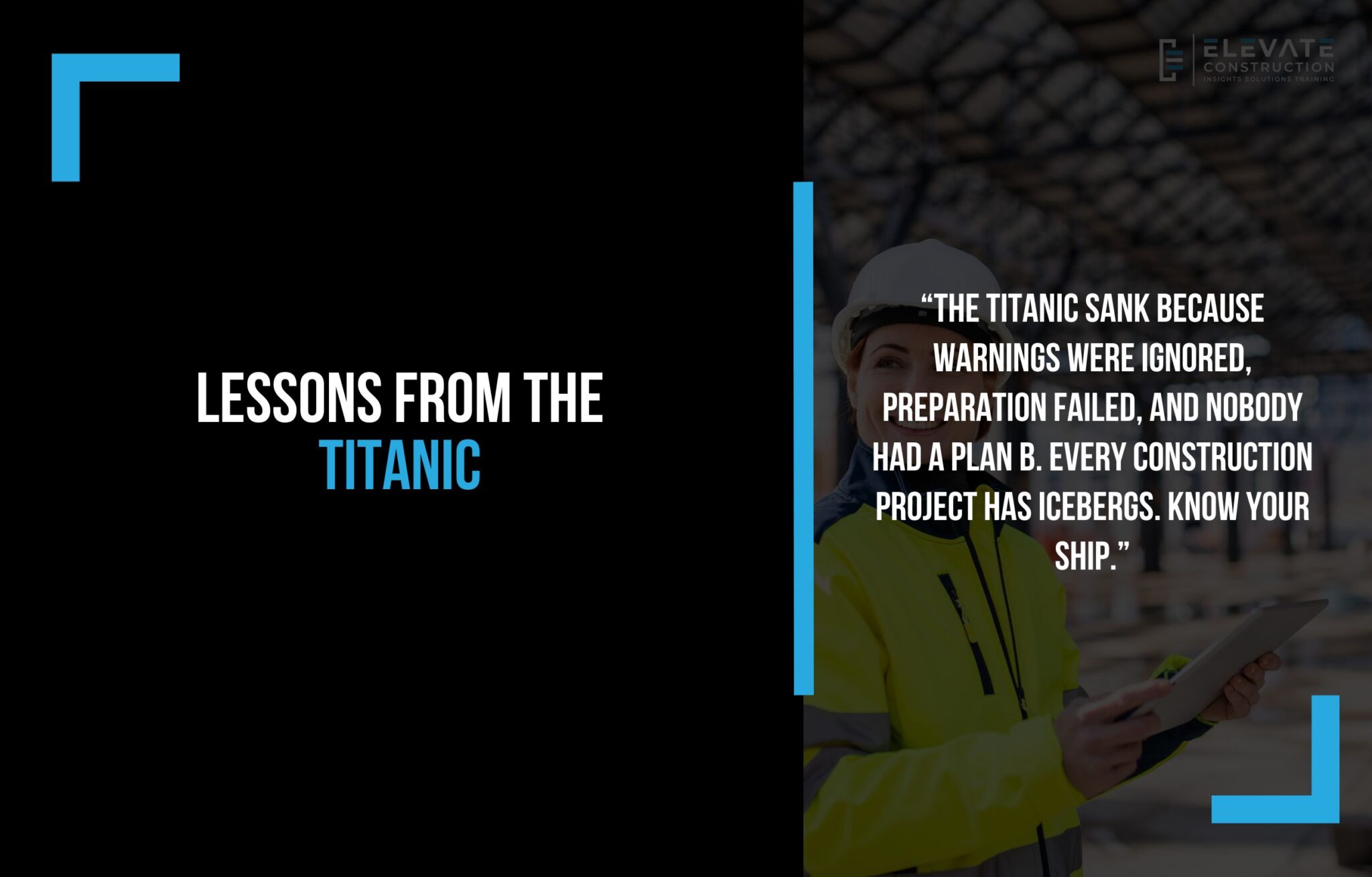
The Titanic and Construction: What Every Project Leader Can Learn From the Ship That Should Not Have Sunk
The Titanic did not sink because it was old technology or because the crew was incompetent. It sank because a series of leadership failures, each one individually correctable, combined into a catastrophe that could not be undone by the most heroic performance in the moment the iceberg appeared. That is the lesson that makes the Titanic relevant to every construction superintendent and project manager who has ever said “we’ll figure it out in the field” or “I think we’ll be fine” about something that deserved a real contingency plan. The crew reversed the engines. They turned the ship hard to starboard. They worked well together in the final moments. It was not enough, because you cannot undo poor preparation with excellent reaction. The construction equivalent of that truth plays out on projects every single day.
The Problem That Reveals Itself When It Is Already Too Late
Walk a project that is in serious trouble in its final third and trace the decisions backward. The change orders that overwhelmed the team in month eight were foreseeable in month two, when the design was still being developed and the scope of owner decisions was already running behind. The manpower shortage that stopped production in month nine was signaled by the labor market six months earlier, in conversations with trade partners who told the team what they were seeing. The exterior skin that is three months behind was identified as a long lead procurement risk in the kickoff meeting and then was not touched again until someone noticed the installation window was already open and the material was not there. The project team saw the warnings. They did not respond to them with preparation. They responded to them with the assumption that it would work out, and by the time the iceberg appeared directly in front of them, the window for correction had already closed.
The System That Produced the Disaster
The Titanic tragedy was not the product of evil intent or deliberate negligence. It was the product of a system that had not been tested, a crew that had not trained together for emergencies, a culture that prioritized speed and image over preparation and caution, and a structure where the person with the most authority to prevent the problem was asleep when the situation was developing. Mr. Ismay commissioned the voyage and asked for full speed ahead through the night. The movie treats him as the villain. Jason Schroeder draws a different conclusion: the captain agreed to go full speed through iceberg-infested waters in the dark without binoculars, without a contingency plan, and without being present on deck. That is the captain’s decision. If you are the leader of your project and the owner asks you to do something that compromises the plan’s integrity, and you do it without the preparation that would make it survivable, the outcome belongs to the leader of the project.
The Lessons That Apply Directly to Construction
Walking through the scene that Jason describes, the failures are distinct and each one maps directly to a failure pattern that appears on construction projects regularly.
The first failure is ignoring warnings from other ships. The Titanic received communications from vessels that had already navigated the waters ahead and were warning about ice. The operators on the Titanic told them to stop transmitting. In construction, the equivalent is ignoring lessons from other projects, other contractors, and other teams who have already been through the conditions you are approaching. The manpower shortage that hit a competitor’s project six months ago is a warning about your labor market. The exterior skin delay that a peer company absorbed on their last healthcare project is a warning about your procurement timeline. If you are not touring other projects, talking to other superintendents, and actively importing lessons from people who have already navigated what you are about to navigate, you are turning off the telegraph.
The second failure is operating without the right equipment. The Titanic’s lookout team had no binoculars. They were navigating at full speed in dangerous conditions with their naked eyes and the informal method of claiming they could smell ice. In construction, going into a complex phase without the right tools, the right technology, the right trained personnel, or the right systems is the equivalent of taking the binoculars out of the equation and hoping the lookout’s instincts are sharp enough to compensate. Preparation is not optional when the consequences of failure include a project that does not recover.
The third failure is the captain being asleep. Not literally asleep in every case, but mentally absent from the conditions that were developing on the project while he was in his quarters. In construction, the superintendent or project manager who is not actively monitoring the state of critical procurement, critical phase transitions, and emerging risks while they are in a stable period is sleeping the same sleep. The stable period is exactly when the work of preparation has to happen.
What the Theory About Turning Into the Iceberg Teaches
There is a theory, and Jason acknowledges it is unverified, that if the Titanic had turned straight into the iceberg rather than attempting to avoid it, it would have breached one or two compartments instead of five. The ship could survive four breached compartments. It could not survive five. Turning away from the iceberg felt like the right instinct. It may have been the decision that sank the ship.
The construction lesson is not that you should run toward problems. The lesson is that the team on the Titanic had never thought through what they would do if they saw an iceberg at close range. There was no plan B. There was no decision tree that said: if we are far enough from the iceberg, steer away; if we are too close to steer away, steer into it. There was one person making a single instinctive decision in a high-stakes moment without a framework that had been thought through in advance. Napoleon outmaneuvered his opponents not because he always had the right plan, but because he had plans B, C, D, E, and F when his opponents had only plan A. The Titanic had plan A. When plan A failed, they had nothing left.
The Construction Equivalent: Contingency Planning That Is Not Optional
Here is what the lack of plan B looks like on a construction project:
- Rain falls on a site with no covered backlog of shop work, prefabrication, or indoor assembly that the crew can shift to, so production stops completely while the team treats the weather as a surprise that somehow keeps repeating itself
- A major trade partner defaults mid-project with no identified backup contractor, no contract provisions that protect the schedule, and no early warning system that would have allowed a replacement to be brought in before the default was complete
- A critical inspection fails and the path to reinspection was never planned, so the superintendent is making calls while the work behind the failed inspection is already half installed
- The structural steel delivery is delayed and there is no sequencing option that allows other work to continue in adjacent areas, because the schedule was never examined for the scenario where steel was late
None of those situations are unforeseeable. All of them are common. The difference between a project team that absorbs them and one that is overwhelmed by them is whether the team had done the thinking before the situation arrived.
The Captain Knew Less About the Ship Than the Designer
One of the most damaging failures in the Titanic story is that the captain did not know, when the carpenter reported back on the compartments that had been breached, exactly what that meant for the ship’s survival. The designer did know. The architect had the information in the drawings. It was not the captain’s information. The captain operated one of the most complex vessels ever built and did not carry the knowledge of the critical threshold that separated a damaged but survivable ship from a sinking one. In construction, the equivalent is the project leader who does not know the critical thresholds of their own project: the productivity rate below which the schedule cannot recover without acceleration, the number of days of float remaining before a particular scope becomes critical path, the amount of material currently on site versus the amount needed to complete the next phase. Those are the drawings the captain needs to have read.
Know Your Ship. Be the Captain. Own the Outcome.
If your project needs superintendent coaching, project support, or leadership development, Elevate Construction can help your field teams stabilize, schedule, and flow.
The closing message from this episode is one of the most direct in the Elevate Construction catalog: you are the captain of your project. Not a partial owner. Not a shared responsibility with the owner or the trade partners or anyone else. The captain. When something goes wrong, the captain does not blame the owner who asked for full speed. The captain is the person who either said no to an unsafe request with a clear alternative or said yes while ensuring the preparation that made the request survivable. One or the other. Not neither.
The Titanic’s captain could not sail his ship into New York City after the sinking and say it was Mr. Ismay’s fault for wanting to arrive early. He could not. The construction project leader cannot finish a project three months late and point to the owner’s decisions as the cause without asking what preparation would have prevented the situation from becoming unrecoverable. Ownership is not partial. If you are the captain, you own the outcome.
Prepare, Listen, Know Your Ship, and Have Plan B
The summary from this episode is four commands that every project leader can apply starting today. Listen to the signals coming from other ships: tour other projects, talk to other superintendents, and import lessons from people who have already been through what you are about to face. Have the right equipment before you need it, which means the tools, the technology, the trained personnel, and the systems that the phase requires. Know your ship, specifically the critical thresholds where a damaged project is still recoverable versus one that has crossed the line into uncontrollable. And have a plan B, C, D, E, and F, developed in advance and documented, before the iceberg appears. As W. Edwards Deming taught: it is not enough to do your best. You must know what to do, and then do your best. Preparation defines what your best actually is.
On we go.
FAQ
Why is the Titanic story relevant to construction project leadership?
Because the failures that produced the disaster are not exotic or unusual. They are the same failures that appear on construction projects regularly: warnings that were received but not acted on, preparation that was skipped in favor of optimism, leadership that was absent from the conditions developing on the project, and no contingency plan for a foreseeable adverse scenario. The Titanic is useful as a case study not because it is a dramatic maritime tragedy but because the failure pattern it illustrates is mundane in construction. The project that lost its exterior skin timeline, the trade partner default that could have been anticipated, the phase transition that was never planned for the scenario where the preceding phase ran late: all of those are small versions of the same set of errors.
Who is ultimately responsible for a project when an owner makes a decision that contributes to a bad outcome?
The project leader. If the captain of a ship agrees to go full speed through iceberg-infested waters in the dark without binoculars, the agreement belongs to the captain. The owner’s request created the pressure. The captain’s decision determined whether the ship had the preparation to survive it. In construction, when an owner asks for a compressed schedule, accelerated delivery, or a decision that the project team knows carries risk, the project leader has two options: say no with a clear alternative, or say yes while building in the preparation that makes the compressed schedule survivable. If neither happens and the project sinks, the ownership of the outcome belongs to the leader of the project.
What is the plan B, C, D framework and why is it important in construction?
The plan B, C, D framework is the practice of thinking through alternative responses to adverse scenarios before those scenarios occur. Plan A is the intended path. Plan B is what happens if a specific assumption underlying plan A proves wrong. Plan C is what happens if plan B also fails. Napoleon outmaneuvered his opponents not because he had better plan As but because he had thought further into the contingency space than they had. In construction, this looks like: plan A is the exterior skin delivers on schedule. Plan B, if the shop drawings are approved late, is to accelerate the glass order while holding the installation sequence. Plan C, if the glass is delayed beyond recovery, is to compress another scope that can run in parallel to protect the overall milestone. Having those options thought through in advance is what allows a project leader to respond to adverse conditions without losing control of the outcome.
What does “knowing your ship” mean for a construction project leader?
It means knowing the critical thresholds of your project: the specific numbers and conditions that determine whether the project is in a position to recover or is past the point where recovery is possible. It means knowing how many days of float remain on the critical path before a specific scope becomes a schedule driver. It means knowing the productivity rate required to finish on time and the actual productivity rate the crews are achieving. It means knowing which procurement items, if delayed beyond a specific date, will breach the schedule in ways that cannot be recovered without unacceptable acceleration cost. The captain who did not know his ship could survive four compartments but not five was operating without the critical information that would have changed his decisions at every point in the sequence. The project leader who does not know their project’s equivalent thresholds is in the same position.
What is the lesson about reaction versus preparation from the iceberg scene?
The crew of the Titanic performed well in the moments after the iceberg was spotted. They executed the turn hard to starboard. They reversed the engines. They worked together under pressure. None of it was enough because the window for a successful response had already closed before the lookouts rang the bell. The lesson is that no amount of excellent performance in the moment of crisis compensates for inadequate preparation before it. In construction, this is the project team that stays late, accelerates production, and calls in favors from trade partners to recover a schedule that could have been protected six months earlier with the right procurement action. The effort in the recovery is real. The outcome is constrained by what the preparation made possible.
If you want to learn more we have:
-Takt Virtual Training: (Click here)
-Check out our Youtube channel for more info: (Click here)
-Listen to the Elevate Construction podcast: (Click here)
-Check out our training programs and certifications: (Click here)
-The Takt Book: (Click here)
Discover Jason’s Expertise:
Meet Jason Schroeder, the driving force behind Elevate Construction IST. As the company’s owner and principal consultant, he’s dedicated to taking construction to new heights. With a wealth of industry experience, he’s crafted the Field Engineer Boot Camp and Superintendent Boot Camp – intensive training programs engineered to cultivate top-tier leaders capable of steering their teams towards success. Jason’s vision? To expand his training initiatives across the nation, empowering construction firms to soar to unprecedented levels of excellence.