
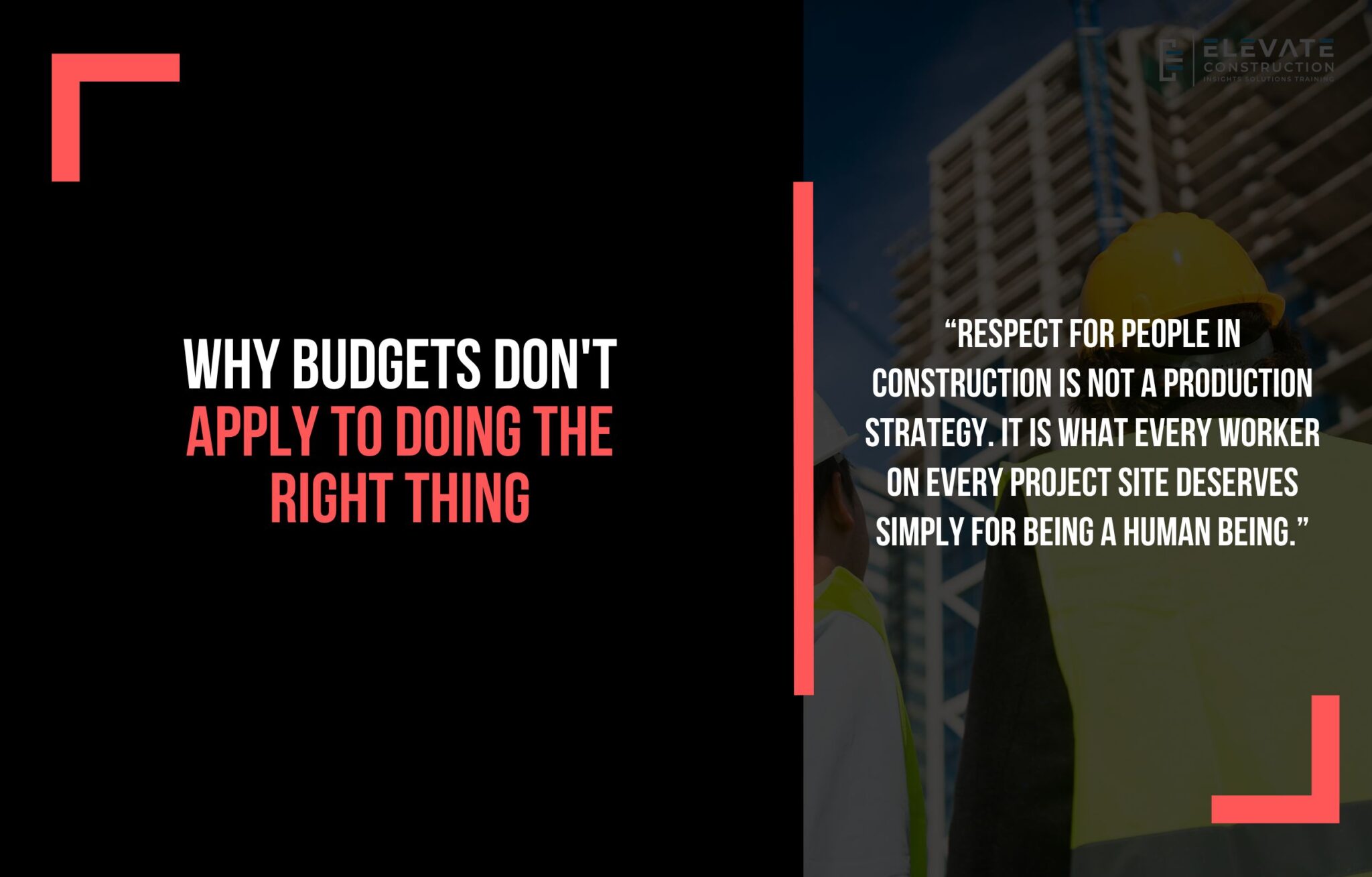
Respect for People Is Not a Budget Line Item: The Standard Every Construction Leader Must Hold
A LinkedIn post sparked this episode, but the episode is not really about the post. It is about a problem that has been embedded in construction culture long enough to feel normal: the habit of treating respect for workers as a conditional investment, something we do when we have the budget for it, when we expect a return, when the project can absorb the general conditions cost, when it fits the schedule. That framing is wrong, and the consequences of getting it wrong are visible across the entire industry right now in the form of a workforce that is leaving and not coming back.
The Definition That Sounded Right and Was Not
The LinkedIn post that Jason Schroeder engaged with defined respect this way: engage and empower the people closest to the work so that they can assess the current condition, create solutions to problems, and standardize what’s working. Reading that definition, most people in construction would nod. It sounds collaborative. It sounds lean. It sounds like what the best project teams try to do. And the intentions behind it are probably exactly right. The problem is the framing, specifically three words: so that they. Those words transform respect from something intrinsic into something instrumental. We engage and empower people so that they can do something useful for us. When the useful thing stops happening, or when the budget for it runs out, the engagement and empowerment presumably stop too.
That is not respect. That is a transactional arrangement dressed up in respectful language. And the construction industry has been running exactly that arrangement for decades.
The System Created the Workforce Problem
The persistent conversation in construction about the skilled labor shortage treats the shortage as if it arrived from outside the industry, as if it were something that happened to construction rather than something construction produced. But trace the pattern back far enough and the picture is different. In 2007, 2008, 2009, and 2010, as construction volume collapsed, the industry responded in the way industries respond to economic pressure: it cut what it could cut. Training was cut. General conditions were squeezed. Workers were laid off and not rehired in proportion to volume recovery. The people who stayed experienced an industry that had communicated, through years of those decisions, that workers were expendable assets rather than human beings with families and futures. The industry made its prioritization visible through its actions. Workers noticed. They made their own decisions accordingly. The workforce shortage is not a mystery. It is a consequence.
The industry now wants more workers, more skilled labor, more people willing to build careers in construction. The pitch is that construction is a good career. And it can be. But the pitch is being made by an industry that has not yet been honest about what its prioritization of budget over people communicated to the people who experienced it. Respect for people is not something that can be turned on for recruiting purposes and turned off when the general conditions budget is tight. Workers can tell the difference.
The Give-to-Get Problem
Jason describes the Silent Square simulation, a team puzzle where the solution requires moving through several stages of orientation. Teams that approach it with a get mentality, focused on what they will receive from the interaction, do not solve it. Teams that move to a give-get orientation, willing to give something in order to get something, get closer but still do not reliably solve it. Only the teams that arrive at a give-first-without-expectation mentality, where the giving happens because it is the right thing to do and not because of what will be returned, consistently solve the puzzle.
That simulation is a model for how project culture actually works. The project team that provides good bathrooms, a clean lunch area, morning worker huddles, and organized environments because those things are expected to produce better PPC or higher productivity metrics is operating in a give-to-get mode. When the metrics do not immediately materialize, or when the budget pressure arrives, the bathrooms get cleaned less often and the huddles get shortened. The workers notice. The trust that was building dissolves. And the team concludes that respect for people did not work, when what actually failed was the transactional motive behind it.
What Respect Actually Requires
Here is what respect for people looks like when it is not conditional on a return:
- Clean bathrooms, cleaned on a schedule that actually maintains cleanliness, because workers are human beings who deserve clean facilities and not because clean bathrooms were shown to reduce absenteeism in a study
- A proper lunch area that is covered, organized, and maintained, because people need a dignified place to eat and rest in the middle of a workday and not because it shows up as a positive on a quality audit
- Morning worker huddles that give every person on site visibility into the plan for their day, safety priorities, and any changes to the schedule, because workers deserve to know what they are doing and why and not because huddles are a lean tool that reduces production variance
- Organized, clean, and safe work areas because people should not have to navigate hazards and clutter to do their jobs and not because OSHA compliance requires a certain standard
- Training and development resources that help workers build skills and advance their careers, because people deserve to grow and not because trained workers produce higher quality work
- Listening to the workers and foremen who are closest to the work, because they have knowledge and experience that matters and deserves to be heard and not because incorporating their input reduces rework
None of those things have a “so that” attached to them. They exist because they are right. The production improvements that follow are real and well-documented, but they are not the reason. The reason is that every person on that project site is a human being with a family, a life outside of work, and inherent worth that does not need to be justified by their productivity.
People Already Assess Conditions and Create Solutions. You Just Have to Listen.
One of the most revealing parts of this episode is Jason’s observation about the assumption embedded in the LinkedIn definition: that by some benevolence of the project team, the workers will begin to assess current conditions, create solutions, and standardize what is working. Workers already do those things. They do it because they are intelligent, capable human beings who are paying attention to the work they are doing every day. The observation about how the concrete is curing, the insight about why the conduit keeps misaligning in that corner, the suggestion about how the morning material staging could be reorganized to save twenty minutes: none of those are new behaviors that the project team produces by engaging workers. They are existing behaviors that the project team either creates a space for or suppresses by not listening.
When a worker stops offering suggestions, it is usually not because they stopped having them. It is because they learned that the suggestions were not welcome, were not acted on, or were not acknowledged. The problem is not worker disengagement. The problem is that the environment was not designed to capture what workers already know. That is a leadership failure, not a labor failure.
The Budget Is Not the Reason
Jason’s message to project managers who use the budget as the reason not to do the right thing is clear and worth stating plainly: a budget is the amount that can be spent without further permission. It is not a prohibition. It is a threshold for independent authority. When the right thing costs more than the budget allows, the correct response is to get permission to spend more, not to use the budget limit as a permanent excuse. The project manager who tells the superintendent that there is no budget for more frequent bathroom cleaning, or for a proper lunch area, or for a worker huddle program, is not describing a constraint. They are describing a choice. And the choice to not spend on respect for people because it was not budgeted is a choice that has consequences, for the workforce, for the project, and for the industry.
Every project that creates a genuinely respectful environment for its workers, funded from whatever it takes to make it happen, is making an investment in something larger than the immediate project. It is making an argument, through action, that construction is a good place to work. It is building the case, through the experience of every person on that site that the industry takes its people seriously. That is the recruiting pitch that works. Not a brochure. An experience.
If your project needs superintendent coaching, project support, or leadership development, Elevate Construction can help your field teams stabilize, schedule, and flow.
The Right Thing Because It Is the Right Thing
The reframing Jason offers at the close of this episode is the one that the industry needs: we engage and empower people because we respect the nature of people and their families, simply as a part of being human. The production improvement, the problem-solving, the standardization of what works, all of that follows from respect. It is a consequence of genuine care, not the justification for it. We do not give so that we can get. We give because giving is right. And then, separately, we run our business. As Immanuel Kant wrote in the Groundwork of the Metaphysics of Morals: act in such a way that you treat humanity, whether in your own person or in the person of any other, never merely as a means to an end, but always at the same time as an end. A worker is not a means to a production number. A worker is an end, a human being with inherent worth, who deserves a clean bathroom, a proper lunch area, and a leader who is listening.
On we go.
FAQ
What is wrong with defining respect as “engage and empower the people closest to the work so that they can assess the current condition, create solutions, and standardize what’s working”?
The problem is the phrase “so that they can.” That framing makes respect instrumental: we engage and empower people in order to extract something useful from them. When the useful thing does not materialize, or when the budget for engagement runs out, the implied logic is that the engagement stops. Genuine respect for people is not conditional on a return. Workers deserve clean facilities, dignified work environments, clear communication, and the opportunity to be heard because they are human beings, not because those things will improve productivity metrics. The production improvements are real and consistent, but they follow from genuine respect rather than motivating it.
Why is the construction labor shortage connected to how the industry has treated workers?
Because people make decisions about where to work based on their experience of being treated. The construction industry’s response to the 2008 economic contraction included cutting training, tightening general conditions, reducing workforce investment, and communicating through those decisions that workers were expendable assets. People who experienced that environment made their own decisions: about whether to stay in construction, about whether to encourage their children to enter construction, about whether the career was worth the conditions it required. The workforce that is now unavailable is partly the product of those decisions, made by an industry that prioritized short-term budget management over long-term investment in the people who build things.
What does the Silent Square simulation reveal about give-to-get mentality on project teams?
The simulation shows that teams only reliably solve a complex collaborative puzzle when they shift to a give-first-without-expectation orientation. Teams in a pure get mentality do not solve it. Teams willing to give in order to get something in return get closer but still fail consistently. Only when the giving happens without an expectation of return does the team develop the trust and communication necessary to solve the problem together. The simulation is a model for how project culture works: a team that provides respectful working conditions because it expects a measurable return will withdraw those conditions when the return does not materialize. A team that provides them because it is the right thing to do builds a different kind of culture, one where the return is a consequence of the culture rather than its justification.
What is the correct response when the budget does not cover what is needed to create a respectful work environment?
Get permission to spend more. A budget is a threshold of independent authority, not a prohibition. When the right thing costs more than the approved budget, the appropriate action is to escalate the conversation and secure additional authorization, not to use the budget limit as a permanent excuse to not do the right thing. The project manager who treats the budget as a final answer to a question about human dignity is making a choice, not describing a constraint. That choice has consequences for the workforce, for the project team’s credibility, and for the industry’s ability to attract people who have other options about where to work.
How does listening to workers connect to respect for people as a core value rather than a strategy?
When respect for people is genuinely a core value rather than a strategy, listening to workers is a natural expression of that value: workers know things worth knowing, have observations that matter, and deserve to be heard. When respect is instrumental, listening to workers is a tool for extracting insight that can be used to improve production. The difference in outcome is significant: the team that listens because workers have inherent worth creates an environment where workers offer observations freely and continuously. The team that listens in order to standardize what’s working creates a more conditional environment, where workers will share what serves the project team’s agenda but may hold back what does not. Genuine listening, grounded in genuine respect, produces a fundamentally different quality of information and a fundamentally different quality of relationship.
If you want to learn more we have:
-Takt Virtual Training: (Click here)
-Check out our Youtube channel for more info: (Click here)
-Listen to the Elevate Construction podcast: (Click here)
-Check out our training programs and certifications: (Click here)
-The Takt Book: (Click here)
Discover Jason’s Expertise:
Meet Jason Schroeder, the driving force behind Elevate Construction IST. As the company’s owner and principal consultant, he’s dedicated to taking construction to new heights. With a wealth of industry experience, he’s crafted the Field Engineer Boot Camp and Superintendent Boot Camp – intensive training programs engineered to cultivate top-tier leaders capable of steering their teams towards success. Jason’s vision? To expand his training initiatives across the nation, empowering construction firms to soar to unprecedented levels of excellence.