
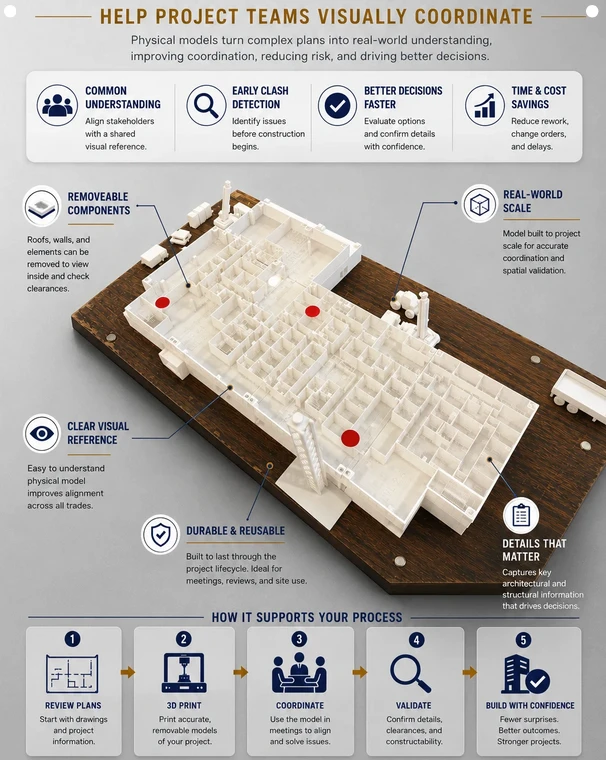
You can’t plan flow on a flat sheet of paper.
That’s why we’ve started using 3D printed models on our projects — not as a showpiece, but as a working planning tool.
Construction is a spatial business.
Where do the cranes sit? Where does material land? How do crews move through the building without stacking on top of each other? Which zones release first, and what path does the work take through them?
Those are the questions that make or break a project, and they’re almost impossible to answer well staring at a 2D site plan.
Put a physical model at real-world scale on the table, and everything changes:
→ Site logistics get planned in three dimensions: laydown, hoisting, access, paths of travel
→ Removable roofs and walls let you see inside and plan how crews flow through each space
→ Trade partners point at the model and plan their handoffs together, in real time
The plan stops being abstract.
Everyone sees the same building, the same zones, the same flow.
Review the plans. Print the model. Plan the flow together. Validate the logistics. Then build with confidence.
Build the team first — and give them something real to plan around.
#Construction #TaktPlanning #LeanConstruction #SiteLogistics #WorkflowPlanning