
Lift Drawings: Build Your Brain Before You Build the Building
Before a single form is set, before a single dowel is placed, before a single cubic yard of concrete is ordered — the building needs to exist somewhere first.
It needs to exist in your mind.
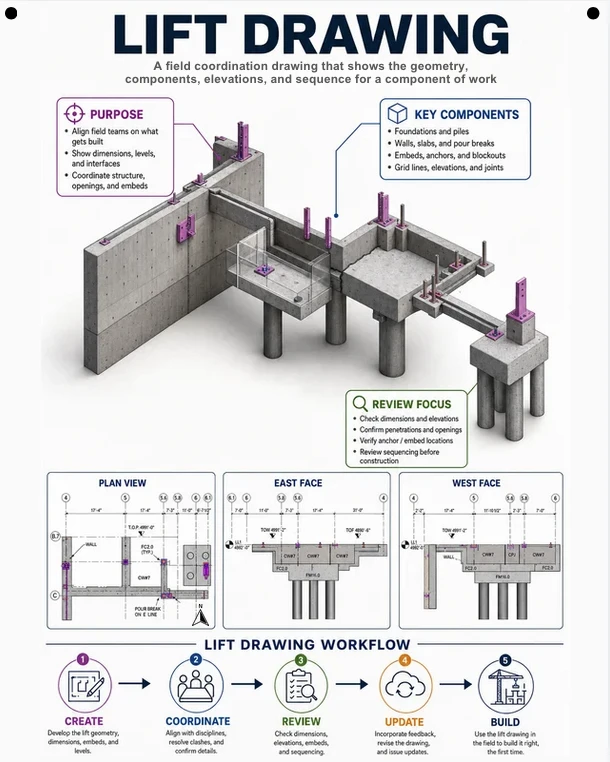
That’s the real power of a lift drawing. Most people see it as an output: a consolidated sheet that pulls architectural, structural, and MEP information together so the crew can build from one document. True — but incomplete.
The more important truth is what producing one does to you.
By the time you’ve finished a thorough lift drawing for a wall, a footing, or an assembly, you know that component cold.
Not generally.
Not approximately.
Completely.
You’ve traced every bar, every embed, every sleeve, every dimension.
You’ve reconciled architectural intent with structural requirements and MEP coordination.
You’ve found the missing information and gotten answers before the crew ever showed up.
That deep, specific, hard-won knowledge of a component before it’s built is what separates a field engineer who creates flow from one who creates chaos.
A lift drawing serves three purposes:
- Know the building. You walk out to the crew not as a spectator with a clipboard, but as the person who knows the assembly as well as anyone on site.
- Find problems. If you can’t draw it, you can’t build it. The act of drawing forces you to confront missing information, dimensions that don’t resolve, and details that conflict.
- Build and check. The finished drawing becomes the quality standard. You take it into the field and compare what’s being built against what was designed.
Here’s the principle underneath all of it: we build people before we build things.
Every lift drawing you produce programs your mind to read in three dimensions, see interfaces between systems, and visualize a finished assembly from a stack of flat sheets.
The drawing is valuable. What producing it does to your brain is irreplaceable.
It’s not wrong until it’s hard and gray. Until then, every discrepancy is fixable at low cost.
If you can draw it, you can build it. If you can’t draw it, you’re not ready.
What’s the best coordination conflict you ever caught on paper before it hit the field?