
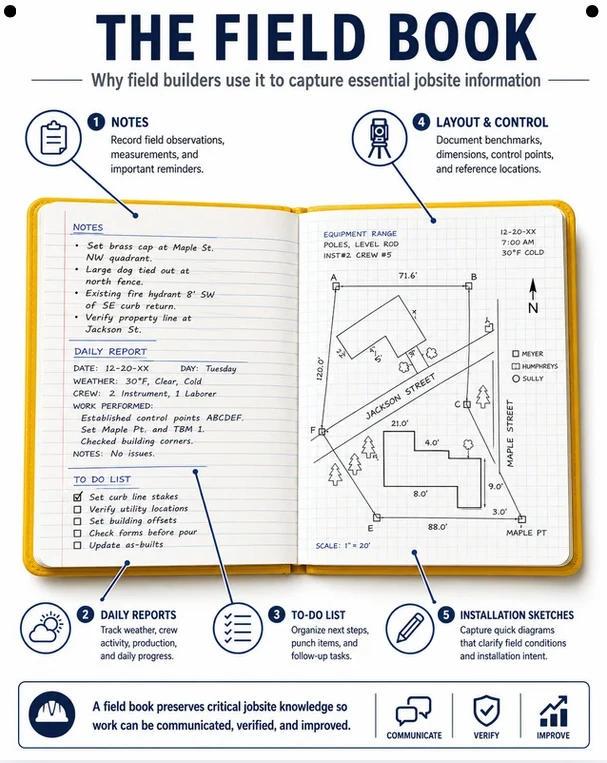
The Field Book. Don’t build without one.
I came up through the trades, and one of the first things I learned from the builders I respected most was this:
The best field people write things down.
Not in their phone.
Not in an app they’ll forget about.
In a field book that lives in their back pocket.
Here’s what goes in mine:
“Set brass cap at Maple St. NW quadrant.”
“Large dog tied out at north fence.”
(Yes, that one matters. Ask anyone who’s been chased.)
→ Daily Reports – Weather, crew, work performed.
When someone asks what happened on site three weeks ago, you’ll know.
Exactly.
→ To-Do Lists – Set curb line stakes. Verify utility locations. Check forms before the placement.
The work doesn’t get done because you remembered it.
It gets done because you wrote it down.
→ Layout & Control – Benchmarks, control points, dimensions, reference locations.
This is sacred information.
Protect it.
→ Installation Sketches – Quick diagrams that capture field conditions and installation intent.
A sketch with dimensions beats a paragraph every time.
My father taught me that how you keep your tools says everything about how you do your work.
Your field book IS a tool.
Maybe the most important one you carry.
Because here’s the truth:
A field book preserves critical jobsite knowledge so the work can be communicated, verified, and improved.
Communicate.
Verify.
Improve.
That’s not just note-taking.
That’s building like a professional.
#Construction #FieldEngineering #LeanConstruction #ConstructionManagement #ContinuousImprovement #JobsiteLeadership