
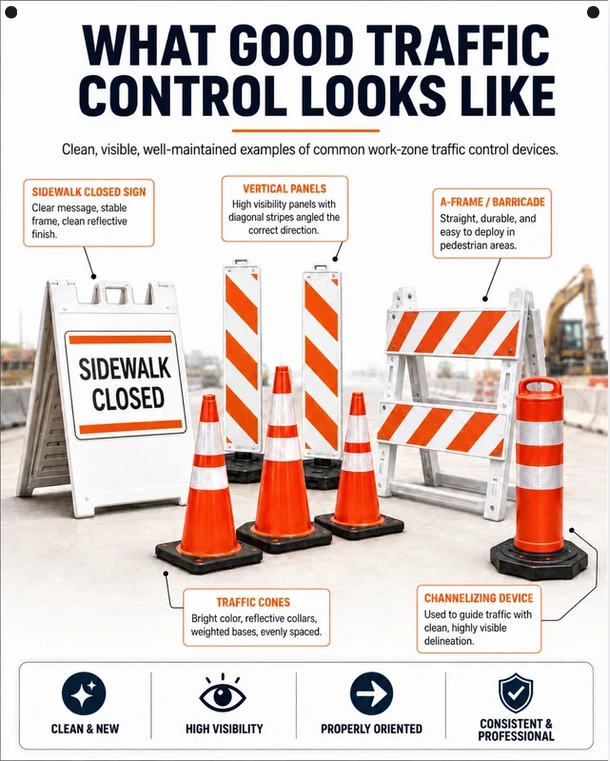
What good traffic control looks like.
I’ve walked a lot of jobsites, and you can tell a lot about a project by its traffic control.
Faded cones. Crooked barricades. A “Sidewalk Closed” sign tipped over in the gutter. When the traffic control is sloppy, it’s almost never just the traffic control. It’s a signal of how the whole operation is being run.
Here’s the truth: traffic control isn’t the lowest-priority item on the site. It’s the first thing the public sees, the first line of safety for your crew, and a daily reflection of your standards.
→ Clean & new — gear that’s maintained, not beat up and forgotten
→ High visibility — bright color, reflective collars, devices people actually see
→ Properly oriented — panels and stripes angled the correct direction, every time
→ Consistent & professional — the same standard on day 1 and day 200
When a driver slows down, when a pedestrian is guided safely around your work, when a crew member trusts the perimeter around them — that’s not luck. That’s intentional work design.
We protect people by caring about the details most folks walk right past.
If your traffic control looks like an afterthought, your safety culture probably feels like one too.