
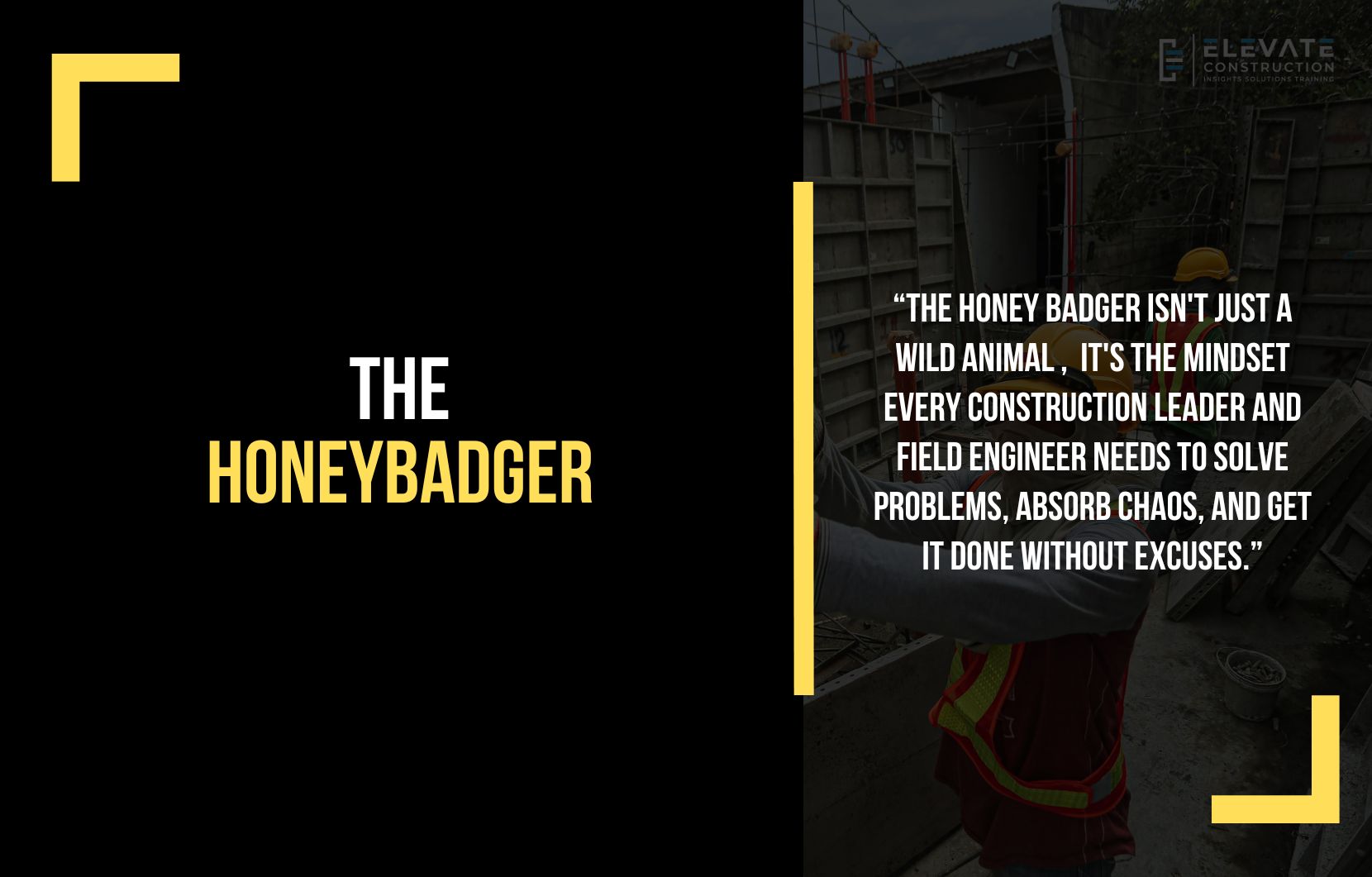
Be the Honey Badger: The Construction Mindset That Changes Everything
Most of the losses in this industry are not caused by bad projects. They are not caused by bad locations, bad weather, bad owners, or bad timing. Most of the losses in construction come from mentality. From leaders who stop at the obstacle instead of going through it. From field engineers who wait to be told what to do instead of figuring it out. From project teams that let circumstance become excuse.
The antidote to all of that has a name, and it is not a system or a software or a training module. It is an animal. It is a honey badger. And once you understand what a honey badger actually is, you will never look at leadership, problem-solving, or performance the same way again.
The Pain That Keeps Projects Stuck
Walk a struggling project and you will find the same pattern. The field engineer is waiting on information that no one has delivered. The foreman is standing around because materials were not staged. The superintendent is firefighting the same problem for the third time this week. And somewhere above all of that, a project manager is writing a report about why the schedule slipped instead of going into the field and doing something about it.
The common thread is not incompetence. These are often talented, hard-working people. The common thread is passivity in the face of friction. The mindset that says, “This is hard, so I will wait for someone to fix it.” That mindset is everywhere in construction, and it is costing companies hundreds of thousands of dollars per project in delay, rework, miscommunication, and lost momentum. The system has trained people to document problems instead of destroy them.
The System Created the Pattern
Here is what needs to be said clearly. The passivity that shows up in construction teams is not a character defect. It is a learned behavior, and the system taught it. When leaders consistently punish people for making decisions without permission, when there is no psychological safety to act boldly and be wrong, when the project culture rewards caution over initiative, people stop going after problems. They start managing their exposure instead of solving the issue. The system failed to create an environment where tenacity is rewarded, and then it blames individuals for lacking it.
That is the failure pattern. And the solution is not to demand more from people without changing the environment. The solution is to develop the honey badger mindset at the individual level while simultaneously building the systems and culture that reward it.
What a Honey Badger Actually Is
The honey badger is a mammal found across Africa, Southwest Asia, and India, and it is one of the most remarkable animals on earth. It has thick skin, ferocious defensive capabilities, and very few natural predators. It will go after a cobra, get bitten, absorb the venom, recover, and then finish the job. It will push through a beehive, get stung repeatedly, and keep going because it is not deterred by discomfort.
In captivity, honey badgers have been documented opening gates, stacking objects to build escape routes, and solving problems that should be far beyond their capability. They are fearless, resourceful, independent when they need to be, and collaborative when the situation calls for it. They have large brains relative to their size. They waste nothing. They eat everything they pursue, down to the bone. And they have one of the longest lifespans of any animal their size because they are built to last. That is not just a fun animal fact. That is a blueprint for leadership in construction.
The Honey Badger in the Field
At Elevate Construction and in the Field Engineer Boot Camp, the honey badger is the official mascot of the field engineer role. The credit for that connection goes to Steve Snedeker, who first made the association, and it is one of the most accurate and useful mascots in the entire program. Because what does a great field engineer actually do? They figure things out. They absorb chaos so that the crews behind them can have stability. They remove friction before it becomes a problem. They get into hard spaces, find the information that does not exist, create the answer that was not provided, and deliver it to the people who need it without being asked twice.
That is the honey badger in practice. Not reckless. Not chaotic. Tenacious, intelligent, nimble, and utterly committed to getting it done regardless of what is in the way.
What the Honey Badger Mindset Looks Like in Practice
This is not just for field engineers. The honey badger mindset applies to every leadership role on a construction project, from foreman to project executive. Here is how it shows up across the work.
- A honey badger field engineer does not wait for the information to arrive. They go find it, verify it, and get it into the hands of the crew before the crew needs it. A honey badger foreman does not accept that the zone is not ready. They make it ready, get the obstacles removed, and protect their crew from friction.
- A honey badger superintendent does not manage the schedule on paper from the trailer. They go to the zone, see what is actually happening, identify the real constraints, and attack the biggest problem first.
- A honey badger project manager does not blame the trade partner for the delay. They get into the coordination, find the root cause, and remove it. The pattern in each case is the same: go toward the problem with intelligence, tenacity, and the expectation that you will get it done. If the task bites you, sleep it off and go back after it. The cobra is still there waiting.
Why Mentality Determines Outcomes
Here is the foundational truth behind all of this. Construction projects do not fail because of circumstances. They fail because of the mentality of the people leading them. A clean, safe, well-organized project with all the right tools and systems in place can still fall apart if the leaders do not have the mindset to drive it. And a difficult project, with all the obstacles and dysfunction and chaos that come with it, can still be stabilized and delivered when the right mentality is present.
Mentality sets the standard. It determines how far a leader will go before they stop. It determines whether an obstacle becomes an excuse or a problem to solve. Core Framework Concept 85 describes this as the mental setpoint: the internal thermostat that governs what conditions a leader is willing to accept. If the setpoint is low, the project will drift to low. If the setpoint is honey badger, the project will be held to a different standard entirely, because the leader in the zone will not stop until it is right.
Most of what holds people back in construction is not external. It is internal. Learning a new scheduling tool looks like a cobra. Building a Takt plan for the first time looks like a cobra. Having a hard conversation with a trade partner looks like a cobra. The question is not whether the cobra is real. The question is whether you are going to go get it. If your project needs superintendent coaching, project support, or leadership development, Elevate Construction can help your field teams stabilize, schedule, and flow.
Building a Team of Honey Badgers
The goal is not to find one honey badger and put them in charge of everything. The goal is to build a team where every person has been trained to operate with this mindset, where the culture rewards tenacity and problem-solving, and where people feel safe enough to act boldly without waiting for permission at every step.
That requires two things working together. First, individual development. People have to be trained in the honey badger attributes: tenacity, fearlessness, resourcefulness, intelligence, nimbleness, and the willingness to not waste what they have been given. Second, the system has to support it. Psychological safety has to exist so that people who go after the cobra and get bitten do not get punished for trying. They need a team and a culture that says, “Good. Sleep it off. Go back out.” When both are present, the results are extraordinary.
The workers and the leaders who thrive in construction are not the ones who had the easiest projects. They are the ones who went through the hardest ones and came back stronger. They built their setpoint by going after cobras and surviving. They became the honey badger through repetition, training, and an environment that expected that level of them and supported them in achieving it.
“We have got to figure out how to not throw people away going forward.” That means building them up. Training them well. Creating conditions where they can develop the mentality and the skills to be the honey badger. That is the work of Elevate Construction, Jason Schroeder, and LeanTakt, and it is the work of every construction leader who is serious about building people who build things. On we go.
Frequently Asked Questions
What is the honey badger mindset in construction?
It is the combination of tenacity, fearlessness, resourcefulness, and intelligence that allows a leader to go after problems instead of waiting for someone else to solve them. It means absorbing difficulty without being stopped by it, recovering from setbacks without losing momentum, and treating every obstacle as something to be defeated rather than avoided.
Why is the honey badger the mascot for field engineers?
Because the field engineer role is fundamentally about removing friction before it reaches the crew. Great field engineers do not wait for information to arrive. They go find it, verify it, and deliver it before anyone needs to ask. That requires exactly the traits the honey badger embodies: independence, resourcefulness, intelligence, and relentless follow-through.
Is the honey badger mindset something you can train?
Absolutely. Mentality is not fixed. It is developed through training, repetition, and exposure to environments that expect and reward tenacity. The Field Engineer Boot Camp at Elevate Construction specifically trains this mindset alongside the technical skills required for the role. People grow into the honey badger through coached experience, not just encouragement.
What is the difference between being a honey badger and being reckless?
A honey badger is fearless but not thoughtless. The animal has a large brain relative to its size, and it uses it. Being a honey badger in construction means going after problems with intelligence and preparation, not just aggression. It means figuring it out before charging in, being nimble when the situation changes, and being strategic about which cobras to go after first.
How do leaders create a team culture where the honey badger mindset thrives?
By rewarding tenacity, providing psychological safety, and making it clear that going after problems is expected and supported. When leaders punish people for acting without permission or for failing while trying, they train passivity. When leaders celebrate the person who identified the roadblock and removed it before anyone else knew it existed, they build a team of honey badgers.
If you want to learn more we have:
-Takt Virtual Training: (Click here)
-Check out our Youtube channel for more info: (Click here)
-Listen to the Elevate Construction podcast: (Click here)
-Check out our training programs and certifications: (Click here)
-The Takt Book: (Click here)
Discover Jason’s Expertise:
Meet Jason Schroeder, the driving force behind Elevate Construction IST. As the company’s owner and principal consultant, he’s dedicated to taking construction to new heights. With a wealth of industry experience, he’s crafted the Field Engineer Boot Camp and Superintendent Boot Camp – intensive training programs engineered to cultivate top-tier leaders capable of steering their teams towards success. Jason’s vision? To expand his training initiatives across the nation, empowering construction firms to soar to unprecedented levels of excellence.