
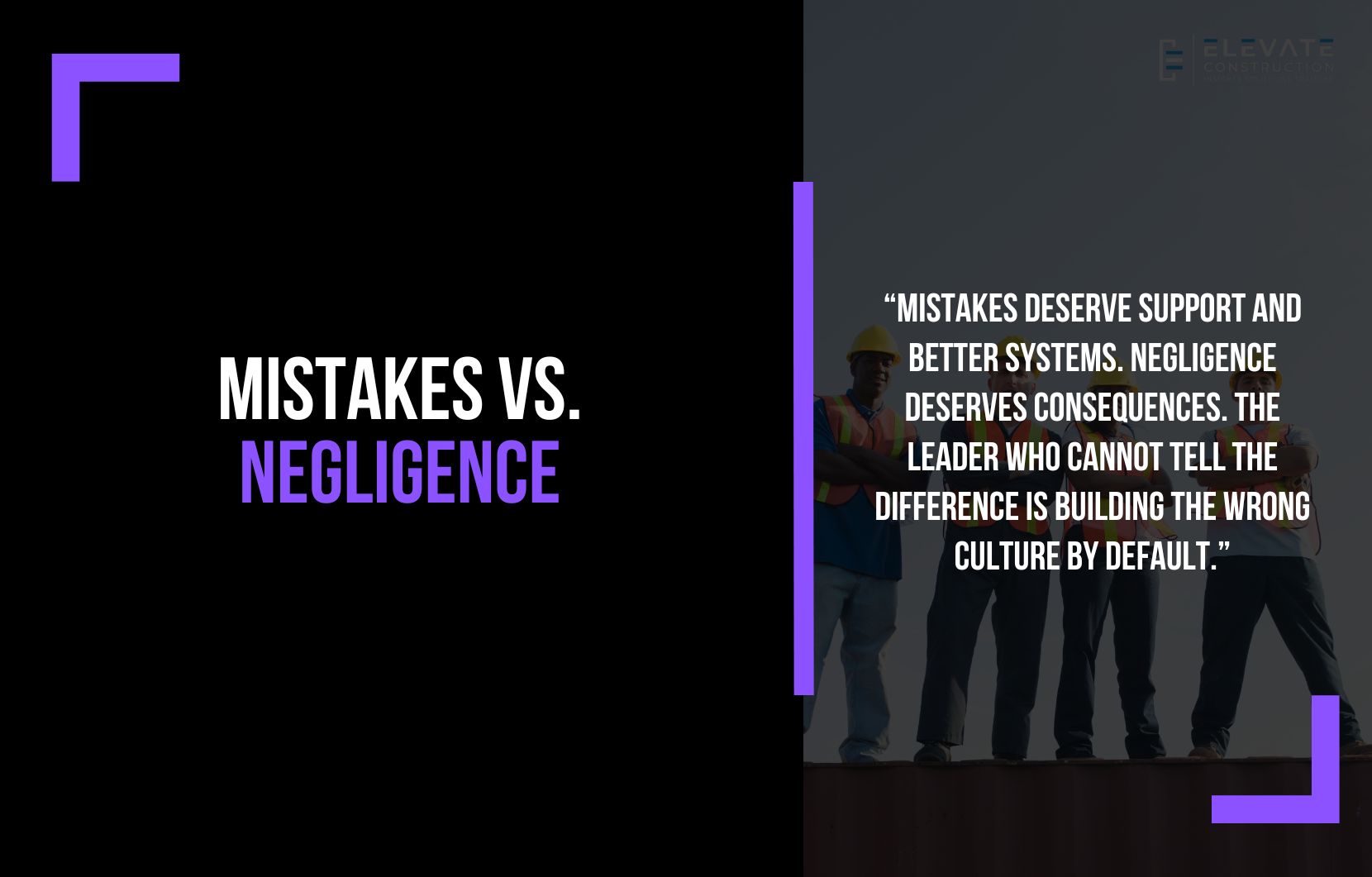
The Difference Between a Mistake and Negligence: What Every Construction Leader Must Understand
There is a moment on construction projects that every leader eventually faces. Someone produces seriously deficient work, a layout error that costs two months and hundreds of thousands of dollars, a quality failure that cascades into something that changes the project’s trajectory entirely. The leader holds the person accountable. And almost immediately, someone in the organization asks the uncomfortable question: are we creating a culture where people get punished for making mistakes? That question sounds principled. It sounds like the kind of thing a good leader should take seriously. The answer is that nobody should face consequences for an honest mistake. But the premise of the question is wrong, because what just happened was not a mistake. And until leaders can make that distinction consistently and precisely, quality culture in construction will continue to drift in exactly the direction that nobody intends.
The Pattern That Keeps Repeating
Walk any construction company long enough and you will find quality failures that were not surprises. The person who produced them had a history. The type of error was predictable. People around the situation could have told you it was coming before it happened, because the behaviors that produce that kind of failure had been visible for months. And yet when the failure occurs, it gets labeled a mistake, handled with a coaching conversation, and within a few weeks everyone is waiting for the next one. The project absorbs the cost. The team absorbs the frustration. The pattern continues because nobody changed anything, and nobody changed anything because the failure was framed as a mistake rather than what it actually was.
The System That Created the Confusion
The lean construction movement, which Jason Schroeder fully endorses, has correctly established that systems should be examined before people are blamed, that workers should not be scapegoated for outcomes produced by bad processes, and that psychological safety requires an environment where people can surface problems without fear of retribution. All of that is right. The gap is that the system-first framing can be misapplied to situations where the process is sound, the culture is clear, the standards have been communicated, and the failure is happening because a person is choosing not to follow them. At that point, the failure is behavioral rather than systemic. It has a different name and it requires a different response from the leader.
The Story That Forces the Distinction
Jason Schroeder describes overseeing a surveyor who was technically sophisticated in every measurable way. This person understood automatic levels, total stations, and GPS equipment. They could discuss the principles of accurate survey work with authority. They were professionally credentialed, genuinely knowledgeable, and personally pleasant to work with. They also produced massive layout mistakes repeatedly, errors that changed jobs, caused months of delay, and cost hundreds of thousands of dollars. These were not the stumbles of someone learning an unfamiliar task. They were the predictable output of someone who did not believe they needed to double-check their work, did not take adequate field notes, and did not follow the verification procedures the survey department had established.
When the surveyor made another significant error, Jason sent him home for three days without pay and initiated a performance improvement plan. The pushback came quickly from others in the organization. Was this the culture they wanted to create, where people were marginalized for making mistakes? Jason’s response was precise: that was not a mistake. The behaviors that produced it had been observable for a long time. The process gaps in the survey department had already been identified and corrected. The standards had been clearly communicated. What remained was a person whose behavior was not aligned with those standards, not because of ignorance or inexperience, but because of a habitual pattern of not caring enough to follow the process. That is negligence. And negligence requires a different response than a mistake, not because punishment is the goal, but because the failure to distinguish between them builds the wrong culture.
When a Mistake Is Actually a Mistake
Before any leader can respond correctly to negligence, they have to know what a genuine mistake looks like. Jason describes asking a group exactly that question: when would it be acceptable for someone to make a mistake? The answers were specific and worth internalizing. The task is genuinely new to the person, and they are doing their best with the knowledge currently available to them. The person consistently asks for help when uncertain. They care about the quality of their work and demonstrate it through their behavior and habits. They are honest when something goes wrong and admit it without concealing it. They use the quality checklist and the verification processes the team has established. They participate in pre-activity meetings and plan their work before executing it. They have a known habit of checking their work, and people around them would describe them as conscientious.
When all of those things are true and a failure still occurs, something in the system did not catch what it should have caught. The process needs to be examined. The training may have a gap. The tools may need improvement. The right response is to lean into the problem alongside the person, support them through the correction, understand what the system missed, and fix it. There is no consequence for the person because there is nothing at the behavioral level to correct. The person did everything they were supposed to do. The system failed them. That is the accurate diagnosis, and it points to the accurate response.
What Negligence Actually Looks Like
Negligence looks like the inverse of everything that defines a genuine mistake. These are the signals that separate a behavioral failure from a systemic one:
- The checklist and verification processes exist, are clearly communicated, and the person consistently does not use them
- The proper tools are available and required, and the person does not use them even knowing they should
- Pre-activity meetings are scheduled and expected, and the person does not genuinely prepare or participate
- When something goes wrong, the person attempts to hide it or minimize it rather than surfacing it immediately
- The person has a known pattern of not asking for help when uncertain and not double-checking completed work
- The failure is predictable to anyone familiar with the person’s habits, not a genuine surprise
When those conditions describe the quality failure, the word mistake is inaccurate. The accurate word is negligence. Not as a judgment of the person’s character or worth as a human being, but as a precise description of what actually occurred. A negligent failure is one where the person knew what they were supposed to do, had the process and the tools available to do it, and chose not to.
The Organizational Immune System
Jason describes two medical analogies that clarify what happens when a system fails to recognize and respond to a threat within itself. Cancer cells carry surface receptors that make them appear normal to the body’s immune system. The body does not recognize them as enemies, does not fight them, and the cancer grows unchecked because the mechanism that should address it is not activated. Leprosy damages the nervous system, removing the body’s ability to feel pain. Injuries that would normally trigger immune response and repair go undetected, and tissue degrades without the body knowing to intervene. In both cases, the damage results not just from the disease itself but from the failure of the body’s recognition and response system.
A construction team that cannot distinguish negligence from mistakes is exhibiting the same failure mode. The harmful behavior is present. The organizational immune system does not recognize it as something requiring a response. The damage accumulates quietly. And every day the leader allows the negligence to continue without consequence, they are not simply tolerating it. They are authorizing it. Authorized behavior becomes normal behavior. Normal behavior becomes culture. Culture becomes process. At that point, the three variables that could have been addressed independently, the process, the culture, and the behavior, are locked in alignment around the wrong standard.
What This Means for the Team That Is Doing It Right
The people on the team who are using the checklist, double-checking their work, asking for help when uncertain, and caring about the quality of their output watch every day to see how the organization responds to the people who are not. When the answer is nothing, the signal they receive is that the effort they are putting in does not matter, that the standard they are holding themselves to is not actually the standard, and that the people around them can produce negligent work without consequence. Over time, that signal degrades the behavior of the people who were doing the right things. The standard does not just fail to improve. It actively pulls the whole team down toward the lowest tolerated behavior, and every conscientious worker on that team bears the cost of a standard the leader chose not to enforce.
Respect for the workers who are doing the work correctly requires that their standard actually be enforced as the standard. That is not separate from the lean construction principle of dignity and respect for people. It is an expression of it. If your project needs superintendent coaching, project support, or leadership development, Elevate Construction can help your field teams stabilize, schedule, and flow.
The Standard You Set Is the Standard You Get
The closing point from this episode belongs to the leader. If negligent behavior exists on a team and has not been addressed, that is not the negligent person’s culture. It is the leader’s culture. The choice to allow the behavior, made through inaction, is the choice to build a culture where that behavior is within the range of what is accepted. When the behavior continues, it is not because the person decided independently to be negligent. It is because the culture communicated, through the leader’s consistent non-response, that negligent behavior is permitted. As Eric Thomas put it directly: if you let people treat you any kind of way, it becomes a culture. What you permit, you promote. What you promote becomes the standard. Know the difference between a mistake and negligence, respond correctly to each one, and build a culture where the workers doing the work right can trust that the standard they are holding themselves to is the actual standard of the organization.
On we go.
FAQ
What is the most reliable way to tell the difference between a mistake and negligence on a construction project?
Examine the behavior pattern surrounding the failure rather than the failure itself. If the person used their process, asked for help, checked their work, and the error still happened, it was a mistake. If the failure was predictable because those behaviors were consistently absent, it was negligence.
Why is it harmful to treat negligence as a mistake when responding to a quality failure?
It removes the consequence the behavior requires and signals to the entire team that the behavior is within the range of acceptable conduct. Over time, that signal becomes the culture, and the culture pulls the standard down toward the lowest tolerated behavior.
How does the system-first principle of lean construction apply when negligent behavior is present?
System-first means examining whether the process, training, and standards were in place before concluding a failure is behavioral. Once those conditions are verified to be sound, a failure that occurs because the person chose not to follow the process is a behavior problem, not a system problem.
What is the difference between a consequence and a punishment in this context?
A consequence is corrective in intent: it signals clearly that a behavior produced an unacceptable result and creates a strong incentive for change, delivered with clarity and respect. A punishment is inflicted to cause suffering as retribution, which is not the goal and not what accountability in a healthy organization looks like.
What should a leader do when they realize negligent behavior has been tolerated without consequence?
Stop allowing it immediately, communicate the actual standard clearly, and begin enforcing it consistently from that point forward. The discomfort of the transition is real, but continuing to authorize negligent behavior through non-response is not a leadership choice that serves the team or the workers who have been doing the work correctly all along.
If you want to learn more we have:
-Takt Virtual Training: (Click here)
-Check out our Youtube channel for more info: (Click here)
-Listen to the Elevate Construction podcast: (Click here)
-Check out our training programs and certifications: (Click here)
-The Takt Book: (Click here)
Discover Jason’s Expertise:
Meet Jason Schroeder, the driving force behind Elevate Construction IST. As the company’s owner and principal consultant, he’s dedicated to taking construction to new heights. With a wealth of industry experience, he’s crafted the Field Engineer Boot Camp and Superintendent Boot Camp – intensive training programs engineered to cultivate top-tier leaders capable of steering their teams towards success. Jason’s vision? To expand his training initiatives across the nation, empowering construction firms to soar to unprecedented levels of excellence.