
The Hard Truth Builders Need to Hear
Here’s the deal. There is a phrase that sounds humble, sounds professional, and sounds like something a good builder would say: “My work speaks for itself.” It sounds right. It sounds grounded. It sounds like the kind of thing someone says when they do not want to brag, show off, or make the work about them.
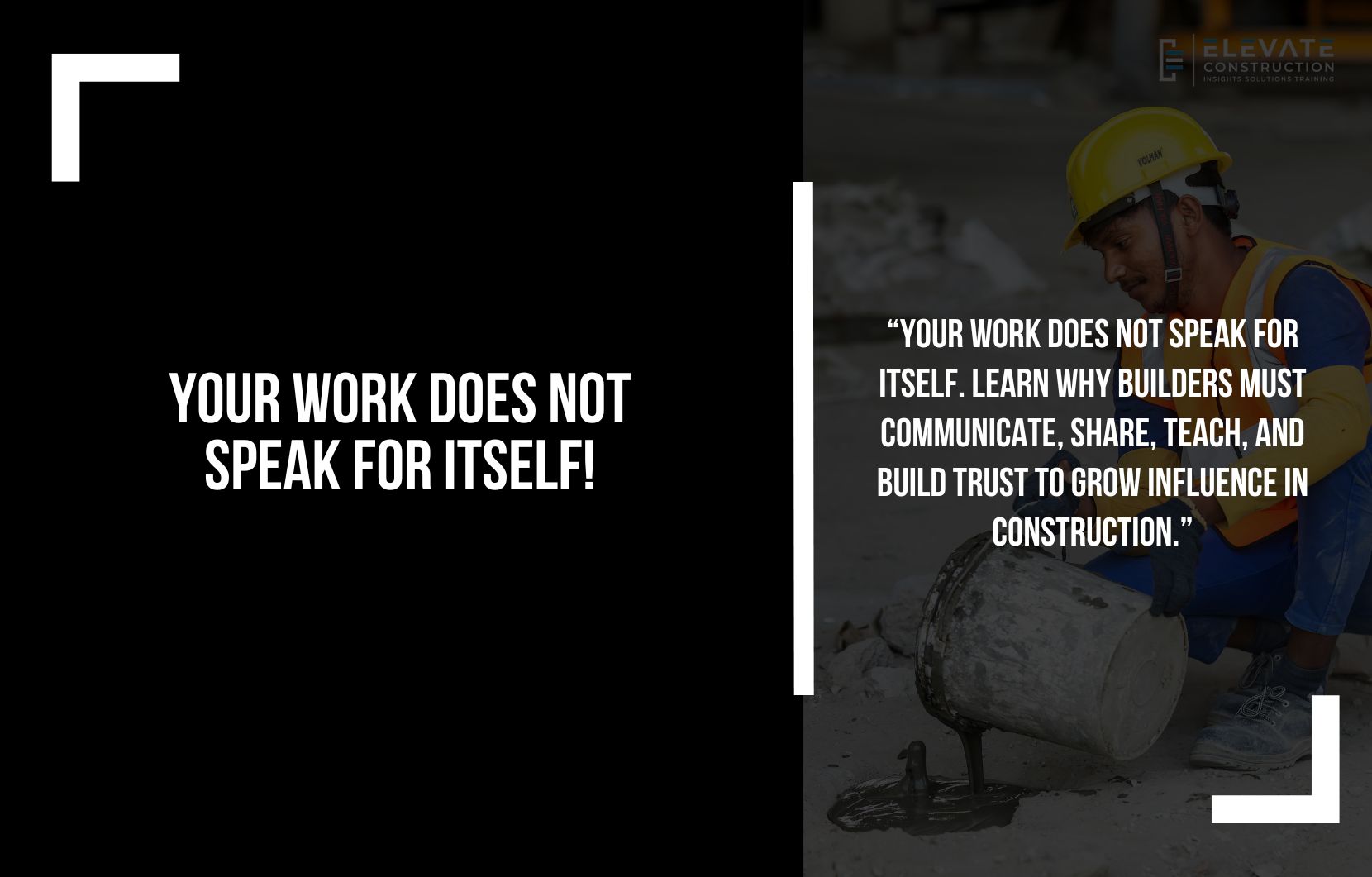
But it is not true. Your work does not speak for itself if nobody sees it. Your work does not speak for itself if nobody learns from it. Your work does not speak for itself if it stays trapped inside your project, inside your files, inside your head, or inside one small circle of people who already know what you do. In construction, good work must be communicated. Good work must be taught. Good work must be shared. Otherwise, it helps one project and dies there.
That is not leadership. That is hidden value. This matters because construction needs builders who are not only technically good, but also influential, trusted, communicative, and generous with what they know. We do not need more silent heroes. We need systems that make good work visible so others can use it, improve it, and pass it on.
The Real Construction Pain
The pain is that we have a lot of talented people in this industry who are doing great work in silence. They are solving problems, helping the field, removing roadblocks, improving schedules, mentoring people quietly, and protecting the project from chaos. But because they are not communicating those wins, nobody else can see the system behind the success. So the company does not learn. Other projects do not benefit. Younger builders do not get trained. Leaders do not see the full picture. The person doing the work gets frustrated because they feel unseen, and the organization gets weaker because the learning never spreads.
You have probably seen this before. A strong superintendent wants to become a general superintendent, but they are only known on their own project. A project engineer wants to become a project manager, but they never step into meetings, present information, mentor the next person, or show they can lead beyond tasks. A project manager wants to grow, but they stay behind the computer, answer emails, and never become the person scaling clarity across the team. The issue is not that these people are bad. The issue is that the system never taught them that communication is part of the work.
The Failure Pattern
The failure pattern is simple. People confuse silence with humility. They think sharing their work is bragging. They think teaching others is showing off. They think visibility is politics. They think if they just keep their head down, someone will eventually notice and reward them.
That is a dangerous belief. If it is not written down, it did not happen. If it is not communicated, people cannot trust it. If it is not shared, it cannot help anyone else. This is true in safety. This is true in quality. This is true in scheduling. This is true in leadership. If OSHA shows up and you say, “I checked that,” but it is not documented, it does not count. The same principle applies to leadership. If the organization cannot see what you are doing, learn from what you are doing, or repeat what you are doing, then your work is not speaking. It is whispering. And whispers do not scale.
Respect for People Means Sharing What Works
The system failed them; they didn’t fail the system. That matters because I do not want anyone reading this to think the message is, “Go promote yourself harder.” That is not the point. This is not about ego. This is not about fame. This is not about becoming the loudest person in the room.
This is about respect for people. Respect for people means we do not make other teams suffer through the same problem we already solved. Respect for people means we do not bury good ideas because we are uncomfortable sharing them. Respect for people means we help the next project, the next foreman, the next project engineer, the next superintendent, and the next leader.
When you share a lesson learned, you reduce waste. When you communicate a risk, you protect flow. When you teach a process, you build capacity. When you make your work visible, you help the system improve. That is not bragging. That is service.
A Field Story About Influence
There was a senior superintendent who wanted to become a general superintendent. From the outside, you would think he was ready. He had the technical skills. He had experience. He understood the work. He had the ability to run a project. But the feedback he received was direct. He was not out there showcasing his work. He was not supporting others at scale. He did not have the influence needed for the next role.
That is a hard message to hear, but it is an important one. Leadership at the next level is not only about doing your own job well. It is about helping others do their jobs well. It is about scaling knowledge, building trust, communicating clearly, and moving the company forward.
There was also a project engineer in downtown Phoenix who wanted to become a project manager. The advice was simple. Get in there. Ask to run portions of the team meeting. Present in the OAC when appropriate. Mentor other project engineers so they can grow into your seat. Show that you can communicate, coordinate, and lead. The response was, “That is not really me. My work speaks for itself.” That mindset will hold people back. Not because they lack talent, but because trust and influence do not grow in silence.
Why It Matters to Projects and Families
This matters because projects run on trust. Trust runs on communication. Communication supports flow. Flow protects people. When a team does not know what is happening, they guess. When they guess, they miss. When they miss, roadblocks linger. When roadblocks linger, trades get stacked, crews get rushed, quality drops, safety risk increases, and people take stress home.
This is why communication is not soft. It is not extra. It is not a personality preference. Communication is a production strategy. LeanTakt, Takt Production System, Last Planner System, Scrum boards, lookaheads, daily huddles, and visual controls all exist for a similar reason. They make the work visible. They make the plan visible. They make roadblocks visible. They make promises visible. When things are visible, people can coordinate. When people coordinate, flow improves.
Your leadership works the same way. If your work is hidden, the system cannot learn from it. If your learning is hidden, the next team repeats the same mistake. If your warnings are hidden, the next project walks into the same roadblock. Hidden knowledge is waste, and waste should annoy us.
The Framework: Communication Builds Trust
The framework is simple. Low communication creates low trust. High communication creates high trust. You may be a high performer, but if nobody knows what you are doing, when it will be done, what risks you are carrying, what you have learned, or what help you need, the team cannot fully trust the system around you. That is not a character attack. That is production reality. Think about a kitchen team. If one person is cooking but never speaks, never calls out timing, never confirms what is ready, and never tells the team what is happening, the rest of the team has to guess. They may be talented, but they are still creating uncertainty. And uncertainty lowers trust.
Construction is no different. The project team needs to know what is happening. The field needs to know what is ready. Leaders need to know where the risks are. Trade partners need clarity. Younger builders need teaching. Other projects need lessons learned. Here are some ways builders create trust through communication:
- Share lessons learned before another team hits the same roadblock
- Give clear updates on risks, procurement, schedule, and readiness
- Teach improvements without making yourself the hero
- Invite others to see what is working on your project
- Document wins so the system can repeat them
Notice the spirit behind those actions. They are not about attention. They are about usefulness. The goal is not, “Look at me.” The goal is, “Here is something that helped us, and I want it to help you too.” That is the right posture.
Sharing Is Not Bragging
One of the biggest mindset shifts builders need is this: sharing is not bragging when the motive is service. Bragging points attention back to you. Sharing points value toward the team. Bragging says, “Look how great I am.” Sharing says, “Here is what we learned.” Bragging makes the person the center. Sharing makes the improvement the center.
That difference matters. If you found a better way to handle a long lead item, share it. If your team created a cleaner logistics setup, share it. If a foreman helped solve a sequence problem, give them credit and share the lesson. If your project improved flow because of better zoning, work packaging, or daily huddles, teach the pattern. If you learned something the hard way, help someone else learn it the easier way.
That is how a company gets better. That is how a builder becomes a leader. A person who says, “I do not want the fame and glory,” may be trying to stay humble. That can be sincere. But sometimes that phrase hides discomfort. Sometimes it means, “I do not want to think beyond my own project.” Sometimes it means, “I do not want to invest in other people.” Sometimes it means, “I do not want to get uncomfortable.” Leadership requires discomfort. Teaching requires discomfort. Influence requires discomfort. Growth requires discomfort.
Practical Guidance for Builders
Start small. You do not need to become a public speaker tomorrow. You do not need to start a channel. You do not need to be flashy. You just need to be useful. If you are a project engineer, ask to present a small part of the meeting. Share a lesson learned with another PE. Offer to train someone on a process you understand. Ask your PM where you can take more ownership. Communicate what you are doing before someone has to pull it out of you.
If you are a superintendent, invite others to walk your project. Share procurement warnings. Send out field observations that help people prepare. Teach the next superintendent what you are seeing. Talk about what is working in your huddles, logistics, make ready, and scheduling systems.
If you are a project manager, scale clarity. Build the team. Help the superintendent. Communicate risks. Teach the owner’s priorities. Make sure the people doing the work have what they need. And when a system works, document it so the next team can use it. Do not make it complicated. Make it consistent.
How to Share Without Ego
There is a right way to do this. Keep the tone humble, practical, and team focused. Give credit. Name the system. Share the lesson. Make it useful. You do not need to say, “I solved this.” You can say, “Here is what our team learned.” You do not need to say, “My project is better.” You can say, “This helped us improve flow.” You do not need to say, “Look at my idea.” You can say, “This may help another team avoid the same issue.” In final third of your career growth, these habits compound:
- Write down one lesson learned each week
- Share one helpful warning with another project
- Mentor one person who is coming behind you
- Give public credit to the team that helped create the win
- Turn one improvement into a repeatable process
That is how you become trusted. That is how you become influential. That is how you build people who build things. And that is how the work finally begins to speak, because you gave it a voice.
Connect Back to the Mission
Elevate Construction exists to build remarkable people and systems that build the world. That mission cannot happen if the best ideas stay hidden. It cannot happen if lessons learned stay on one project. It cannot happen if leaders stay silent because they are afraid of being seen. We need builders who communicate. We need builders who teach. We need builders who share. We need builders who make the work visible so the next person can win.
If your project needs superintendent coaching, project support, or leadership development, Elevate Construction can help your field teams stabilize, schedule, and flow. And that matters because stability is not only a scheduling issue. It is a people issue. When teams communicate, trust grows. When trust grows, flow improves. When flow improves, people get to go home with more energy for their families. That is the point.
Conclusion: Give Your Work a Voice
Your challenge this week is simple. Find one thing you are doing that could help someone else, and share it. Share a lesson. Share a warning. Share a process. Share a field story. Share a mistake in a way that helps someone avoid it. Share the good work of your team. Do not bury your talent. Do not wait for someone to magically discover the value you are creating. Do not confuse silence with humility. Be generous. Be useful. Be clear. Jason Schroeder said it directly: “Your work does not speak for itself.” That is not a criticism. That is a call to lead. Communicate the work. Teach the work. Improve the work. Give the work away so others can win.
On we go.
Frequently Asked Questions
Why doesn’t good work speak for itself?
Good work only helps at scale when people can see it, understand it, and repeat it. If the work stays hidden, the result may help one project, but the process does not help the organization. Leadership means making lessons visible so others can learn from them.
Is sharing my work the same as bragging?
No. Bragging makes the person the center of attention. Sharing makes the lesson useful to others. When you give credit, focus on the system, and teach what helped the team, you are serving people, not promoting yourself.
How does communication build trust on a construction project?
Communication removes guessing. When people know what is ready, what is blocked, what has changed, and what needs action, they can coordinate with confidence. Low communication creates uncertainty, and uncertainty lowers trust.
What should I share with other builders?
Share lessons learned, procurement warnings, schedule risks, quality improvements, safety practices, LeanTakt insights, meeting improvements, and anything that helps another team create flow. The goal is to reduce waste and help others avoid preventable pain.
How can I start if sharing feels uncomfortable?
Start with one small action. Send one helpful note, mentor one person, document one process, or offer one short lesson in a meeting. You do not need to be loud. You just need to be useful, consistent, and willing to help others win.
If you want to learn more we have:
-Takt Virtual Training: (Click here)
-Check out our Youtube channel for more info: (Click here)
-Listen to the Elevate Construction podcast: (Click here)
-Check out our training programs and certifications: (Click here)
-The Takt Book: (Click here)
Discover Jason’s Expertise:
Meet Jason Schroeder, the driving force behind Elevate Construction IST. As the company’s owner and principal consultant, he’s dedicated to taking construction to new heights. With a wealth of industry experience, he’s crafted the Field Engineer Boot Camp and Superintendent Boot Camp – intensive training programs engineered to cultivate top-tier leaders capable of steering their teams towards success. Jason’s vision? To expand his training initiatives across the nation, empowering construction firms to soar to unprecedented levels of excellence.