Multi Faceted Societies, Feat. John Coffman

Read 6 min

Why A Diverse Crew Is A Team’s Greatest Strength

A diamond does not sparkle just because light happens to hit its surface at the right moment. It sparkles because light enters through one facet and has to find its way back out through another, multiplied by everything it bounced off along the way inside the stone before it ever reaches the surface again.

Where Diversity Gets Tolerated Instead Of Celebrated

A crew brings together people from genuinely different backgrounds, different countries, different languages, different life experiences, and that diversity often gets treated as simply something to manage, a logistical reality rather than a genuine asset worth drawing on. Nobody actively dislikes it or pushes back against it. It just sits there, tolerated rather than actually drawn on, and the real strength it could offer never gets a genuine chance to actually show up in the work itself.

Confusing Tolerance With Genuine Celebration

The failure pattern is assuming that simply not discriminating against a diverse crew is the same thing as actually celebrating what that diversity brings to a team’s real capability. Tolerance means differences are allowed to exist without conflict or friction getting in the way. Celebration means those differences get actively welcomed, asked about, and genuinely valued as something that makes the whole team stronger together. The gap between those two postures is enormous, even though they can look remarkably similar from the outside looking in.

The System Failed Them, They Didn’t Fail The System

The system failed them, they did not fail the system. Nobody explicitly teaches leaders how to actively celebrate a team’s genuine diversity rather than simply accommodate it quietly in the background of daily operations. Without that deliberate effort, real potential strength sits unused on a crew, present but never actually drawn out into the actual work itself where it could genuinely make a difference.

What Makes A Diamond Actually Sparkle

A diamond starts as a rock that allows light in, but it does not actually sparkle until many individual facets get cut into its surface. Light entering through one facet cannot easily find its way back out. It has to strike another facet at exactly the right angle, and by the time it does, it has been multiplied by everything else bouncing around inside the stone along the way. What people actually see as sparkle is not one beam of light. It is many multiplied rays finding their way back out together.

Why This Distinction Matters

This matters because a crew works the same way. Each person’s background, language, and life experience functions like one of those facets, and a team that only tolerates those differences never gives them the chance to actually bounce off each other and multiply into something stronger. A team that genuinely celebrates those differences, asking real questions, learning from different perspectives, actively valuing what makes each person unique, creates exactly the conditions where that multiplication can actually happen.

Celebrating Differences Strengthens The Work Itself

This is not just about morale, though morale genuinely improves when people feel truly seen rather than merely tolerated. Different backgrounds bring different ways of solving a problem, different perspectives on a challenge, and genuinely different strengths that a more uniform team would never have access to in the first place. A leader who actively draws on that range of experience, rather than treating it as background noise, gets access to a wider range of real problem solving ability than a team that never bothers to ask.

The Difference Between Tolerating And Celebrating Diversity

Keep these in mind when assessing how your own team actually treats its differences.

  • Tolerating means differences simply exist without conflict or friction
  • Celebrating means differences get actively asked about and valued
  • Tolerating leaves real strength sitting unused on the team
  • Celebrating lets that strength actually multiply into better work

Connect To Mission

None of this means every difference needs to become a formal program. If your project needs superintendent coaching, project support, or leadership development, Elevate Construction can help your field teams stabilize, schedule, and flow. It means genuinely valuing what each person on a crew actually brings, rather than simply allowing their differences to exist quietly in the background.

Ways To Actively Celebrate Your Crew’s Differences

Use these to start drawing genuine strength from your team’s diversity.

  • Ask real questions about someone’s background and experience
  • Create space for people to share what makes their perspective unique
  • Notice when a different approach solves a problem in a new way
  • Treat a team’s range of experience as a real asset, not a footnote

A Challenge For Every Leader Building A Team

Here is the challenge this week. Ask one person on your crew a genuine question about their background or experience, and actually listen to what they share. As has been said plainly, what makes a team sparkle is not the differences themselves, but what happens once those differences are genuinely welcomed instead of simply tolerated.

On we go.

Frequently Asked Questions

What is the difference between tolerating diversity and genuinely celebrating it? Tolerating means differences are simply allowed to exist without conflict, while celebrating means those differences get actively asked about, valued, and drawn on, which creates a much stronger sense of belonging and a genuinely stronger team.

Why does the diamond and facets metaphor apply well to a construction crew? A diamond only sparkles once light multiplies by bouncing between many individual facets, much like a team only reaches its full strength once its members’ different backgrounds and perspectives genuinely combine rather than sitting unused side by side.

What are some practical ways to actively celebrate a team’s diverse backgrounds? Asking genuine questions about someone’s background, creating space for people to share what makes their perspective unique, and actively valuing different problem solving approaches are all practical ways to move from simple tolerance toward real celebration.

Why does celebrating diversity actually strengthen a team’s output, not just morale? Different backgrounds bring different ways of approaching a problem, which means a team that genuinely draws on that range has access to a wider set of real solutions than a more uniform team would ever encounter on its own.

How can a leader start building this kind of culture on their own crew? Starting with genuine curiosity, asking real questions, and actively noticing when a different perspective improves the work are simple, practical starting points that any leader can begin using immediately.

If you want to learn more we have:


-Takt Virtual Training: (Click here)
-Check out our Youtube channel for more info: (Click here) 
-Listen to the Elevate Construction podcast: (Click here) 
-Check out our training programs and certifications: (Click here)
-The Takt Book: (Click here)

Discover Jason’s Expertise:

Meet Jason Schroeder, the driving force behind Elevate Construction IST. As the company’s owner and principal consultant, he’s dedicated to taking construction to new heights. With a wealth of industry experience, he’s crafted the Field Engineer Boot Camp and Superintendent Boot Camp – intensive training programs engineered to cultivate top-tier leaders capable of steering their teams towards success. Jason’s vision? To expand his training initiatives across the nation, empowering construction firms to soar to unprecedented levels of excellence.

Posted in All

If… by Rudyard Kipling

Read 6 min

Why Treating Triumph And Disaster The Same Way Actually Matters

A poem written over a century ago includes a line that captures something every construction leader eventually has to learn, usually the hard way and usually more than once. It describes meeting triumph and disaster and treating those two impostors exactly the same, no matter how different they feel in the moment.

Where Big Wins And Big Losses Both Create Real Danger

A project hits a genuine milestone, finishes a phase ahead of schedule, or lands glowing praise from an owner, and the natural response is to relax, assume the momentum will simply continue on its own without further effort. A different project runs into a real setback, a missed date, a costly mistake, a difficult client conversation, and the natural response swings the opposite direction entirely, panic, self doubt, or a sudden willingness to abandon good systems out of fear. Both reactions, riding high on success and collapsing under setback, create real problems of their own that often go unnoticed until much later.

Confusing Emotional Reaction With Actual Judgment

The failure pattern is letting the emotional intensity of a moment, whether triumph or disaster, actually drive decision making instead of staying anchored in sound judgment regardless of the outcome in front of you. A big win convinces a leader that the current approach needs no further attention or refinement. A big setback convinces a leader that the entire approach was wrong all along, even when it genuinely was not. Neither reaction is actually accurate, and both can quietly derail a project that was fundamentally on the right track the whole time.

The System Failed Them, They Didn’t Fail The System

The system failed them, they did not fail the system. Nobody explicitly teaches leaders that emotional stability through both extremes is a skill that can be deliberately built, rather than a personality trait some people simply have and others do not. Without recognizing that distinction, it feels natural to ride whatever wave a project happens to be on, celebration or crisis, instead of staying genuinely level through both.

Why Both Extremes Are Actually Impostors

Calling triumph and disaster impostors captures something important about both experiences. A triumphant moment does not actually guarantee the next one will follow just as easily, and treating it as proof that everything is now solved invites real complacency. A disastrous moment does not actually mean the entire approach has failed, and treating it as a verdict on someone’s ability invites panic that makes the situation genuinely worse. Both extremes exaggerate the truth of the moment, and both deserve the same measured, level response rather than an emotional overcorrection in either direction.

What Staying Level Actually Looks Like In Practice

A leader who stays level after a real win keeps following the same disciplined systems that produced it, rather than assuming success will simply repeat itself without continued effort. A leader who stays level after a real setback keeps trusting a sound plan, addresses the actual problem directly, and resists the urge to abandon good practices out of fear or embarrassment. Neither response requires suppressing genuine emotion. It requires not letting that emotion override sound judgment about what actually needs to happen next.

Why This Distinction Matters

This matters because projects, careers, and teams move through real highs and real lows constantly, and how a leader responds to both shapes everything that follows far more than the highs and lows themselves. A team led by someone who stays level through both extremes learns to trust that leader’s judgment regardless of which direction the project happens to be moving in that particular week.

Signs You’re Riding The Emotional Wave Instead Of Staying Level

Watch for these patterns the next time a real win or a real setback shows up.

  • Relaxing standards immediately after a genuine success
  • Abandoning a sound plan the moment a real setback occurs
  • Letting one good week convince you nothing else needs attention
  • Letting one bad week convince you the whole approach was wrong

Connect To Mission

None of this means suppressing genuine emotion during a real win or a real loss. If your project needs superintendent coaching, project support, or leadership development, Elevate Construction can help your field teams stabilize, schedule, and flow. It means recognizing that both triumph and disaster deserve the same steady, measured response rather than an overcorrection in either direction.

Ways To Stay Level Through Both Triumph And Disaster

Use these to build genuine emotional stability regardless of which direction things are moving.

  • Keep following your systems after a win instead of relaxing them
  • Address a real setback directly instead of panicking or hiding from it
  • Ask what actually caused an outcome before reacting emotionally to it
  • Remind yourself that both extremes are temporary, not permanent verdicts

A Challenge For Every Leader Riding A Real High Or Low

Here is the challenge this week. Notice whether a recent win or setback has pulled your standards or your confidence in either direction, and deliberately bring yourself back to level. As has been said plainly, if you can meet with triumph and disaster and treat those two impostors just the same, you will have built something genuinely durable.

On we go.

Frequently Asked Questions

Why does an old poem about resilience still apply directly to construction leadership? The poem describes a kind of emotional steadiness that matters just as much on a jobsite as anywhere else, since projects constantly move through real highs and lows that test a leader’s judgment in exactly the way the poem describes.

Why is it dangerous to let a big win create overconfidence? Overconfidence after a real win can lead a team to relax the very systems and discipline that actually produced the success, quietly setting up the next setback without anyone noticing it happening.

Why is it dangerous to let a setback create panic or fear? Panic after a real setback often leads to abandoning sound practices out of fear, which tends to make the actual problem worse rather than solving it, even though the underlying plan may have still been fundamentally sound.

What does staying level actually look like in practice? It looks like continuing disciplined systems after a win and addressing a real problem directly after a setback, without letting the emotional intensity of either moment override sound judgment about what actually needs to happen next.

How can a leader build this kind of emotional stability deliberately? Noticing when a win or a setback is pulling standards or confidence in either direction, and consciously choosing to return to a steady baseline, is a practical way to build this skill deliberately over time rather than leaving it to chance.

If you want to learn more we have:


-Takt Virtual Training: (Click here)
-Check out our Youtube channel for more info: (Click here) 
-Listen to the Elevate Construction podcast: (Click here) 
-Check out our training programs and certifications: (Click here)
-The Takt Book: (Click here)

Discover Jason’s Expertise:

Meet Jason Schroeder, the driving force behind Elevate Construction IST. As the company’s owner and principal consultant, he’s dedicated to taking construction to new heights. With a wealth of industry experience, he’s crafted the Field Engineer Boot Camp and Superintendent Boot Camp – intensive training programs engineered to cultivate top-tier leaders capable of steering their teams towards success. Jason’s vision? To expand his training initiatives across the nation, empowering construction firms to soar to unprecedented levels of excellence.

Posted in All

The Field Engineering Methods Manual – Chapters 12 – 22

Read 7 min

Why A Small Measurement Error Becomes A Big, Expensive Problem

A concrete deck in downtown Phoenix was off by a full inch, and the exposed edge of that deck meant there was nowhere to actually hide the mistake. The cause traced back to something as simple as using the wrong kind of tape measure for the distance involved.

Where A Small Error Feels Harmless In The Moment

A measurement comes in a fraction of an inch off, and that small gap feels genuinely harmless in the moment it happens, easy to dismiss as close enough for the situation. On a project where finishes are exposed, columns need to align precisely, and edges are meant to be seen rather than covered, that same small error becomes a real, visible, expensive problem the moment it actually gets discovered.

Assuming One Tool Works For Every Situation

The failure pattern is assuming that a standard measuring tool works equally well for every distance and every application on a project. A basic tape measure is genuinely accurate over short distances and genuinely unreliable over longer ones, especially anywhere past thirty feet or so, where a fraction of an inch of natural sag or stretch compounds into something far larger by the time the full distance gets covered. Treating every measurement the same way, regardless of distance or precision required, invites exactly this kind of error.

The System Failed Them, They Didn’t Fail The System

The system failed them, they did not fail the system. Most people are never explicitly taught which specific situations genuinely require more precise, calibrated tools versus which do not, so it feels reasonable to grab whatever tape is closest at hand regardless of the distance actually being measured. Without that specific knowledge, small errors compound quietly until they finally show up somewhere impossible to ignore.

A Deck Where The Mistake Had Nowhere To Hide

One real story shows exactly how this plays out. On a concrete deck downtown, a contractor measured a grid line a full inch off from where it actually needed to be, using a standard tape measure across a distance long enough that small inaccuracies had genuinely compounded along the way. That deck was exposed concrete, meaning every column and every edge was meant to be seen clearly rather than covered by a finish later. Once the actual source of the error was identified, a properly calibrated measuring tool solved the problem directly, but only after real frustration and a genuinely serious risk to work that could not simply be hidden or covered up afterward.

Why This Distinction Matters

This matters because the cost of catching an error like this early is dramatically lower than the cost of discovering it after concrete has already been placed or a finish has already gone up. A fraction of an inch feels trivial in isolation. Multiplied across an entire building, or discovered on work that cannot be covered or adjusted afterward, that same fraction becomes a genuinely serious, expensive problem demanding immediate attention.

Checking From More Than One Reference Point

A related principle worth understanding involves never relying on a single measurement or a single reference point when real accuracy actually matters. Confirming a location or a dimension from multiple independent references, rather than trusting one single shot or one single tape pull, reveals inconsistencies that a single measurement alone would never expose. That habit of cross checking, built into how a team approaches layout and precision generally, catches exactly the kind of quiet error that only becomes obvious once it is far more expensive to actually fix.

Figuring It Out Was Never Meant To Mean Alone

A genuinely important closing principle applies far beyond just measurements and layout. Stepping back to honestly question whether something looks right, recalibrating tools when a result seems off, and asking for a second opinion when real uncertainty remains are all part of doing the job well, not signs of failing to do it independently. Figuring something out was never meant to mean figuring it out entirely alone.

Signs A Measurement Error Might Be Bigger Than It Looks

Watch for these signs before assuming a small discrepancy is not worth real attention.

  • A distance measured with a tool not suited for its actual length
  • Work that will remain exposed rather than covered by a later finish
  • A small error appearing consistently across multiple locations
  • Frustration building around a discrepancy nobody has actually explained

Connect To Mission

None of this means every measurement requires elaborate, time consuming precision. If your project needs superintendent coaching, project support, or leadership development, Elevate Construction can help your field teams stabilize, schedule, and flow. It means recognizing which specific situations genuinely require extra precision, and catching small errors before they become expensive, visible problems later on.

Steps To Take When Something Doesn’t Look Right

Use these the next time a measurement or a layout does not look quite right.

  • Step back and honestly ask whether the result actually looks correct
  • Recalibrate the tool being used before assuming the measurement is wrong
  • Check the same point from more than one independent reference
  • Ask for a second opinion instead of assuming you have to solve it alone

A Challenge For Every Field Engineer And Superintendent

Here is the challenge this week. Identify one measurement or layout task on your project where the tool being used may not actually match the precision the situation genuinely requires. As has been said plainly, whenever we say figure it out, we never said figure it out by yourself, and that principle applies just as much to catching a quiet error as it does to solving any other real problem on a project.

On we go.

Frequently Asked Questions

Why can a small measurement error become a genuinely expensive problem? Small errors compound across distance and across an entire structure, and on work that remains exposed rather than covered by a later finish, even a fraction of an inch can become a visible, costly problem once it is finally discovered.

Why do some distances require more precise tools than others? Standard measuring tools are generally reliable over short distances but become increasingly inaccurate over longer ones, since natural sag, stretch, and temperature all affect a measurement more the further it actually travels.

What does it actually mean to double check a measurement using multiple references? It means confirming a location or dimension from more than one independent point instead of trusting a single shot or a single tape pull, which reveals inconsistencies that one measurement alone would never actually expose.

Why does figure it out not actually mean figure it out alone? Genuine problem solving often requires stepping back, recalibrating tools, and asking for a second opinion, all of which represent doing the job well rather than failing to handle it independently.

What should someone do when a measurement or a layout doesn’t look right? Stepping back to honestly question the result, recalibrating the tool being used, checking from a different independent reference, and asking for a second opinion are all reasonable, practical next steps worth taking seriously.

If you want to learn more we have:


-Takt Virtual Training: (Click here)
-Check out our Youtube channel for more info: (Click here) 
-Listen to the Elevate Construction podcast: (Click here) 
-Check out our training programs and certifications: (Click here)
-The Takt Book: (Click here)

Discover Jason’s Expertise:

Meet Jason Schroeder, the driving force behind Elevate Construction IST. As the company’s owner and principal consultant, he’s dedicated to taking construction to new heights. With a wealth of industry experience, he’s crafted the Field Engineer Boot Camp and Superintendent Boot Camp – intensive training programs engineered to cultivate top-tier leaders capable of steering their teams towards success. Jason’s vision? To expand his training initiatives across the nation, empowering construction firms to soar to unprecedented levels of excellence.
Posted in All

The Field Engineering Methods Manual – Chapter 11 – Office Duties

Read 6 min

Why Lift Draw ings Do More Than Just Consolidate Information

Lift drawings get treated as just one more document to produce and check off a list before moving on to the next task. They actually serve three distinct purposes, and the order they serve them in matters more than most people ever realize until it is explained clearly.

Where Teams Rush Straight To The Finished Document

A team needs a lift drawing, a detailed set consolidating scattered information into something a foreman can actually build from, and the focus goes straight to finishing that document as quickly as possible so everyone can move on. That instinct feels efficient in the moment it happens. It usually skips right past the real value the process itself was actually meant to provide before the finished drawing ever mattered at all in the field.

Confusing The Finished Product With The Actual Value

The failure pattern is treating a lift drawing’s only real value as the finished document itself, something to hand off to a foreman and move on from. The genuine value actually comes from the process of creating it, tracing through every detail, catching errors on paper, and building real understanding of the structure long before the document ever gets used in the field.

The System Failed Them, They Didn’t Fail The System

The system failed them, they did not fail the system. Nobody explicitly teaches that a lift drawing serves several distinct purposes in a specific, meaningful order, so it becomes easy to rush toward the finished product while skipping the deeper value the earlier steps were actually meant to provide. Without that understanding, teams miss most of what actually makes the exercise worth doing in the first place.

Three Real Purposes, In A Specific Order

The first and most important purpose is forcing the person creating the drawing to genuinely learn the building itself. Tracing through every detail by hand builds real understanding that no amount of simply reading finished plans ever fully provides on its own. The second purpose is catching mistakes and missing information before they ever reach the field. A detail that cannot be drawn accurately on paper usually cannot be built accurately in real life either, and catching that gap early costs far less than discovering it once work has already started. The third purpose, and genuinely the least important of the three, is producing an actual finished document that a foreman can build from directly. If a drawing only accomplishes the first two purposes and never gets used as a final reference, it was still entirely worth the real effort that went into creating it.

Why This Distinction Matters

This matters because rushing straight to the third purpose, the finished document, without genuinely engaging with the first two, produces a drawing that looks complete without actually delivering its real value. A field engineer who traces through every genuine detail learns the building in a way that pays off for the rest of their career, developing the ability to actually visualize a structure in three dimensions and communicate about it clearly with anyone else on the project.

Why Learning To Read And Create Drawings Matters So Much

At the core of a builder’s actual job sits one essential skill, translating a two dimensional plan into a real, physical structure that did not exist before. That skill depends entirely on genuinely understanding how drawings work, not simply glancing at them when a question comes up. Studying real drawings consistently, even just a short amount of focused time each day, builds the kind of fluency that lets someone spot a problem long before it actually becomes an expensive one in the field.

The Three Purposes Of A Lift Drawing, In Order

Keep these in the correct order, since skipping ahead misses most of the real value.

  • Learning the building by tracing through every genuine detail
  • Catching mistakes and missing information before the field does
  • Producing a finished document a foreman can actually build from

Connect To Mission

None of this means every project needs elaborate, time consuming drawings for every detail. If your project needs superintendent coaching, project support, or leadership development, Elevate Construction can help your field teams stabilize, schedule, and flow. It means recognizing that the process of creating a detailed drawing often matters more than the finished product it eventually produces.

Ways To Get Real Value From Creating Detailed Drawings

Use these to make sure the process delivers its full value, not just a finished document.

  • Trace through every real detail instead of copying from memory
  • Treat catching an error on paper as a genuine win, not a delay
  • Study real drawings consistently, even in short daily sessions
  • Ask trade partners for help interpreting details outside your expertise

A Challenge For Every Field Engineer And Superintendent

Here is the challenge this week. The next time your team needs a detailed drawing, slow down enough to genuinely trace through the details instead of rushing straight to a finished document. As has been said plainly, if you can’t draw it, you can’t build it, and that process is where the real value actually lives.

On we go.

Frequently Asked Questions

What is a lift drawing, and why does it matter in construction? A lift drawing consolidates scattered information from many different contract drawings into a single, clear reference that a foreman can build from, reducing the errors and confusion that come from working off dozens of separate sheets.

What are the three real purposes of creating a lift drawing, in order? The three purposes are learning the building by tracing through its real details, catching mistakes and missing information before they reach the field, and finally producing a usable, finished document for the foreman to actually build from.

Why does the process of creating a drawing matter more than the finished document? Tracing through every real detail builds genuine understanding of the structure and catches errors early, which delivers far more lasting value than simply having a finished document to hand off once the work is done.

Why should field engineers learn drafting tools even if they won’t use them daily? Learning how drawings are actually put together builds the ability to visualize a structure in three dimensions and communicate about it clearly, a skill that pays off constantly even outside of formal drafting work.

What happens when a team skips straight to producing a lift drawing without the earlier steps? The finished document may look complete, but it misses the real learning and error catching that make the exercise genuinely valuable, often leaving mistakes undiscovered until they actually show up in the field.

If you want to learn more we have:


-Takt Virtual Training: (Click here)
-Check out our Youtube channel for more info: (Click here) 
-Listen to the Elevate Construction podcast: (Click here) 
-Check out our training programs and certifications: (Click here)
-The Takt Book: (Click here)

Discover Jason’s Expertise:

Meet Jason Schroeder, the driving force behind Elevate Construction IST. As the company’s owner and principal consultant, he’s dedicated to taking construction to new heights. With a wealth of industry experience, he’s crafted the Field Engineer Boot Camp and Superintendent Boot Camp – intensive training programs engineered to cultivate top-tier leaders capable of steering their teams towards success. Jason’s vision? To expand his training initiatives across the nation, empowering construction firms to soar to unprecedented levels of excellence.
Posted in All

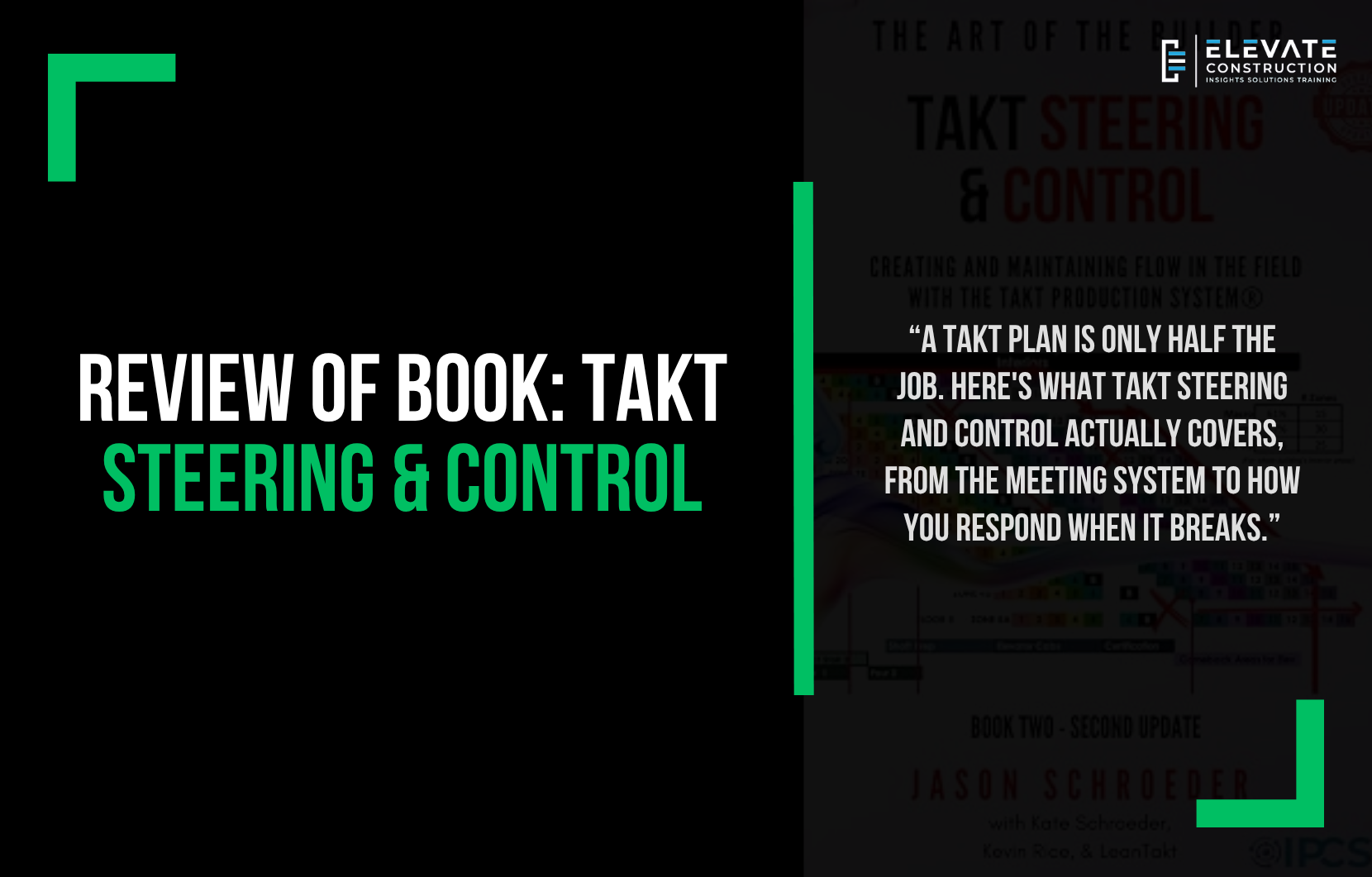
Review of Book: Takt Steering & Control

Read 8 min

Takt Steering and Control: How to Respond Once Your Plan Meets Reality

Here’s the deal. There is a well known saying that everybody has a plan until they actually get hit. A Takt plan is no different. Building the plan is only half the job. The other half is knowing exactly how to steer the train of trades through a real jobsite and control the environment once reality inevitably pushes back against what you designed on paper. That second half is what an entire dedicated resource, Takt Steering and Control, exists specifically to cover.

Why This Is Book Two, Not Book One

This resource picks up directly where a foundational Takt planning guide leaves off. Once a team knows how to actually build a Takt plan, this is where the work shifts toward the Last Planner System, the Kanban method, and Eliyahu Goldratt’s theory of constraints, woven together into one coherent approach for running the plan once trades are actually moving through the building.

The front portion ties everything directly back to the Last Planner System, presented in the same highly visual format that makes the concepts genuinely usable rather than theoretical. From there, the material moves quickly into constraints, and it draws a distinction worth restating briefly here, since so much of the industry gets it wrong. Constraints are system problems, built into the design of the plan itself. Roadblocks are the temporary, removable things actually standing in the way of the train of trades. Confusing the two is exactly why so many teams misdiagnose their own schedule problems, and this resource walks through the different types of constraints visually, specifically so a team can genuinely learn to see them on their own project instead of only recognizing them after the fact.

The Meeting System, Fully Spelled Out

Here is the section that genuinely earns this resource its place on a project delivery team’s shelf. It covers, in full, exactly how to run the Last Planner System inside a Takt structure. Not a rough outline. A complete overview of when each meeting happens, what visuals need to be present, the actual agenda, and a step by step walkthrough of how to run it.

Any boards referenced throughout are listed clearly enough to either purchase directly, at genuinely low cost, or print yourself, since much of this material is available for free through the toolbox resources on the Elevate Construction website. Every piece of the system is spelled out completely, with nothing left as a vague gesture toward what a team should probably figure out on their own.

Watch for these signs a Takt implementation is missing this level of meeting system detail:

  • Meetings happening on an inconsistent schedule with no clear agenda tied to the Takt structure itself
  • No standard visual boards used consistently across the project team
  • A team that understands Takt zoning conceptually but has never actually run a structured Last Planner meeting cadence around it

Recovery, KPIs, Quality at the Source, and Reporting

Past the meeting system itself, the resource covers exactly how to recover once something genuinely goes wrong, how to track the KPIs that actually matter for a Takt project rather than generic project metrics, and how to build quality in at the source rather than catching problems after they have already compounded downstream. It closes with a full reporting mechanism, giving a team a way to actually communicate all of this clearly to the people who need to see it, whether that is internal leadership or the owner.

That combination, recovery, KPIs, quality at the source, and reporting, is genuinely what separates steering and control from simply having a plan. A plan tells you what should happen. This is what tells you how to respond the moment it does not.

The KPI piece deserves particular attention, since generic project metrics rarely capture what actually matters on a Takt project. Tracking the right indicators, ones tied directly to zone flow, buffer consumption, and roadblock removal, gives a team an early warning system rather than a lagging report of what already went wrong. That distinction is exactly what separates a team that catches problems early from one that only discovers them once they have already cost real schedule.

Why the Books Are Meant to Be Used Together

None of these resources were built to stand alone, and understanding how they map to specific questions makes the whole ecosystem far easier to actually use.

If the question is how do I build the plan in the first place, that answer lives in the foundational Takt planning resource, the one this book directly continues from. If the question is how do I actually run pre-construction and set up an entire Lean system before ground even breaks, that answer lives in a separate resource built specifically for pre-construction planning. If the question is how do I train my team to physically feel these concepts before they ever hit a real jobsite, that is exactly what a physical simulation kit is built to do. And if the question is how do I recover from delays and actually run the meeting system once trades are moving through the building, that is precisely what Takt Steering and Control answers.

Each resource is genuinely useful on its own, and together they cover the entire lifecycle of a Takt implementation, from the first pre-construction conversation through the daily reality of steering trades through a live jobsite. Every one of them is also available in audio format, so none of this requires sitting down with a physical book if listening during a commute genuinely works better for how someone learns.

Thinking about the full lifecycle this way also helps a team diagnose exactly where their own implementation is genuinely weak. A team that plans well but consistently struggles once trades hit the field has a steering and control gap, not a planning gap, and the fix belongs in a completely different part of the system than a team that struggles to build a coherent plan in the first place.

Why This Matters More Than a Plan Alone

A plan that only exists on paper, without a real system for steering it through actual disruption, is not really a complete plan at all. It is a hope. Constraints will surface. Roadblocks will show up. Delays will happen regardless of how well the original Takt plan was built. What actually determines whether a project holds together is whether the team has a genuine, practiced system for responding when that happens, rather than improvising a response under real pressure for the first time.

If your project needs superintendent coaching, project support, or leadership development, Elevate Construction can help your teams build and practice this exact steering and control system before a real delay forces you to learn it the hard way. Having the meeting system, the recovery strategies, and the reporting mechanism already in place is what lets a team respond calmly to a real disruption instead of scrambling to invent a response in the moment.

So here is the challenge. Look at your current project’s response the last time a real delay or constraint hit the schedule. Was there a clear, practiced meeting system already in place to respond, or did the team improvise a reaction on the spot? If it was the latter, that gap is exactly where steering and control needs to be built before the next disruption arrives.

Jason Schroeder said it plainly: “This is how you respond to getting punched in the face.” Build that response system before you need it, and the punch stops being able to knock the whole plan down.

On we go.

FAQ

What is the actual difference between this resource and a foundational Takt planning guide?

A foundational Takt planning resource focuses on how to actually build the plan itself, zones, sequencing, and the underlying calculations. This resource picks up from there, focusing specifically on how to run and steer that plan once real trades are moving through a real jobsite, including the meeting system, recovery strategies, and how to respond when constraints or roadblocks actually disrupt the schedule.

Why does the meeting system get such detailed treatment rather than a general overview?

Because a Takt plan only holds together in practice if the meeting cadence supporting it is genuinely consistent and well structured, covering when meetings happen, what visuals are used, and a clear agenda for each one. A team that understands Takt conceptually but has never run a properly structured meeting system around it tends to lose coordination the moment real disruptions start piling up.

Why does the resource emphasize quality at the source rather than catching defects later?

Because a defect caught late in a process typically costs far more to fix than one caught immediately, often requiring rework that disrupts the flow of every trade sequenced behind it. Building quality checks into the source of the work, rather than relying on downstream inspection, prevents that kind of compounding disruption before it ever has the chance to start.

If you want to learn more we have:

-Takt Virtual Training: (Click here)
-Check out our Youtube channel for more info: (Click here) 
-Listen to the Elevate Construction podcast: (Click here) 
-Check out our training programs and certifications: (Click here)
-The Takt Book: (Click here)

Discover Jason’s Expertise:

Meet Jason Schroeder, the driving force behind Elevate Construction IST. As the company’s owner and principal consultant, he’s dedicated to taking construction to new heights. With a wealth of industry experience, he’s crafted the Field Engineer Boot Camp and Superintendent Boot Camp – intensive training programs engineered to cultivate top-tier leaders capable of steering their teams towards success. Jason’s vision? To expand his training initiatives across the nation, empowering construction firms to soar to unprecedented levels of excellence.

Posted in All

The Art of War Reflections – Chapter 5 – Use of Energy

Read 8 min

Five Notes, Limitless Music

Sun Tzu makes a striking point in the fifth chapter of The Art of War, titled The Use of Energy: just five musical notes, or five primary colors, arranged well, can produce limitless combinations. The same principle applies directly to organizing people. A genuinely limited set of core elements, structured with real intention, can produce enormous collective capability, far more than the same people operating without that structure ever could.

The Real Pain: Energy Lost to Disconnection

The real pain is what happens when people are not all moving in the same direction. Energy that could be building momentum toward a shared goal instead gets lost to disconnection, and that lost energy does not simply disappear. It gets consumed by the natural entropy, the steady pull toward disorganization and waste, that is always working against every project, whether anyone is paying attention to it or not.

The Failure Pattern: Individual Gangs Instead of One Team

The failure pattern is crews and departments operating as separate, disconnected units, effectively individual gangs, rather than one genuinely unified force. Without real, deliberate structure and connection, a project’s natural tendency is to fragment into smaller pockets pulling in slightly different directions, each technically working, none of them fully aligned with the others.

A few signs tend to show up when a project’s teams are operating as disconnected units rather than one coordinated force, and they are worth checking honestly:

  • Different crews or departments can describe their own tasks clearly but struggle to explain how their work connects to the overall project vision.
  • Information has to be repeated multiple times across different groups because it never reliably flows between them.
  • Teams feel more like separate, competing units than layers of one connected effort heading toward the same milestones.

This Isn’t About Rigid Hierarchy, It’s About Clear, Connected Structure

Sun Tzu describes a pyramid of command, building from individual soldiers up through progressively larger units, pair, squad, platoon, and beyond, each with its own leader. That language sounds rigid and purely military on the surface. The actual point translates into something far more human and practical: clear layers of genuinely connected leadership, foreman to general foreman to field engineers to superintendents to senior superintendents, each layer actually linked to the ones above and below it, not simply issuing top-down commands.

Five Things Every Team Actually Needs

Here is a practical translation of Sun Tzu’s five notes and five colors, applied directly to building real construction teams. First, genuine connection, foremen and workers actually know and trust each other, not just share a job site. Second, the right balance of complementary skills, drawing on established frameworks like working genius assessments or personality profiles to make sure a team’s strengths actually balance each other rather than duplicate or conflict. Third, the right team size, neither so large that coordination breaks down nor so small that real productivity suffers.

Fourth, real communication and clarity, ensuring each team stays genuinely connected to the larger project vision rather than operating with only a narrow, local view of their own scope. Fifth, genuine accountability to clear, specific goals and targets, so that connection, skill, and communication actually translate into real, measurable progress. From just these five elements, structured well, an enormous range of effective team configurations becomes possible, the same way five notes produce limitless music.

Why It Matters: A More Organized Team Steers the Outcome

This matters because of Sun Tzu’s closing point in this chapter: a skilled leader controls the movement of the opposition rather than being controlled by it. Applied to construction, where the real opposition is waste, variation, and natural entropy, a genuinely well-organized team does not simply survive that constant pull toward disorganization. It actively steers around and outpaces it, staying ahead of decay rather than being dictated by it.

Teach the Framework: Huddles as the Connective Tissue

This is precisely the thinking behind the morning worker huddle as a core practice, informed directly by ideas found in books like The Culture Code and The Proximity Principle. Huddles function as the actual connective tissue linking every layer of a project’s structure, foreman, general foreman, field engineers, superintendents, back to one shared vision and plan. Without that consistent connection, even a technically well-organized hierarchy on paper can quietly fragment into isolated pockets of activity, each doing their own job well while the collective energy of the whole team leaks away.

A few practical questions help check whether a project’s teams are genuinely connected or quietly operating in isolation:

  • Can someone on any given crew clearly explain how their work today connects to the project’s larger milestones?
  • Does information actually flow reliably between different layers of the team, or does it require constant repetition and rework to reach everyone?
  • Would each team score well across all five factors, connection, complementary skills, right size, clear communication, and genuine accountability, or does one of them consistently fall short?

Turning This Into Daily Practice

Audit your own project’s teams honestly against these five factors: real connection, the right balance of complementary skills, appropriate team size, genuine communication and clarity, and real accountability to specific goals. Use huddles deliberately and consistently as the mechanism that keeps every layer of the organization genuinely linked to one shared, visible plan, rather than assuming a good org chart alone will keep everyone aligned.

Connecting It Back to Building People, Not Just Projects

None of this happens without leaders willing to build genuine structure and connection deliberately, rather than assuming a project will naturally stay organized on its own. Building that kind of intentional, connected energy across every layer of a team is exactly what allows a project to outpace the natural entropy working against it every single day.

If your project needs superintendent coaching, project support, or leadership development, Elevate Construction can help your field teams build the kind of genuine structure and connection that turns individual effort into real, unified momentum.

The Challenge

So here is the challenge worth carrying onto your next project: check your teams honestly against the five factors, connection, complementary skills, right size, real communication, and genuine accountability, and see where the energy is actually leaking out. As Sun Tzu put it, a skilled leader controls the movement of the opposition instead of being controlled by it. On we go.

FAQ

What does Sun Tzu’s “five notes, limitless music” idea mean applied to construction teams?

It means that a small number of core organizational elements, well structured, can produce a vast range of effective team configurations. Rather than needing endless complexity, getting a handful of fundamentals genuinely right unlocks far more capability than most teams realize.

What are the five things every construction team needs, according to this framework?

Genuine connection between foremen and workers, the right balance of complementary skills, the appropriate team size, real communication and clarity linking the team to the larger project vision, and genuine accountability to specific goals and targets.

Why does Sun Tzu’s “pyramid of command” matter for modern construction leadership?

It describes building clear, connected layers of leadership, from individual workers up through foremen, superintendents, and beyond, so that coordinated action remains possible even when different parts of a team cannot communicate directly in the moment. The key is that each layer stays genuinely linked to the ones above and below it, not simply issuing commands downward.

How do huddles connect to this chapter’s concept of “energy”?

Huddles serve as the practical connective tissue that keeps every layer of a project’s organization genuinely linked to one shared plan and vision. Without that consistent connection, even a well-organized structure on paper can quietly fragment into isolated pockets of activity that lose collective momentum.

What does it mean to “control the enemy’s movements instead of being controlled by them” in a construction context?

Since the real opposition in construction is waste, variation, and natural disorganization, a genuinely well-organized team does not simply react to that constant pull toward decay. It actively stays ahead of it, steering the project’s outcome rather than being dictated by the entropy working against it.

If you want to learn more we have:

-Takt Virtual Training: (Click here)
-Check out our Youtube channel for more info: (Click here) 
-Listen to the Elevate Construction podcast: (Click here) 
-Check out our training programs and certifications: (Click here)
-The Takt Book: (Click here)

Discover Jason’s Expertise:

Meet Jason Schroeder, the driving force behind Elevate Construction IST. As the company’s owner and principal consultant, he’s dedicated to taking construction to new heights. With a wealth of industry experience, he’s crafted the Field Engineer Boot Camp and Superintendent Boot Camp – intensive training programs engineered to cultivate top-tier leaders capable of steering their teams towards success. Jason’s vision? To expand his training initiatives across the nation, empowering construction firms to soar to unprecedented levels of excellence.
Posted in All

How to Run a Trade Partner Meeting

Read 9 min

“Just a Lot of Me Talking”

A recurring question shows up constantly from superintendents and project engineers: I follow a template for my weekly trade partner meeting, but I never walk out feeling like there was real collaboration. It ends up being mostly me talking. That frustration is common, and it rarely comes from a missing agenda template. It comes from what actually gets discussed once everyone is in the room.

The Real Pain: A Meeting Where Everyone Already Knows What’s Coming

The real pain is simple: trade partners usually already know when they are planning to do their work. A meeting that spends most of its time repeating scheduling information people already had access to is naturally going to feel flat, one-directional, and forgettable. If the meeting only covers what people already know, there is nothing left to actually discuss.

The Failure Pattern: Telling Instead of Asking, When Instead of How

The failure pattern is running the meeting as a broadcast rather than a genuine discussion, telling trade partners what is happening rather than asking them to explain what they are doing so the whole room can actually coordinate around it. It also shows up as a focus on when things happen, rather than how they will actually get done, which is exactly where the real coordination problems and roadblocks actually live.

A few topics belong in every trade partner meeting as a genuine minimum, and they are worth naming directly:

  • Safety, quality standards, pre-installation meetings, and first-in-place mock-ups, since installing things right the first time is what actually protects schedule and flow.
  • The arrival, staging, and ongoing maintenance of materials, tracked specifically rather than assumed.
  • Roadblocks, discussed openly and by name, not glossed over or left for a private conversation later.

This Isn’t About a Better Template, It’s About What You Actually Discuss

None of this means the agenda template itself is the problem. A well-organized template still fails if the actual content of the conversation stays shallow, repeating information people already had rather than surfacing the genuine problems and coordination questions that only get solved by talking them through together.

Complaining Trade Partners Are Gold Coins

Here is a mindset shift worth adopting directly. A foreman who is constantly bringing up problems and roadblocks is not a nuisance to manage, as long as the behavior stays respectful, they are handing over exactly the information needed to actually protect the schedule. Treat that complaining as valuable, not annoying, closer to a slot machine that keeps paying out useful information than a headache to shut down. Every roadblock surfaced early is one that gets removed before it actually costs real time and money.

Why It Matters: Visuals Matter More Than the Meeting Itself

This matters because real preparation determines whether a meeting has anything genuine to react to. Two screens matter directly, the schedule visible on one side, the model or drawings visible on the other, so trade partners can physically point to exactly where and how their work connects to everyone else’s. A conference room genuinely designed around visuals, roadblock tracking maps, a procurement log, sequence maps, a delivery board, all visible and current, gives a team something concrete to actually discuss.

Just as important, the weekly work plan itself should already be pre-filled and sent out to trade partners a few days ahead of the meeting, pulled directly from the Takt plan and already coordinated in advance. Building the plan live, from scratch, during the meeting wastes the room’s time and leaves little space for the real conversation that actually needs to happen.

Teach the Framework: The Actual Meeting Structure

A real, working structure starts with genuine preparation, at least thirty minutes beforehand, and opens with real energy rather than a flat, hesitant start. From there, two to four genuine shout-outs set a positive tone before anything else happens. A lightning round follows, giving every person in the room thirty to sixty seconds to share a quick update and name what is actually on their mind, with topics noted and prioritized so the meeting stays on schedule and the most pressing issues get real time.

From there, the group gets anchored back to the actual Takt plan and real project milestones, not simply what individual trades would prefer to do on their own timeline. That anchoring matters, because real, healthy pressure toward a shared deadline is exactly what makes people more willing to surface genuine roadblocks rather than quietly hoping they resolve themselves. A quick review of the previous week and current progress follows, then the group walks through the already-prepared weekly work plan together, using the visuals directly, pointing to the schedule and the drawings to talk through where and how the work actually connects.

The real engine of the meeting comes next: going zone by zone through the roadblock tracking map and asking directly what will prevent the team from hitting the plan. This is where trades actually start talking, offering ideas, pushing back, and coordinating with each other in real time, because the conversation has shifted from information they already knew to problems they still need to solve together. The meeting closes with a purpose-driven reflection, not a generic “what did you like” check-in, but a direct question: did this meeting accomplish what it was actually meant to accomplish, a real weekly work plan, real roadblocks surfaced and assigned, real collaboration. Whatever comes out of that reflection should go out to the team immediately, not hours or days later.

A few practical signs confirm a trade partner meeting has genuinely become collaborative rather than a one-way briefing:

  • Trade partners are pointing directly at visuals, the schedule, the model, the roadblock map, rather than just listening passively.
  • Roadblocks get named specifically and assigned for follow-up, rather than mentioned vaguely and left unresolved.
  • People leave with real information they did not have going in, rather than a repeat of what they already knew.

Turning This Into Daily Practice

Build in real preparation time before the meeting and a genuine buffer, at least thirty minutes, afterward for follow-up calls, emails, and schedule updates. Without that buffer, promised follow-through quietly disappears, and the meeting’s credibility erodes over time. Once this structure becomes stable and reliable, layer in genuine culture and enjoyment on top of it, real shout-outs, some lighthearted moments, a reason for people to actually look forward to showing up. A serious, high-stakes meeting and a genuinely engaging one are not mutually exclusive, and treating them as opposites is a mistake worth avoiding directly.

The clearest measure of success is simple: when a trade partner sees this meeting on their calendar, do they feel like it is worth their hour, or do they dread it. That single reaction reveals more about whether the meeting is actually working than any agenda template ever could.

Connecting It Back to Building People, Not Just Projects

None of this happens without leaders willing to prepare seriously, shift real conversation toward genuine problem-solving, and treat trade partner input as valuable information rather than an inconvenience. Building that kind of meeting culture is exactly what turns a weekly obligation into one of the most productive hours of a project’s entire week.

If your project needs superintendent coaching, project support, or leadership development, Elevate Construction can help your field teams build the kind of trade partner meetings that people actually want to attend, and that actually move the project forward.

The Challenge

So here is the challenge worth carrying into your next trade partner meeting: shift the conversation from what everyone already knows to the roadblocks nobody has said out loud yet, and watch how much more the room actually talks. As Jason put it plainly, “Problems are not a problem, we want all roadblocks to the surface.” On we go.

FAQ

Why do so many trade partner meetings feel like one person just talking the whole time?

Trade partners usually already know when their work is scheduled, so a meeting that mostly repeats that information leaves little room for genuine discussion. Real collaboration happens when the meeting shifts toward how the work will actually get done and what roadblocks stand in the way.

Why does Tony Eisenhut’s advice to “ask, don’t tell” matter so much in these meetings?

Asking trade partners to explain what they are doing, rather than telling them what is happening, keeps the whole room actively coordinating rather than passively receiving information. This helps prevent stacking, out-of-sequence work, and coordination problems that only surface through genuine discussion.

Why should a complaining foreman or trade partner be seen as valuable rather than annoying?

Someone consistently raising problems and roadblocks is handing over exactly the information a team needs to protect its schedule and avoid costly surprises later. As long as the behavior stays respectful, that input is worth genuinely appreciating rather than dismissing.

Why does visual preparation matter more than the meeting agenda itself?

A well-prepared room, with a visible schedule, model, and roadblock tracking map, gives trade partners something concrete to point to and discuss directly, rather than relying on abstract verbal updates. Without that visual foundation, conversation tends to stay shallow and disconnected from the real coordination work that needs to happen.

What is a better way to close a trade partner meeting than asking what people liked or didn’t like?

Asking directly whether the meeting accomplished its actual purpose, a completed weekly work plan, real roadblocks surfaced and assigned, genuine collaboration, produces far more useful reflection than a generic satisfaction question. Whatever comes out of that reflection should be acted on and communicated immediately, not left for later.

If you want to learn more we have:

-Takt Virtual Training: (Click here)
-Check out our Youtube channel for more info: (Click here) 
-Listen to the Elevate Construction podcast: (Click here) 
-Check out our training programs and certifications: (Click here)
-The Takt Book: (Click here)

Discover Jason’s Expertise:

Meet Jason Schroeder, the driving force behind Elevate Construction IST. As the company’s owner and principal consultant, he’s dedicated to taking construction to new heights. With a wealth of industry experience, he’s crafted the Field Engineer Boot Camp and Superintendent Boot Camp – intensive training programs engineered to cultivate top-tier leaders capable of steering their teams towards success. Jason’s vision? To expand his training initiatives across the nation, empowering construction firms to soar to unprecedented levels of excellence.
Posted in All

The Art of War Reflections – Chapter 4 – Tactical Dispositions

Read 8 min

“There Goes Jason Again”

On one university project, exposed concrete stair tower walls had formwork hanging off the edge of the building, ten to fifteen feet above a sidewalk and an adjacent road with a light rail line running alongside it. In nearly every team meeting, the same risk got named directly: that stair tower, that formwork, the real danger of a tool, a nail, or debris falling onto the road below.

The superintendent and project manager took it seriously. A lot of the rest of the team eventually started rolling their eyes: there goes Jason again. But walking the site regularly kept turning up the same real, specific problems worth correcting: planks not properly secured, gaps between the base and the toe boards, snow fencing that was not fully up. The job was going well overall, clean, safe, organized, on schedule, profitable. None of that made the risk any less real.

The Real Pain: “Delays and Mistakes Happen in the Real World”

A common pushback shows up constantly in training: Jason, this is all great in theory, but in the real world, delays and mistakes happen. That statement is true. It is also, on its own, an incomplete way of thinking about risk, because it treats all variation as equally unavoidable, when a large amount of it is actually preventable.

The Failure Pattern: Confusing “Some Variation Is Inevitable” With “Nothing Is Controllable”

The failure pattern is letting the existence of genuinely unpredictable variation become an excuse to stop controlling the variation that is actually preventable. In reality, tightly controlling what genuinely can be controlled is exactly what frees up the energy, focus, and morale needed to handle real, inevitable surprises well when they eventually show up. A team constantly firefighting problems that could have been prevented has nothing left in reserve for the problems that genuinely could not have been.

A few signs tend to show up when a team has confused “some things are unpredictable” with “nothing is worth controlling,” and they are worth checking honestly:

  • Preventable mistakes get waved off with “that’s just construction,” rather than being genuinely addressed and corrected.
  • A team feels perpetually exhausted and demoralized, with no sense of consistent wins in the areas that are actually within their control.
  • A known, named risk keeps recurring without any real corrective action, simply because “it hasn’t caused a real problem yet.”

This Isn’t About Being a Pessimist, It’s About Productive Paranoia

None of this is doom-and-gloom thinking, or a refusal to celebrate real progress and genuine wins. It is a specific, deliberate discipline: staying alert to real risk especially when things are going well, rather than assuming smooth progress means nothing can go wrong. That discipline has a name worth using directly: productive paranoia, the healthy, ongoing habit of taking real risks seriously precisely because a project is currently going well, not despite it.

A 98% Chance of Nothing, and a 100% Chance of Going Out of Business

Here is a useful way to think about risk that genuinely changes decisions. In a recent contract negotiation, a lawyer advised that a particular clause carried roughly a ninety-eight percent chance of never causing a real problem. That framing sounds reassuring on its own. The more useful framing is this: there is a ninety-eight percent chance that nothing happens, but a genuine risk that the remaining two percent could mean the entire business goes under.

Low probability does not mean low priority when the consequence is severe enough. This same logic applies directly to a hanging piece of formwork above a public road, the odds of something actually falling might be genuinely low on any single day, but the consequence if it happens is serious enough to demand real, ongoing attention regardless of how unlikely it feels.

Why It Matters: Complacency After a Win Is Still a Risk

This matters because of a direct warning worth taking seriously: a comfortable, easy victory is not automatically a mark of real skill, and the true reasons behind any success are not always fully visible in the moment. A project running smoothly can create exactly the kind of ego and complacency that allows a real risk to go unaddressed simply because nothing bad has happened yet.

“We’re fine, it’s not a big deal” is precisely the wrong posture, even, and especially, when a project genuinely is going well. Confidence built on current success rather than ongoing vigilance is fragile in exactly the moments it matters most.

Teach the Framework: Measure, Estimate, Calculate, Compare

The practical discipline worth building directly is a real risk and opportunity register. Rather than guessing or simply hoping a known risk resolves itself, real risks get measured, their potential cost and probability estimated, the actual exposure calculated, and the whole picture compared honestly against the project’s current plan and real chances of success. This is not a passive, one-time exercise. It is an ongoing habit of quantifying real risk rather than relying on gut feeling or optimism alone.

This is exactly what Sun Tzu means when he says a victorious army wins its victories before ever seeking battle. Outcomes are largely decided during preparation and planning, not improvised successfully in the moment through sheer effort or good luck.

A few practical steps build a genuine risk and opportunity register rather than a symbolic one:

  • Name specific, real risks directly and repeatedly, even when doing so makes you the person who “always brings that up.”
  • Estimate the actual cost and probability of each named risk, rather than relying on a vague sense of how likely it feels.
  • Revisit and update the register regularly, especially during stretches when the project is genuinely going well and complacency becomes more tempting.

Turning This Into Daily Practice

Identify your own project’s version of that stair tower, the specific, real risk that becomes easy to overlook precisely because everything else is going smoothly. Keep naming it directly and consistently, even if it means being the person who repeats the same warning in meeting after meeting. That consistency, not a single dramatic intervention, is what actually prevents real harm.

Connecting It Back to Building People, Not Just Projects

None of this happens without leaders willing to stay genuinely alert to real risk, even when doing so feels repetitive or unwelcome to a team that is otherwise feeling good about their progress. Building that kind of productive paranoia directly into a project’s culture is exactly what protects people and outcomes long after the easy confidence of a smooth stretch has worn off.

If your project needs superintendent coaching, project support, or leadership development, Elevate Construction can help your field teams build the kind of real risk management discipline that wins the battle before it ever has to be fought.

The Challenge

So here is the challenge worth carrying onto your next project: name your project’s real, specific risk directly, and keep naming it consistently, even when things are going well and nobody wants to hear about it anymore. As Sun Tzu put it, “A victorious army wins its victories before seeking battle. An army destined to defeat fights in the hope of winning.” On we go.

FAQ

What is the difference between preventable and unpreventable variation?

Preventable variation includes mistakes, risks, and problems that real planning and diligence can actually avoid, while unpreventable variation includes genuinely unpredictable events outside anyone’s control. Tightly controlling the preventable kind is what preserves the energy and focus needed to handle the unpreventable kind well when it eventually happens.

What does “productive paranoia” mean in a construction context?

It means staying alert to real, specific risks even, and especially, when a project is going well, rather than assuming smooth progress means nothing can go wrong. This discipline helps catch and correct genuine hazards before they cause real harm, rather than after.

Why does a low-probability risk still deserve serious attention?

When the potential consequence is severe enough, even a small probability of it happening carries real weight, since the cost of being wrong once can outweigh the comfort of being right most of the time. A ninety-eight percent chance nothing goes wrong still leaves a genuine risk worth planning for if the two percent outcome would be catastrophic.

Why is complacency after a successful stretch of a project considered dangerous?

A smooth, easy run of success is not automatically evidence of great skill, and it can create exactly the kind of overconfidence that allows a real, known risk to go unaddressed. Sun Tzu’s warning is that the true reasons behind success are not always fully visible, which makes ongoing vigilance essential even during a genuinely strong stretch.

What is a risk and opportunity register, and why does it matter?

It is a practical tool for systematically measuring, estimating, calculating, and comparing real risks and opportunities on a project, rather than relying on guesswork or hope. Keeping this register current, especially during periods when a project feels like it is going smoothly, helps ensure that real risks stay visible and actively managed rather than quietly forgotten.

If you want to learn more we have:

-Takt Virtual Training: (Click here)
-Check out our Youtube channel for more info: (Click here) 
-Listen to the Elevate Construction podcast: (Click here) 
-Check out our training programs and certifications: (Click here)
-The Takt Book: (Click here)

Discover Jason’s Expertise:

Meet Jason Schroeder, the driving force behind Elevate Construction IST. As the company’s owner and principal consultant, he’s dedicated to taking construction to new heights. With a wealth of industry experience, he’s crafted the Field Engineer Boot Camp and Superintendent Boot Camp – intensive training programs engineered to cultivate top-tier leaders capable of steering their teams towards success. Jason’s vision? To expand his training initiatives across the nation, empowering construction firms to soar to unprecedented levels of excellence.

Posted in All

The Art of War Reflections – Chapter 3 – Attack by Strategy

Read 8 min

Win Without Fighting

Sun Tzu’s third chapter of The Art of War makes a point worth sitting with directly: real victory is not measured by how much destruction you cause. The actual goal is to subdue the opposition through genuine strategy, ideally without ever needing to fight directly at all. That idea translates almost perfectly into construction leadership, where the real enemy, waste, bad behavior, toxic culture, bad process, rarely gets defeated through a direct, head-on confrontation.

The Real Pain: Confronting Toxic Behavior Head-On Rarely Works

The real pain is the natural instinct to go straight at a difficult person the moment their behavior becomes a problem, a foreman who is not bought in, a team member spreading negativity, someone actively undermining the culture you are trying to build. That instinct feels satisfying in the moment. It very often backfires, entrenching the person deeper into their position rather than actually changing anything.

The Failure Pattern: Winning the Argument, Losing the War

The failure pattern shows up clearly in a real story worth telling directly. After a heated conference room confrontation with a foreman, one leader walked away feeling like he had clearly won the argument. A colleague pulled him aside afterward and told him plainly: you lost today. Not only had he lost that foreman’s respect, but that foreman would never again go the extra mile for him. Winning the argument had cost him something far more valuable than the argument itself.

A few signs tend to show up when direct confrontation is not actually working as a strategy, and they are worth checking honestly:

  • A difficult team member becomes more entrenched in their position after a direct confrontation, rather than less.
  • Cooperation and goodwill from that person, and often from people watching the interaction, noticeably decline afterward.
  • The same conflict keeps recurring in different forms, even after being “won” in the moment.

This Isn’t About Manipulation, It’s About Shaping Culture on Purpose

None of what follows is a cynical or manipulative tactic aimed at secretly undermining someone. It is the deliberate, intentional building of a genuinely positive culture, strong enough that toxic behavior becomes unpopular entirely on its own, without ever requiring a personal attack on the individual behind it.

Encircling Without Confronting

Here is the actual tactic worth understanding directly, one Sun Tzu calls separating the enemy from its allies. Instead of going straight at a difficult person, the more effective approach builds the surrounding environment deliberately. In worker and foreman huddles, correct principles get taught consistently and positively. Good behavior gets genuinely praised, sometimes even recognized directly to that person’s own company leadership. Clear standards get stated plainly and calmly: on this job site, we do this, and we do not do that, without ever pointing directly at any one individual.

Over time, this approach isolates toxic behavior by contrast rather than confrontation. The behavior itself becomes visibly out of step with everything being reinforced and celebrated around it, and the person behind it eventually faces a real choice: genuinely change, quietly comply, or leave. None of those outcomes required a single direct fight to achieve.

Why It Matters: An Angry Leader Loses Even When They “Win”

This matters because of a story tied to Sun Tzu’s own teaching about emotional control. An emperor commanding a hundred thousand troops once requested wine from an opposing general as custom dictated, and received a pot of urine instead, a deliberate insult. Enraged, he attacked the city immediately. Within thirty days, more than half his army was dead.

The lesson is direct: a leader’s job is to remain in control of their own emotions, and their team’s emotions, especially in the exact moments when provocation feels strongest. Reactive decisions made in anger are rarely good decisions, no matter how justified the anger might feel in the moment.

Teach the Framework: Build the Culture That Makes Bad Behavior Impossible to Sustain

The actual mechanism behind this strategy is consistency. Regularly reinforcing the right behaviors, publicly and genuinely, combined with calmly and clearly articulating real standards, creates a social environment where toxic behavior increasingly stands out rather than blending in. This approach is slower than a direct confrontation. It is also far more durable, because it changes the actual social dynamics around a problem rather than simply winning one isolated argument.

A few practical steps help apply this strategy directly, without ever requiring a personal confrontation:

  • Use regular huddles to consistently reinforce correct principles and genuinely recognize good behavior, publicly and specifically.
  • State clear standards calmly and generally, “on this job site, we do this,” rather than singling out any individual directly.
  • Recognize good behavior to a person’s own leadership or company when appropriate, reinforcing the contrast between supported and unsupported behavior.

Turning This Into Daily Practice

Build the habit of using huddles and everyday interactions to consistently reinforce the culture you actually want, rather than saving your energy for confrontations after something has already gone wrong. Resist the instinct to directly confront someone in the heat of a frustrating moment, and ask instead whether the more effective path is building the surrounding culture strong enough that the behavior isolates itself naturally over time.

This same principle applies to how a team gets organized around a shared plan. In one training exercise, teams that laid their planning materials out visually on the ground, where everyone could see and contribute, consistently outperformed teams where one person held all the information and simply issued directions. Unified purpose, built around something everyone can see and rally behind, works the same way against toxic behavior that it does against poor planning: it wins through genuine alignment, not through force.

Connecting It Back to Building People, Not Just Projects

None of this happens without leaders willing to trade the short-term satisfaction of winning a direct confrontation for the slower, far more durable work of building a genuinely strong culture. That patience is exactly what allows toxic behavior to lose its footing naturally, rather than simply going underground after one heated argument.

If your project needs superintendent coaching, project support, or leadership development, Elevate Construction can help your field teams build the kind of strong, positive culture that makes toxic behavior genuinely unsustainable, without requiring constant direct conflict to maintain it.

The Challenge

So here is the challenge worth carrying into your next difficult team situation: before confronting someone directly, ask whether building the surrounding culture, consistently and patiently, might actually be the stronger, more lasting strategy. As one colleague put it after a hard-won argument, “You lost today.” On we go.

FAQ

Why does directly confronting a toxic team member often make the situation worse?

Direct confrontation can cause a person to become more entrenched in their position rather than genuinely reconsidering their behavior, and it often damages goodwill and cooperation even when the confrontation is technically “won.” A quieter, culture-based approach tends to produce more lasting change.

What does “separate the enemy from its allies” mean in a construction leadership context?

It means building a strong, positive culture around a difficult situation rather than attacking the individual directly, through consistent huddles, genuine recognition of good behavior, and clearly stated standards. Over time, this isolates toxic behavior by contrast, making it increasingly unsustainable without ever requiring a direct personal confrontation.

Why is emotional control so important for a leader dealing with provocation?

Reactive decisions made in anger tend to produce worse outcomes than calm, deliberate responses, even when the initial provocation feels completely justified. A leader who stays in control of their own emotions, and helps their team do the same, avoids costly mistakes driven by momentary frustration.

What does it mean to “win the argument but lose the war”?

It refers to situations where someone technically wins a direct confrontation but permanently damages the relationship, trust, or future cooperation of the person they argued with. True success often requires prioritizing the long-term relationship and culture over the short-term satisfaction of winning a single exchange.

How does building a strong team culture help address individual behavior problems?

When positive behavior is consistently reinforced and clear standards are calmly stated, toxic or unsupportive behavior becomes increasingly visible and unsupported within that environment. This creates natural pressure for genuine change without requiring ongoing direct conflict to maintain the standard.

If you want to learn more we have:

-Takt Virtual Training: (Click here)
-Check out our Youtube channel for more info: (Click here) 
-Listen to the Elevate Construction podcast: (Click here) 
-Check out our training programs and certifications: (Click here)
-The Takt Book: (Click here)

Discover Jason’s Expertise:

Meet Jason Schroeder, the driving force behind Elevate Construction IST. As the company’s owner and principal consultant, he’s dedicated to taking construction to new heights. With a wealth of industry experience, he’s crafted the Field Engineer Boot Camp and Superintendent Boot Camp – intensive training programs engineered to cultivate top-tier leaders capable of steering their teams towards success. Jason’s vision? To expand his training initiatives across the nation, empowering construction firms to soar to unprecedented levels of excellence.

Posted in All