
The Best Systems Don’t Just Catch Mistakes. They Protect the People Who Would Otherwise Be Blamed for Them.
Here’s the deal: when something goes wrong with pipe inverts on a construction project, the conversation almost always starts in the same place the foreman. Who ran the shots? Who set the grade? Who was responsible for this? And nine times out of ten, the answer points to a person before it points to a process. That’s not accountability. That’s scapegoating a skilled professional for a system failure that never gave them a structured way to document what they did, verify what they found, and catch an error before it became a costly problem in the ground.
The Survey Invert Calc Sheet is not a compliance form. It’s a protection system. It’s standard work designed to verify every elevation is correct before the pipe goes in the trench and to provide the documented evidence that tells the team exactly what happened when something doesn’t go right. It protects the foreman, protects the project, and protects the crews who are out there grinding every day without the documentation that would defend them if anything ever came into question.
What Happens Without Standard Work for Survey Operations
Most pipe crews run invert shots with a level of skill that comes from years of field experience. The instrument tech sets up, takes a backsight, records the height of instrument, takes the sideshots, and moves on. The process is known. The problem is that “known” is not the same as “documented.” When the shots are being taken correctly, everything is fine and nobody notices the absence of a formal process. When something goes wrong an error in the benchmark elevation, a compensator that wasn’t tapped, a delta on 3-wire leveling that was outside tolerance but nobody wrote it down the absence of documentation becomes a serious problem.
The investigation that follows has no data to work with. Nobody knows whether the setup was checked. Nobody knows whether the benchmark was verified before work started. Nobody knows if the check-in shot to a known elevation confirmed the setup before sideshots were taken. The foreman remembers what they did, but memory in a legal or contractual dispute is not documentation. The investigation cannot find the root cause because the root cause was never recorded. So the default answer is the person standing closest to the problem the foreman who ran the shots and the system that failed to provide them proper standard work gets no scrutiny at all.
The system failed them. They didn’t fail the system.
A Story About What Documentation Changes
I was on a large civil project years ago where we had a significant invert discrepancy discovered during final inspection on a section of force main. The pipe was in. The grade was off. The cost to investigate, expose, and correct was significant, and the first conversation was about who was responsible. The pipe foreman was one of the best I had worked with meticulous, experienced, and genuinely invested in the quality of the work. But when the question came about what documentation existed for the shots that established grade on that section, there was nothing formal. No recorded backsight check. No benchmark verification at the start of the day. No check-out shot confirming the setup held through the shift.
The problem was eventually traced to a benchmark that had been disturbed by equipment traffic and was no longer at its originally surveyed elevation. The foreman had done everything right relative to the information they had. But without a documented check-in shot to an independent known elevation, there was no way to prove when the benchmark discrepancy began. The foreman absorbed accountability for a system problem. Standard work would have caught the elevation error before a single joint was made and would have protected the foreman from a consequence they didn’t deserve.
What the Survey Invert Calc Sheet Is Built Around
The calc sheet is standard work a defined, documented process that every instrument tech follows for every invert shot, every time. Standard work is the foundation that allows continuous improvement to compound without the system constantly resetting. When the process is standardized, variation becomes visible. When variation is visible, root cause analysis becomes possible. And when root cause is possible, the system improves instead of repeating the same failure in the next zone.
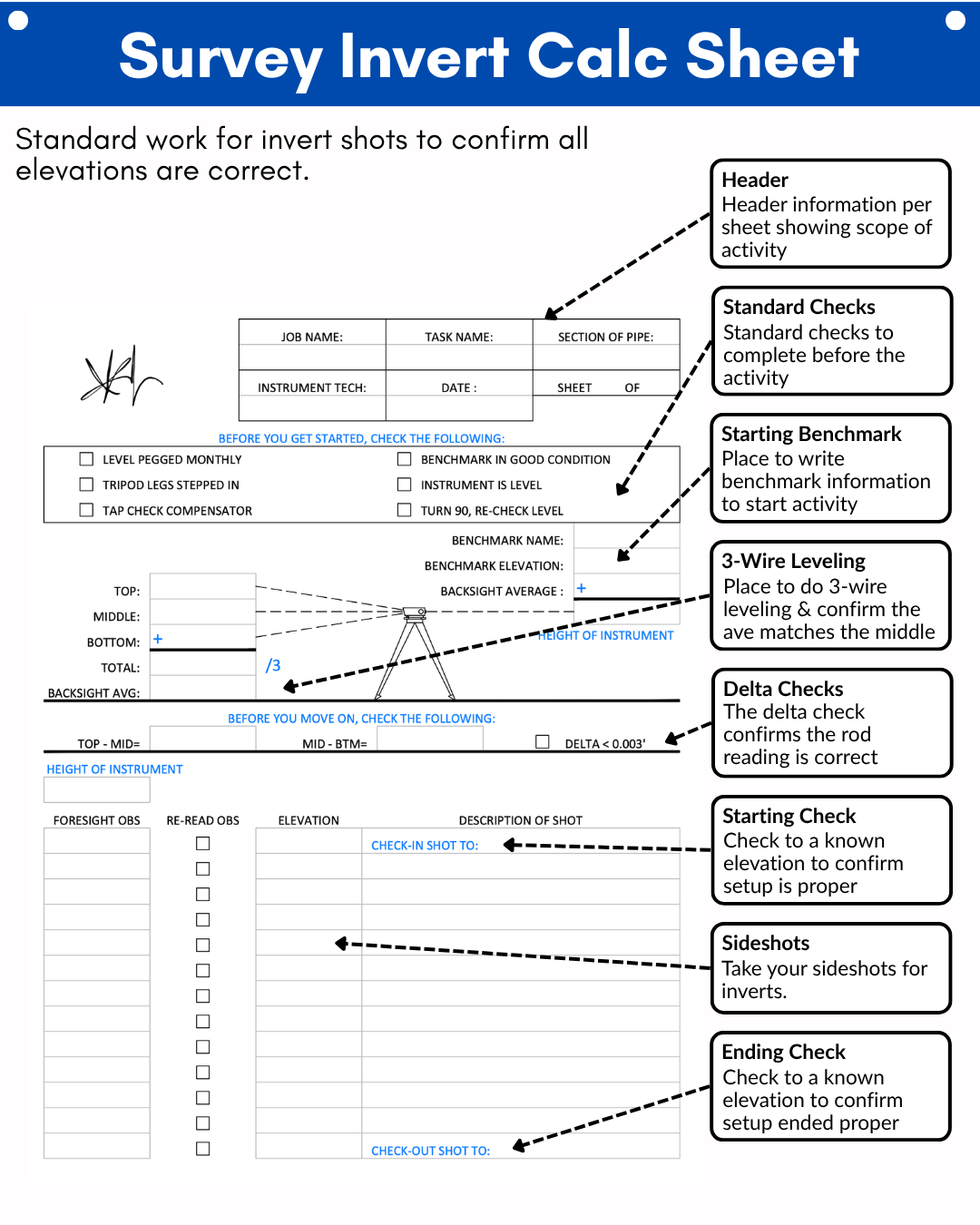
The header section establishes scope before the shot begins job name, task name, section of pipe, instrument tech, date, and sheet number. This is not administrative overhead. This is chain of custody for field data. When a question comes up weeks later about which shots were taken when, and by whom, the header tells the story without requiring anyone’s memory.
The pre-flight checklist level pegged monthly, tripod legs stepped in, compensator tapped, benchmark in good condition, instrument is level, turn 90 and re-check runs before any elevation is taken. These are the conditions that make the shot valid. A compensator that wasn’t tapped introduces systematic error that affects every foresight reading taken from that setup. Tripod legs that weren’t properly stepped in on soft ground can shift during the session. The checklist catches these conditions before the data is compromised not after.
Watch for these signals that invert survey work on your project lacks adequate standard work:
- Invert discrepancies that cannot be traced to a specific cause because no setup data was recorded
- Benchmark verification happening verbally rather than as a documented step before shots begin
- No check-in shot to a known elevation at the start of each setup to confirm instrument configuration
- Delta checks on 3-wire leveling not being recorded, leaving no way to verify rod reading accuracy
- No check-out shot at the end of the day to confirm the setup held through the session
The Three-Wire Method and the Delta Check
The 3-wire leveling section of the calc sheet is where precision is verified through mathematics rather than assumption. The instrument tech reads the top, middle, and bottom crosshairs on the rod, records all three, and averages the top and bottom to confirm it matches the middle reading within a defined tolerance. The delta check confirming the difference between top and middle matches the difference between middle and bottom within 0.003 feet is the quality gate that confirms the rod reading is correct before the height of instrument is calculated.
This is Poka-Yoke applied to field survey work. The delta check cannot pass on a misread. If the rod was read incorrectly if the wrong graduation was observed the math will not close. The error is caught at the source, before it propagates into the height of instrument calculation and then into every foresight reading taken from that setup. A delta failure at this step costs sixty seconds to re-level and re-read. The same error discovered in the ground after pipe installation costs days and significant money.
The check-in shot to a known elevation before sideshots begin, and the check-out shot to the same known elevation at the end of the day, bookend the session with independent verification. If the setup was correct at check-in and confirmed at check-out, every reading taken in between has a verified bracket around it. If the check-out doesn’t match, the team knows immediately that something changed during the session and exactly which shots need to be reviewed.
Why This Is a Foreman Protection Question, Not a Paperwork Question
Jason Schroeder teaches that the foreman is the most important leadership role in construction the last planner closest to the work, the primary production leader, the person the entire system is designed to support. When foremen are forced into daily firefighting because the system failed to give them what they need, the system is failing them. And when something goes wrong and the foreman is the default answer because there is no documented system that protected them, the organization has compounded that failure with an injustice.
The Survey Invert Calc Sheet is how the system shows up for the foreman before the shot begins. It says: we designed a process that documents your setup, verifies your benchmark, confirms your accuracy, and creates a record that tells the real story if anything ever needs to be investigated. That is not micromanagement. That is what leader standard work looks like in the field. It gives the foreman the tools to back up their work and the checks to catch a problem before it costs the project or costs them professionally.
If your project needs superintendent coaching, project support, or leadership development, Elevate Construction can help your field teams stabilize, schedule, and flow. Standard work at the crew level including field survey standard work is part of the foundation that makes flow possible and people protectable.
Build the Standard Before the Pipe Goes in the Ground
Here is the challenge. Look at the invert survey process on your current project and ask: is there documented standard work that every instrument tech follows for every setup? Is the benchmark being verified to an independent check point before shots begin? Is a delta check being run on every 3-wire reading? Are check-in and check-out shots being recorded for every session?
If the answer to any of those questions is no, the process is relying on individual skill and memory to protect the project and the people doing the work. Standard work doesn’t replace skill. It documents it. It makes the skilled person’s good work visible, verifiable, and defensible when the question ever gets asked. Build the standard. Train to it. And protect the foremen who are out there grinding every day with a system worthy of the work they do.
As Jason Schroeder teaches: “If work is not standardized, reliability becomes luck.” The invert shot is not where we want to be lucky.
On we go.
Frequently Asked Questions
What is the Survey Invert Calc Sheet and what does it standardize?
It’s standard work documentation for pipe crew invert shots covering pre-flight instrument checks, 3-wire leveling with delta verification, benchmark recording, check-in and check-out shots, and a complete foresight log for every sideshot taken during the session.
What is a delta check and why does it matter for accuracy?
The delta check confirms that the rod readings from the top, middle, and bottom crosshairs are mathematically consistent within 0.003 feet. A delta failure reveals a misread before it affects the height of instrument calculation and every subsequent foresight taken from that setup.
How does standard work protect the foreman when something goes wrong?
Documented standard work creates an evidentiary record of what was done, when, and under what verified conditions. When a discrepancy is investigated, the data points to the actual root cause benchmark issue, equipment problem, or field condition change rather than defaulting to the person who ran the shots.
If you want to learn more we have:
-Takt Virtual Training: (Click here)
-Check out our Youtube channel for more info: (Click here)
-Listen to the Elevate Construction podcast: (Click here)
-Check out our training programs and certifications: (Click here)
-The Takt Book: (Click here)
Discover Jason’s Expertise:
Meet Jason Schroeder, the driving force behind Elevate Construction IST. As the company’s owner and principal consultant, he’s dedicated to taking construction to new heights. With a wealth of industry experience, he’s crafted the Field Engineer Boot Camp and Superintendent Boot Camp – intensive training programs engineered to cultivate top-tier leaders capable of steering their teams towards success. Jason’s vision? To expand his training initiatives across the nation, empowering construction firms to soar to unprecedented levels of excellence.