
Lean Doesn’t Stick in the Conference Room. It Sticks at the Huddle.
Here’s the deal: we talk about Lean constantly. In the trailer, in the coordination meeting, with the project manager, with trade partners, with the design team. We use terms like Takt, Last Planner, zone control, and pull planning with fluency. And then we wonder why the worker tying rebar at 6 AM doesn’t behave in a Lean way. Nobody ever told him what Lean was. Nobody showed him what it looks like in his zone, with his crew, in the work he does every day. The Lean conversation happened somewhere above his line of sight and never made it to the floor.
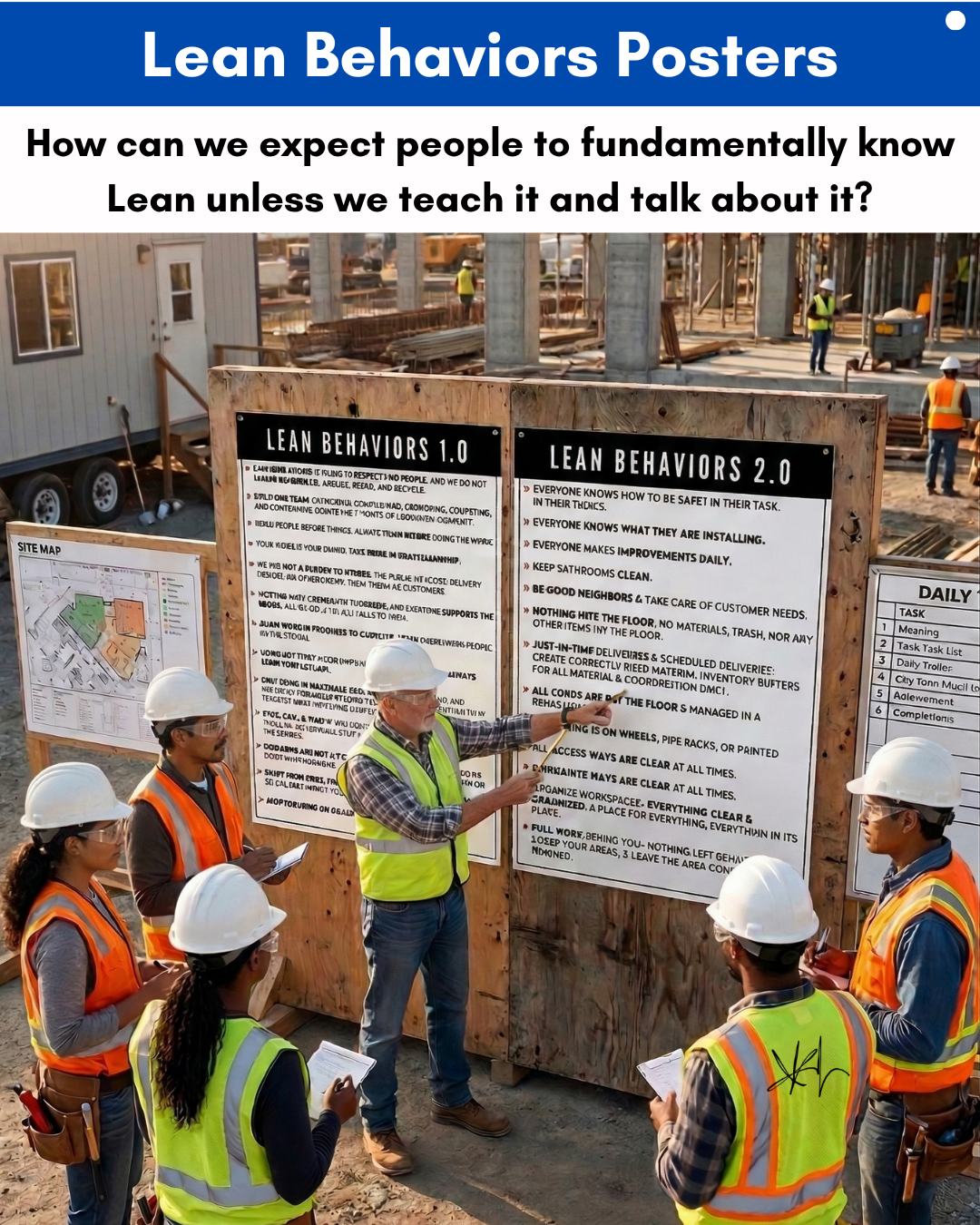
The Lean Behaviors Poster solves this at the simplest level possible. It takes the principles that the project team discusses in meetings and puts them on a board, at the huddle location, in front of every worker, every morning until the language isn’t the GC’s language anymore. Until it’s the crew’s language. Until a foreman can point at the board and say “here’s how we work on this project” and every worker behind him already knows it because they’ve been reading it since day one.
What the Conference Room Keeps to Itself
Most Lean implementation in construction is top-down by design. Leadership attends a workshop. The project team gets trained. The superintendent learns the language. The scheduling system gets updated. And somewhere in that chain, the implementation stops before it reaches the person who actually executes the plan the journeyman, the apprentice, the foreman running a crew of seven through a Takt zone. They see a different project than the one being discussed three floors up. They see instructions, task lists, and daily assignments. They don’t see the system those instructions are built on, the reasoning behind the zone boundaries, or the connection between their daily work and the production rhythm the whole project depends on.
That gap is not their failure. It is the system’s failure to complete the communication loop. Jason Schroeder teaches that total participation requires everyone not just superintendents, not just PMs to see as a group, know as a group, and act as a group. You cannot have total participation with partial information. And when Lean knowledge stops at the trailer door, every worker beyond it is being asked to operate in a system they were never taught to see. The system failed them. They didn’t fail the system.
I saw the Lean Behaviors Posters for the first time at a DPR jobsite. Two boards mounted at the morning huddle location. A simple sign above them: “Lean Project.” I stood there reading every word, and something clicked. This was it. This was what had been missing from every Lean implementation I had tried to run before. Not another tool, not another meeting, not another system in the trailer. Two boards. At the huddle. In front of the workers. Every morning.
What the Lean Behaviors Posters Actually Teach
The two boards Lean Behaviors 1.0 and 2.0 cover the behavioral expectations that define what a Lean project looks and feels like at the crew level. Not abstract principles. Specific, actionable, observable behaviors that any worker can read, understand, and apply to their own work without a trainer in the room.
Lean Behaviors 1.0 covers the foundational culture: how we treat each other, how we treat trade partners, how we run the project environment, how we communicate, and the standards that apply to everyone on the site regardless of trade or tier. Nothing in this section requires a Lean certification. It requires showing up ready to work in a system designed around respect for the work, for the people doing it, and for the crews that follow.
Lean Behaviors 2.0 moves into the operational principles: everyone knows what they’re installing and is safe in their task. Everyone makes improvements daily. Bathrooms stay clean. Nothing hits the floor. Just-in-time deliveries and scheduled delivery windows keep the staging areas clear and the supply chain zoned. All cords are off the floor. Access ways are clear at all times. Organize the workspace everything clear and organized, a place for everything, everything in its place. Pull work behind you, leave the area complete as you move on. These are not policies to be enforced. They are behaviors to be taught, repeated, and modeled until they become automatic.
Watch for these signals that the Lean language has stayed in the trailer and never reached the floor on your project:
- Workers unfamiliar with even the most basic Lean terms when asked during a zone control walk
- Behaviors like cord management, nothing-on-the-floor, and just-in-time staging being inconsistent across trades
- Lean training topics in the morning huddle landing without retention because there’s no visual reference to reinforce them
- Foremen unable to explain to their crew why the zone rules exist, only that they do
- Improvement culture limited to the project team meeting rather than visible at the crew level
How Repetition and Visibility Build the Common Language
Jason Schroeder teaches the Two-Second Lean method learn the eight wastes, 3S your area daily, fix what bugs you, shoot a before-and-after video, share it in the morning huddle. That system creates total participation in continuous improvement without requiring complex training. But it only works when the team has a common language first. You cannot ask workers to look for waste they were never taught to see. You cannot ask crews to make improvements to a system they don’t understand. The Lean Behaviors Poster is how you build that language not in a classroom, not in a one-time orientation, but daily, at the huddle, in front of the people who need it most.
The mechanism is repetition. A worker who reads the same two boards every morning for six months has read them over 250 times. The first week, they’re new. The second week, they’re familiar. By the sixth week, the crew lead is referring to them by memory during the crew prep huddle. By month three, a journeyman uses the language in a conversation with a foreman from another trade, who picks it up and starts using it. That’s how common language spreads not through mandate, but through ambient, consistent, visible repetition at the place of work.
This is visual management applied to culture. Jason Schroeder teaches that the fifth pillar of Lean utilizing visual systems for total participation is the most important because without it, everything else is invisible. The Takt plan is invisible to the worker who can’t see it. The zone boundaries are invisible to the crew that was never shown the map. And the Lean principles are invisible to the workforce unless they are posted where the workforce gathers every morning and reviewed until they become the operating standard of the project, not just the vocabulary of the project team.
What Happens When the Whole Team Shares the Language
I took those two boards and posted them at every worker huddle location across the project. At every crew prep area. Everywhere people gathered before the work started. And something happened that I had not fully anticipated. The project didn’t just change because the workers knew more about Lean. It changed because the workers and the project team started talking about the same things. A worker raised a cord management issue in the huddle using the Lean Behaviors language. A foreman referenced the just-in-time delivery principle when explaining to his crew why the staging area needed to stay clear. The conversations that used to happen only in coordination meetings started happening in the zones because the crew had the vocabulary to have them.
That’s total participation. That’s where culture lives. Not in the plan, not in the system, not in the schedule in the daily conversations of a workforce that was taught to see the same project through the same lens. If your project needs superintendent coaching, project support, or leadership development, Elevate Construction can help your field teams stabilize, schedule, and flow. The Lean Behaviors Poster is one of the most cost-effective, highest-return tools available to build that common language at scale.
Post the Boards. Teach Every Morning. Watch the Culture Build.
Here is the challenge. Before your next project or next phase begins, print the Lean Behaviors 1.0 and 2.0 boards. Mount them at the morning worker huddle location at the right height, in a position that is readable by a full crowd. Walk through one behavior from the boards every morning at the huddle. Not all of them. One. Ask a worker to explain it back. Ask the crew prep huddle to reference it in the task briefing.
Do that for thirty days. By day thirty, you will not need to prompt the behavior. The crew will be doing it. The foremen will be referencing it. And the project will have a common language that no conference room training could have built as fast or as deeply as two boards at a morning huddle.
As Jason Schroeder teaches: “See as a group, know as a group, act as a group.” You cannot do any of those things unless everyone is working from the same language. Post the boards. Teach it daily. Give your workforce the tools to win.
On we go.
Frequently Asked Questions
What are Lean Behaviors Posters and where should they be placed?
They are two boards 1.0 and 2.0 covering crew-level Lean behavioral standards, mounted at every morning worker huddle and crew prep location so every worker reads them daily before entering the work.
Why does Lean need to be taught to workers, not just the project team?
Because total participation requires everyone not just superintendents and PMs to see and act on the same principles. A Lean system run by leaders but invisible to the crew is a partial system, and partial systems produce partial results.
How long does it take for the Lean language to stick with a crew?
Consistent daily exposure at the huddle walking through one behavior each morning typically produces observable language adoption within four to six weeks and behavioral habit within sixty to ninety days of consistent reinforcement.
What is the difference between Lean Behaviors 1.0 and 2.0?
1.0 covers foundational cultural behaviors how we treat each other, the project environment, and communication standards. 2.0 covers operational field behaviors cord management, nothing on the floor, just-in-time staging, clean access paths, and completing work before moving zones.
How do these boards connect to the morning worker huddle?
They provide a standing visual reference for daily brief training topics delivered at the huddle one behavior reviewed per morning gives the crew 250-plus repetitions over a six-month project, which is how principles become culture rather than just policy.
If you want to learn more we have:
-Takt Virtual Training: (Click here)
-Check out our Youtube channel for more info: (Click here)
-Listen to the Elevate Construction podcast: (Click here)
-Check out our training programs and certifications: (Click here)
-The Takt Book: (Click here)
Discover Jason’s Expertise:
Meet Jason Schroeder, the driving force behind Elevate Construction IST. As the company’s owner and principal consultant, he’s dedicated to taking construction to new heights. With a wealth of industry experience, he’s crafted the Field Engineer Boot Camp and Superintendent Boot Camp – intensive training programs engineered to cultivate top-tier leaders capable of steering their teams towards success. Jason’s vision? To expand his training initiatives across the nation, empowering construction firms to soar to unprecedented levels of excellence.