
The Worker Heat Stress Prevention System: How to Keep Your Crew Safe When the Temperature Hits 110
Every summer, construction workers die from heat. Every single summer. And here is what gets me: almost all of it is preventable.
We are not talking about moonshot technology or a million-dollar safety overhaul. We are talking about water, shade, a fan, a vest, and a schedule that respects what extreme heat does to a human body. That is the whole system. And the projects that build it deliberately, before the heatwave arrives, are the projects where crews go home intact. The projects that treat heat safety as something to figure out when it gets bad are the ones that get the phone call nobody wants to make.
The Pain That Arrives Every June
In Phoenix, in Las Vegas, in any high-desert or Gulf Coast project running through summer, heat is not a background condition. It is an active threat to every person on the site. Temperatures above 100 degrees Fahrenheit are common. Above 110 degrees, the body’s ability to regulate its own temperature starts to lose the battle. A worker who is dehydrated, new to the job, or pushing through because the schedule is tight is a worker who is one bad hour away from heat exhaustion or heat stroke.
Heat stroke is not a slow emergency. It can move from early symptoms to a life-threatening condition in under an hour. And the early symptoms, fatigue, irritability, slight confusion, reduced coordination, are easy to miss on a busy site because they look like a tired worker on a hot afternoon. By the time someone is visibly in distress, the window for easy intervention has already closed.
This happens every summer. It happens on projects with safety programs. It happens on projects where someone sincerely believed the crew would speak up if they felt bad. The problem is not that people don’t care. The problem is that the system was not built to prevent it before it started.
The Failure Pattern
The failure pattern looks like this. A crew starts a project in spring when temperatures are manageable. Heat protocols are mentioned in the onboarding packet and reviewed at a safety meeting. Water coolers get set up near the trailer. Nobody thinks much more about it because it is not yet a problem.
Then July arrives. Temperatures climb. A new hire who started two weeks ago is working at full pace without a completed acclimatization period. The water station is two hundred feet from the work face and getting there means stopping, which means the schedule slips, which means people stop going as often as they should. The shade tent is on the other side of the building from where the most physically demanding work is happening. The misting system that was ordered in May is still waiting on a delivery.
Nobody designed that situation. It assembled itself from a dozen small decisions that each made sense individually and combined into a system that left people exposed. That is almost always how it happens. The failure is not negligence in the dramatic sense. It is the absence of a system that was built for the actual conditions.
They Didn’t Fail the System
When a worker pushes through heat symptoms without saying anything, or doesn’t drink enough water because the station is too far away, or skips a rest break because the foreman is watching the clock, that worker has not failed anyone. The system failed them.
A person in the early stages of heat exhaustion does not think clearly about risk. That is part of what heat does to cognition. Asking people to self-report symptoms and self-regulate behavior in extreme heat is asking the system to fix itself using the component that the system is currently damaging. It does not work reliably, and it is not fair to expect it to.
The decision to drink water, rest in shade, and pace the work has to be made upstream, by the people who design the schedule, position the resources, and set the cultural expectation around rest breaks. When a foreman builds mandatory rest breaks into the Takt rhythm of the day, workers rest. When a superintendent positions a chilled water station at the work face rather than at the trailer, workers drink. The behavior follows the environment. Build the environment first.
The System That Actually Works
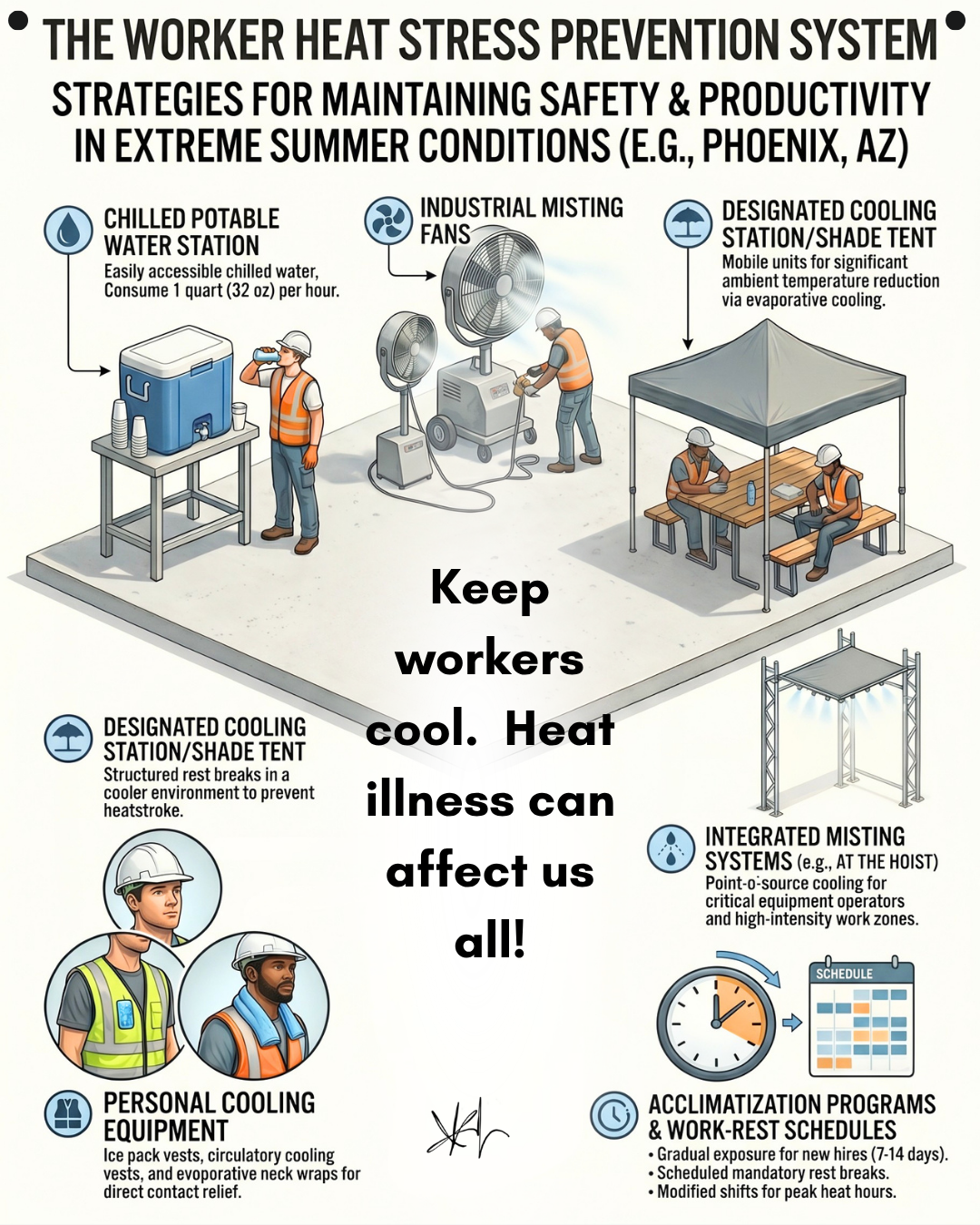
The Worker Heat Stress Prevention System is not complicated. It has six components that work together, and all six need to be in place before extreme heat arrives, not after the first incident.
The foundation is chilled potable water, positioned at the work face, with a target of one quart per hour per worker during high-heat conditions. Room-temperature water at a trailer two hundred feet away does not meet the same need. Chilled water at the point of work eliminates the friction that stops people from drinking enough. It is the single highest-leverage intervention on the list and it costs almost nothing relative to the risk it addresses.
The second component is shade infrastructure. A designated cooling station with shade tent and seating is not a luxury. It is the physical space where mandatory rest breaks happen, and mandatory means scheduled, not optional. Shade tents with evaporative cooling capability can drop the ambient temperature significantly compared to direct sun exposure. Positioning them close to the highest-intensity work zones is a design decision that has to be made intentionally, because the default is to put them where they are convenient to set up, which is often not where the work is.
Industrial misting fans and integrated misting systems at high-intensity zones and equipment operator positions extend the reach of cooling beyond the shade tent. Point-of-source cooling for crane operators, equipment operators, and workers in confined or high-radiant-heat areas addresses the places where passive shade does not reach. These systems work through evaporative cooling and their effectiveness scales with how close to the worker they are placed.
Personal cooling equipment, including ice pack vests, circulatory cooling vests, and evaporative neck wraps, puts the cooling system on the person rather than in the environment. For workers in direct sun doing high-exertion work, personal cooling equipment is the difference between a body that can regulate and a body that cannot. Ice vests in particular are well-documented in their effectiveness and their cost is low relative to the protection they provide.
Signals Your Heat System Has Gaps
Before you evaluate what you have, look for these patterns on your site:
- Workers are drinking less than one quart per hour during peak heat, either because they don’t know the target or because the water is not accessible enough to make it easy
- Rest breaks are treated as optional or get skipped when schedule pressure increases
- New hires within their first two weeks are working at the same pace and in the same conditions as experienced crew
- The shade tent is more than one hundred feet from the highest-exertion work zones
- Nobody has assigned a person to watch for heat illness symptoms during peak temperature hours
Any one of those gaps can be the gap that leads to an incident. All five together is a system that is waiting for a bad day.
Acclimatization Is Not Optional
The acclimatization component deserves its own attention because it is the one most often skipped under schedule pressure.
A new hire’s body is not physiologically prepared to work at full intensity in extreme heat. The cardiovascular and thermoregulatory adaptations that allow experienced workers to function in high-heat environments take seven to fourteen days of graduated exposure to develop. A worker who starts on day one at full pace in 110-degree heat is working in a body that has not yet built the systems to manage that condition. The risk of heat illness in the first week is dramatically higher than in subsequent weeks, and that risk applies regardless of the worker’s fitness level or experience in other climates.
A structured acclimatization program looks like this: reduced duration and intensity in the first three days, gradual increase through day seven, modified schedule accommodations through day fourteen, with mandatory rest breaks and supervisor observation throughout. It is not complicated and it does not require paperwork beyond a simple tracking sheet. What it requires is a decision that the schedule will accommodate the biology rather than the other way around. That decision is made by the people who write the schedule, not the people doing the work.
Why This Is About More Than Compliance
Here is the part that needs to be said directly.
Safety compliance sets a floor. It tells you the minimum required to avoid regulatory action. The projects that treat heat safety as a compliance exercise build systems designed to meet the floor, which means they are built to do the least required rather than the most effective. Those projects still have incidents, because the floor is not high enough to prevent them.
The projects that treat heat safety as a statement about how the organization values its people build something different. A chilled water station at the work face says your hydration matters to us. A shade tent with mandatory scheduled breaks says you are allowed to rest and we will protect that time. An ice vest on day one says we invested in you before the heatwave hit. A fourteen-day acclimatization plan says we are not going to throw you to the wolves because the schedule is tight.
Those signals are received. Crews that feel genuinely protected work harder, stay longer, and refer other skilled tradespeople to the project. Safety, done at the level of actual care rather than compliance, is one of the most effective recruiting and retention tools in this industry, and almost nobody talks about it that way. If your project needs superintendent coaching, project support, or leadership development, Elevate Construction can help your field teams stabilize, schedule, and flow, and that work includes building the operational systems that keep people safe when the conditions get serious. Jason Schroeder and the Elevate team know that a stable, productive crew is first a crew that goes home healthy every day.
Build It Before You Need It
Here is your challenge. Do not wait for the first heat advisory. Do not wait until someone is sitting in the shade looking pale. Build the system in spring, walk the site with the heat map in mind, and ask yourself honestly whether every component is positioned for the actual work, not for the convenience of setup.
Heat does not care about your deadline. It does not care that you are three weeks behind or that the owner is watching the schedule. What your people care about is whether you cared enough to build the system before they needed it. That is the question the ice vest and the shade tent and the water station answer before anyone has to ask it out loud.
Edwards Deming put it plainly: “A bad system will beat a good person every time.” In extreme heat, a bad system does not just slow people down. It kills them. Your people are good. Build them a system worthy of that.
On we go.
FAQ
How much water should workers drink during extreme heat conditions?
The target during high-heat work is approximately one quart, or 32 ounces, per hour. That rate needs to be supported by accessible, chilled water positioned at the work face rather than at a remote station. Workers will not consistently walk to a trailer to hydrate when they are under schedule pressure. Accessibility drives behavior, and behavior drives outcomes.
What is the difference between heat exhaustion and heat stroke?
Heat exhaustion involves heavy sweating, weakness, cold or pale skin, a weak pulse, nausea, and possible fainting. It is serious and requires immediate cooling and hydration. Heat stroke is a medical emergency involving a body temperature above 103 degrees Fahrenheit, hot and red skin, rapid and strong pulse, and possible unconsciousness. Heat stroke requires immediate emergency response. The difference matters because heat stroke is life-threatening within minutes if not treated, and the symptoms can escalate from exhaustion to stroke faster than most people expect.
Why does acclimatization take so long if someone is already physically fit?
Physical fitness improves general cardiovascular capacity but does not accelerate the specific thermoregulatory adaptations that come from heat exposure. Those adaptations, including increased plasma volume, earlier onset of sweating, and reduced cardiovascular strain in heat, develop only through graduated exposure over seven to fourteen days regardless of baseline fitness. A fit worker who is new to extreme heat conditions is still physiologically vulnerable in the first week.
If you want to learn more we have:
-Takt Virtual Training: (Click here)
-Check out our Youtube channel for more info: (Click here)
-Listen to the Elevate Construction podcast: (Click here)
-Check out our training programs and certifications: (Click here)
-The Takt Book: (Click here)
Discover Jason’s Expertise:
Meet Jason Schroeder, the driving force behind Elevate Construction IST. As the company’s owner and principal consultant, he’s dedicated to taking construction to new heights. With a wealth of industry experience, he’s crafted the Field Engineer Boot Camp and Superintendent Boot Camp – intensive training programs engineered to cultivate top-tier leaders capable of steering their teams towards success. Jason’s vision? To expand his training initiatives across the nation, empowering construction firms to soar to unprecedented levels of excellence.