
The Circle of Trust: A Visual Management System for Collective Accountability on Construction Projects
Most construction teams do not have a trust problem. They have a visibility problem.
That distinction matters more than it might first appear. When people assume the problem is trust, the solution they reach for is culture work, team building, better relationships, more communication. Those things have value, but they do not fix the underlying issue, which is that on most projects, performance problems stay hidden until they are too big to ignore, accountability is subjective and therefore contested, and only the GC is expected to hold anyone responsible for the outcome. The Circle of Trust is not a relationship program. It is a visual management system, and its job is to make performance impossible to ignore.
The Pain That Compounds in the Dark
Here is what happens on a project without a performance visibility system. A trade partner’s daily reports start coming in late. Nobody tracks it formally, so nobody addresses it formally. The foreman knows, the project engineer knows, but it feels too small to escalate and too awkward to raise in a meeting where the trade partner’s superintendent is sitting across the table. So it goes unaddressed.
Three weeks later, the same trade partner’s cleaning is being done by another crew because the reminders stopped working. That cost gets absorbed somewhere. The safety plan submittal is two weeks overdue but the project is busy and the conversation keeps getting deferred. And now a pattern that started as a small performance gap has compounded into a set of habits that the project has implicitly accepted by never formally naming.
This is not a dramatic story about a bad trade partner. It is the normal trajectory of unaddressed performance issues on any project without a system for making them visible. The problems are not hidden because anyone is hiding them deliberately. They are hidden because the project never built a mechanism for surfacing them consistently, non-subjectively, and early enough to address them before they compound.
The Failure Pattern
The failure pattern is accountability that lives only at the top of the hierarchy and arrives only after a problem is already serious.
The general contractor holds everyone accountable in theory. In practice, accountability conversations happen when the issue has become undeniable, which means they happen late, they happen when the relationship is already stressed, and they happen with the emotional weight of accumulated frustration rather than the clarity of a specific observable performance gap. The trade partner feels blindsided. The GC feels like they have been tolerating something they should have addressed weeks ago. Both are right, and the system is why.
When accountability is subjective, it is also contestable. “Your performance has been poor” is an opinion and invites a counterargument. “Your daily reports have been submitted on time twice in the last fourteen days” is a fact and invites a problem-solving conversation. The difference between those two conversations is entirely about whether the project has been tracking non-subjective performance criteria consistently. Most projects have not been, which means most accountability conversations are opinion fights dressed up as performance reviews.
They Didn’t Fail the System
When a trade partner is performing below standard, the instinct in this industry is to assess the trade partner. They do not have the right people on this job. Their management is not engaged. They are not that kind of company.
That assessment is sometimes accurate and almost always premature. Before concluding that the trade partner is the problem, it is worth asking what the project gave them to succeed. Did they have a clear, non-subjective picture of what good performance looks like on this project? Did they receive weekly feedback on how they were tracking against that picture? Did they have a forum for raising the constraints that were affecting their performance? Did they know that the GC was going to be graded by the same system they were?
A trade partner operating without those things is operating without a performance system. The behaviors that follow, reactive scheduling, waiting for GC coordination instead of self-performing, defaulting to complaints rather than solutions, are rational adaptations to an environment that never gave them a clear standard or a feedback loop. The Circle of Trust changes the environment. Change the environment and the behavior follows.
What the Circle of Trust Actually Is
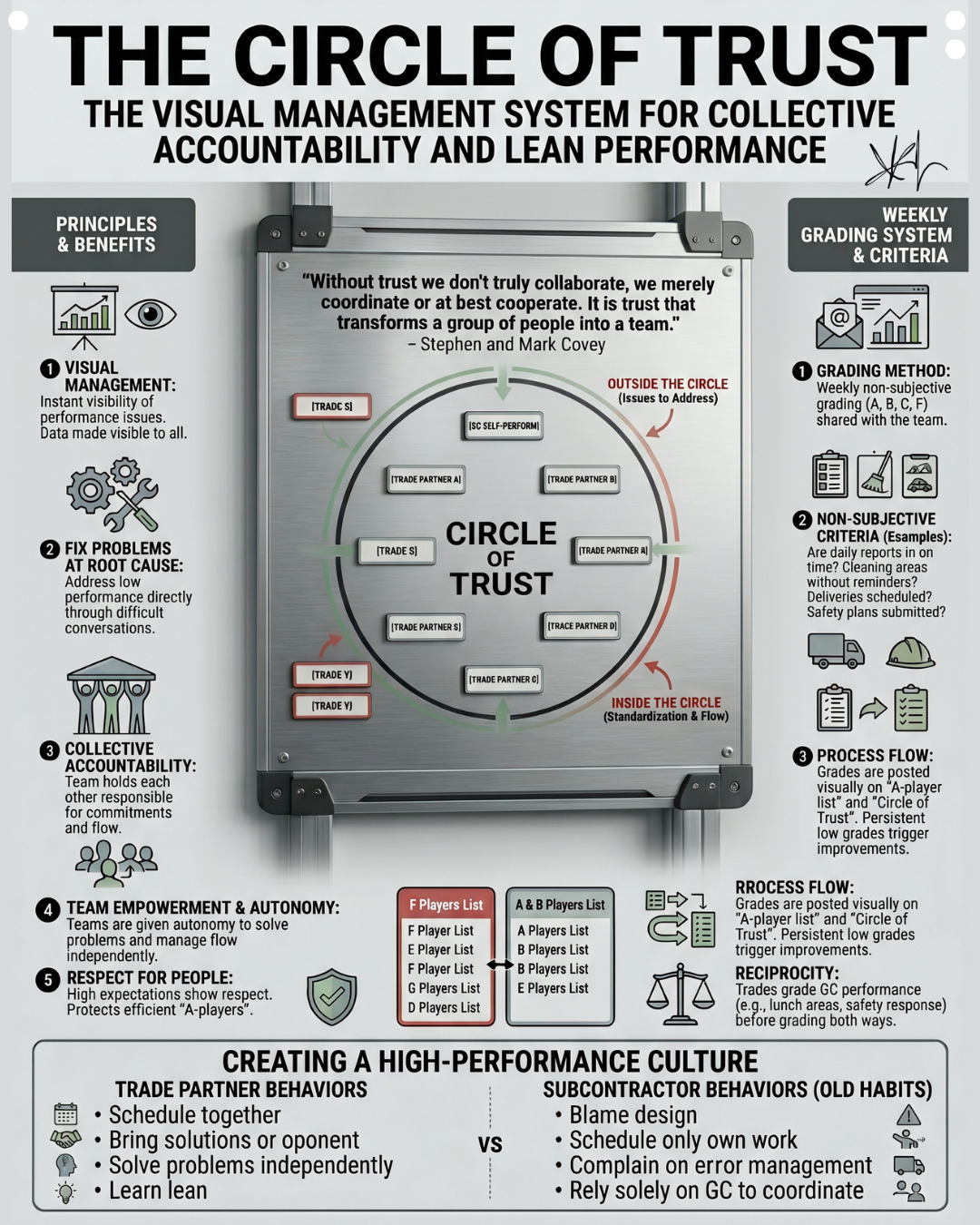
The Circle of Trust is a visual management system built around three core mechanisms: non-subjective grading criteria, public visibility, and reciprocity.
The grading criteria are the foundation. Every trade partner receives a weekly grade, A, B, C, or F, based on observable, non-subjective performance indicators. Are daily reports submitted on time? Are work areas cleaned without prompting? Are deliveries scheduled in advance? Is the safety plan submitted and current? These are not attitude assessments or relationship grades. They are measurable behaviors that either happened or did not happen in the past seven days. That objectivity is what makes the system credible and what separates it from the personality-driven accountability conversations that most projects rely on.
The visual posting of those grades is what gives the system its operational power. Grades appear on an A-player list and on the Circle itself, which is physically present in the project’s visual management space. Inside the circle means the trade partner is operating in standardization and flow. Outside the circle means there are issues to address. That visual language is shared with the whole team, which means performance is not a private conversation between the GC and an individual trade partner. It is a collective reality that everyone can see and that the team holds together.
Reciprocity is what makes the system legitimate. Trade partners grade the GC on the same cadence. Lunch areas maintained, safety responses delivered, coordination commitments met. The GC is in the system, not above it. That single design decision transforms the dynamic from a compliance program the GC runs on the trades to a shared accountability system that everyone participates in equally.
What Shifts When You Run It This Way
The behavioral changes that follow a well-implemented Circle of Trust are not subtle.
Trade partners stop waiting for the GC to schedule their work and start scheduling together. That shift happens because the grading criteria make self-performance visible and rewarded, and waiting for GC coordination becomes a performance liability rather than a safe default. When your grade reflects whether your deliveries are scheduled, you schedule your deliveries. The behavior the project needs becomes the behavior that protects the grade.
Complaints give way to solutions because the system creates a forum for root cause conversations rather than blame conversations. When a trade partner is outside the circle, the conversation is: what is causing this, and what needs to change? That is a different conversation than “your performance has been unacceptable,” and it produces different results. Trade partners who feel heard in a structured root cause process bring problems to the surface earlier because they have learned that surfacing a problem leads to problem-solving rather than punishment.
The GC’s coordination burden drops when trade partners are operating as active participants in the project’s performance system rather than as subcontractors waiting to be told what to do. That is the high-performance culture the system is designed to produce, and it shows up in schedule performance, quality, and safety outcomes before it shows up in any formal metric.
Signals Your Project Needs This System
Walk your project and look for these patterns before you decide whether to build a Circle of Trust:
- Performance conversations are being deferred because they feel subjective or relationship-threatening
- The same trade partner issues are appearing week after week without a formal root cause conversation
- Trade partners are not self-performing their coordination, creating zone conflicts that the GC has to resolve
- Accountability conversations happen reactively after problems are already affecting the schedule
- The GC team is doing work that trade partners should be doing themselves because it is easier than the accountability conversation
Any one of those patterns is evidence that the project’s performance system has a visibility gap. The Circle of Trust closes that gap by making performance visible before it compounds.
Building It Into the Takt Rhythm
The Circle of Trust works best when it is integrated into the project’s weekly Takt rhythm rather than running as a separate management track.
Grades are posted on the same cadence as the look-ahead update. The visual board lives in the same space as the Takt plan and the constraint log. The root cause conversation for a trade partner outside the circle happens in the same weekly coordination meeting where Takt commitments are made and tracked. That integration means accountability is not a separate event that happens when things go wrong. It is a feature of the project’s normal operating rhythm, which means it runs consistently regardless of how busy the week has been.
The A-player list serves a dual function in this integration. It recognizes trade partners who are performing at standard, which is the positive side of the visibility equation. High performance should be as visible as low performance, because visible recognition is what sustains the behaviors the project needs over the long run. A trade partner whose on-time reporting and clean areas show up on the A-player list every week is a trade partner who has learned that the standard is noticed and valued, not just expected and ignored.
The Mission Underneath the Metrics
High expectations are a form of respect. That is the principle the Circle of Trust is built on, and it is worth staying with for a moment.
A project that holds no one accountable is not a kind project. It is a project that has decided the standard does not matter enough to protect. The trade partner who is performing well is working alongside someone who is not, with no acknowledgment that the difference exists. Over time, the high performer adapts downward because the environment communicates that the standard is whatever anyone happens to do. The system failed both of them before anyone noticed.
A project that holds everyone accountable through a clear, non-subjective, reciprocal system is a project that has decided every person’s contribution matters enough to measure. That is respect expressed through design rather than sentiment, and it is the foundation on which genuine collaboration is built. If your project needs superintendent coaching, project support, or leadership development, Elevate Construction can help your field teams stabilize, schedule, and flow. Jason Schroeder and the LeanTakt team implement the Circle of Trust as part of a broader visual management system that transforms how trade partners engage with schedule, quality, and collective accountability.
Install the System Before You Need It
Here is your challenge. Before your next trade partner coordination meeting, define three non-subjective performance criteria that every partner on your project should be meeting. Write them down. Share them. Tell the team that you will be tracking them weekly and posting the results visually. Then do it.
Taiichi Ohno put it plainly: “Without standards, there can be no improvement.” The Circle of Trust is the standard made visible. Post it, protect it, and hold it equally for everyone in the room, including yourself.
On we go.
FAQ
How do you prevent the grading system from feeling punitive or damaging to relationships?
By making the criteria non-subjective and the process reciprocal from the start. When every party knows in advance what the criteria are, when grades are based on observable behaviors rather than opinions, and when the GC is graded by the same system, the grades are not personal. They are data. Root cause conversations that follow a low grade are problem-solving sessions, not indictments, and trade partners who experience that distinction quickly stop finding the system threatening.
What happens when a trade partner gets an F and disputes the grade?
The non-subjective criteria are what make this manageable. If the criterion is whether daily reports were submitted on time and the record shows they were not, the dispute has nowhere to go. If the trade partner has a legitimate reason, a material delivery failure, a coordination gap on the GC side, that is exactly the kind of constraint the root cause conversation should surface. A disputed grade is an invitation to understand what actually happened, not a confrontation to win.
How do you handle a trade partner who is chronically outside the circle?
The system is designed to surface that pattern early enough to address it before it becomes a project crisis. Persistent low grades trigger escalating root cause conversations, starting at the foreman level and moving to senior leadership as needed. If the root cause is a capability or resource gap that cannot be closed, that information is better surfaced in week three than in week twelve. The Circle of Trust does not solve every performance problem, but it makes them impossible to ignore until they become crises.
If you want to learn more we have:
-Takt Virtual Training: (Click here)
-Check out our Youtube channel for more info: (Click here)
-Listen to the Elevate Construction podcast: (Click here)
-Check out our training programs and certifications: (Click here)
-The Takt Book: (Click here)
Discover Jason’s Expertise:
Meet Jason Schroeder, the driving force behind Elevate Construction IST. As the company’s owner and principal consultant, he’s dedicated to taking construction to new heights. With a wealth of industry experience, he’s crafted the Field Engineer Boot Camp and Superintendent Boot Camp – intensive training programs engineered to cultivate top-tier leaders capable of steering their teams towards success. Jason’s vision? To expand his training initiatives across the nation, empowering construction firms to soar to unprecedented levels of excellence.