
Contractor Grading: How Thirteen Non-Subjective Metrics Changed Every Project We Run
A CEO once drove two hours from Phoenix to Tucson to nearly punch me in the face.
Her company got a D on our weekly trade partner grading sheet. She walked into my trailer hot. “Jason, what do I have to do to get my score up?” The answer was simple. Clean your area. Show up to meetings on time. Submit your safety paperwork. She stared at me for a long moment. “Why isn’t my foreman doing that?” I told her I didn’t know. Go ask him. She walked out, had the conversation, and her crew’s performance changed overnight.
That is the power of contractor grading. Not the conversation I had with the CEO. The conversation the CEO had with her foreman. The grading system did not fix the performance problem. It made the performance problem visible to the person with the authority to fix it. That is all a good system has to do.
The Pain That Nobody Wants to Say Out Loud
Here is what most project teams live with and never name. Everyone on the project knows which trade partners are performing and which ones are not. The superintendent knows. The project engineer knows. The other trades know. The information is distributed across dozens of people who each have a partial picture, and none of them have a mechanism for making that picture visible, shared, and actionable.
So the problems persist. The trade that doesn’t clean their area gets reminded, then reminded again, then the reminders stop because the person doing the reminding got tired of the conversation and the trade learned that the consequence for ignoring the reminder is another reminder. The foreman who misses the morning huddle gets a comment, maybe a follow-up comment, and eventually the absence becomes the new standard because nobody has a system for tracking it. The safety audit that doesn’t get completed gets absorbed into the background noise of a busy project.
None of this is invisible. Everyone can see it. What’s missing is not awareness. What’s missing is a mechanism that takes the awareness and makes it formal, documented, shared with everyone who needs to see it, and connected to a grade that means something. Without that mechanism, accountability is a conversation. With it, accountability is a scoreboard.
The Failure Pattern
The failure pattern is accountability that depends on the energy and willingness of one person to have uncomfortable conversations repeatedly.
On most projects, the superintendent is the accountability system. When a trade is underperforming, the superintendent addresses it. When the trade improves temporarily and then slides back, the superintendent addresses it again. When the improvement doesn’t hold, the superintendent either escalates, which takes time and political capital, or absorbs the gap, which costs schedule and quality. Either way, the burden of accountability sits on one person, and that person has a hundred other things competing for their attention.
That model is exhausting and it does not scale. A superintendent can hold three or four accountability conversations in a week before the emotional and political cost starts to interfere with the relationships they need to run the project. A grading system holds thirteen accountability conversations simultaneously, every single week, with every trade partner on the project, and it does it without requiring the superintendent to be the one delivering the message. The scoreboard delivers the message. The superintendent gets to spend their energy on solving problems instead of identifying them.
They Didn’t Fail the System
When a trade partner is underperforming, the instinct in this industry is to diagnose the trade. They don’t have the right people. Their management is disengaged. They are not an A-player company.
Sometimes that is accurate. More often, the trade partner is operating in a system that never gave them clear, measurable expectations, never gave them weekly feedback on how they were tracking, and never made their performance visible to the people upstream who have the authority and the motivation to fix it.
That CEO who drove two hours from Phoenix did not know her foreman was missing huddles and skipping safety paperwork. She didn’t know because nobody had told her in a format that demanded her attention. The weekly report didn’t surface it. The project meeting didn’t name it. The foreman certainly didn’t self-report it. It took a letter grade on a scorecard sent to every stakeholder on the project to make the problem undeniable. And once it was undeniable, it got fixed in a day.
The foreman didn’t fail the project. The CEO didn’t fail the project. The system failed the project by keeping performance invisible until someone built a mechanism to make it visible.
What the Grading System Actually Measures
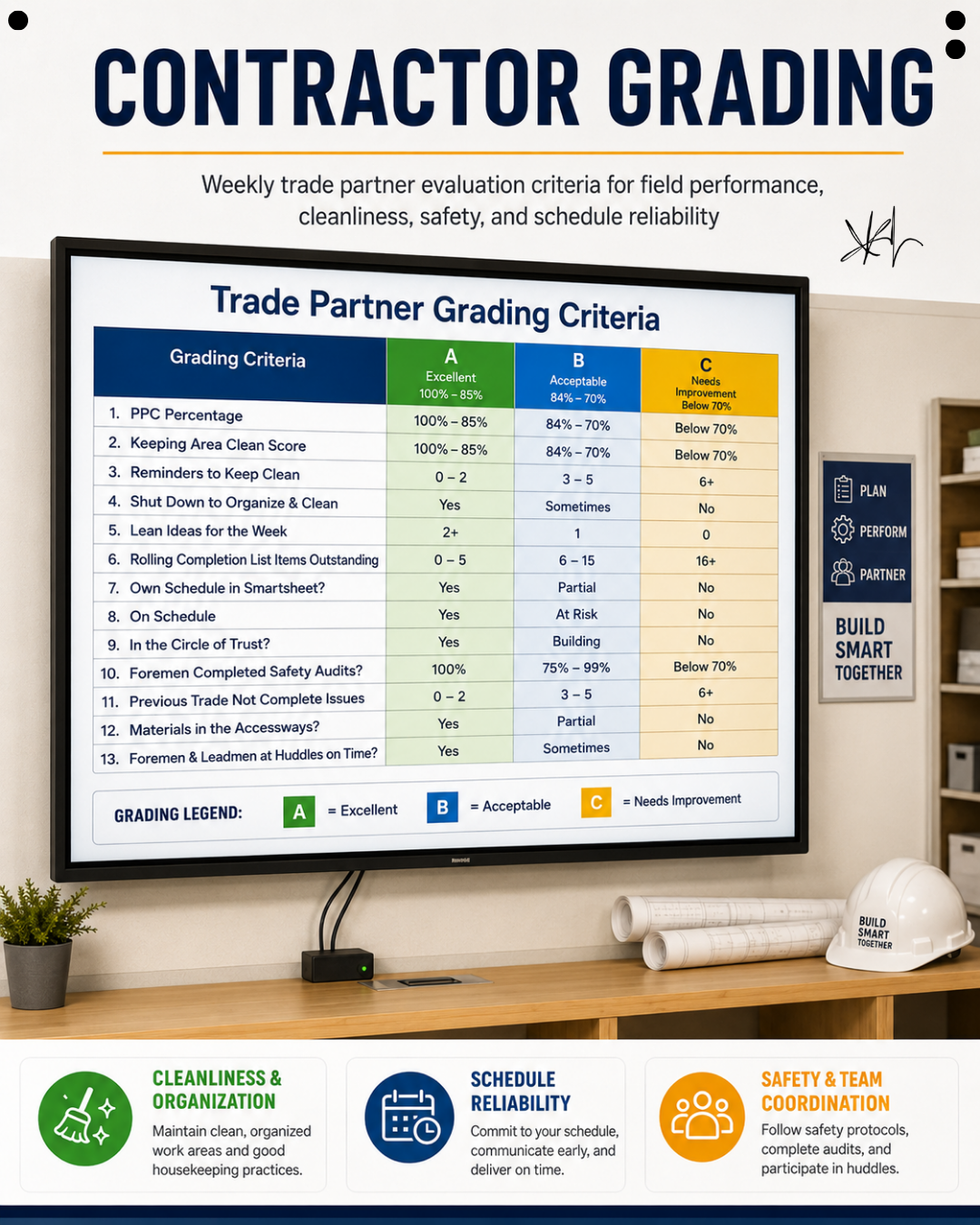
The contractor grading system runs on thirteen non-subjective metrics evaluated weekly. No opinions. No relationship grades. No “does the superintendent like this trade.” Just data that either happened or did not happen in the past seven days.
PPC percentage measures whether the trade is completing their committed work. Keeping area clean score and reminders to keep clean track housekeeping performance and the level of supervision required to maintain it. Shut down to organize and clean measures whether the trade stops to maintain their space or leaves it for someone else. Lean ideas submitted tracks whether the trade is contributing to continuous improvement or just executing. Rolling completion list items outstanding measures how quickly the trade closes out deficiency items. Ownership of their Smartsheet schedule measures whether the trade is managing their own work plan or waiting to be managed. On-schedule status is a binary read of where the trade stands against the Takt rhythm. Circle of Trust status tracks whether the trade is operating inside the project’s collective accountability system. Foremen completed safety audits measures whether frontline leaders are running safety as a practice or treating it as paperwork. Previous trade not-complete issues tracks whether the trade is leaving problems for the next crew in the zone. Materials in the accessways measures whether the trade is respecting shared circulation space. And foremen and leadmen at huddles on time measures whether frontline leadership is showing up for the coordination that makes the schedule work.
Each metric has a clear threshold. A is 85 to 100 percent. B is 70 to 84 percent. C is below 70 percent. There is no ambiguity, no interpretation, and no room for the grade to feel personal, because it isn’t personal. It is a measurement.
What Happens When You Turn the Scoreboard On
The first time I rolled this out on a hundred-million-dollar research lab, half the trades were grading at D and F levels. That is not unusual. It is what you find on any project that has been running without a performance visibility system. The performance was always at that level. The grading didn’t create the problem. It revealed it.
Six weeks later, the picture was different. Most trades had moved to A and B grades. The lowest performer had climbed to a C-plus. The site got cleaner, safer, and more predictable, not because the trades were different people, but because the environment had changed around them. The scoreboard created a feedback loop that the project had never had before: perform, get graded, see the grade, understand the gap, close the gap, get graded again.
That feedback loop is self-sustaining in a way that superintendent-driven accountability is not. The superintendent does not need to have the same conversation every week because the scoreboard already had it. The energy that used to go into identifying and communicating performance gaps now goes into solving the root causes behind them.
Why “That’s Disrespectful” Is the Wrong Objection
I know what some people think when they see this system. They think it’s disrespectful. They think grading a trade partner like a student is demeaning and that construction should run on relationships, not report cards.
Here is the gut check. Would a professional sports team refuse to put the score on the scoreboard because it might hurt feelings? Would an elite military unit tell their instructor not to coach them when they are failing? Would you trust a hospital that refused to track surgical outcomes because the surgeons found it uncomfortable?
No. And the reason is that in those environments, the stakes are high enough that everyone accepts transparency as a condition of participation. Construction stakes are equally high. The schedule is someone’s livelihood. Safety is someone’s life. Quality is someone’s building for the next fifty years. The idea that we should protect people from seeing their own performance data, in an industry where the consequences of poor performance land on other people’s families, is not respect. It is avoidance.
You do not build a team by sympathy-voting bad behavior. You build a team by holding each other accountable, out loud, in the open, with real numbers. That is respect expressed through transparency rather than through silence.
Signals Your Project Needs Contractor Grading
Look for these patterns on your project before you decide whether the system is worth building:
- The same performance issues are appearing with the same trades week after week without measurable improvement
- Accountability conversations are happening verbally and the improvements they produce are temporary
- The superintendent is spending significant energy being the project’s accountability system rather than its problem-solving system
- Trade partner leadership upstream does not have visibility into how their field teams are performing on your project
- The project team can name the low performers but cannot produce data to support the assessment
Any one of those patterns is evidence that the project has a visibility gap, not a people gap. Contractor grading closes the visibility gap.
How the Grades Change the Culture
The grades go out every Monday to everyone. Owners, designers, every trade CEO, every project manager, every foreman. That distribution is not punitive. It is the mechanism that makes the system work.
When a trade CEO sees a C grade on Monday morning, the conversation that follows is between that CEO and their field team. That conversation is more powerful than any conversation the superintendent could have, because it comes from the person who signs the foreman’s paycheck rather than the person who manages the schedule. The system routes the accountability to the person with the most leverage to create change, and it does it automatically, every week, without the superintendent spending a single minute on the communication.
Over six weeks, the culture shifts. Trades stop waiting to be told what the standard is because the scorecard defines it clearly. Trades stop resisting accountability because the accountability is non-subjective and applies equally to everyone, including the GC. Trades start self-correcting before the grade comes out because they know the measurement is happening and they know the results will be visible. The scoreboard does the coaching, and the superintendent gets their time back.
This is Lean at its most practical. Visual management, non-subjective measurement, collective accountability, and continuous improvement driven by a feedback loop that runs without requiring constant leadership energy. If your project needs superintendent coaching, project support, or leadership development, Elevate Construction can help your field teams stabilize, schedule, and flow. Jason Schroeder and the LeanTakt team implement contractor grading as part of a broader visual management and Takt planning system that transforms how trade partners engage with schedule, quality, safety, and collective accountability on every project.
Run It for Six Weeks
Here is your challenge. Define your thirteen metrics. Build the scorecard. Send the first round of grades on Monday. Tell every trade partner, every CEO, every PM, and every foreman that the grades are coming weekly and that the criteria are non-subjective. Then run it for six weeks without backing down.
You will stop being the nag. The scoreboard will do the coaching for you. The trades that are already performing well will appreciate the recognition. The trades that are underperforming will either improve or make their limitations undeniable, and both of those outcomes are better than the invisible status quo.
Taiichi Ohno said: “Without standards, there can be no improvement.” Thirteen metrics. Three grade levels. Every Monday. That is the standard. Now watch what happens.
On we go.
FAQ
Won’t grading trade partners damage relationships?
Non-subjective grading strengthens relationships by removing the subjectivity that makes accountability feel personal. When the grade is based on data that both parties can verify, the conversation shifts from “you think we’re doing a bad job” to “the data shows our PPC at 65 percent, what’s causing that.” That second conversation is productive and relationship-building in a way the first one never is.
How do you handle a trade partner who pushes back on the grading system?
The system handles it. When a trade pushes back on a specific grade, the criteria are verifiable. Were daily reports on time or not? Was the area clean or not? Were foremen at the huddle or not? The non-subjective nature of the metrics eliminates the space for argument about whether the grade is fair. The conversation moves directly to root causes and solutions, which is where it should be.
What if the GC’s own performance is poor on the reciprocal grading?
That is the point of reciprocity. If the GC grades poorly on coordination commitments, lunch area maintenance, or safety responsiveness, that grade is visible to the same audience. The system’s credibility depends on the GC being inside it rather than above it. A GC that receives a low grade and addresses it transparently earns more trust than a GC that only holds others accountable.
If you want to learn more we have:
-Takt Virtual Training: (Click here)
-Check out our Youtube channel for more info: (Click here)
-Listen to the Elevate Construction podcast: (Click here)
-Check out our training programs and certifications: (Click here)
-The Takt Book: (Click here)
Discover Jason’s Expertise:
Meet Jason Schroeder, the driving force behind Elevate Construction IST. As the company’s owner and principal consultant, he’s dedicated to taking construction to new heights. With a wealth of industry experience, he’s crafted the Field Engineer Boot Camp and Superintendent Boot Camp – intensive training programs engineered to cultivate top-tier leaders capable of steering their teams towards success. Jason’s vision? To expand his training initiatives across the nation, empowering construction firms to soar to unprecedented levels of excellence.