
Paul Akers’ Lean Standup Desk: A Quiet Masterclass in Removing the Friction You Stopped Noticing
Most desks are built to keep you in one place. This one is built to move.
Here is the deal. Paul Akers built a mobile standup desk out of black pipe fittings, casters, and a few carefully chosen accessories, and the desk itself is not really the point. The point is what the desk demonstrates. Every design decision on it exists to remove a specific, small friction that most people have simply learned to live with. Wasted motion. Scattered tools. The wrong working height. A missing plug when you need one. None of those problems are dramatic. All of them quietly drain a day, and almost nobody bothers to fix them because each one feels too minor to justify the effort.
The Pain That Feels Too Small to Fix
Think about a typical workday at a standard fixed desk. You need a tool, and it is in a drawer three feet away, so you reach, shift your chair, retrieve it, and settle back in. You need to plug in a laptop, and the outlet is behind the desk, so you crouch, feel around, and eventually find it. You need to move your work to a different part of the room for a conversation or a different task, and the desk stays exactly where it is, because it was never built to go anywhere. Each of these moments costs seconds, not minutes. None of them feels worth solving.
That is exactly why they persist. A friction that costs thirty seconds does not trigger the kind of attention that a friction costing thirty minutes would. But the thirty second friction repeats dozens of times a day, every day, for as long as the workspace stays the same. Multiply a small cost by a high frequency and the total is significant, even though no single instance ever feels significant enough to address.
Most people do not calculate that math. They just adapt. They learn where the outlet is. They develop a habit of reaching for the drawer without thinking about it. The friction becomes invisible not because it stopped costing anything, but because the person absorbing it got good enough at absorbing it that it no longer registers as a problem.
The Failure Pattern
The failure pattern is treating small, personal frictions as unworthy of design attention, while reserving design thinking for larger, more visible systems.
This happens at every scale. A company will invest heavily in software, workflow systems, and process documentation, while an individual’s actual physical workspace, the desk, the tool layout, the power access, gets almost no design attention at all. The assumption is that big systems deserve engineering and small personal spaces do not, as though the friction in a two-foot radius around a person does not add up the same way friction in a larger system does.
Paul Akers’ desk rejects that assumption entirely. It applies the same rigor to a personal workstation that a Lean practitioner would apply to a production line. Every component exists because it removes a specific friction that was identified through actual observation of how the desk gets used, not through guessing at what might be convenient.
They Didn’t Fail the System
When someone’s workspace is inefficient, cluttered, or awkward, the instinct is to think they should be more organized or more deliberate about their setup. That instinct misplaces the responsibility.
Most people were never taught to look at their own workspace the way a Lean practitioner looks at a production line. Nobody walked them through the exercise of counting how many times they reach for something, how far they walk to plug something in, or how often they change the height or position of their work throughout the day. Without that observation, the workspace simply accumulates whatever configuration happened to exist when it was first set up, and it stays that way indefinitely because nobody applied the same design thinking to it that they would apply to any other system they were responsible for improving.
The friction in a personal workspace is not a personal failing. It is a design gap, exactly the same kind of design gap that shows up in an unmanaged connex box or an unlabeled storage bin. The difference is scale, not category.
What the Desk Actually Solves
Every component on this desk maps directly to a friction that most people never bother to name.
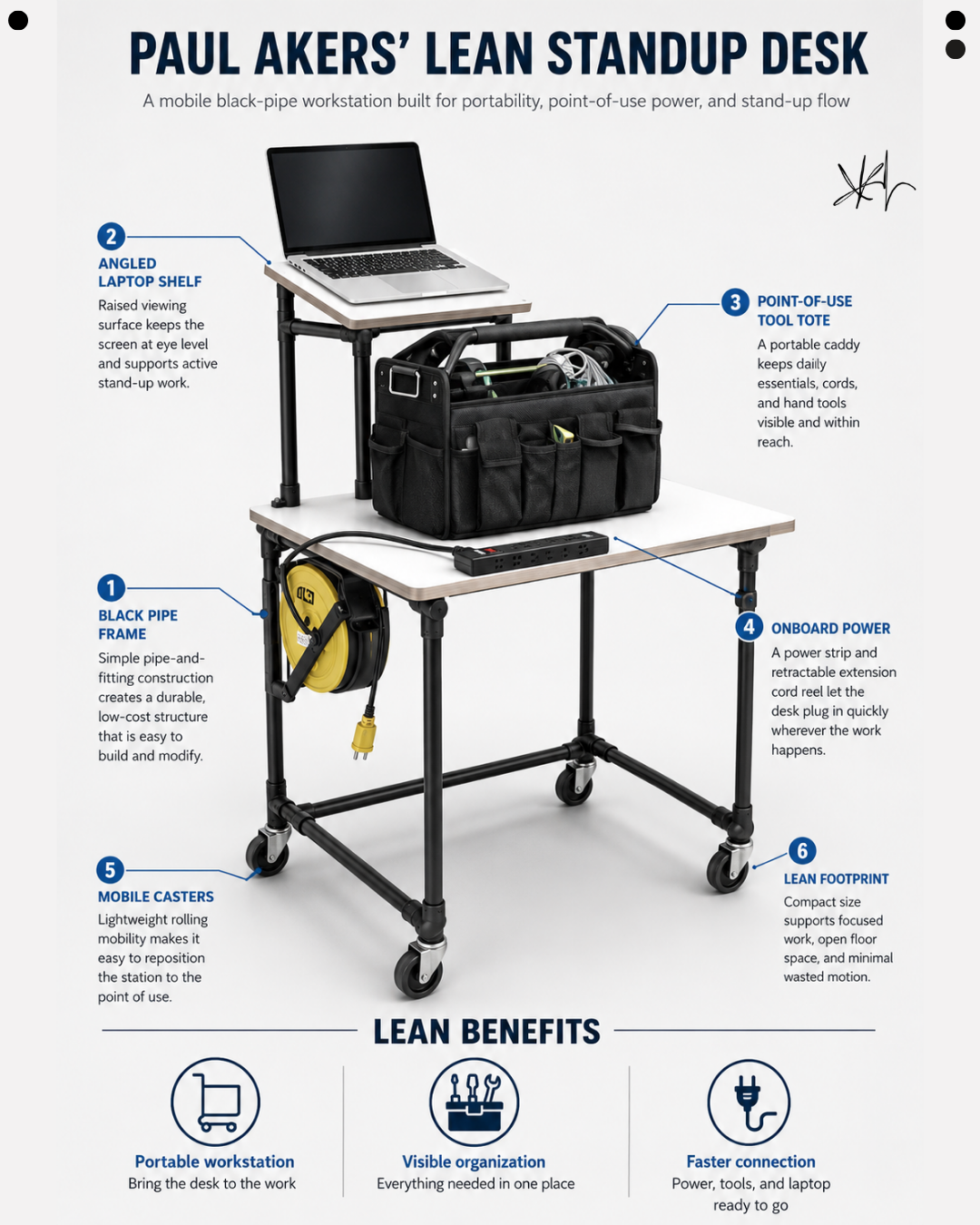
The black pipe and fitting frame solves the cost and rigidity problem of conventional furniture. Pipe and fitting construction is cheap, durable, and easy to modify. If the working height needs to change, or a new accessory needs to be added, the frame accommodates it without requiring a whole new piece of furniture. That adaptability matters because a fixed-purpose desk locks you into whatever configuration it was built for, and needs change faster than furniture typically does.
The angled laptop shelf solves the eye-level problem. A laptop sitting flat on a standard desk surface forces the user into a downward head position for hours at a time, a posture that compounds into fatigue and discomfort over a full day. Raising and angling the screen keeps it at eye level and supports active, engaged standup work rather than the slumped posture that a flat surface encourages.
The point-of-use tool tote solves the scattered tools problem. Instead of tools distributed across drawers, shelves, and surfaces where retrieval requires searching, everything lives in one portable caddy that stays visible and within reach. This is the same principle behind the Lean Connex Box applied at individual scale: everything needed has a home, and that home is close enough that retrieval does not interrupt the flow of work.
Onboard power solves the missing plug problem. A power strip and retractable cord reel mean the desk can plug in wherever the work happens, without requiring a search for the nearest outlet or a long extension cord snaking across the floor. This single addition removes one of the most common small frictions in any workspace: the moment of realizing your equipment cannot function where you currently are because power is not available there.
Mobile casters solve the fixed location problem. A desk on wheels goes to wherever the work needs to happen, rather than requiring the work to come to the desk. That flexibility means the workstation adapts to the task instead of forcing the task to adapt to the workstation’s location.
And the lean footprint solves the wasted space problem. A compact size supports focused work without occupying more floor space than the task requires, keeping the surrounding area open and minimizing unnecessary movement around the workstation itself.
The Mindset Behind the Desk
The real lesson is not the desk. It is the discipline of looking at a small, personal space with the same seriousness that Lean thinking applies to a factory floor or a jobsite.
Lean is often associated with large, visible systems: production lines, material flow, project schedules. But the discipline underneath Lean is not about scale. It is about seeing waste wherever it exists and refusing to accept it just because it is small or personal. Wasted motion is wasted motion whether it happens on an assembly line or in the two feet of space around your own workstation. Scattered tools cost time whether they are scattered across a jobsite connex box or across your own desk drawers. The principle transfers completely. Only the scale changes.
This connects directly to everything this factory has covered about staging materials, organizing connex boxes, and eliminating friction on jobsites. All of those practices are about applying design attention to spaces that were previously left to accumulate friction unnoticed. Paul Akers’ desk simply applies the identical discipline at the smallest possible scale: one person, one workstation, one day at a time.
Signals Your Own Workspace Has Unaddressed Friction
Look honestly at your own daily setup and watch for these patterns:
- You regularly search for a tool or item that should have an obvious, fixed location
- You have developed a habit of working around a missing plug, an awkward height, or an inconvenient layout rather than fixing it
- Your workspace stays in one location even when the task would be better served somewhere else
- You have accepted a posture or setup that causes discomfort because changing it feels like more effort than it is worth
- You could not describe, right now, why your workspace is arranged the way it is, other than that it has always been that way
Each of these is a small, fixable friction that most people carry for years simply because nobody applied design thinking to their own immediate space.
Why the Small Scale Matters Most
There is a reason this lesson deserves attention even though it is about a desk rather than a jobsite. If someone cannot apply Lean thinking to their own immediate workspace, the two feet of space they occupy every single day, it is unlikely they will apply it consistently to a much larger and more complex system like a construction project.
The discipline of noticing friction, naming it specifically, and designing a fix is a skill that develops through practice, and the smallest, most personal scale is the easiest place to practice it. A superintendent who has trained themselves to notice and fix friction in their own workspace carries that same noticing habit onto the jobsite, into the connex box, into the material staging plan, into the daily rhythm of the whole project. The habit is the same habit. It just gets applied at a bigger scale once it has been built at a small one.
Lean is not a program you install on a project. It is a way of seeing waste everywhere, including the small radius immediately around you, and refusing to accept that waste just because it is familiar or small. That way of seeing is what Elevate Construction helps field teams build, one habit at a time, starting wherever the friction is easiest to notice and fix. If your project needs superintendent coaching, project support, or leadership development, Elevate Construction can help your field teams stabilize, schedule, and flow, starting with the discipline of seeing waste at every scale, from the jobsite down to the desk.
Fix the Two Feet Around You
Here is your challenge. Look at your own workspace today, whatever it is, a desk, a truck cab, a laptop bag. Identify one small friction you have been quietly absorbing for months. A tool that is never where you need it. A cord you are always hunting for. A height that is never quite right. Fix that one thing this week.
Taiichi Ohno taught that waste hides in the places people have stopped looking, because familiarity makes it invisible. Your own workspace is one of those places. Go look at it the way Paul Akers looked at his desk, and fix what you find.
On we go.
FAQ
Why build a custom desk instead of buying a standard standup desk?
A custom build using pipe and fittings costs less than most commercial standup desks and can be modified freely as needs change, adding a new accessory, adjusting height, or reconfiguring the tool storage without needing to replace the entire piece of furniture. That adaptability is difficult to match with a fixed commercial product designed for a general use case rather than your specific daily friction points.
What is the value of casters on a workstation like this?
Casters let the workstation go to wherever the work needs to happen rather than requiring the work to come to a fixed location. This is the same logic behind portable material staging and mobile connex units: bringing the resource to the point of use eliminates the friction of relocating yourself or your materials to match a fixed setup.
How does this connect to Lean principles used on construction jobsites?
The desk applies the identical discipline used in the Lean Connex Box and material staging practices: give everything a fixed, visible location, eliminate wasted motion, and design the physical environment around actual use patterns rather than accepting whatever arrangement happened to exist by default. The scale is different. The underlying principle of eliminating friction through deliberate design is exactly the same.
Is a standup desk actually better than a seated desk for daily work?
The ergonomic case for alternating between sitting and standing throughout the day is well established for reducing the health costs of prolonged sitting. The desk in this design supports standup work at eye level specifically, which is one piece of the overall friction-elimination approach rather than the entire point. The larger lesson applies regardless of whether someone chooses a standup or seated configuration for their own workspace.
If you want to learn more we have:
-Takt Virtual Training: (Click here)
-Check out our Youtube channel for more info: (Click here)
-Listen to the Elevate Construction podcast: (Click here)
-Check out our training programs and certifications: (Click here)
-The Takt Book: (Click here)
Discover Jason’s Expertise:
Meet Jason Schroeder, the driving force behind Elevate Construction IST. As the company’s owner and principal consultant, he’s dedicated to taking construction to new heights. With a wealth of industry experience, he’s crafted the Field Engineer Boot Camp and Superintendent Boot Camp – intensive training programs engineered to cultivate top-tier leaders capable of steering their teams towards success. Jason’s vision? To expand his training initiatives across the nation, empowering construction firms to soar to unprecedented levels of excellence.