
Advanced Work Packaging Done Right: Give the Field the Right Work, Ready, at the Right Time
Advanced Work Packaging should not be complicated. At its best, it is simple. Give the field the right work, in the right sequence, with the right materials, at the right time, with the roadblocks removed before the crew arrives. That is the whole game.
Here is the deal. AWP has a reputation for being a megaproject bureaucracy, buried under acronyms, oversized packages, disconnected planners, and beautiful documentation that still does not help the foreman on Monday morning. That reputation is deserved on a lot of projects, not because the underlying idea is flawed, but because the system got built for the document instead of the crew. AWP was never meant to be paperwork. It was meant to create flow, and the difference between those two outcomes is entirely a matter of execution discipline.
The Pain of a Package That Isn’t Actually Ready
Here is what happens on a project running AWP badly. A crew shows up Monday morning with an Installation Work Package that looks complete on paper. The drawings are attached. The scope is defined. The package has gone through review. And then the crew discovers that half the material listed is not actually on site, or is on site but staged in the wrong location, or the permit required to start work has not been submitted, or a predecessor task that this package depends on is only ninety percent complete rather than fully done.
The package existed. It was documented. It went through the process. And it still failed the crew, because documentation and readiness are not the same thing. A package that lists what materials are needed is not the same as a package that confirms those materials are physically present, staged, and accessible. A package that names a predecessor task is not the same as a package that verifies the predecessor is genuinely complete. The gap between “documented” and “ready” is exactly where AWP breaks down on most projects, and it breaks down invisibly, because the paperwork looks fine right up until the crew is standing there with nothing to do.
The Failure Pattern
The failure pattern is treating package creation as the finish line instead of treating package readiness as the actual deliverable.
Most AWP implementations put enormous energy into the engineering and planning phases. Engineering Work Packages get built with drawings, models, specs, and quantities. Procurement Work Packages get built identifying what needs to be bought and delivered. Construction Work Packages get built dividing the field scope by area and discipline. All of that work is real, necessary, and often done well. Then the system hands off an Installation Work Package to the field and assumes the upstream planning guarantees downstream readiness.
It does not. A package can be planned correctly and still arrive at the crew incomplete, because planning and verification are different activities. Planning determines what should happen. Verification confirms that what should happen actually has happened, in the field, in physical reality, before the crew’s clock starts. Projects that skip the verification step and rely on the planning step alone are the projects where AWP becomes bureaucracy: extensive documentation that never quite translates into a crew starting work without interruption.
They Didn’t Fail the System
When a crew shows up to an incomplete package and loses the morning waiting on missing material or an unresolved predecessor, the instinct is to look at whoever assembled the package. Why didn’t they check? Why wasn’t this caught?
The honest answer is usually that nobody’s job was specifically to verify full kit readiness before the package was released to the field. Engineering did their part. Procurement did their part. Construction planning did their part. Each function completed its own piece and handed it forward, trusting that the next function would catch anything incomplete. Nobody owned the final checkpoint that confirms, physically and specifically, that every element of the package is actually present and ready before a crew is scheduled against it.
That is not a person failing to do their job. That is a system with no assigned owner for the step that matters most. Build that ownership into the process and the failure disappears. Leave it unassigned and the same gap will repeat on every package, regardless of how skilled or careful any individual planner happens to be.
The Path of Construction Drives Everything
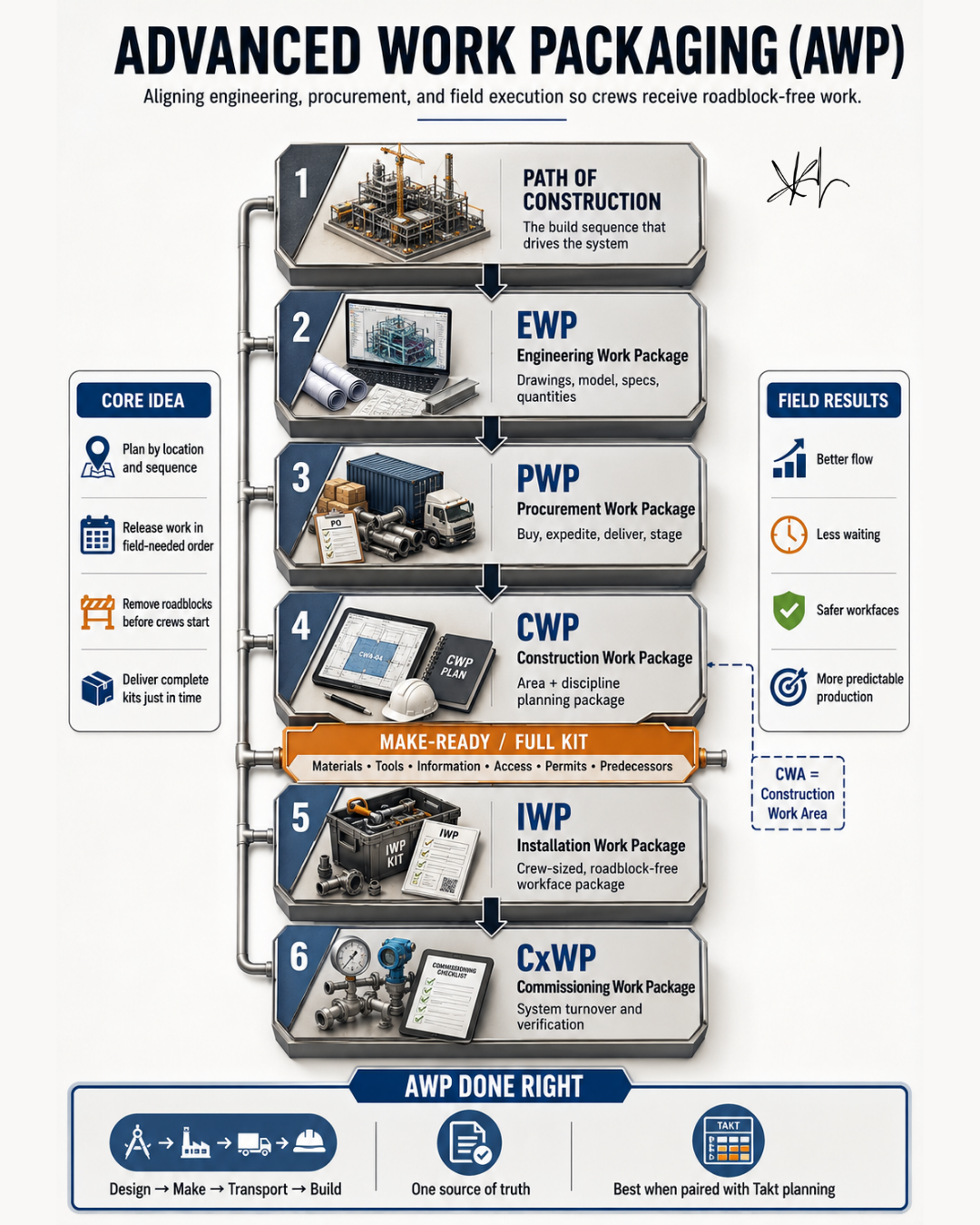
Advanced Work Packaging starts with the Path of Construction, the real sequence the work wants to be built in, driven by the physical and logical constraints of the actual build rather than by an arbitrary planning convenience. This is the foundation everything else aligns to. Get the Path of Construction wrong, and every downstream package inherits that error, no matter how well each individual package is documented.
From the Path of Construction, the system aligns through five package types, each answering a specific question. The Engineering Work Package answers what are we building, providing the drawings, model, specifications, and quantities that define the scope. The Procurement Work Package answers what needs to be bought, delivered, and staged, translating design intent into material that physically exists on site. The Construction Work Package answers how the field scope divides by area and discipline, organizing the larger sequence into planning units that make sense for coordination. The Installation Work Package answers what one crew needs to install, safely and completely, sized specifically to a crew’s actual capacity for a defined period of work. And the Commissioning Work Package answers whether the finished system actually works, closing the loop from design intent to verified, functioning system.
Each package type builds on the one before it, and the alignment between them is what makes the whole system coherent. A CWP that does not trace cleanly back to the Path of Construction creates confusion downstream. An IWP that does not trace cleanly back to its CWP creates the same problem at a smaller scale. The alignment is not bureaucratic overhead. It is what keeps every level of the system pointed at the same actual sequence of work.
Full Kit Is the Whole Point
Here is the requirement that separates AWP done right from AWP done as paperwork. The package is only valuable if it is ready. Not mostly ready. Not “we will figure it out in the field” ready. Not “the material is somewhere onsite” ready. Ready means full kit.
Materials physically present and staged at the point of use, not merely ordered or somewhere in a laydown yard. Tools available and positioned for the specific installation task. Information current and accurate, matching field conditions rather than an earlier revision. Access confirmed, meaning the crew can physically get to the work location without obstruction. Permits secured and in hand before the crew arrives, not in process. Predecessors genuinely complete, verified rather than assumed. Roadblocks removed, meaning every known obstacle between the crew and productive work has been cleared in advance.
Every one of those six elements has to be true simultaneously for a package to be genuinely ready. Five out of six is not full kit. It is a package with a gap, and that gap is exactly where the crew loses time, exactly the kind of loss this factory has covered before in staging materials and workface planning. The difference with AWP is scale: a staging gap on a single task costs a crew minutes. A full kit failure on an Installation Work Package can cost a crew an entire morning, because the package was supposed to be the crew’s complete instruction set for the day, and an incomplete instruction set means the crew has nothing productive to fall back on.
Why Pairing AWP With Takt Planning Completes the System
AWP defines what work is packaged and confirms that it is ready. Takt planning defines the rhythm and location that work moves through. Paired together, the system gains something neither one produces alone: work that is not just packaged, but packaged to the beat of production, by location, in the order the field actually needs it.
Without Takt, a well-built AWP system can still produce packages that are individually ready but poorly sequenced against the actual rhythm of the project, arriving too early, too late, or out of step with the crews working adjacent zones. Takt planning gives AWP its cadence, ensuring that full kit packages arrive exactly when the production rhythm calls for them, no earlier and no later. That pairing is what turns AWP from a documentation exercise into a genuine production system, because the packages are not just complete, they are timed.
Signals Your AWP System Has Become Paperwork
Look for these patterns on your current project:
- Installation Work Packages are released to the field with material listed as needed but not confirmed as staged and present
- Crews regularly discover incomplete predecessors or missing permits after their package has already started
- The path from Engineering Work Package through Installation Work Package involves multiple disconnected planners with no single owner verifying alignment
- Packages are sized larger than what a single crew can complete in the planned duration, creating ambiguity about what “done” means
- Nobody has a specific responsibility for confirming full kit readiness before a package is scheduled to the field
Each of these signals the same underlying gap: documentation exists, but verification does not, and that gap is exactly where AWP degrades into bureaucracy.
Building the Verification Step Into the System
The fix is not more documentation. It is assigning a specific ownership role for full kit verification, someone whose job is to walk through every element, materials, tools, information, access, permits, and predecessors, and confirm each one is physically true before the package is released. That verification should happen close enough to the scheduled work date that conditions have not changed since the check, but early enough that any gap found can still be closed before the crew is scheduled against the package.
This is the same discipline behind make-ready planning and workface planning that this factory has covered before, applied specifically at the packaging level. The principle does not change. The work should meet a clean, prepared, fully ready environment every time it begins, because a crew that starts with a complete package stays in flow, and a crew that starts with a gap spends the day recovering from a failure that upstream planning should have caught. If your project needs superintendent coaching, project support, or leadership development, Elevate Construction can help your field teams stabilize, schedule, and flow. Jason Schroeder and the LeanTakt team pair Advanced Work Packaging with Takt planning specifically because packaging without rhythm is paperwork, and rhythm without full kit readiness is a schedule that looks good on paper and fails in the field.
Build One Prepared Package Before You Build a Hundred
Here is your challenge. Take one upcoming Installation Work Package and walk it against all six full kit elements yourself, physically, before it goes to the field. Materials staged. Tools available. Information current. Access confirmed. Permits in hand. Predecessors truly complete. Fix whatever gap you find before the crew is scheduled against it.
Design, make, transport, build. One source of truth. One clear path. One prepared package at a time. That is what separates AWP as a practical field system from AWP as documentation nobody trusts. Start with one package done right, and let the discipline scale from there.
On we go.
FAQ
What is the single biggest reason AWP implementations fail on real projects?
The most common failure is treating package documentation as the deliverable instead of package readiness. A package can be planned, drawn, and specified correctly and still fail the crew if materials, permits, access, or predecessor completion were not physically verified before release. Documentation and readiness are different things, and most failed AWP systems only ever achieved the first one.
How is full kit different from a standard material list on a work package?
A material list identifies what is needed. Full kit confirms that materials are physically present, staged at the point of use, along with tools, current information, confirmed access, secured permits, and verified predecessor completion. Full kit is a verification standard, not a planning document, and it requires someone to physically check field conditions rather than trust that the plan was executed as written.
Who should be responsible for verifying full kit readiness before a package is released?
A specific, assigned owner, distinct from the engineering, procurement, and construction planning functions that build the package. This role’s job is to confirm, close to the scheduled work date, that every full kit element is genuinely true in the field. Without a single owner for this checkpoint, verification tends to fall through the gaps between functions that each assume someone else already checked.
If you want to learn more we have:
-Takt Virtual Training: (Click here)
-Check out our Youtube channel for more info: (Click here)
-Listen to the Elevate Construction podcast: (Click here)
-Check out our training programs and certifications: (Click here)
-The Takt Book: (Click here)
Discover Jason’s Expertise:
Meet Jason Schroeder, the driving force behind Elevate Construction IST. As the company’s owner and principal consultant, he’s dedicated to taking construction to new heights. With a wealth of industry experience, he’s crafted the Field Engineer Boot Camp and Superintendent Boot Camp – intensive training programs engineered to cultivate top-tier leaders capable of steering their teams towards success. Jason’s vision? To expand his training initiatives across the nation, empowering construction firms to soar to unprecedented levels of excellence.