
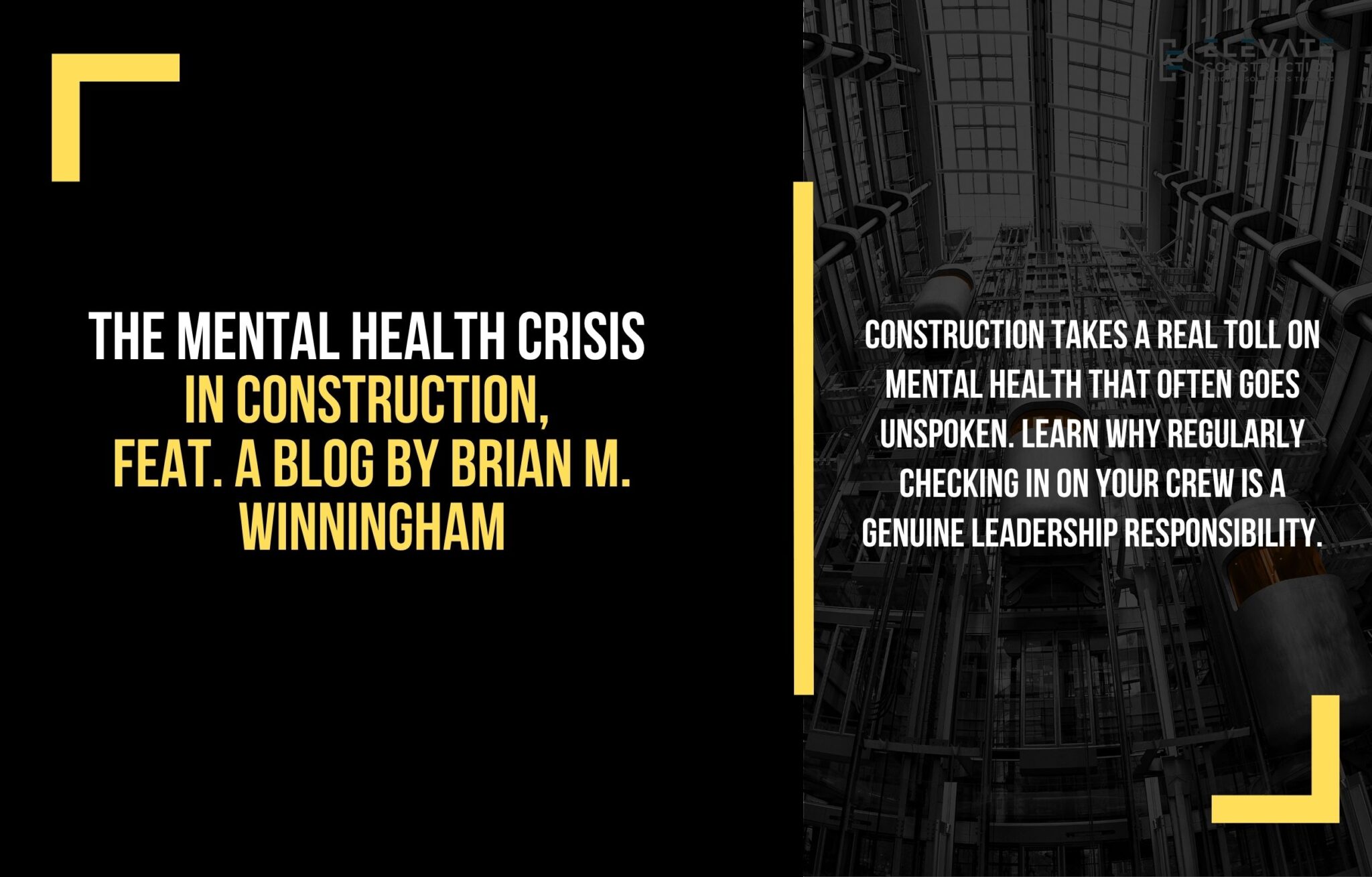
Why Checking In On Your Crew Matters More Than You Think
Mental health struggles touch nearly everyone at some point in their life, yet construction culture has rarely made space to talk about that openly or without judgment. That silence has a real cost, one that shows up in ways far beyond the jobsite itself, following people home and into every part of their life.
Where Struggle Gets Carried Alone Instead Of Shared
A worker or a leader is genuinely struggling, exhausted, hurting physically, disconnected from family for weeks or months at a time, and carries all of it quietly rather than saying anything out loud to anyone. Construction culture has historically treated that kind of openness as a weakness rather than something worth actually supporting and encouraging. The struggle does not disappear just because nobody talks about it out loud. It simply moves further out of sight, where it becomes far harder for anyone to actually help.
Treating Mental Health As Off Limits At Work
The failure pattern is treating mental health as an entirely private matter that has no place in a professional conversation, as if checking in on someone’s wellbeing were somehow separate from checking in on their safety or their work. A crew that never talks about how people are actually doing rarely notices when someone is struggling until real damage has already been done. Silence does not protect people. It just delays the moment help finally arrives.
The System Failed Them, They Didn’t Fail The System
The system failed them, they did not fail the system. Construction culture has long rewarded toughness and discouraged vulnerability, so people learn early to carry real struggle quietly instead of bringing it into the open where someone could actually help them through it. Without a deliberate effort to change that pattern across an entire crew, genuine suffering stays hidden behind a job that looks perfectly fine from the outside looking in.
Why This Industry Makes It Especially Hard
Several real, well documented factors make this particularly difficult in construction specifically, more so than in many other lines of work. The work is often physically demanding in ways that wear on a person’s body far earlier than it should, and constant physical pain is closely linked to declining mental health over time in study after study. Projects frequently require relocating away from family and familiar support systems for extended stretches, removing exactly the kind of connection that helps people cope with real difficulty when it actually shows up. And a culture that has long prized toughness over openness makes it genuinely hard for anyone, worker or leader, to say out loud that they are not doing well right now.
Why This Distinction Matters
This matters because a leader who actively checks in on a crew’s wellbeing changes what people believe is actually acceptable to say out loud on a jobsite. Asking a genuine question and actually listening to the answer signals that struggle is not something to hide, and that reaching out for real support is a sign of strength rather than weakness in front of a crew. That shift, small as it seems in the moment, is often what allows someone to actually get help before a private struggle becomes something far more serious down the road.
Building A Culture Where People Actually Check In
Normalizing these conversations does not require becoming a mental health professional overnight or having all the right answers. It requires treating a genuine check in with the same seriousness given to a safety walk, a regular, expected part of how a project actually runs day to day. It requires leaders willing to go first, acknowledging that everyone struggles sometimes, including themselves, so that admitting real difficulty does not feel like standing alone in front of the whole crew. And it requires knowing where to point someone when a conversation reveals something more serious than a rough week, toward a real professional, a real resource, or a real crisis line built specifically for exactly that moment.
Why Construction Culture Makes This Especially Hard
Keep these factors in mind, since they explain why this problem runs deeper here than in many other industries.
- Physically demanding work that wears on the body over time
- Extended time away from family and familiar support systems
- A culture that has long rewarded toughness over openness
- Struggles that stay hidden because nobody asks a real question
Connect To Mission
None of this means every hard day signals a genuine crisis. If your project needs superintendent coaching, project support, or leadership development, Elevate Construction can help your field teams stabilize, schedule, and flow. It means building a culture where checking in on people is simply part of how a well run project actually operates, not an afterthought reserved for when something has already gone seriously wrong.
Ways To Actually Check In On Your Crew
Use these to make real check ins a genuine, regular part of how your team operates.
- Ask a real question about how someone is doing, and actually listen
- Share your own struggles occasionally so others feel safe sharing theirs
- Treat a check in as seriously as a safety walk, not an afterthought
- Know a real resource to point someone toward if things feel serious
A Challenge For Every Leader On A Crew
Here is the challenge this week. Have one genuine conversation with someone on your team about how they are actually doing, not just how the work is going. If you or someone you know is struggling and needs to talk to someone right away, the 988 Suicide and Crisis Lifeline is available by call or text, any time, for exactly that reason.
On we go.
Frequently Asked Questions
Why does construction culture make it hard to talk about mental health openly? A long standing emphasis on toughness over vulnerability has taught many people in the industry to carry real struggle quietly, which means genuine difficulty often stays hidden until it becomes far more serious than it needed to be.
Why does actively checking in on a crew matter as much as checking on safety? A crew’s wellbeing directly affects decision making, focus, and safety on site, which means a genuine check in is not a separate concern from the work itself but a real part of running a healthy, well functioning project.
What are some simple ways to actually start these conversations? Asking a real, specific question about how someone is doing, actually listening to the answer, and occasionally sharing your own struggles first are all simple, practical ways to open the door to a genuine conversation.
Why might someone hesitate to bring up their own struggles at work? A culture that has historically treated vulnerability as weakness makes it genuinely difficult for people to admit they are struggling, especially without a clear signal from leadership that doing so is actually safe and welcomed.
What should a leader do if someone on their team seems to be really struggling? Listening without judgment, taking the concern seriously, and knowing a real resource or professional to point that person toward, including a crisis line when the situation feels urgent, are the most important and practical steps a leader can actually take.
If you want to learn more we have:
-Takt Virtual Training: (Click here)
-Check out our Youtube channel for more info: (Click here)
-Listen to the Elevate Construction podcast: (Click here)
-Check out our training programs and certifications: (Click here)
-The Takt Book: (Click here)
Discover Jason’s Expertise:
Meet Jason Schroeder, the driving force behind Elevate Construction IST. As the company’s owner and principal consultant, he’s dedicated to taking construction to new heights. With a wealth of industry experience, he’s crafted the Field Engineer Boot Camp and Superintendent Boot Camp – intensive training programs engineered to cultivate top-tier leaders capable of steering their teams towards success. Jason’s vision? To expand his training initiatives across the nation, empowering construction firms to soar to unprecedented levels of excellence.