
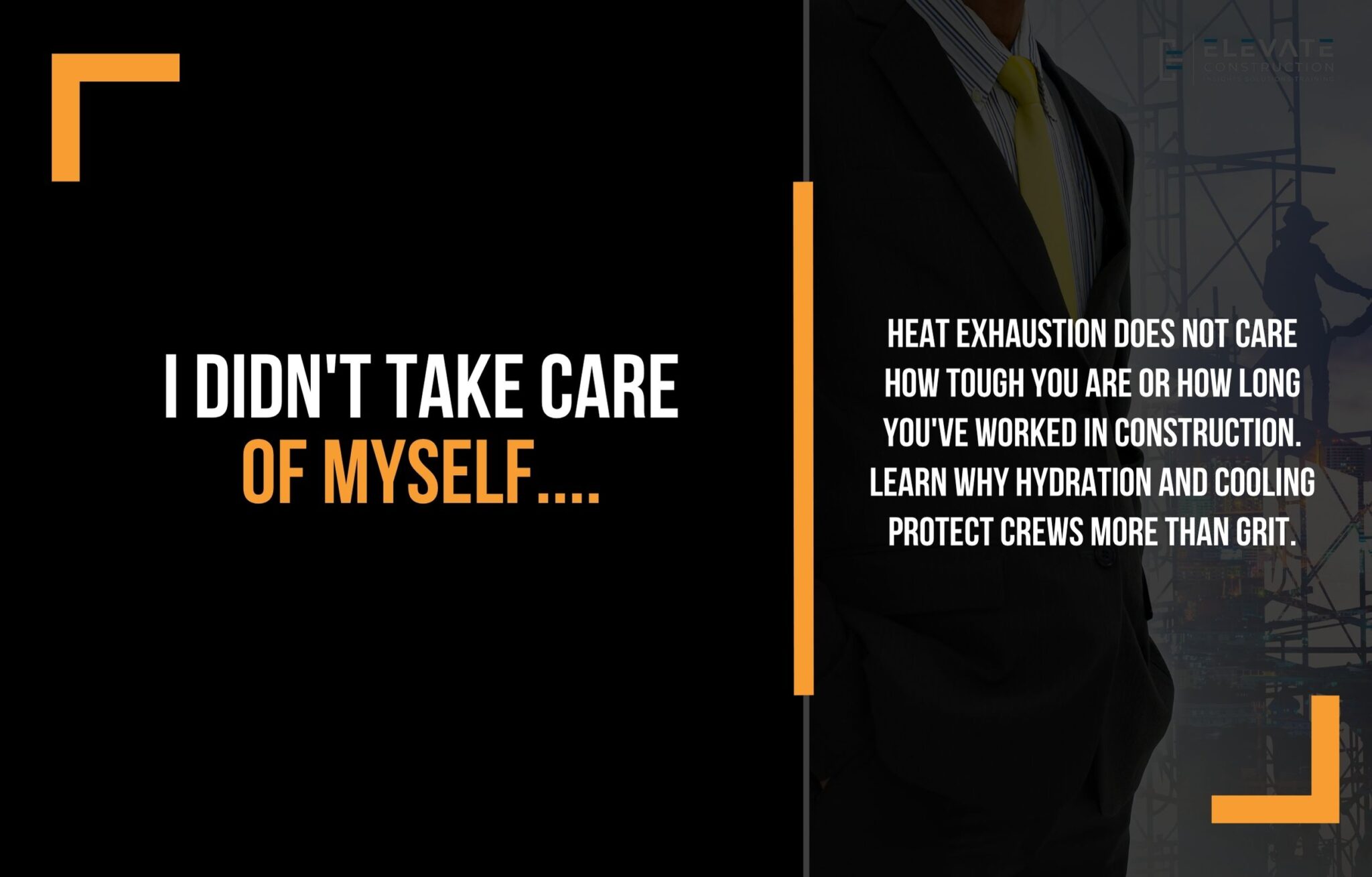
You Can’t Be Cocky About Heat Exhaustion On A Jobsite
We have got to take care of our health. That simple line carries more weight than it sounds like at first, especially for anyone who has spent years believing that toughness alone is enough to survive a hot jobsite. It is easy to say that line in passing. It is much harder to actually live it when a schedule is tight and everyone around you is pushing through anyway.
Where Tough It Out Culture Actually Leads
Plenty of construction careers start the same way. A young worker gets told to tough it out, figure it out, be a man about the heat, and the message sticks. Years of working through extreme temperatures without complaint starts to feel like proof of toughness. What actually happens underneath that tough exterior is a body absorbing damage it may never fully recover from, whether anyone notices at the time or not. The pride comes fast. The bill often comes years later, quietly, long after anyone has stopped paying attention to it.
Confusing Toughness With Safety
The failure pattern shows up whenever heat tolerance gets treated as a personal strength instead of a real physiological limit. A crew works through triple digit heat because that is simply what the job has always required. Nobody schedules real hydration breaks because nobody wants to be seen needing one. The assumption underneath all of it is that pushing through discomfort is the same as handling it safely, and that assumption is exactly what puts people in the hospital, sometimes years after the habit first formed.
The System Failed Them, They Didn’t Fail The System
The system failed them, they did not fail the system. Plenty of field workers came up in an era and a culture where extreme heat exposure was simply accepted as part of the job, with little structure around cooling, hydration schedules, or recognizing early warning signs. Nobody built the systems that would have protected them, so toughing it out became the only strategy anyone had.
One Hundred Thirty Degrees And A Warning Nobody Heeded
Early in a construction career, working tilt up concrete panels in the desert meant measured air temperatures around one hundred thirty degrees, no breeze, sun reflecting directly off the panels onto the crew below. The only way to survive those days was pouring water over yourself constantly and staying soaked from morning to night, with big jugs of water kept on hand specifically for that purpose. That environment taught a dangerous lesson, that being tough enough to work through extreme heat was something to be proud of, rather than something the body was quietly paying for in the background the entire time.
A Hike, A Hospital, And A Heart Finding
Years later, that same mindset led to a much more serious moment, one that started with a decision that felt small at the time. After more than a full day of stomach illness and dehydration, a youth hike went ahead anyway in one hundred twelve degree heat, out of a sense of obligation to show up for a commitment already made. Drinking water during the hike did not matter, because the body was already too depleted to absorb it properly. What followed was a trip to the hospital, a diagnosis of dehydration serious enough to affect the heart’s electrical signal, and six weeks of barely being able to leave the house afterward. For a stretch afterward, simply gripping a doorknob took real effort, a small task that had never once required conscious thought before that week. The ability to tolerate extended heat never fully returned to what it had been before that day, a reminder that some lessons about the body do not come with a full refund.
Why This Distinction Matters
This matters because heat illness does not check anyone’s resume first, and it never asks how long someone has worked in the trade before it shows up. It does not care about tattoos, background, hometown, or how many summers someone has already survived. Dehydration and heat exhaustion can affect major organs, including the heart, and recovery is not guaranteed to be complete. On a jobsite, that risk touches real families, husbands and wives who are, in a very real sense, on loan to a project for the hours they spend there every day, and who deserve to get that person back home in one piece.
The Danger Hiding In Ordinary Warm Days
One of the more overlooked risks shows up during interim weather, the days that are warm but not obviously brutal, spring and fall stretches that nobody thinks to plan around the way they plan around a summer heat wave. Extreme heat tends to trigger real caution, constant water, frequent breaks, visible awareness. Milder heat does not trigger that same instinct, so people quietly under hydrate without noticing, right up until their body cannot regulate its own temperature anymore. Moderate heat can be more dangerous precisely because it does not feel dangerous, and that false sense of safety is exactly what catches people off guard.
What Actually Protects A Crew
Real protection starts with the basics done consistently. Cooling stations, shaded rest areas, ice water available at all times, and a genuine hydration schedule rather than an assumption that people will drink enough on their own. None of this requires expensive equipment. It requires treating heat exposure as a real physiological risk instead of a test of character, and building that belief into how a project actually runs day to day, not just into a toolbox talk that gets forgotten by lunch.
Signs Of Heat Exhaustion Worth Taking Seriously
Watch for these signals in yourself and your crew, especially during a heat wave or an unexpectedly warm stretch of ordinary weather that nobody planned around in advance.
- Shaking, chills, or sudden fever after time in the heat
- Weakness strong enough to affect grip or basic movement
- Nausea, headache, or confusion that shows up during or after exposure
- A slow, difficult recovery that stretches on for days instead of hours or a single afternoon
Connect To Mission
Taking heat seriously is not about lowering productivity expectations or slowing a project down. If your project needs superintendent coaching, project support, or leadership development, Elevate Construction can help your field teams stabilize, schedule, and flow. It means building a jobsite where hydration and cooling are treated as seriously as any other safety requirement, because the people out there are somebody’s husband, wife, or parent, and they deserve to go home the same way they showed up.
Ways To Protect Your Crew This Summer
Use these to build real heat protection into a project, not just a poster on the wall.
- Set up dedicated cooling and shaded rest areas before the heat arrives
- Keep ice water genuinely accessible, not just technically available
- Schedule hydration breaks instead of assuming people will ask for one
- Watch interim weather as closely as extreme heat days
A Challenge For Every Leader
Here is the challenge this week. Walk your project and ask honestly whether cooling stations, shade, and water are genuinely accessible, or just technically present somewhere on site because a checklist required it. As has been said plainly, we can’t be cocky when it comes to the heat, we can’t be cocky when it comes to dehydration, we just have to take care of ourselves, one shift, one water break, one honest check in at a time.
On we go.
Frequently Asked Questions
Why is heat exhaustion dangerous even for experienced construction workers? Experience and toughness do not change the body’s physical limits, and years of working through extreme heat without proper hydration can cause lasting damage regardless of how tough someone believes they are.
Can dehydration really affect the heart? Yes. Severe dehydration can affect the heart’s electrical signal and other major organs, and recovery from that kind of episode is not guaranteed to fully restore prior heat tolerance.
Why is heat illness risk also high during mild or interim weather? Extreme heat triggers obvious caution, while milder warm days do not, which means people are more likely to under hydrate without realizing it until symptoms already appear.
What should actually be available on a jobsite to prevent heat exhaustion? Genuinely accessible cooling stations, shaded rest areas, ice water, and a real hydration schedule protect a crew far more than a general expectation that people will take care of themselves without any structure in place to support it.
Why doesn’t toughness protect someone from heat illness on a jobsite? Toughness can mask early warning signs and encourage someone to keep working past the point their body can safely handle, which is exactly how a manageable situation turns into a hospital visit.
If you want to learn more we have:
-Takt Virtual Training: (Click here)
-Check out our Youtube channel for more info: (Click here)
-Listen to the Elevate Construction podcast: (Click here)
-Check out our training programs and certifications: (Click here)
-The Takt Book: (Click here)
Discover Jason’s Expertise:
Meet Jason Schroeder, the driving force behind Elevate Construction IST. As the company’s owner and principal consultant, he’s dedicated to taking construction to new heights. With a wealth of industry experience, he’s crafted the Field Engineer Boot Camp and Superintendent Boot Camp – intensive training programs engineered to cultivate top-tier leaders capable of steering their teams towards success. Jason’s vision? To expand his training initiatives across the nation, empowering construction firms to soar to unprecedented levels of excellence.