
I Have No Idea What I’m Doing: The Leader’s Confession Every Construction Professional Needs to Hear
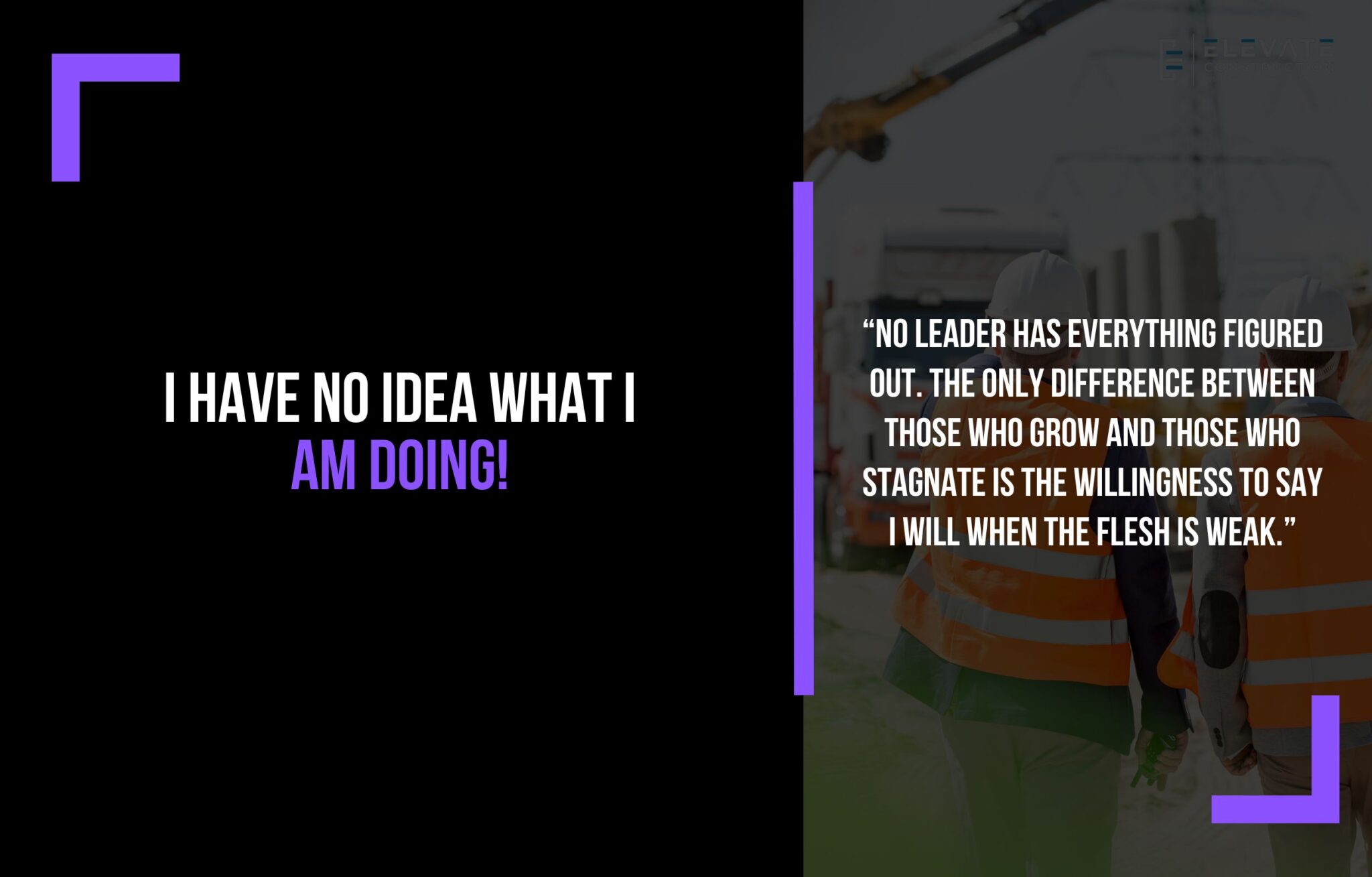
Here is something that almost nobody in a leadership position says out loud: I have no idea what I am doing. Not the leader who just got promoted and is running their first project. Not the superintendent who has been in the industry for twenty years. Not the business owner who just signed a third client while trying to make payroll for the first time. Not the project manager who is about to implement lean systems on a project that has never seen them. Nobody says it out loud, even though every single one of them feels it at some point. And because nobody says it, everyone assumes they are the only one experiencing it, which adds the burden of isolation to an already difficult situation. This episode is permission to say it out loud, along with the honest truth about what comes after you say it and do the thing anyway.
The Problem That Goes Unnamed
The construction industry produces a culture of confidence as a baseline professional standard. Superintendents are expected to project certainty. Project managers are expected to know the plan. Foremen are expected to have the answer before the crew asks the question. That expectation of confidence is not entirely wrong: the field needs decisive leadership, and hesitation in some situations has real consequences. But the culture of projected certainty also creates a significant problem. It makes it nearly impossible for leaders at any level to admit that they are scared, uncertain, or genuinely unsure of what to do next. And when that admission is impossible, leaders stop asking for help, stop taking risks that might fail, and stop doing the hard things that produce growth.
The System That Creates Alone-ness
This problem is systemic, not personal. The construction culture that expects projected confidence from its leaders was designed without a genuine mechanism for leaders to acknowledge what they do not know or what they are afraid of. The result is a profession full of capable, experienced people who are carrying a private weight of uncertainty that they cannot set down because the culture does not have a place to put it. The leader who is terrified about making payroll this week and the superintendent who is afraid to implement a new production system on a project where their reputation is at stake are experiencing the same thing: the flesh is weak, and the blood is running a little cold, and there is no one they can say that to without feeling like they are failing their role.
The Honest Starting Point
Jason Schroeder has eleven children and started a business when the income was uncertain, the model was unproven, and the financial reserves were being used to fund the launch. His wife Katie pushed the risk forward. He followed because he believed in the direction. And he can say plainly, on a podcast with 480 episodes behind it, that he has no idea what he is doing. Not in the sense of being incompetent. In the sense that starting a business, scaling a business, hiring professionals who depend on you for their livelihoods, managing client relationships while expanding a team and creating new offerings: none of that came with a manual. None of it maps cleanly onto what he learned as a superintendent or a project manager. He is figuring it out in real time, one step at a time, with faith that the direction is right even when the specifics are unclear.
That is not a confession of failure. It is a description of every meaningful thing a person does for the first time.
The Verse That Says It Better Than Most
His daughter Effie reads a verse from the hymn “A Poor Wayfaring Man of Grief,” and one line carries the weight of the whole episode: the flesh was weak, my blood ran chill, but my free spirit cried, I will. Every significant decision a leader makes, every hard thing they do that was not on the list of easy and comfortable options, has that structure. The flesh is weak. The blood runs a little cold. The thing is scary enough that the body registers it. And then the spirit decides anyway.
Think about the version of that experience that belongs to you. The conversation you needed to have and kept postponing. The promotion or new role you almost turned down because it felt too uncertain. The system you knew the project needed but was afraid to push for because the owner or the team might push back. The apology you owed someone that required you to be the first to lower your defense. Every one of those moments has a moment in it where the flesh is weak. The question is what happens next.
What Happens When Leaders Say I Will
Here is the honest picture of what doing the hard thing produces, drawn from real experiences:
- The superintendent who implements Takt planning on a project where no one has seen it before and the pushback is immediate and real emerges with a team that eventually trusts the system, a project that flows, and a professional credibility that cannot be built any other way
- The project manager who tells the owner honestly that the schedule needs more time, even when the owner does not want to hear it, builds a relationship of trust that survives the difficult conversation
- The foreman who speaks up in a planning meeting about a sequencing problem that the superintendent has not seen protects the crew and earns the kind of respect that cannot be manufactured
- The leader who admits to a client that they do not have the answer right now but will find it and come back demonstrates the kind of professional honesty that generates loyalty beyond any single project
- The young superintendent who takes the role they are not sure they are ready for, and asks for help along the way, becomes in two years what the comfortable version of themselves would not have become in ten
None of those outcomes arrive without the moment where the flesh is weak and the spirit decides anyway.
The Biodome Tree and What It Teaches Construction Leaders
Jason tells the story of the biodome experiments conducted near Tucson, Arizona, where scientists attempted to grow trees in a controlled environment. The trees grew quickly and appeared healthy. Then they toppled over. The root systems had not developed the strength to support the above-ground growth. The cause was the absence of wind. When a tree grows in a natural environment, the constant pressure of wind against its trunk and branches triggers a cellular response that strengthens the wood structure and drives the roots deeper. Remove the wind and the tree grows without the feedback that makes it strong. The adversity was not harming the tree. It was building the tree. Without it, the growth was real but the foundation was not.
Construction leaders who have never had a difficult project, never had to fight for a schedule they believed in, never had to deliver bad news to an owner, never had to rebuild trust with a team after a rough start, have grown without wind. They may look like senior leaders and carry senior titles. The first genuine adversity will reveal what the biodome obscured.
Effie adds the point that makes this more than a biology lesson: the opposition is what fills the vacuum with growth. The hard thing, overcome, creates room that was not there before. And then, because you have been through it, you can help someone else go through it. The growth connects you to the people who are behind you on the same path.
The Fear Does Not Mean You Are Wrong
The critical mistake that stops many construction leaders from doing the hard thing is interpreting fear as a signal that the direction is wrong. It is not. Fear is the signal that the direction matters. The things that are truly unimportant do not make the blood run cold. The conversations, decisions, and commitments that generate genuine fear are generating it because something real is at stake. That is not a reason to stop. It is a reason to recognize that you are at the right place, facing the right challenge, with the opportunity to grow in a way that would not be available if the thing were easy.
Faith, as Jason describes it in this episode, has a specific structure: you know something is possible, you have a desire for it, and you are willing to act before you have certainty about the outcome. It is not confidence that everything will work out exactly as planned. It is the willingness to take the next step in the direction you believe is right and trust that the step after that will become clear.
Built for Leaders Who Are Figuring It Out
The purpose of this podcast and of Elevate Construction’s work in the construction industry is to build people who build things. Not to build systems for people who already have everything figured out. To build systems for people who are scared, uncertain, facing something they have not faced before, and need both the practical framework and the honest encouragement to keep going. Jason Schroeder can say he has no idea what he is doing because being honest about that does not undermine the work. It is the work. The leaders who change projects, teams, and companies are almost always the ones who were scared and did it anyway. If your project needs superintendent coaching, project support, or leadership development, Elevate Construction can help your field teams stabilize, schedule, and flow.
Say I Will and Take the Next Step
Whatever the hard thing is in front of you right now, whether it is implementing a system your project has never seen, having a conversation you have been avoiding, taking a role you are not sure you are ready for, or simply admitting to your team that you do not have the answer yet but you will find it, the invitation from this episode is to feel the fear honestly and act anyway. The flesh is weak. The blood runs a little cold. And the spirit can still cry, I will. As Ernest Hemingway wrote in A Farewell to Arms: the world breaks everyone, and afterward, many are strong at the broken places. Construction leadership breaks every leader who takes it seriously. What it builds in the breaking is what makes the rest of the career possible.
On we go.
FAQ
Why is it important for construction leaders to admit when they do not know what they are doing?
Because the culture of projected certainty that construction demands also creates isolation and prevents leaders from asking for the help they need. A leader who cannot admit uncertainty will not seek coaching, will not acknowledge when a system is not working, will not ask the owner for an honest conversation about the schedule, and will not create the kind of psychological safety that allows a project team to surface problems early. Admitting that you do not have everything figured out is not a professional weakness. It is the precondition for honest collaboration, continuous learning, and the kind of trust that makes difficult projects work.
What does the biodome tree story teach about leadership development?
It teaches that adversity is not the enemy of growth. It is the mechanism of growth. Trees grown in protected environments without wind develop without the cellular feedback loop that strengthens wood structure and drives root growth. When they reach a certain height, they topple because the root system cannot support what grew above it. Construction leaders who are never challenged, never pushed to implement a new system, never required to have a difficult conversation, and never placed in situations where failure is a genuine possibility develop the same way. The growth is visible but the foundation is not there. The adversity that feels like it is working against development is often the precise thing that makes the development real.
How does fear indicate that a decision or direction matters?
Because the things that do not matter do not generate genuine fear. The conversations, commitments, and decisions that make the blood run a little cold are the ones where something real is at stake: a relationship, a professional reputation, a project outcome, a family’s financial security. That fear is the body registering the weight of what is in front of you. It is not a signal to stop. It is a signal that the direction is significant enough to be worth the fear. Jason Schroeder describes this directly in the episode: starting a business with eleven children and uncertain income generated genuine fear that he did not override. He moved through it because the direction felt right and the purpose was clear. The fear was real and it did not stop him.
What is the structure of faith as Jason describes it in this episode?
Faith, in Jason’s framing, has three components: knowing that something is possible, having a genuine desire for it, and being willing to act before the outcome is certain. This is different from confidence, which assumes a known result, and from wishful thinking, which involves desire without action. Faith is the middle state where the direction is clear, the destination is uncertain, and the next step is taken anyway. For a construction leader, this looks like implementing a production system on a project where the team has not seen it, having a difficult conversation with a client before the relationship deteriorates further, or taking on a role that is bigger than any previous role, trusting that the capability will develop through the doing.
How does overcoming a hard experience prepare a leader to help others?
Because the person who has gone through a genuinely difficult experience carries specific knowledge that cannot be learned from a book or a course: what it feels like to be scared, how to take the next step when you cannot see the one after it, what the other side of a hard decision actually looks and feels like. Effie’s insight in this episode is that connection is part of the purpose of difficulty. The leader who has implemented lean systems on a resistant project team, rebuilt trust after a breakdown, or made a difficult change in their professional life can reach a colleague who is facing the same situation in a way that no amount of technical expertise alone can match. The growth you do not seek for yourself because it is hard is sometimes the exact growth that equips you to help someone else.
If you want to learn more we have:
-Takt Virtual Training: (Click here)
-Check out our Youtube channel for more info: (Click here)
-Listen to the Elevate Construction podcast: (Click here)
-Check out our training programs and certifications: (Click here)
-The Takt Book: (Click here)
Discover Jason’s Expertise:
Meet Jason Schroeder, the driving force behind Elevate Construction IST. As the company’s owner and principal consultant, he’s dedicated to taking construction to new heights. With a wealth of industry experience, he’s crafted the Field Engineer Boot Camp and Superintendent Boot Camp – intensive training programs engineered to cultivate top-tier leaders capable of steering their teams towards success. Jason’s vision? To expand his training initiatives across the nation, empowering construction firms to soar to unprecedented levels of excellence.