
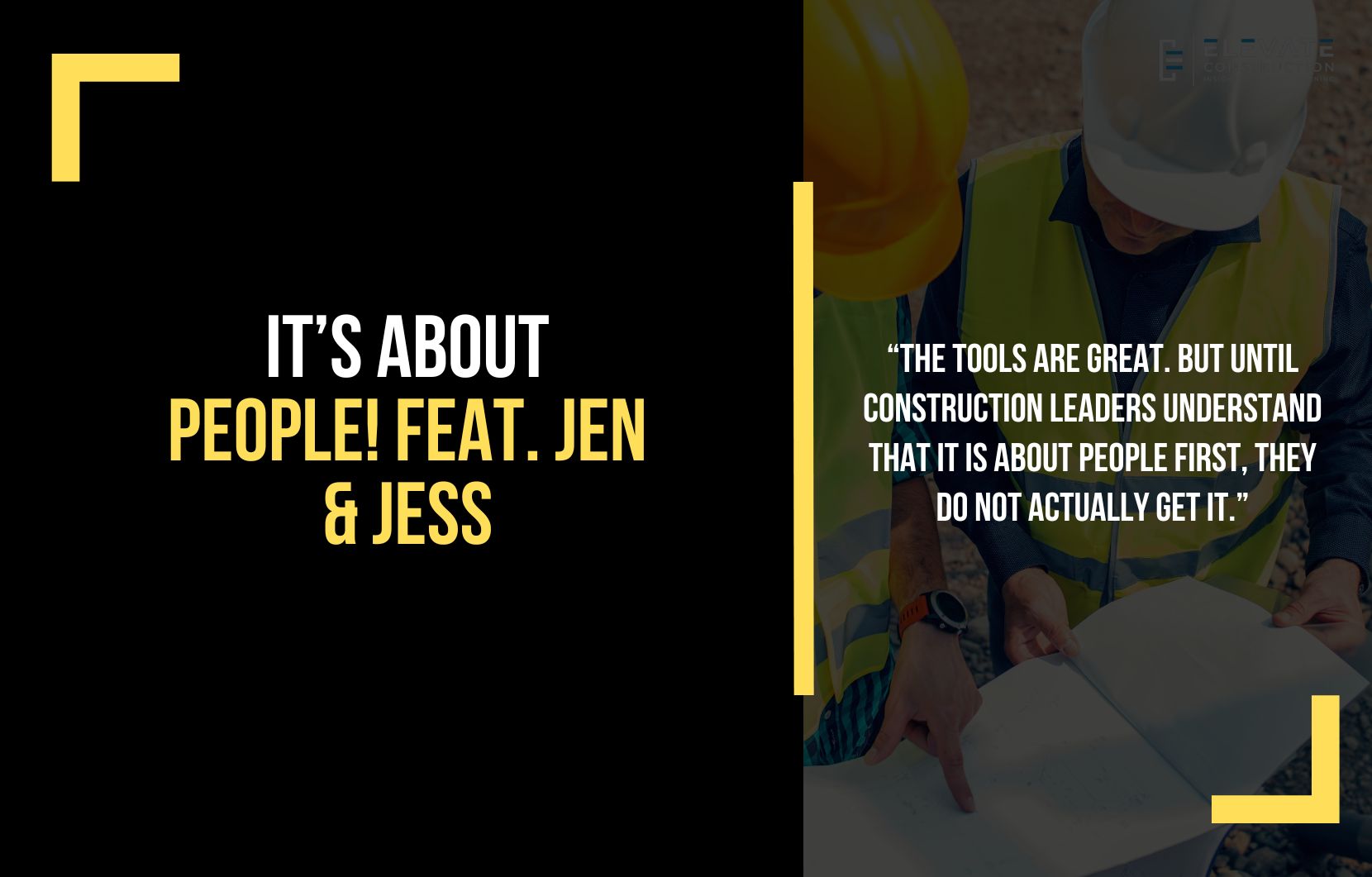
The Tools Are Nothing Without the People: Jennifer Lacey and Jesse Hernandez on Vulnerability, Connection, and the People Side of Lean
Jennifer Lacey is a lean practice leader with nearly two decades at Robinson Morton, a national healthcare construction company. Jesse Hernandez is a second-generation plumber who came up through the trades and is now a podcaster, content creator, and community builder. Together they run No BS with Jen and Jess, a platform that started with a single unconventional idea: applying 5S to personal relationships. What happened when they started sharing that idea publicly, with full vulnerability and no agenda, changed both of them and is changing the people who found them. This episode is a conversation about what they discovered, what it reveals about construction culture, and why the people side of lean is not a soft addendum to the real work. It is the real work.
The Problem That Was Hiding in Plain Sight
Jennifer and Jesse did not set out to build a community around vulnerability in construction. They set out to do a live stream about 5S and personal relationships, which seemed like a stretch even to Jennifer at first. What 5S has to do with marriage and family and human connection was not immediately obvious. But they did it anyway, and something unexpected happened. The audience did not ask follow-up questions about 5S on job sites. They asked about their marriages. Their relationships with their children. The moments where they had shown up wrong and did not know how to fix it. The things they were carrying alone that they had never said out loud to another person.
The armor that construction workers wear is well-documented in the industry’s mental health statistics. The suicide rate in construction is significantly higher than the national average. More people die by suicide in the industry than die from construction accidents. The armor is real and the cost of wearing it is real. What Jennifer and Jesse found is that when two people show up without armor, consistently and publicly, others take theirs off too. Not all at once. Gradually. A thumbs up. Then a comment. Then something personal. Then something intimate. Then a phone call. Then a post on their own page. The vulnerability spectrum, as Jennifer names it, has a progression, and once someone moves through it, they rarely go back.
What Construction Culture Is Actually Asking People to Do
The construction industry has built a culture that rewards appearing capable and penalizes showing difficulty. The superintendent who says I am really stressed about this and I need your help right now is communicating something more honest and more productive than the one who says if we don’t get those air handlers going, I’m going to kill somebody. But the second version is what the culture has trained people to produce. The first version takes a kind of professional courage that the culture has never adequately honored, and in many companies actively discourages.
Jason reflects on his own version of this pattern directly in the conversation. He describes being on a job site and saying something threatening and aggressive when what he actually felt was fear about the project’s trajectory and a genuine need for his team’s support. The difference between what he said and what he meant is the difference between command and connection. And connection, as Jennifer and Jesse demonstrate repeatedly, is what actually moves people to act.
What Vulnerability Actually Looks Like in Practice
Jesse’s challenge to every person listening is specific and immediate: go into your workspace this week and meet somebody new. Learn their name. Find out what they are interested in. Share something about yourself. Do not talk about work. Do that once a week. That is the entire challenge. It is small enough to do today and meaningful enough to change a relationship, and potentially a project, over time.
Jennifer’s challenge completes it: before you speak to anyone, at work or at home, consider that they got up that morning in a situation you know nothing about and showed up anyway. And when you leave work and go home, consider that the people waiting for you do not know what you dealt with all day and deserve the same consideration you would extend to a colleague. Those two frames, applied consistently, change how a leader enters every conversation. They make space for the humanity that the construction culture has been asking people to suppress.
Here is what that shift produces on a construction project when leaders practice it:
- Trade partners who feel seen and respected show up differently to coordination meetings, more honest about their constraints and more willing to make real commitments
- Workers who know they matter to their foreman perform at a different level than workers who are treated as interchangeable production units
- Project teams that have learned to be honest about problems surface them earlier, when they are still small enough to address without crisis
- Superintendents who can say I need help right now get better help than the ones who project certainty until the situation is already unrecoverable
- The communities that form around shared vulnerability, whether on a job site or a live stream, generate the kind of loyalty and creative problem-solving that no management system can manufacture
The People Side of Lean Is Not Separate From the System
The lean construction movement has done extraordinary work on production systems, scheduling methods, waste reduction, and flow. The Last Planner System, Takt planning, and the four laws of production give the industry tools that, when properly applied, can transform how buildings are built. But Jesse and Jennifer make a point that every lean practitioner eventually confronts: the tools are nothing without the people. A Takt plan that nobody trusts will not be followed. A Last Planner commitment made in an environment of fear is not a real commitment. A morning huddle in a culture where workers do not feel that they matter is a ritual without substance.
The people side of lean is what makes the system actually work. Psychological safety is not a soft concept added to lean implementation to make it feel humane. It is the precondition for the system to function as designed. Workers who feel safe surface problems. Foremen who feel respected make honest commitments. Trade partners who feel valued bring their best capacity. Remove those conditions and the production tools produce a fraction of what they are capable of producing.
Here is what the people side of lean looks like when it is working alongside the production system:
- Morning worker huddles where the foreman knows every worker’s name and treats the huddle as a genuine communication moment produce more honest information than huddles that are treated as a compliance ritual
- Coordination meetings where trade partners feel respected and heard produce more accurate commitments than meetings where the superintendent does all the talking
- Project teams where people feel they matter to the organization report fewer quality problems because they care about the outcome rather than just the paycheck
- Construction sites where dignity is the standard rather than the aspiration retain workers across the full arc of the project rather than losing them to better environments halfway through
Showing Up, Receiving, Reflecting, and Reciprocating
Jesse offers a frame for how to engage with the growth that is coming as the construction industry continues to converge around better systems, better culture, and better leadership: show up, receive, reflect, and reciprocate. There is no control in that sequence. There is no fear. There is openness to what each interaction offers and a commitment to return value to the person and the community that offered it.
That frame is also a description of how the best lean leaders operate on their projects. They show up with their plan and their tools, and they remain open to what the field and the team are telling them. They receive the information that the production system generates without filtering it through the story they want to tell about the project. They reflect on what the data and the people are saying before they respond. And they reciprocate by creating the conditions where the people on their team can show up and do the same.
If your project needs superintendent coaching, project support, or leadership development, Elevate Construction can help your field teams stabilize, schedule, and flow.
People Want to Matter. That Is the Whole Thing.
Jennifer closes the conversation with the simplest and most complete summary of everything that No BS with Jen and Jess is trying to do: people want to matter. The worker who shows up at six in the morning wants to matter. The foreman who is carrying something heavy wants to matter. The superintendent who is scared about the schedule and pretending not to be wants to matter. The project manager who has not been honest with the owner about the cost situation wants to matter. Every person on every project site wants someone to see them and treat them as significant, not as a resource to be deployed. When leaders provide that, the performance that follows is not a mystery. It is the natural output of human beings who feel invested in something they are part of.
The tools are remarkable. The systems are getting better. The lean construction movement is producing real results on real projects. And none of it reaches its potential until the people inside the system feel that they matter to the people leading it.
On we go.
FAQ
What is the No BS with Jen and Jess platform and what does it offer the construction industry?
It is a live stream and community platform created by Jennifer Lacey and Jesse Hernandez focused on vulnerability, trust, and the people side of lean. It offers a space where construction professionals can be honest about what they are carrying without the armor the industry typically requires.
What is the vulnerability spectrum that Jennifer describes?
It is the observable progression from passive watching, to commenting, to sharing something personal, to reaching out directly, to going public with your own voice. It describes how people move from guarded to genuinely connected when the environment makes it safe to do so.
Why does psychological safety matter for lean construction implementation?
Because the tools only work when people trust the environment enough to use them honestly. A Last Planner commitment made in fear is not real. A morning huddle in a culture of suppression produces no useful information. Safety is the precondition, not the reward.
What is Jesse’s challenge for construction leaders this week?
Go meet someone new in your workspace. Learn their name, learn something about them, share something about yourself, and do not talk about work. Do it once a week.
What does show up, receive, reflect, and reciprocate mean for a construction leader?
It means approaching every interaction without a controlling agenda, being genuinely open to what people and the system are telling you, processing that information before responding, and returning value to the people and community that offered it.
If you want to learn more we have:
-Takt Virtual Training: (Click here)
-Check out our Youtube channel for more info: (Click here)
-Listen to the Elevate Construction podcast: (Click here)
-Check out our training programs and certifications: (Click here)
-The Takt Book: (Click here)
Discover Jason’s Expertise:
Meet Jason Schroeder, the driving force behind Elevate Construction IST. As the company’s owner and principal consultant, he’s dedicated to taking construction to new heights. With a wealth of industry experience, he’s crafted the Field Engineer Boot Camp and Superintendent Boot Camp – intensive training programs engineered to cultivate top-tier leaders capable of steering their teams towards success. Jason’s vision? To expand his training initiatives across the nation, empowering construction firms to soar to unprecedented levels of excellence.