
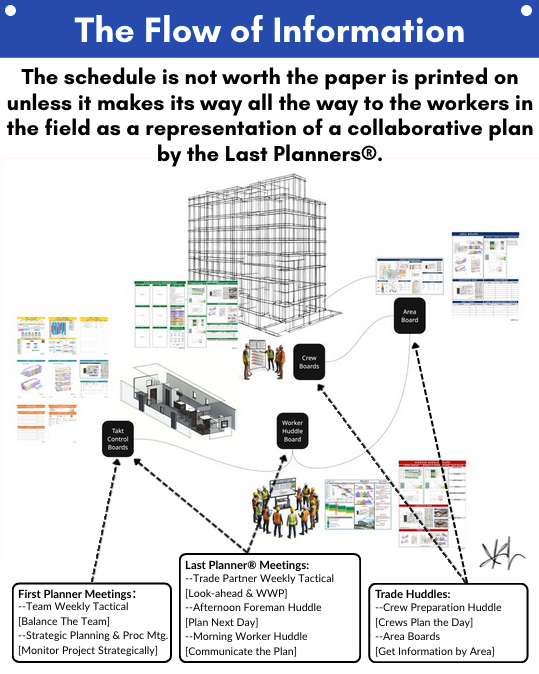
The schedule isn’t worth the paper it’s printed on.
Not until it reaches the worker holding the tools.
We spend hours building beautiful schedules in the office, then act surprised when the field doesn’t execute them.
The problem isn’t the schedule.
It’s the handoff.
Information has to flow — not just exist.
Here’s how it should move from office to field:
↓ Strategic Planning & Procurement (weekly)
The long view. Milestones, lead times, manpower. Are we still on the right road?
The long view. Milestones, lead times, manpower. Are we still on the right road?
↓ Trade Partner Weekly Tactical
The Last Planners® turn the look-ahead into commitments. “We will finish this scope, in this zone, by Friday.”
The Last Planners® turn the look-ahead into commitments. “We will finish this scope, in this zone, by Friday.”
↓ Afternoon Foreman Huddle
Tomorrow gets built. Constraints surface while there’s still time to fix them.
Tomorrow gets built. Constraints surface while there’s still time to fix them.
↓ Morning Worker Huddle
The plan finally lands with the people doing the work.
The plan finally lands with the people doing the work.
↓ Crew Preparation Huddle
The last hundred feet. Crews break down their zone and get to work.
The last hundred feet. Crews break down their zone and get to work.
Each meeting exists to make the next one possible.
Skip one, and the chain breaks.
The First Planners set direction.
The Last Planners make commitments.
The huddles make those commitments real.
The Last Planners make commitments.
The huddles make those commitments real.
A schedule on a trailer wall isn’t a plan.
It’s a wish.
It’s a wish.
It only becomes a plan when a worker can describe — in their own words — what they’re doing today and why.