
One of the biggest problems on construction sites is simple:
People don’t have the information they need where the work is happening.
Plans are in the trailer.
Logistics are in someone’s email.
The weekly work plan is buried in a meeting.
Logistics are in someone’s email.
The weekly work plan is buried in a meeting.
Meanwhile, crews are trying to build.
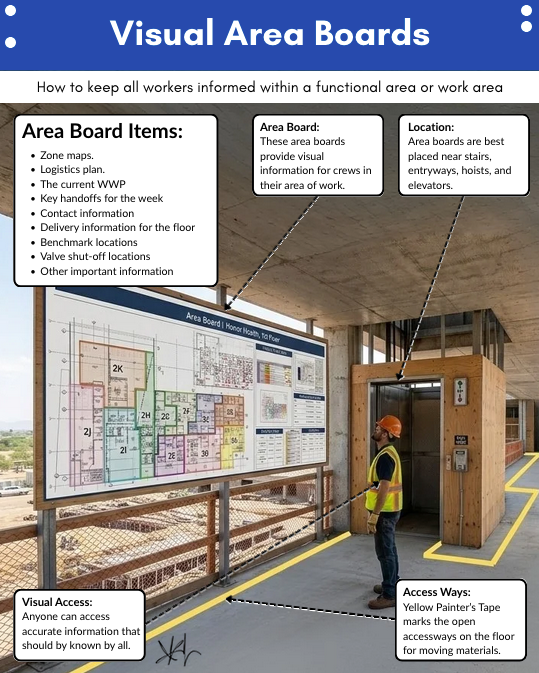
This is why Visual Area Boards are so powerful.
Instead of information living in spreadsheets, binders, or someone’s head, the most important details are posted right where the work happens:
- Zone maps
- Logistics plans
- Weekly Work Plans
- Key handoffs
- Delivery information
- Benchmark locations
- Emergency shut-offs
- Contact information
Anyone walking into that area should be able to understand the work in seconds.
That’s the goal of visual management:
Make the work, the plan, and the problems visible so teams can coordinate better and solve issues faster.
A well-designed jobsite should function like a visual workplace where people don’t need to chase information — it’s already there.
Good projects communicate through meetings.
Great projects communicate through the environment.
Great projects communicate through the environment.
Build systems where the jobsite speaks.