
Struck-by incidents remain one of the top four causes of construction fatalities — and most happen where workers and equipment share the same ground.
A painted line isn’t a safety system. This is.
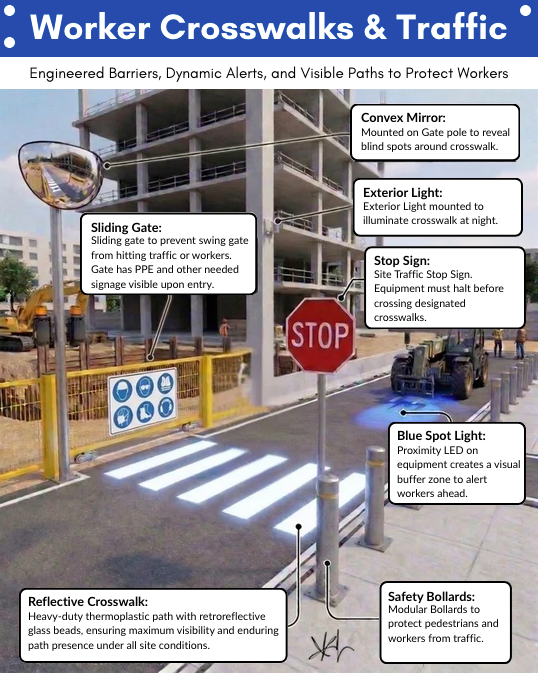
When we designed our worker crosswalks, we stopped thinking about “signage” and started thinking about layered controls. Every element does a specific job:
- Sliding gate (not swing) — eliminates the arc that puts workers and traffic in the same plane
- Convex mirror on the gate pole — kills the blind spot before it kills someone
- Exterior lighting — because second shift doesn’t mean second-tier protection
- Site stop sign — equipment halts before the crossing, not at it
- Blue spot proximity LED — projects a visual buffer zone ahead of moving equipment
- Thermoplastic crosswalk with retroreflective glass beads — stays visible through mud, rain, and night work
- Modular safety bollards — physical separation, not optical suggestion
- PPE signage at entry — compliance starts before the boot hits the slab
None of these are new technologies.
What’s new is treating the crosswalk as a system instead of a stripe.
What’s new is treating the crosswalk as a system instead of a stripe.
If your site still relies on workers making eye contact with operators,
you’re one distraction away from an incident report.
you’re one distraction away from an incident report.
What controls are you layering on your sites?