
What a Japanese Toilet Teaches Construction Leaders About Eliminating Friction Nobody Named
A modern Japanese toilet has more thoughtful design than most construction trailers, most project management systems, and most field offices combined.
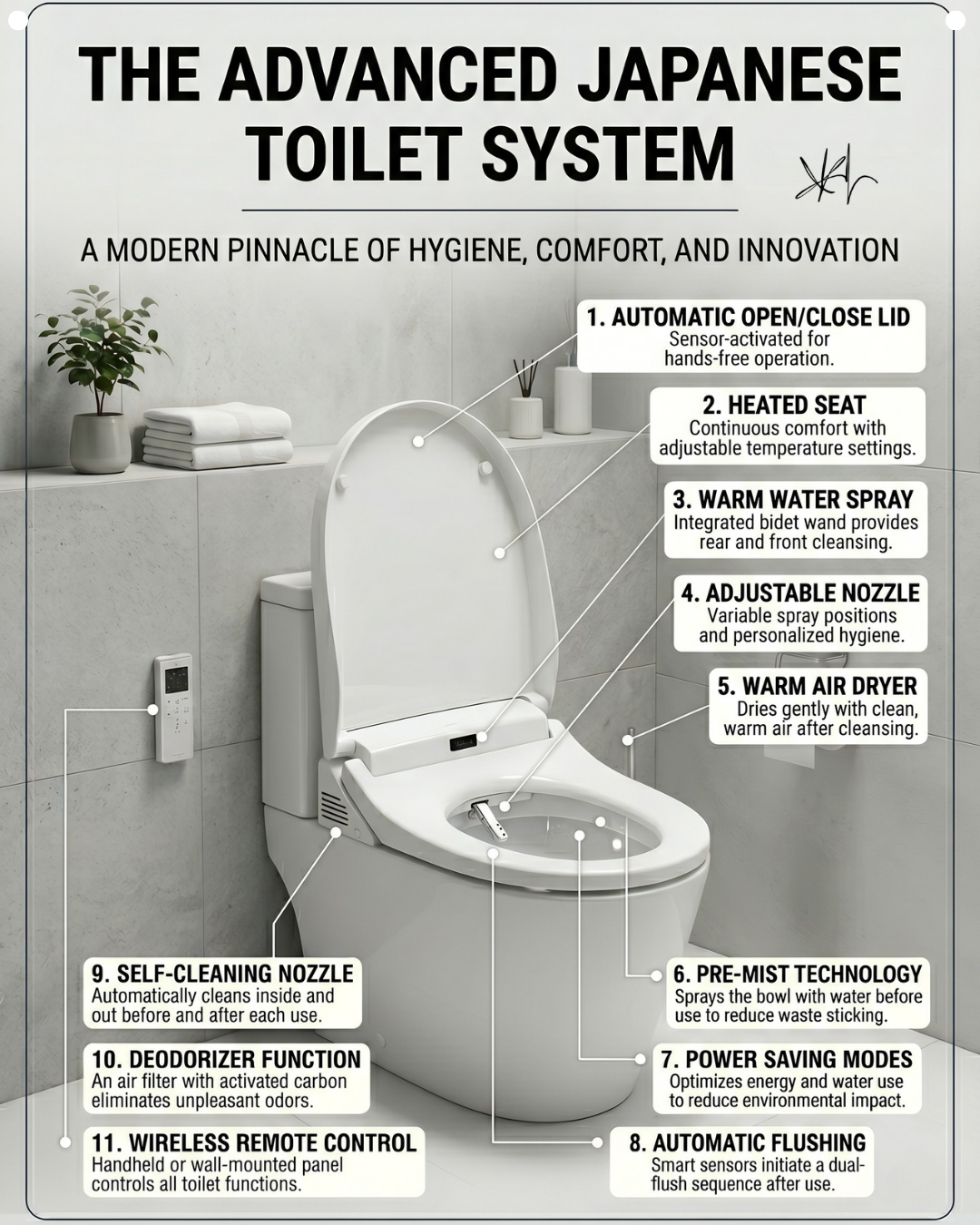
Here is the deal. Eleven distinct features, each one solving a small problem most people never thought to articulate. A sensor-activated lid so you never touch the surface. A pre-mist that coats the bowl before use so waste does not stick. A self-cleaning nozzle that cleans itself before and after every cycle. An activated-carbon deodorizer. A dual-flush system with smart sensors. A heated seat with adjustable temperature. Power-saving modes that optimize water and electricity without requiring the user to think about it. Eleven solutions to eleven frictions, and the person using it never has to name a single one of them because the system already did.
That is not overengineering. That is what happens when someone watches the actual experience closely enough to see the friction that everyone else learned to ignore.
The Pain That Becomes Invisible
Every industry has friction that has become so familiar it stops registering as friction. People adapt to it, work around it, absorb the cost of it daily, and eventually forget it was ever a problem at all. That adaptation is the most dangerous thing that can happen to a process, because once a problem becomes invisible, it becomes permanent.
In construction, the list is long. The foreman who walks two hundred feet to a water cooler because the water station was positioned for setup convenience rather than crew access. The superintendent who opens the same document three times a day because the filing system has no logic. The crew that stages material in a congested corridor because nobody designed a laydown plan for that phase. The trade partner who waits forty minutes for an answer because the person who can give it is physically unreachable somewhere on the site.
None of those people file a complaint. None of them log the waste. They just absorb it. They get good at absorbing it, and getting good at absorbing waste is the thing that keeps it alive. The friction stays because the adaptation is quiet, and because nobody with the authority to redesign the system is watching closely enough to see what the adaptation is costing.
The Failure Pattern
The failure pattern is building systems for the average case and then asking people to tolerate the gaps.
The Japanese toilet does not do this. It does not assume the user will figure out hygiene on their own and only step in for the major functions. It observes the complete experience, every moment of contact between person and product, and designs a response for each one. Pre-mist before use. Self-cleaning before and after. Deodorizer during. Warm air drying after. Each feature addresses a specific, small, real friction that the user has learned to live with, and the sum of all eleven is an experience where the user never encounters a problem the system has not already solved.
Construction systems are built the opposite way. We design for the major functions, the schedule, the budget, the safety program, and leave the small frictions to the user. The result is a system full of gaps that people fill with improvisation, workaround, and tolerance. Those gaps are not visible in any report. They are visible only to the person standing in them, and that person has usually stopped seeing them because they adapted years ago.
The failure is not that we do not care about the small things. The failure is that we do not watch closely enough to see them.
They Didn’t Fail the System
When a crew is slow, when a foreman seems disorganized, when a superintendent is perpetually reactive, the diagnosis in this industry almost always lands on the person. They are not efficient. They need better habits. They need to manage their time.
Here is what I would ask instead. How many invisible frictions did that person absorb today before anyone noticed? How many times did they walk farther than they needed to because the resource was in the wrong place? How many times did they wait for information that should have been at their fingertips? How many small problems did they solve manually that a well-designed system would have prevented entirely?
The person did not fail. The system never eliminated the friction that was consuming their capacity. And because the friction was small enough to absorb individually, it never got named, never got logged, and never got fixed. The person just got a little slower, a little more tired, a little more reactive, and the project called that a performance issue.
What Eleven Features Actually Teach
The Japanese toilet is not remarkable because of any single feature. A heated seat is nice. A self-cleaning nozzle is convenient. Any one of those features alone is a minor improvement. What makes the system remarkable is the completeness of the design, the fact that someone watched the entire experience from beginning to end and refused to leave any friction unaddressed.
That completeness is the lesson. World-class experiences are not built by adding one impressive feature. They are built by obsessing over every small friction the user has learned to ignore and eliminating all of them systematically.
Apply that thinking to a construction project and the implications are significant. Walk the experience of a crew from arrival to departure. Where do they park? How far is the walk to the work face? Where is their gear staged? How do they get information about the day’s plan? Where is the water? Where is the shade? How do they report a problem? How long does it take to get an answer? Each of those touchpoints is a moment where the system is either serving the person or asking the person to serve the system. The sum of all those moments is the crew’s actual experience of the project, and it determines their energy, their engagement, their ownership, and ultimately their output.
The Pre-Mist Principle
There is one feature on the Japanese toilet that deserves particular attention because it illustrates a design philosophy that transfers directly to construction operations.
The pre-mist sprays a fine layer of water on the bowl surface before use. The purpose is simple: a wet surface prevents waste from adhering, which means the flush cycle is more effective and the bowl stays cleaner with less water. The feature is invisible to most users. They do not know it is happening. They just notice that the toilet stays clean.
That is preventive design. It addresses the problem before the problem occurs, rather than cleaning up after it. The pre-mist does not wait for the mess and then work harder to remove it. It changes the surface condition so the mess never forms in the first place.
In construction, the equivalent is make-ready planning, constraint removal before the work begins, kitting materials before the crew arrives, clearing the zone before the trade enters it. Every one of those practices is a pre-mist. They change the conditions ahead of the work so the work flows cleanly rather than fighting friction that should have been eliminated upstream.
The projects that practice this consistently are the projects where crews describe the work as smooth, where the schedule holds, where the Takt rhythm actually produces what it was designed to produce. The projects that skip it are the projects where every day feels like a fight, where recovery plans are more common than execution plans, and where the people doing the work absorb the cost of upstream failures they had no part in creating.
Signals Your System Has Unaddressed Friction
Before you design anything new, go watch the current experience and look for these patterns:
- A task that requires more steps than it logically should, where people have stopped noticing the extra steps because they have been doing them for months
- A resource that is positioned for the convenience of setup rather than the convenience of the person using it daily
- A workaround that has become so standard it feels like the process, even though someone invented it to get around a gap
- Information that requires a person to go find it rather than having it arrive where and when they need it
- A small annoyance that every person on the site can name but nobody has proposed fixing because it feels too minor to bring up
Each of those is a feature that the system should have but does not. Each one is a pre-mist that was never installed.
Why the Small Frictions Are the Expensive Ones
The instinct in construction is to focus leadership attention on the large problems, the schedule recovery, the budget overrun, the safety incident, the trade conflict. Those are real and they deserve real attention. But they are also visible, named, and already in the system. Someone is working on them.
The small frictions are not in the system. Nobody is working on them. They persist for months, sometimes for the entire duration of a project, quietly consuming capacity from every person who encounters them every day. A two-minute friction that hits thirty people twice a day is two hours of lost capacity, every day, for the life of the project. That math is worse than most named problems on the constraint log, and it never appears on the constraint log because nobody named it.
This is why the Japanese toilet is a better teacher than most management books. It does not lecture about eliminating waste. It demonstrates what it looks like when someone actually watches the complete experience and refuses to leave friction in place just because it is small. That refusal is the discipline. And that discipline, applied to a construction project, is what separates a project that feels good to work on from a project that wears people down.
Lean construction teaches exactly this. Takt planning is the framework for making flow visible. Workface planning is the method for clearing constraints before crews arrive. Kitting, point-of-use storage, and zone control are the tools for positioning resources where the work actually happens. If your project needs superintendent coaching, project support, or leadership development, Elevate Construction can help your field teams stabilize, schedule, and flow. Jason Schroeder and the LeanTakt team bring the discipline of seeing small friction and eliminating it systematically, which is the discipline that transforms a project from one that functions into one that flows.
Go Find the Friction Nobody Named
Here is your challenge. This week, walk one complete crew experience from arrival to the work face and back. Do not fix anything. Just count the frictions. Count the extra steps, the unnecessary walks, the waits, the workarounds, the searches for information that should have been at hand. Write the number down.
That number is your project’s invisible cost, and it has been running every day since the crew mobilized. Now that you can see it, you can design for it. That is all the Japanese toilet did. Someone counted the frictions, then eliminated them, one feature at a time, until the experience was seamless.
Taiichi Ohno said it directly: “Having no problems is the biggest problem of all.” The frictions your crew stopped reporting are the problems your project stopped seeing. Go see them.
On we go.
FAQ
How does a Japanese toilet relate to construction management?
The connection is the design philosophy, not the product. The Japanese toilet demonstrates what happens when someone watches the complete user experience and eliminates every small friction systematically. That same discipline applied to a construction crew’s daily experience, from arrival to the work face and through every resource interaction, is what separates projects that flow from projects that grind. The product is different. The observation practice is identical.
What is the “pre-mist principle” in construction terms?
It is preventive design: changing the conditions before the work begins so the work encounters less friction. Make-ready planning, constraint removal, kitting, and point-of-use staging are all pre-mist equivalents. They address the problem before the crew arrives rather than asking the crew to fight through conditions that should have been cleared upstream.
How do you find friction that people have stopped seeing?
Walk the experience yourself and count everything that requires extra effort, extra steps, or extra time. People who have adapted to friction cannot see it, but someone who walks the experience with fresh eyes and a counting habit will find it immediately. The other method is to ask a new hire what surprised them in their first week. New people have not yet adapted, so the friction is still visible to them.
If you want to learn more we have:
-Takt Virtual Training: (Click here)
-Check out our Youtube channel for more info: (Click here)
-Listen to the Elevate Construction podcast: (Click here)
-Check out our training programs and certifications: (Click here)
-The Takt Book: (Click here)
Discover Jason’s Expertise:
Meet Jason Schroeder, the driving force behind Elevate Construction IST. As the company’s owner and principal consultant, he’s dedicated to taking construction to new heights. With a wealth of industry experience, he’s crafted the Field Engineer Boot Camp and Superintendent Boot Camp – intensive training programs engineered to cultivate top-tier leaders capable of steering their teams towards success. Jason’s vision? To expand his training initiatives across the nation, empowering construction firms to soar to unprecedented levels of excellence.