
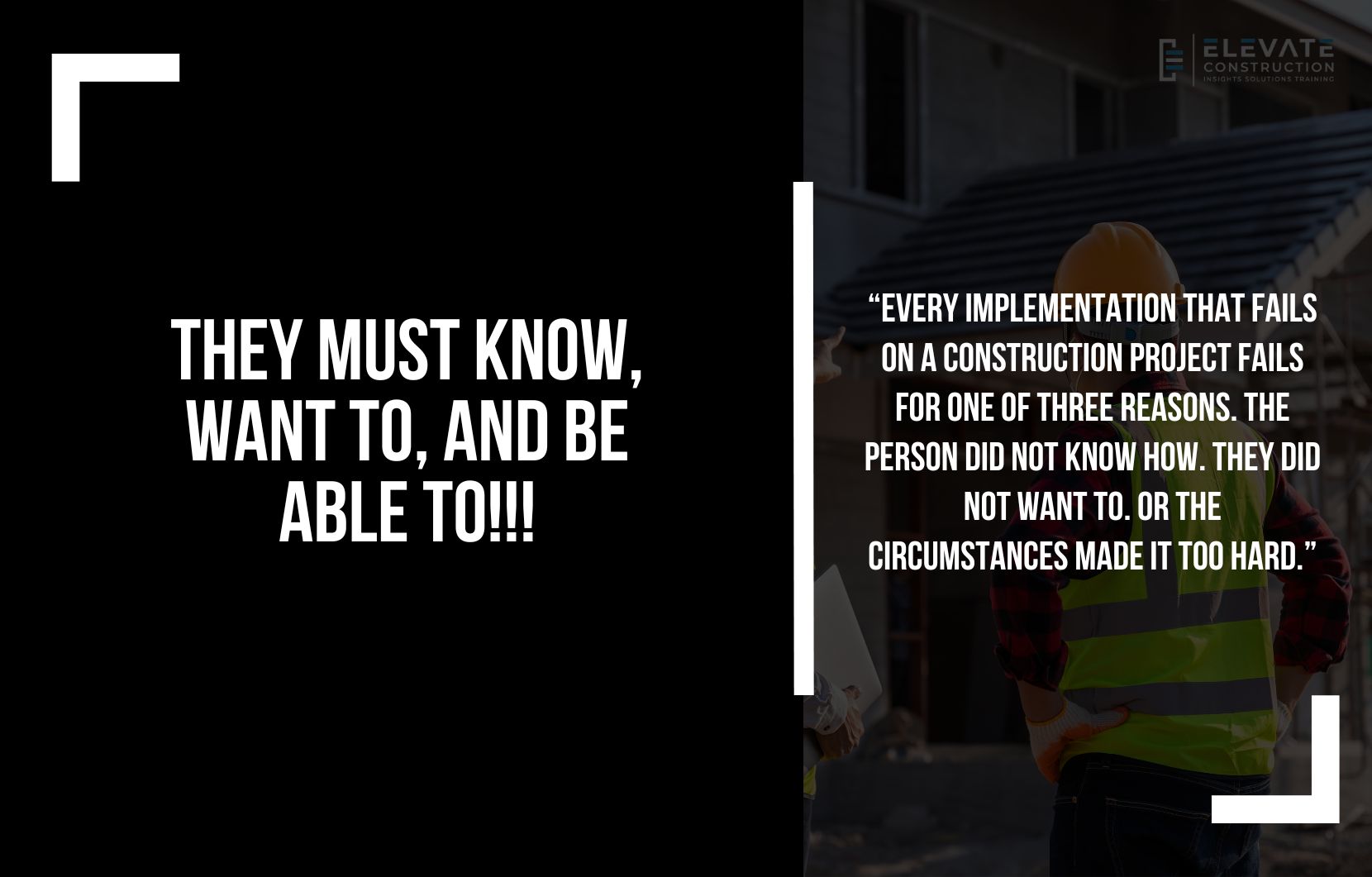
You Must Have All Three: The Framework Every Construction Leader Needs to Drive Real Change
There is a pattern behind almost every failed implementation on a construction project. The superintendent announces a new process. The team nods. The process gets used for a week, maybe two. Then it quietly disappears. The superintendent notices and either pushes again or accepts that it did not take. Nobody identifies why it failed because nobody asks the right question. Was it that people did not know how to do it? Was it that they did not want to? Or was it that the circumstances made it harder to do than to skip? Most leaders jump straight to assuming the problem is compliance, which leads to more pressure, which rarely works, because pressure is not a substitute for addressing the actual missing component.
The Problem That Keeps Repeating
Jason Schroeder describes stopping at an airport kiosk that invited travelers to nominate TSA employees for good service. The kiosk was clearly designed, easy to operate, and prominently placed. He watched it for a while. Nobody used it. And looking at it through the Switch framework, the reason was immediately obvious: travelers moving through an airport have one priority, getting to their gate. They know how to push the button. The button is easy to push. They simply have no reason to want to. The knowledge was there. The circumstances were frictionless. The motivation was completely absent. Without all three, the system does not work, regardless of how well the other two elements are designed.
That airport kiosk is a perfect metaphor for how most construction implementation efforts fail. The process is documented. The training was delivered. The form is in the system. And yet nobody uses it, because somewhere in the chain of know how, want to, and circumstances, one of the three is missing. Until the leader diagnoses which one, every intervention will miss the point.
The System That Skips the Diagnosis
Construction culture is heavily oriented toward execution: identify the problem, implement the solution, move on. That bias toward action is genuinely valuable in field leadership. But it produces a characteristic blind spot in implementation: the assumption that telling people to do something is sufficient, and that when it does not happen, the response is to tell them again more forcefully. The system was never designed to ask which of the three components is missing, so it never produces that diagnosis. It produces pressure, which addresses compliance but not capability, motivation, or circumstance.
The foreman who does not submit their daily production report is experiencing one of three things: they do not know exactly what the report requires, they do not see a reason to submit it given everything else competing for their attention, or the system for submitting it is clunky enough that doing it under time pressure at the end of a shift is genuinely difficult. A leader who responds to that pattern by reminding the foreman to submit the report has not addressed any of those three possibilities. They have added pressure to an already present awareness. The report still will not get submitted reliably until the actual missing component is identified and addressed.
The Rider, the Elephant, and the Path
Chip and Dan Heath’s Switch framework uses an analogy that is worth understanding fully before applying it. A small rider sits on top of a massive elephant. The rider can steer. The elephant has the power. And both of them need a clear path to travel on.
The rider represents knowledge and direction: the rational, analytical part of a person that can understand instructions, follow a process, and make a plan. The elephant represents motivation and desire: the emotional, instinctual part that determines what someone actually does when their attention is pulled in multiple directions and no one is watching. And the path represents the circumstances: the environment, the systems, the friction or the ease with which the desired behavior can actually be executed.
The rider who knows exactly where to go but cannot motivate the elephant will lose. The elephant is enormously more powerful than the rider. You can know what to do and still not do it, consistently, because wanting to is what produces behavior at scale. But a motivated elephant on a path full of obstacles will not get very far either. All three have to be present and aligned for implementation to work.
What This Looks Like in Construction
Here is where the three-component framework produces immediate diagnostic clarity for leaders who apply it. Before assuming a compliance problem, ask the three questions for every implementation that is not working:
- Does the person actually know how to do this? Not in theory, but in practice, with the specific system, form, or process that is being asked of them right now in their current project context?
- Does the person want to do this? Is there a reason from their perspective that makes this worth their attention and effort, given everything else competing for both?
- Are the circumstances set up so that doing this is easy rather than friction-filled? Is the system accessible when they need it, does it take a reasonable amount of time, and does it fit into the flow of their actual workday?
The answers to those three questions tell a leader exactly what is missing and therefore exactly what to fix. The implementation does not need more pressure. It needs the missing component.
Common Missing Components on Construction Projects
Most implementation failures in construction cluster around a predictable set of missing components. Recognizing the pattern makes the diagnosis faster:
- Pretask plans that do not get completed before work starts: the crew knows the form exists, but the want to is absent because nobody has connected the pretask plan to crew safety in a way that feels personal rather than procedural, and the circumstances often require completing it before the day starts when the crew is already moving
- Expense reports and invoice reviews that pile up until month-end: the process is known, but the circumstances are not set up to make it a daily or weekly habit that takes five minutes rather than a monthly event that takes two hours
- Feature of workboard updates that get skipped when production pressure is high: the superintendent knows what to update but loses the want to when it competes with everything else on a difficult day, because the connection between the board and production outcomes has never been made viscerally real
- Foreman look-ahead planning that stays at a surface level: the desire to do it well is present, but the knowledge of what a meaningful twelve-week look-ahead actually requires is not there, so the form gets filled but not used
- Double-checking survey work before reporting it complete: the procedure exists, but a culture that has rewarded speed over verification has eliminated the want to, making skipping the check feel like the professionally appropriate response to time pressure
Each of those failures looks like a compliance problem from the outside. None of them are. They are diagnostic failures: the leader identified that something was not being done and responded with pressure rather than with the question of why.
How to Build All Three into Your Next Implementation
When a new process, standard, or system needs to be implemented on a project or in a company, building all three components in from the start changes the outcome significantly. Knowledge is the easiest: clear instructions, demonstration, and practice time with feedback. Circumstances require deliberately designing the environment so that the desired behavior is the path of least resistance, which might mean changing when something is done, where it is done, what system it is done in, or how long it is expected to take. Motivation is the most commonly neglected, and it is the elephant: the most powerful force in the system. It requires connecting the desired behavior to something the person genuinely cares about, not just telling them it matters but showing them in terms that are real from where they stand.
If your project needs superintendent coaching, project support, or leadership development, Elevate Construction can help your field teams stabilize, schedule, and flow.
Check All Three Before Adding More Pressure
The practical commitment from this episode is simple: the next time an implementation is not working, do not add pressure before running the three-question diagnostic. Ask which component is missing. Then fix that specific component. A team that knows how, wants to, and has the circumstances to do something will do it consistently without being reminded. A team that is missing any one of the three will not do it consistently regardless of how many times they are reminded, because reminders only reach the rider. The elephant and the path are not listening to the reminder. They respond to motivation and to the design of their environment. Build all three and the implementation takes care of itself.
On we go.
FAQ
What are the three components every person needs to change their behavior?
They need to know how to do it, want to do it, and have circumstances that make it easy to do. All three must be present for implementation to stick.
Why does adding pressure rarely fix a failing implementation?
Pressure only reaches the rational, directive part of a person. If the missing component is motivation or friction in the environment, pressure cannot address it and the behavior will not change.
What is the rider, the elephant, and the path analogy from the Switch framework?
The rider is knowledge and direction, the elephant is motivation and desire, and the path is the circumstances and environment. The elephant is far more powerful than the rider, which is why motivation determines behavior more than instruction does.
How do you diagnose which component is missing when an implementation fails?
Ask three direct questions: does the person know exactly how to do this in practice, do they have a genuine reason to want to, and are the circumstances frictionless enough that doing it is easier than skipping it?
What is the most commonly neglected component in construction implementations?
Motivation. Most implementations focus on documenting the process and making it accessible, but rarely connect the desired behavior to something the person genuinely cares about from their own perspective
If you want to learn more we have:
-Takt Virtual Training: (Click here)
-Check out our Youtube channel for more info: (Click here)
-Listen to the Elevate Construction podcast: (Click here)
-Check out our training programs and certifications: (Click here)
-The Takt Book: (Click here)
Discover Jason’s Expertise:
Meet Jason Schroeder, the driving force behind Elevate Construction IST. As the company’s owner and principal consultant, he’s dedicated to taking construction to new heights. With a wealth of industry experience, he’s crafted the Field Engineer Boot Camp and Superintendent Boot Camp – intensive training programs engineered to cultivate top-tier leaders capable of steering their teams towards success. Jason’s vision? To expand his training initiatives across the nation, empowering construction firms to soar to unprecedented levels of excellence.