
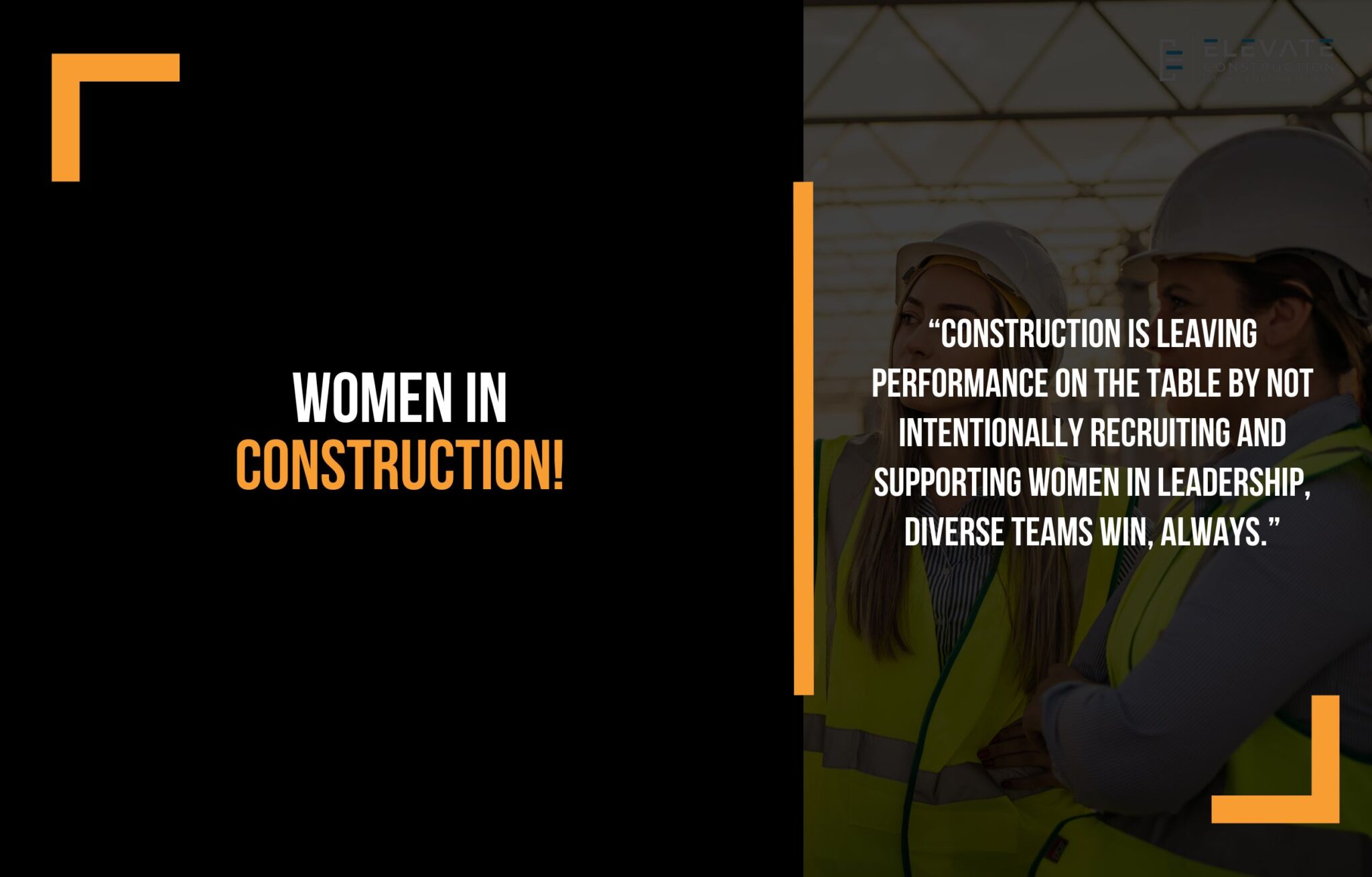
Women in Construction: Why Diversity Is Not a Social Cause, It Is a Competitive Strategy
This is the conversation that a lot of construction leaders want to have but do not know how to start. Not because they do not care, but because it is genuinely complicated territory. Some women in construction want to be recognized specifically as women who are succeeding in a field that has historically made that harder than it should be. Others want nothing more than to be called a superintendent, full stop, without any qualifier that sets them apart from the rest of the team. Some leaders are unsure whether calling attention to diversity makes things better or reinforces the idea that someone needs special consideration to be there. The uncertainty is real. But letting uncertainty prevent action is its own kind of failure, and this episode, recorded with Katie Schroeder and Jason Schroeder, works through the complexity honestly and arrives at a conclusion that any construction leader can apply: create safe, inclusive environments, recruit intentionally, and say directly, we need women in construction.
The Performance Gap the Industry Is Ignoring
Before getting into the cultural and interpersonal dimensions, there is a practical argument that every construction leader can engage with regardless of where they stand on the social dimensions: diverse teams outperform homogeneous ones. Research consistently shows that teams with diverse backgrounds, perspectives, and experiences produce better decisions, more creative solutions, and stronger results than teams that are composed of people who think and communicate in the same way. The construction industry, which continues to be overwhelmingly male in its leadership ranks, is operating with a narrower talent pool than it could have, a narrower range of perspective than it needs, and a narrower set of problem-solving approaches than the complexity of its work demands.
This is not a soft argument about inclusivity as a social value. It is a hard argument about competitive performance. If you want the best team, you need the widest possible pool of capable people. If you are systematically excluding half the population from serious consideration, you are not building the best team. You are building a limited version of it.
The System Built the Problem, Not the People
The underrepresentation of women in construction leadership is not primarily the result of individual prejudice, though individual prejudice certainly exists and needs to be addressed. It is the result of a system that was built without women in mind and has been slow to redesign itself. The culture of many construction sites, from the casual acceptance of harassment to the informal networks through which opportunities are communicated, was designed for and by a demographic that did not include women. Women who entered that system had to navigate conditions that were not designed for them and were often actively hostile to them. The barrier was systemic, not personal.
That matters because it changes the response. If the problem were purely individual attitudes, the solution would be individual attitude change. But if the problem is systemic, the solution requires systemic design: intentional recruiting that reaches women candidates who would not otherwise find the opportunity, mentorship programs that build the pipeline, cultural standards that are enforced rather than aspirational, and leadership accountability for the composition and health of the teams they build.
What Hensel Phelps Got Right
Jason Schroeder describes watching Hensel Phelps make a decision, roughly fifteen to seventeen years ago, that felt uncomfortable at the time: they were going to intentionally hire women and develop them through the leadership ranks. Some people inside the organization, including Jason in his own admission, questioned whether this was the right approach. Looking back, he recognizes it as one of the most important decisions the company made. Hensel Phelps project sites now include women in project management, superintendent, operations management, and vice president roles in proportions that exceed the industry average by a significant margin. The quality of leadership, the culture of those projects, and the company’s reputation in the industry have all benefited from the intentionality of that decision.
The lesson is not that you need a mandate. The lesson is that intentionality is required. If a company simply posts an opening and waits for applicants, the pool of applicants will reflect the existing demographics of the industry. Intentional recruiting means actively reaching people who would not otherwise see the opportunity. It means building relationships with universities, trade schools, and professional organizations that serve women in construction. It means designing the interview and selection process in a way that does not unintentionally filter out candidates who do not fit a narrow cultural template. None of that is complicated. All of it requires making a decision that this is a priority rather than leaving it to chance.
What Women in Construction Are Actually Navigating
Katie Schroeder describes experiences that are common for women in construction and common in professional settings more broadly. The job site interaction that establishes, without words, that the woman in the room is viewed differently. The leer that produces a skin-crawling response that is not about oversensitivity but about the body’s accurate read of a situation where someone is using their perceived power to diminish someone else. The mechanic who assumes a woman needs her husband to make a decision about her own car. The car dealer who gives her brother a better price after she has already negotiated. The accumulation of small moments, each one individually dismissible as not a big deal that adds up over years to a persistent message: you are not quite the same as the people who were here first.
These are not hypothetical. They are described by a woman who leads a company, has decades of professional experience, and does not identify as someone who is looking for reasons to feel diminished. When someone like that describes an experience of being treated as less than, the response is not to question whether she perceived it correctly. The response is to understand that this is still happening, that it has real effects on real people, and that the construction industry has a specific responsibility to address it because the industry’s culture has historically been a significant contributor to it.
Signs That Your Project or Company Has Work to Do
Before looking at what to do differently, it helps to be honest about where a project or company currently stands:
- Is the leadership team of your project entirely or nearly entirely male, and has that ever been examined as a potential limitation rather than a neutral fact?
- Are the informal channels through which opportunities, mentorships, and advancement decisions happen accessible to everyone, or do they primarily flow through networks that women have limited access to?
- Are there behaviors on your project site, in your office, or in your team communication that create discomfort for women and are tolerated because the person doing them is otherwise valuable?
- When something uncomfortable or inappropriate happens, is the response swift and clear, or is it managed quietly in ways that protect the culture of silence?
- Have you ever directly asked the women on your team what would make the environment more supportive, rather than assuming the current environment is neutral?
Honest answers to those questions reveal where the work is.
What to Do With the Information
The practical steps for a construction leader who wants to create a genuinely inclusive environment are not complicated, though they require consistent follow-through. Jason summarizes one of the most important ones with a phrase that his brother-in-law used in a different context: we do not do that around here. When something is wrong, when someone is being treated with less respect than they deserve, when a comment or behavior is setting a standard that the project should not accept, the response from anyone in a leadership position is to say so, directly, in the moment. Not in a report. Not in a meeting later. In the moment.
The other critical step is to be intentional about who is in the room. Who is on the project leadership team? Who is being considered for the senior superintendent role? Who is being invited to the site visits, the client meetings, the professional development opportunities? If the answer to those questions consistently produces the same demographic, it is not because the talent is only coming from one group. It is because the system of selection is not reaching everyone who qualifies.
Built for an Industry That Wants to Win
Katie’s closing point in this episode is the one that every construction leader should take forward: if you see something, stop it. Not because it is politically required or because there is a policy that demands it, but because the industry is better, and projects are better, and teams are better, when everyone in them can bring their full capability without spending energy navigating an environment that is working against them. Elevate Construction is committed to supporting women in construction, to celebrating their success as the outcome of their talent and effort, and to creating the conditions where more of that success becomes possible. If your project needs superintendent coaching, project support, or leadership development, Elevate Construction can help your field teams stabilize, schedule, and flow.
Make It Normal, Then Make It the Standard
The goal is not a construction industry where women are tolerated or accommodated. The goal is a construction industry where the question of whether a superintendent, project manager, or operations leader is a woman is as unremarkable as the question of whether they are left-handed. Hensel Phelps built toward that goal deliberately over decades and now has projects that reflect the full range of talent available in the labor market. Other companies and project teams can follow the same path. It starts with saying it clearly, as Maya Angelou wrote: in diversity there is beauty and there is strength. Say it, mean it, and build the systems that make it real.
On we go.
FAQ
Why is intentional recruiting for diversity better than just posting an open position and waiting for applicants?
Because the pool of applicants who respond to a standard posting reflects the existing demographics of the industry, which is already heavily skewed toward one demographic. Intentional recruiting means actively reaching beyond that pool to build relationships with universities, trade schools, and professional organizations that serve underrepresented groups, including women in construction. It means designing the posting, the interview process, and the selection criteria in ways that do not unintentionally filter out candidates who do not fit a narrow template. The talent exists. Intentional recruiting is how you find it.
How should a construction leader respond when they witness inappropriate behavior toward a woman on their project?
Immediately and directly, in the moment. The phrase Jason uses in this episode captures it well: we do not do that around here. Not a report filed later. Not a quiet conversation after the fact that the person who was targeted never hears about. A clear, direct statement in the moment that establishes what the standard is and that it is being enforced. Leaders who wait for formal processes to handle what they could address directly are allowing the behavior to continue longer than necessary and communicating to everyone watching that the standard is aspirational rather than real.
What does the research say about diverse teams versus homogeneous ones?
The research consistently shows that diverse teams, meaning teams with different backgrounds, perspectives, and problem-solving approaches, produce better decisions and more creative solutions than homogeneous ones. Katie references the Antifragile concept in this episode, and the broader research literature supports the conclusion: when a team is composed of people who think similarly and communicate in similar ways, it has a narrower range of pattern recognition, a narrower set of responses to novel problems, and a narrower view of what the right answer looks like. Adding perspectives that approach problems differently makes the team’s collective intelligence higher than any individual contribution. For construction, which is full of novel, complex, multi-stakeholder problems that matters.
What is the tension between calling out women in construction specifically and simply treating everyone as equal?
This is a genuine tension that the episode addresses honestly. Some women in construction want to be recognized specifically as women succeeding in a field that has historically made that harder, and they want the industry to name the barriers and work to remove them. Others prefer to simply be called what they are, a superintendent or a project manager, without any qualifier that implies they are a special case. Both positions are reasonable. The answer that Jason and Katie land on is to be intentional about inclusion without treating any individual as a special case within the team. At the organizational level, say clearly that women in construction are needed, wanted, and valued, and recruit intentionally toward that goal. At the individual level, treat every person as a capable professional whose role is defined by their work.
What does a psychologically safe construction environment actually look like in practice?
It looks like a site where anyone can raise a concern, ask a question, or report a problem without fear of retribution or social cost. It looks like a leadership team that models respect across every interaction, including the informal ones that set the real cultural standard. It looks like clear enforcement of conduct expectations, where the first violation is addressed directly and publicly enough that everyone understands the standard is real. It looks like women in leadership roles that are earned through capability and recognized without qualification. And it looks like a team that is better at its work because it is drawing on the full range of talent and perspective available, rather than a limited subset of it.
If you want to learn more we have:
-Takt Virtual Training: (Click here)
-Check out our Youtube channel for more info: (Click here)
-Listen to the Elevate Construction podcast: (Click here)
-Check out our training programs and certifications: (Click here)
-The Takt Book: (Click here)
Discover Jason’s Expertise:
Meet Jason Schroeder, the driving force behind Elevate Construction IST. As the company’s owner and principal consultant, he’s dedicated to taking construction to new heights. With a wealth of industry experience, he’s crafted the Field Engineer Boot Camp and Superintendent Boot Camp – intensive training programs engineered to cultivate top-tier leaders capable of steering their teams towards success. Jason’s vision? To expand his training initiatives across the nation, empowering construction firms to soar to unprecedented levels of excellence.