What Is A Site Supervisor’s Responsibilities?

Read 3 min

What Are a Site Supervisor’s Responsibilities?

If you’re stepping into the role of a Site Supervisor, congratulations, you’re taking on one of the most important positions on a construction project. This blog dives into your core responsibilities and the key systems you need to manage to run an efficient, safe, and organized site.

Daily Reports

As a Site Supervisor, you’re responsible for completing daily reports or logs. These should document weather, site conditions, delays, issues, and general progress. With today’s technology and AI tools, documenting is easier than ever but accuracy and attention to detail are still crucial.

A helpful habit: take plenty of photos throughout the day to maintain a clear record of progress and conditions.

Essential Logs to Maintain

Beyond daily reports, you’ll also need to track a few critical project logs:

  • Trade Partner Preparation / Quality Logs (buyout, preconstruction meetings, inspections).
  • Submittal or Procurement Logs (to manage material deliveries and supply chains).
  • Testing and Inspection Logs (to ensure compliance and performance checks).
  • Risk and Opportunity Registers (to identify, track, and mitigate potential issues).
  • Roadblock Tracker (to spot and resolve problems quickly arguably your most important log).

Additionally, make time for regular field walks, reviewing drawings, and updating your schedule or production plan.

Safety, Scheduling & Compliance

Your two biggest priorities as a Site Supervisor? Safety and rhythm.

Safety means ensuring compliance with all site rules, cleanliness, and organization.

Rhythm means keeping every crew aligned with the schedule so the project flows smoothly.
These two elements shape your site’s environment and your leadership.

What If You Miss a Report or Hazard?

Occasionally missing a report for good reason isn’t catastrophic, but consistency matters. You should never miss daily reports or fail to document safety hazards. If it happens and you’re genuinely doing your best, ask your team for support but always treat safety as your first priority.

Stakeholder Management

Depending on the project, you’ll also have some level of client and stakeholder interaction. Be approachable, professional, and collaborative, you represent your company every time you step on site.

Systems and Templates

To stay organized, use proven systems and checklists. I recommend the following resources:

  • Elevating Construction Superintendents.
  • Elevating Construction Senior Superintendents.
  • Elevating Pre-Construction Planning.

These guides outline the minimum base systems and daily habits that help Site Supervisors excel.

Key Takeaway

A great Site Supervisor keeps the project moving by mastering daily reporting, maintaining key logs, prioritizing safety, and staying organized through proven systems and checklists. Consistency and communication are what turn good supervision into great leadership.

If you want to learn more we have:

-Takt Virtual Training: (Click here)
-Check out our Youtube channel for more info: (Click here) 
-Listen to the Elevate Construction podcast: (Click here) 
-Check out our training programs and certifications: (Click here)
-The Takt Book: (Click here)

Discover Jason’s Expertise:

Meet Jason Schroeder, the driving force behind Elevate Construction IST. As the company’s owner and principal consultant, he’s dedicated to taking construction to new heights. With a wealth of industry experience, he’s crafted the Field Engineer Boot Camp and Superintendent Boot Camp – intensive training programs engineered to cultivate top-tier leaders capable of steering their teams towards success. Jason’s vision? To expand his training initiatives across the nation, empowering construction firms to soar to unprecedented levels of excellence.


On we go
Posted in All

Never Built This Type of Project Before? Here’s Where A Superintendent Should Start

Read 4 min

Never Built This Type of Project Before? Here’s Where a Superintendent Should Start

If you’ve ever found yourself leading a type of construction project you’ve never built before maybe a bridge, an airport, or a lab, you’re not alone. Many great superintendents started exactly there. The secret? Strong processes and smart preparation.

I come from a background where one of my first mentors told me something that completely changed how I saw construction:

“Our processes make us great. You can take anyone with reasonable intelligence, attach them to strong processes, and they can build a great job.”

That mindset shaped everything that came after and it’s exactly what this blog is about.

Process Builders vs. Experience Builders

There are generally two types of builders in construction:

  1. Process Builders – Those who follow structured, proven systems to build any project successfully, whether it’s a school, a dam, or an airport.
  2. Experience Builders – Those who believe you need experience building a certain type of project before you can build another one like it.

Most of the industry leans toward the “experience builder” mindset but the truth lies somewhere in between.

The book How Big Things Get Done studied over 16,000 projects worldwide and found one major success factor: having an experienced builder with a loyal team. Think of Frank Crowe, the legendary builder behind the Hoover Dam. His experienced leadership and strong team delivered the project ahead of schedule. The same happened with the Empire State Building.

So, yes, experience matters. But if you’re sharp, disciplined, and committed to learning, processes can bridge the gap and help you perform as if you’ve done it before.

How to Approach a Project You’ve Never Built Before

Here’s the step-by-step approach I recommend, the same one I’ve used throughout my career.

  1. Take Ownership

If you’re leading the project, own it completely. Understand what’s required, what risks exist, and what skills or experience you may need to supplement. Leadership starts with accountability.

  1. Understand the Mission Clearly

Get absolute clarity on:

  • The conditions of satisfaction.
  • Owner expectations.
  • Project scope, schedule, and specifications.

The clearer you are on the mission, the better you can plan and execute.

  1. Gather the Wisdom of the Team

This is the most important step.
If you haven’t built this type of project before, find people who have. Tour their projects. Ask questions.

When I was a project superintendent on a research laboratory in Tucson, I had never built a lab before. So, I reached out to veteran superintendents, visited similar projects weekly, and absorbed every bit of knowledge I could. That wisdom was invaluable.

  1. Secure the Right Resources

If you’re building something specialized, say, a data center, connect with experts: MEP superintendents, electricians, and planners who’ve done it before. Understand what makes that type of project unique, and prepare your tools, systems, and team accordingly.

  1. Get the Proper Training

Every project type has unique challenges. Learn the rules of the environment you’re building in:

  • Airports: foreign object debris (FOD) prevention, shutdowns, and passenger safety.
  • Bridges: traffic control and work under live conditions.
  • Data centers: high-voltage safety and redundancy systems.

Training gives you the confidence and knowledge to lead effectively in specialized environments.

  1. Find a Mentor

Even if the “experienced builder” can’t be on-site, they can still be your guide. Seek out mentors who’ve built similar projects before and stay in touch throughout the process. Their insights can help you avoid pitfalls and accelerate your growth.

The Big Picture

If you follow this process, take ownership, gain clarity, gather wisdom, secure resources, get trained, and find a mentor, you can build anything.

Strong processes, combined with the right experience and mentorship, make you unstoppable.

Key Takeaway

You don’t need to have built every type of project to succeed, you just need a solid process, the humility to learn, and the courage to lead.

If you want to learn more we have:

-Takt Virtual Training: (Click here)
-Check out our Youtube channel for more info: (Click here) 
-Listen to the Elevate Construction podcast: (Click here) 
-Check out our training programs and certifications: (Click here)
-The Takt Book: (Click here)

Discover Jason’s Expertise:

Meet Jason Schroeder, the driving force behind Elevate Construction IST. As the company’s owner and principal consultant, he’s dedicated to taking construction to new heights. With a wealth of industry experience, he’s crafted the Field Engineer Boot Camp and Superintendent Boot Camp – intensive training programs engineered to cultivate top-tier leaders capable of steering their teams towards success. Jason’s vision? To expand his training initiatives across the nation, empowering construction firms to soar to unprecedented levels of excellence.


On we go
Posted in All

How To Become A Construction Site Supervisor

Read 4 min

How to Become a Construction Site Supervisor

If you’ve been in the field for years and are now thinking about stepping into a leadership role, this blog is for you. Becoming a construction site supervisor doesn’t mean starting over, it’s about transforming how you present yourself, think, and lead. Let’s dive into what it takes to make that transition smoothly and successfully.

What Is a Site Supervisor?

A site supervisor is anyone who takes on a management, supervisory, or project delivery role on a construction site. This could include:

  • Foremen or general foremen.
  • Assistant superintendents.
  • Superintendents.
  • Or other positions that directly manage the work on-site.

No matter your exact title, the principles for moving up are the same.

From Tradesperson to Supervisor Without Starting Over

If you’ve been in the trades for years and want to move up, here’s what works. These steps have been proven time and time again.

  1. Dress Like a Supervisor

You don’t need to wear a suit, but appearance matters. Wear a collared shirt, clean and professional PPE, and neat work clothes. Keep your pants and boots clean, no holes, no stains. When you look sharp, people start seeing you as someone ready for the next level.

  1. Talk Like a Professional

You don’t have to sound fake, just intentional. Supervisors communicate clearly, respectfully, and confidently. Limit slang and profanity, and focus on being articulate and professional while keeping your personality intact.

  1. Get Organized

This is one of the biggest factors that separates future supervisors from everyone else.

  • Keep your home, truck, desk, and phone clean and organized.
  • Make sure your voicemail isn’t full.
  • Start using a to-do list and stay on top of your commitments.

Professional organization communicates reliability and that’s what earns trust and promotions.

  1. Take Every Opportunity to Learn and Lead

If there’s a chance to grow, take it.

  • Attend training sessions.
  • Read books about leadership and construction.
  • Volunteer to lead coordination meetings or create three-week lookaheads.

When you start stepping up, people notice.

Jason shared how he once bought his own computer, learned AutoCAD on his own, and started experimenting with scheduling. His initiative earned him a promotion from cement mason to field engineer. That’s the kind of drive that gets recognized.

Focus on Soft Skills

Technical skills will get you far but soft skills will get you promoted.

Start by reading:

  • How to Win Friends and Influence People.
  • Leadership and Self-Deception.

Learn how to manage people, resolve conflict, and keep your composure under pressure. Leadership isn’t about control; it’s about influence and emotional intelligence.

How to Show You’re Ready

Don’t try to convince your manager you’re ready, prove it.

Volunteer for leadership opportunities:

“Hey, let me lead that meeting.”
“I’ll handle the next schedule update.”

Keep taking on responsibilities until your actions speak louder than any words. Eventually, your manager will realize. you’re already doing the job.

Should You Stay Loyal or Switch Companies?

This is one of the hardest questions.

The reality is, in construction, career growth often requires changing companies at least once or twice. That’s because many organizations raise wages slowly, while others will pay more to bring in experienced hires.

Jason’s advice is straightforward:

  • If your current company values you and pays you fairly, stay and grow there.
  • If they don’t, and you’re stuck or underpaid, it might be time to move on.

It’s not disloyalty, it’s how the system is designed.

Final Thoughts

Becoming a site supervisor is about evolution, not reinvention. Start showing up as the person you want to become in how you dress, talk, organize, and lead.

Keep learning. Keep volunteering. Keep proving yourself through action.

Key Takeaway

You don’t need a new start, just a new standard. Elevate how you present, speak, and organize yourself, and leadership opportunities will naturally follow.

If you want to learn more we have:

-Takt Virtual Training: (Click here)
-Check out our Youtube channel for more info: (Click here) 
-Listen to the Elevate Construction podcast: (Click here) 
-Check out our training programs and certifications: (Click here)
-The Takt Book: (Click here)

Discover Jason’s Expertise:

Meet Jason Schroeder, the driving force behind Elevate Construction IST. As the company’s owner and principal consultant, he’s dedicated to taking construction to new heights. With a wealth of industry experience, he’s crafted the Field Engineer Boot Camp and Superintendent Boot Camp – intensive training programs engineered to cultivate top-tier leaders capable of steering their teams towards success. Jason’s vision? To expand his training initiatives across the nation, empowering construction firms to soar to unprecedented levels of excellence.


On we go

Posted in All

How Much Does A Site Supervisor Earn?

Read 4 min

How Much Does a Site Supervisor Earn?

How much does a site supervisor actually earn? In this blog, we’ll break it down honestly, from hourly rates to long-term career growth and the hidden benefits you might overlook.

Typical Range

In the United States, site supervisors typically earn between $22 and $35 per hour.
In the United Kingdom, entry-level supervisors make £18 to £25 per hour, and with five to ten years of experience, that can double.

As you advance, overseeing multiple crews, larger areas, or moving toward a superintendent role, salaries can climb to $85,000–$100,000+ per year.

It’s always best to research local pay scales for the most accurate figures in your area.

Can You Make Six Figures Without a Degree?

Yes, it’s possible. If “site supervisor” in your region means you’re acting as a general foreman or assistant superintendent, you can absolutely reach six figures especially when you take on more work, responsibility, and risk.

A college degree isn’t a strict requirement. As Jason shared from his own experience, being a continual learner matters far more.

Pay Structure: Hourly or Salary?

This depends heavily on where you work.

  • On the West Coast (and often in unionized environments), foremen and general foremen are usually hourly employees with overtime pay.
  • Once you transition to assistant superintendent, you typically move to a salary meaning no overtime, but often access to bonus structures.

In some regions (like the Midwest near Chicago), even superintendents may still receive overtime pay through union agreements.

If you’re moving to salary, be sure to negotiate fairly for your base pay and bonus potential, since overtime won’t be included.

Which Jobs Pay the Most?

Between the main construction sectors, commercial construction pays the most, followed by infrastructure and then residential.

However, specialized industries can pay significantly higher:

  • Oil and gas.
  • Mining.
  • High-risk remote projects (like offshore rigs).

These environments often come with higher compensation due to the increased risk and difficulty.

Union vs. Non-Union Pay

Let’s keep this neutral and fact-based.

Historically, unions have played an important role in protecting workers’ rights and ensuring proper training and benefits. Many union tradespeople are exceptionally skilled and well-compensated.

However, in some non-union (or “Right-to-Work”) regions, the pay and skill levels can vary more widely.

“When I worked in Southern California, every carpenter was highly skilled. When I moved to Texas, the overall skill level was noticeably lower.”

If you’re just starting out, unions can provide valuable training and stability. But if you find a great company that treats employees well and pays competitively, you may not need union representation.

Ultimately, it’s about finding a system that works best for you and your growth.

Hidden Perks to Look For

When negotiating your offer, don’t just look at the base pay. Consider these additional benefits that can make a huge difference:

Basic perks:

  • Company truck or vehicle allowance.
  • Gas card.
  • Laptop, iPad, or communication gear.

Major perks:

  • Per diem (if working away from home).
  • Regional cost-of-living adjustments (especially in high-cost areas like California or the Northeast).
  • Medical, dental, and vision coverage.
  • Retirement or 401(k) plans.
  • Bonus opportunities.

A strong compensation package considers all these elements together, not just the salary figure.

Final Thoughts

This blog wraps up some of the most common questions about site supervisor pay, roles, and career paths.

Remember, salaries vary by location, market, and company. What matters most is understanding your value, staying curious, and continuing to learn.

Key Takeaway

A site supervisor’s earnings depend on experience, location, and scope of responsibility but with continuous learning, negotiation skills, and awareness of benefits beyond salary, you can build a six-figure career in construction even without a degree.

If you want to learn more we have:

-Takt Virtual Training: (Click here)
-Check out our Youtube channel for more info: (Click here) 
-Listen to the Elevate Construction podcast: (Click here) 
-Check out our training programs and certifications: (Click here)
-The Takt Book: (Click here)

Discover Jason’s Expertise:

Meet Jason Schroeder, the driving force behind Elevate Construction IST. As the company’s owner and principal consultant, he’s dedicated to taking construction to new heights. With a wealth of industry experience, he’s crafted the Field Engineer Boot Camp and Superintendent Boot Camp – intensive training programs engineered to cultivate top-tier leaders capable of steering their teams towards success. Jason’s vision? To expand his training initiatives across the nation, empowering construction firms to soar to unprecedented levels of excellence.


On we go
Posted in All

Production, not Administration!

Read 4 min

The Difference between Administration and Production

In construction, there’s a clear divide between two types of people, those who administer and those who get things done.
The difference between these two mindsets is the difference between projects that stall and projects that soar.

Administration vs Production

The construction industry today is filled with administrator’s people who thrive on paperwork, reports, and meetings but rarely produce anything of value. It’s a system rooted in the teachings of the Project Management Institute (PMI) and the PMP certification process, which, as stated in its own guide, focuses heavily on administration rather than production.

When I read the Project Management Body of Knowledge (PMBOK), I realized it had nothing to do with actually building things. It doesn’t even claim to cover production systems or production management. It’s all about managing from a desk not leading from the field.

I gave it several tries, even invested $1,500 in test prep, and still couldn’t stomach it. It wasn’t reality. Construction isn’t about endless reviews, risk registers, or document trails it’s about building things and moving the ball down the field.

The “Administrators” vs the “Doers”

I’ve seen this play out too many times.
There’s an individual I’ve had to work with brilliant on paper, completely ineffective in action. Endless meetings, endless opinions, endless analysis and zero implementation. Every session turned into a three-hour cycle of “discuss, re-discuss, and return to square one.”

This person represents what I call the era of administration people obsessed with managing, not doing. They believe their job is to create reports, send emails, give opinions, and “monitor progress,” yet they never move a single thing forward.

Then there are the doers the builders, the honey badgers of construction. They don’t wait for meetings or reports; they take ownership, make decisions, clear roadblocks, and execute. They are the ones who actually get things done.

The Real Product

Progress, Not Paperwork

Construction is not about administration it’s about production.
It’s about physically creating something of value. But we’ve reached a point where many “project managers” think their product is the email, not the building.

I’ve seen PMs spend their entire day sending updates, making decisions without consulting the field, and producing reports nobody reads all while the project stands still. They’ve been trained to believe that managing information is equivalent to leading production. It’s not.

A true leader doesn’t hide behind credentials or certifications. They lead crews, train teams, make real-time calls, walk the job site, and ensure that work flows smoothly.

As I often say, you can either be a commentator or a player.
Commentators talk about the game.
Players move the ball down the field.

And right now, in too many places, we’ve sent our players to commentator school and we wonder why no one’s scoring.

Time to Get Back on the Field

If you’re tired of waste, meetings, and meaningless paperwork, it’s time to shift your focus.
If it doesn’t help build something, it’s not adding value. The reports might look nice, the meetings might feel important, but if they don’t advance the work they’re waste.

We need fewer administrators and more builders.
Fewer talkers and more doers.
Less management and more movement.

Construction is about getting things done so stop talking about it and start building.

Key Takeaway

The future of construction belongs to the builders the ones who lead from the field, take action, and move work forward. Administration doesn’t build projects people who get things done do.

If you want to learn more we have:

-Takt Virtual Training: (Click here)
-Check out our YouTube channel for more info: (Click here) 
-Listen to the Elevate Construction podcast: (Click here) 
-Check out our training programs and certifications: (Click here)
-The Takt Book: (Click here)

Discover Jason’s Expertise:

Meet Jason Schroeder, the driving force behind Elevate Construction IST. As the company’s owner and principal consultant, he’s dedicated to taking construction to new heights. With a wealth of industry experience, he’s crafted the Field Engineer Boot Camp and Superintendent Boot Camp – intensive training programs engineered to cultivate top-tier leaders capable of steering their teams towards success. Jason’s vision? To expand his training initiatives across the nation, empowering construction firms to soar to unprecedented levels of excellence.

On we go
Posted in All

Tracking Implementation

Read 5 min

How to Make Change Stick in Construction

Construction teams love new ideas. Every week, someone’s got a new tool, a new system, or a new “lean” initiative to roll out. But here’s the truth: most companies implement too much, too fast, and very little of it actually sticks.

In this blog, I want to share a simple but powerful way to track implementation a method that helps you ensure change becomes permanent, not just another flash in the pan.

When “Lean” Isn’t Really Lean

Recently, I came across a large healthcare organization working with multiple general contractors. They were forcing everyone to use a mandated scheduling software. On paper, they claimed it was a “lean” solution. In practice, it was doing the exact opposite blocking flexibility, slowing down progress, and handcuffing contractors from using systems like Takt that actually improve productivity.

That’s not Lean.
One of Toyota’s original Lean principles is that you only use thoroughly tested tools based on actual needs, not enterprise mandates.

Unfortunately, this kind of top down control still dominates our industry. Big organizations sign massive enterprise agreements that lock everyone into rigid, poorly designed systems and then wonder why projects can’t flow.

To be fair, there are great tools out there:

  • Autodesk products (AutoCAD, Revit, Navisworks) incredible.
  • Microsoft Office, Miro, Bluebeam excellent, flexible, and truly helpful.

But most construction-specific tech still hurts more than it helps because it’s built for administrators, not builders. Until we start choosing software that serves the field, not corporate checklists, we’ll keep seeing this disconnect between “Lean” philosophy and unlean execution.

When Owners Create Chaos

Here’s another example.
A contractor I know is working for one of the worst kinds of owners the kind that preaches ethics but practices chaos.

The owner refuses to hold the design team accountable, constantly changes materials, and keeps making massive scope changes late in the game. Instead of taking responsibility, they blame the contractor using a CPM schedule that’s already outdated.

Every week, it’s another meeting full of finger-pointing, reports, and butt chewings. No problem-solving, no teamwork, no progress just noise.

What’s tragic is that the contractor’s team has absorbed over 13 major delays using Takt planning and still gets punished for things outside their control.

This is the dark side of bad leadership: when control replaces collaboration. Owners and reps who demand paperwork instead of performance destroy trust, morale, and flow. And worse they set the trades up for failure.

The Point of No Return

Now, let’s get into the good stuff the solution.
In our company, we’ve been tracking implementation differently. Instead of launching endless new initiatives, we identify a handful of priorities maybe six and focus on bringing each one to what I call the “point of no return.”

I actually borrowed the term from Aliens vs. Predator. In the movie, the “point of no return” is the moment when the ship doesn’t have enough fuel to go back it has to move forward.

That’s exactly what true implementation looks like.
When a change becomes so embedded that you’ll never go back to the old way you’ve reached your point of no return.

We track every initiative (like Takt implementation, integrator walks, or crew boards) weekly. We don’t just check boxes; we ask, what support do they need? What resources are missing? What’s still preventing full adoption?

Once a system crosses that line once it becomes “just how we do business” only then do we add something new. This keeps us from overwhelming the team or letting good ideas die halfway through rollout.

How You Can Apply This

If you’re running a project, department, or company, try this:

  1. Identify 3–5 initiatives that matter most right now.
  2. Track them weekly not through admin reports, but through real conversations and support.
  3. Bring each one to the point of no return before starting the next.
  4. Balance your capacity for change with your utilization of change.

Implementing 85 new ideas at once doesn’t make you innovative it makes you unstable.
The key is to focus, finish, and flow.

Final Thought

Construction doesn’t need more software, meetings, or “initiatives.” It needs leaders who stay with change long enough to make it stick. The teams that win are the ones who understand that sustainable improvement happens at the speed of trust and the pace of capacity.

Key Takeaway

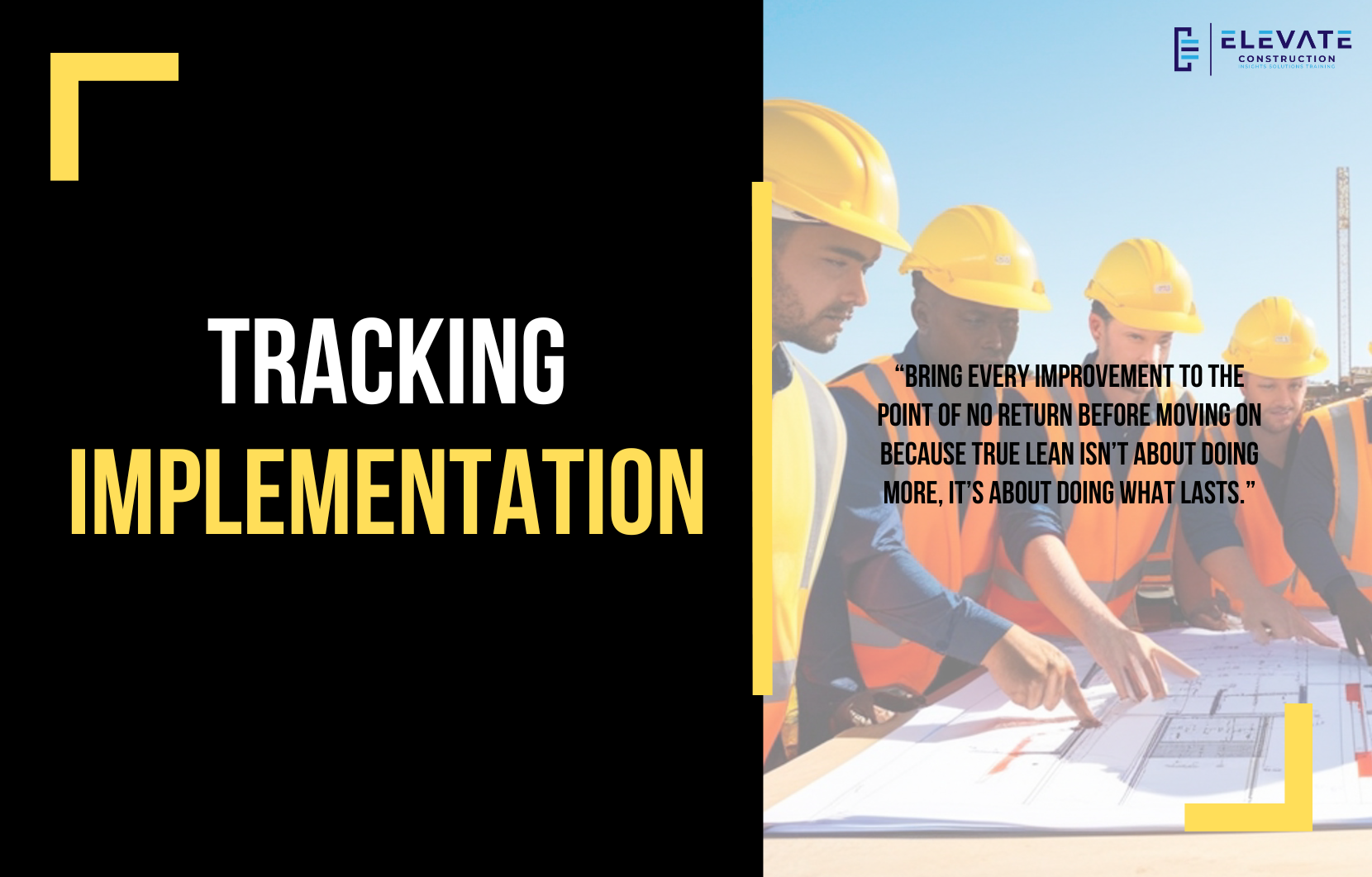
Real progress happens when you stop chasing change and start tracking it. Bring every improvement to the point of no return before moving on because true Lean isn’t about doing more, it’s about doing what lasts.

If you want to learn more we have:

-Takt Virtual Training: (Click here)
-Check out our YouTube channel for more info: (Click here) 
-Listen to the Elevate Construction podcast: (Click here) 
-Check out our training programs and certifications: (Click here)
-The Takt Book: (Click here)

Discover Jason’s Expertise:

Meet Jason Schroeder, the driving force behind Elevate Construction IST. As the company’s owner and principal consultant, he’s dedicated to taking construction to new heights. With a wealth of industry experience, he’s crafted the Field Engineer Boot Camp and Superintendent Boot Camp – intensive training programs engineered to cultivate top-tier leaders capable of steering their teams towards success. Jason’s vision? To expand his training initiatives across the nation, empowering construction firms to soar to unprecedented levels of excellence.


On we go
Posted in All

No Such Thing as a Win/Lose – Copy

Read 3 min

Why There’s No Such Thing as a Win Lose in Construction

Over the past week, I had the privilege of running two Foreman Boot Camps one with the High Street team and another up in Edmonton. Both were powerful, and while day one had participants feeling a little confused and stretched, by day two the light bulbs were turning on. By day three, many foremen were energized, motivated, and ready to implement what they had learned.

The biggest reflection from these sessions? Many foremen aren’t used to this kind of focused training and support. It was clear that the environment sitting down, engaging, connecting, and applying was unusual for them. But once they leaned in, the experience became transformational. This further confirmed for me that if there’s one group in construction we absolutely must invest in, it’s our foremen. They are the linchpins of our projects.

But I also want to share a concept I’ve been thinking about deeply, there’s no such thing as a win-lose.

The Myth of Win-Lose

We often hear phrases like, “That’s a win lose situation.” But when you look closely, a win-lose eventually turns into a lose lose.

Take marriage, for example. If one partner consistently “wins” while the other “loses,” that relationship won’t last it inevitably devolves into a lose-lose.

On construction projects, the same holds true. If a contractor prioritizes the client but neglects trade partners or designers, the project will unravel leading to schedule delays, poor quality, and frustration. What seemed like a win-lose for the client ends in lose-lose for everyone.

Even owner’s reps can fall into this trap. If they push against contractors and designers to protect the owner, they may believe they’re winning. But as the other parties struggle, the project outcome weakens, and the owner ultimately loses too.

The Real Secret: It’s Either Win-Win or Lose-Lose

Life and construction aren’t zero sum games. It’s not about one side winning while another loses. The truth is simple:

  • Everyone wins together, or everyone loses together

When trades collaborate, when owners, designers, and contractors align, and when leaders create environments of abundance and trust, projects thrive. But when competition becomes toxic, silos form, and one group tries to win at the expense of others, the result is always lose-lose.

That’s why in construction and in life we must reject the idea of win-lose thinking. The only sustainable path forward is win-win.

Key Takeaway

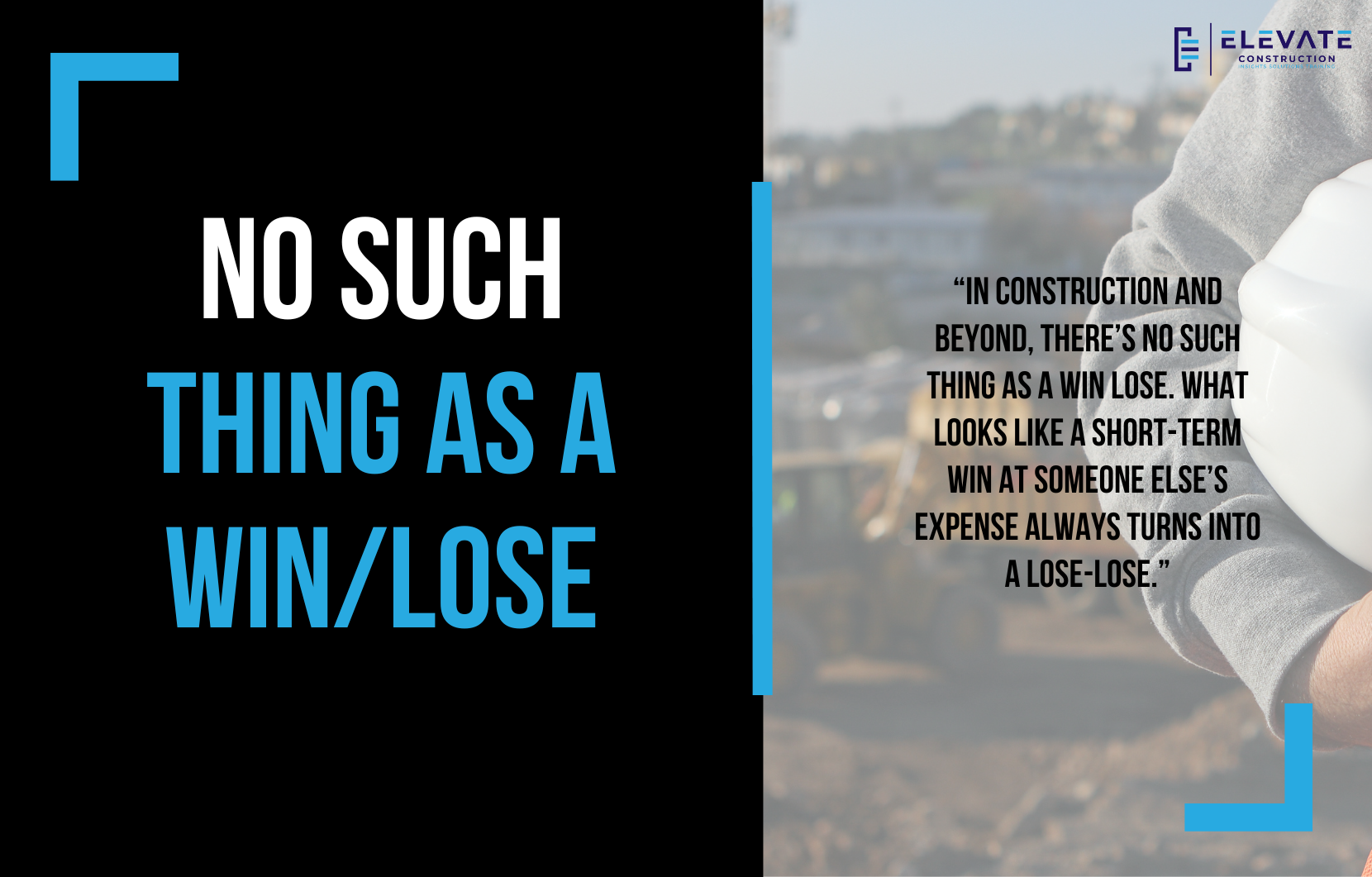
In construction and beyond, there’s no such thing as a win lose. What looks like a short-term win at someone else’s expense always turns into lose-lose. The only real path to success is building true win-win outcomes where everyone rises together.

If you want to learn more we have:

-Takt Virtual Training: (Click here)
-Check out our Youtube channel for more info: (Click here) 
-Listen to the Elevate Construction podcast: (Click here) 
-Check out our training programs and certifications: (Click here)
-The Takt Book: (Click here)

Discover Jason’s Expertise:

Meet Jason Schroeder, the driving force behind Elevate Construction IST. As the company’s owner and principal consultant, he’s dedicated to taking construction to new heights. With a wealth of industry experience, he’s crafted the Field Engineer Boot Camp and Superintendent Boot Camp – intensive training programs engineered to cultivate top-tier leaders capable of steering their teams towards success. Jason’s vision? To expand his training initiatives across the nation, empowering construction firms to soar to unprecedented levels of excellence.

On we go

Posted in All

Its Just How It Is Here

Read 4 min

It’s Not “Just the Way They Are” Shifting the Mindset in Construction

Recently, I received feedback from a reader who resonated with our focus on excellence in construction. This person had left a toxic company where systems didn’t exist, leadership was unqualified, and workers were left unsupported. They implemented as much as they could, but ultimately the environment was so broken that success was impossible. Now they’re struggling to find a company that truly values health, safety, and excellence especially as a woman in construction.

This struggle is real, and it’s happening across the industry. But here’s the truth; it doesn’t have to be this way.

The Dangerous Thought Holding Us Back

During a recent training, someone told me: “Jason, that’s not reality. People don’t want to work anymore. That’s just the way it is.”

Let me be blunt: that is a wrong thought. It’s a damaging belief that undermines people, projects, and progress.

When we say “workers today don’t care” or “the new generation won’t put in the effort,” we are spreading lies that keep our industry stuck. These aren’t truths they’re excuses. They disrespect workers, lower expectations, and directly harm project outcomes.

Operational Excellence Is Possible Everywhere

I’ve seen operational excellence on projects ranging from $5 billion mega data centers to $500,000 residential builds. I’ve seen it in civil projects, multifamily housing, and union environments. Clean, organized sites. Worker huddles. Respect for people. Consistent results.

If one project can achieve it, any project can achieve it. Excellence is not limited by project size, location, or type of workers it is limited only by mindset.

The belief that “our people can’t do it” is not just false, it’s disrespectful. If I can walk onto a site and get it done with the same workforce, then the workforce is not the problem. The problem is the way leaders choose to think about their people.

The Truth About Workers Today

Here’s the reality, workers today are just as hardworking as any generation before. The difference isn’t effort it’s motivation.

Yes, the industry has always faced labor shortages, supply chain issues, and resource challenges. These problems aren’t new. What has changed is how we choose to lead and inspire people.

When leaders believe in their teams, set high standards, and create environments of respect, workers rise to the challenge. When leaders dismiss people as lazy or incapable, they drag everyone down.

Stop Saying “It’s Just the Way It Is”

Anytime someone says, “That’s just the way it is here,” what they’re really saying is, “That’s the way we’ve chosen to think.”

I’ve seen operational excellence in every environment north, south, union, non-union, large jobs, small jobs, even in places where people swore it was impossible. The difference was never the people. It was always the mindset.

If you want better results, stop excusing mediocrity. Stop blaming workers. Stop believing the lie that things can’t improve. Change starts the moment you decide it will.

Key Takeaway

Excellence in construction is not limited by location, generation, or project type it’s limited by mindset. Stop excusing mediocrity with “it’s just the way they are.” Believe in people, lead with respect, and operational excellence will follow.

If you want to learn more we have:

-Takt Virtual Training: (Click here)
-Check out our Youtube channel for more info: (Click here) 
-Listen to the Elevate Construction podcast: (Click here) 
-Check out our training programs and certifications: (Click here)
-The Takt Book: (Click here)

Discover Jason’s Expertise:

Meet Jason Schroeder, the driving force behind Elevate Construction IST. As the company’s owner and principal consultant, he’s dedicated to taking construction to new heights. With a wealth of industry experience, he’s crafted the Field Engineer Boot Camp and Superintendent Boot Camp – intensive training programs engineered to cultivate top-tier leaders capable of steering their teams towards success. Jason’s vision? To expand his training initiatives across the nation, empowering construction firms to soar to unprecedented levels of excellence.

On we go
Posted in All

How To Be A Construction Site Supervisor

Read 5 min

How to Be a Construction Site Supervisor

Becoming a great construction site supervisor isn’t just about managing people or projects – it’s about learning to serve, add value, and lead with purpose. In this blog, we’ll explore the most common questions people ask about becoming a site supervisor, and I’ll share practical advice, real stories, and key book recommendations that will help you grow into a trusted leader on site.

What Is a Site Supervisor?

When we talk about a site supervisor, we’re referring to anyone overseeing work on a construction site – a foreman, a dedicated site supervisor, or a superintendent. In some regions, this might even be a hybrid project manager–superintendent role. No matter the title, the essence is the same: you’re responsible for leading people and ensuring work gets done safely, efficiently, and to a high standard.

Let’s go through some of the most common questions about the role and how to prepare yourself for it.

  1. How Do I Gain Leadership Experience If I’ve Only Worked with Tools?

This is one of my favorite questions because it shows genuine curiosity and readiness to grow.

If you’ve only ever worked with tools, here’s the truth: you already have the foundation. Leadership isn’t about status, it’s about service.

There are two essential mindsets to adopt:

  1. Serve your team

As soon as you step into leadership, your job becomes helping others succeed. A great book that captures this perfectly is The Motive by Patrick Lencioni. It describes two types of leaders: those who think “everybody owes me,” and those who believe “I owe my team.” The best leaders always choose the latter.

I once worked with a rebar foreman at Hensel Phelps in Austin, Texas, who told me, “For my crew, I feed them information, materials, encouragement, and water.” That’s leadership – serving your people.

Another excellent book, The Captain Class, explores how sports team captains throughout history led through service, not authority.

  1. Add value

Leadership means consistently adding value to others. Everybody Matters is another great book that illustrates how companies thrive when they focus on caring for their people, not just chasing profits.

When your crew feels supported, respected, and valued, they’ll naturally follow your lead.

  1. What Are the Key Habits of Great Leaders?

If you want to grow as a leader, focus on these patterns:

  • Build the team. Keep your crew united and motivated.
  • Have the hard conversations. Don’t tolerate toxic behavior.
  • Mentor and coach. Train and support your people daily.
  • Run effective meetings. Bring clarity, not confusion.
  • Ensure clarity. Every worker should know exactly what’s expected and what success looks like.

Your team should always be able to answer:

“Do I have what I need?” and “Do I have clarity?”

That’s your responsibility as a leader.

To get started, read classics like How to Win Friends and Influence People and keep learning from leadership books that inspire you.

If you follow one rule: give, serve, and add value, you’re already on the right path.

  1. What Training Should I Get While I’m Still in the Trades?

Simple answer: skills first, leadership second.

If you’re a tradesperson, lead person, or field engineer, your priority is to master your craft. Learn every skill you can from technical work to planning and coordination.

Once you’ve built that foundation, start experimenting with leadership. Volunteer, mentor others, and read. But if you skip the technical learning, you’ll end up in leadership without the credibility that comes from skill mastery.

So, keep filling your “tool belt” both literally and figuratively.

  1. How Do I Manage Crew Members Who Used to Be My Peers?

This one can be tough. When you’re promoted from within, your old peers might tease or test you.

The key is to serve, not boss around. Show them that you’re not above them, you’re there to support them.

If someone jokes or doubts your role, respond calmly:

“Hey, I get it, I know I’m new to this. But what do you need? I’m here to help.”

That attitude earns respect faster than authority ever could.

And if someone crosses the line, remind them: “We’re a team, right?” setting boundaries firmly but respectfully.

  1. What’s the Fastest Way to Show I’m Ready for a Supervisory Role?

Start thinking and acting like a leader now.

That means:

  • You connect well with existing leaders.
  • You notice problems before others do.
  • You help get things done without being told.

People will see that you understand the “bigger picture.” That’s what makes you ready not your title.

  1. Do I Need to Be Perfect Before Taking on a Supervisory Role?

Not at all. You don’t need to be perfect, you just need to be effective.

Be the person who:

  • Volunteers to help.
  • Follows through on commitments.
  • Communicates transparently.
  • Checks in and collaborates with the team.

When you do those things, you’ll be trusted and that’s what truly defines readiness.

Final Thoughts

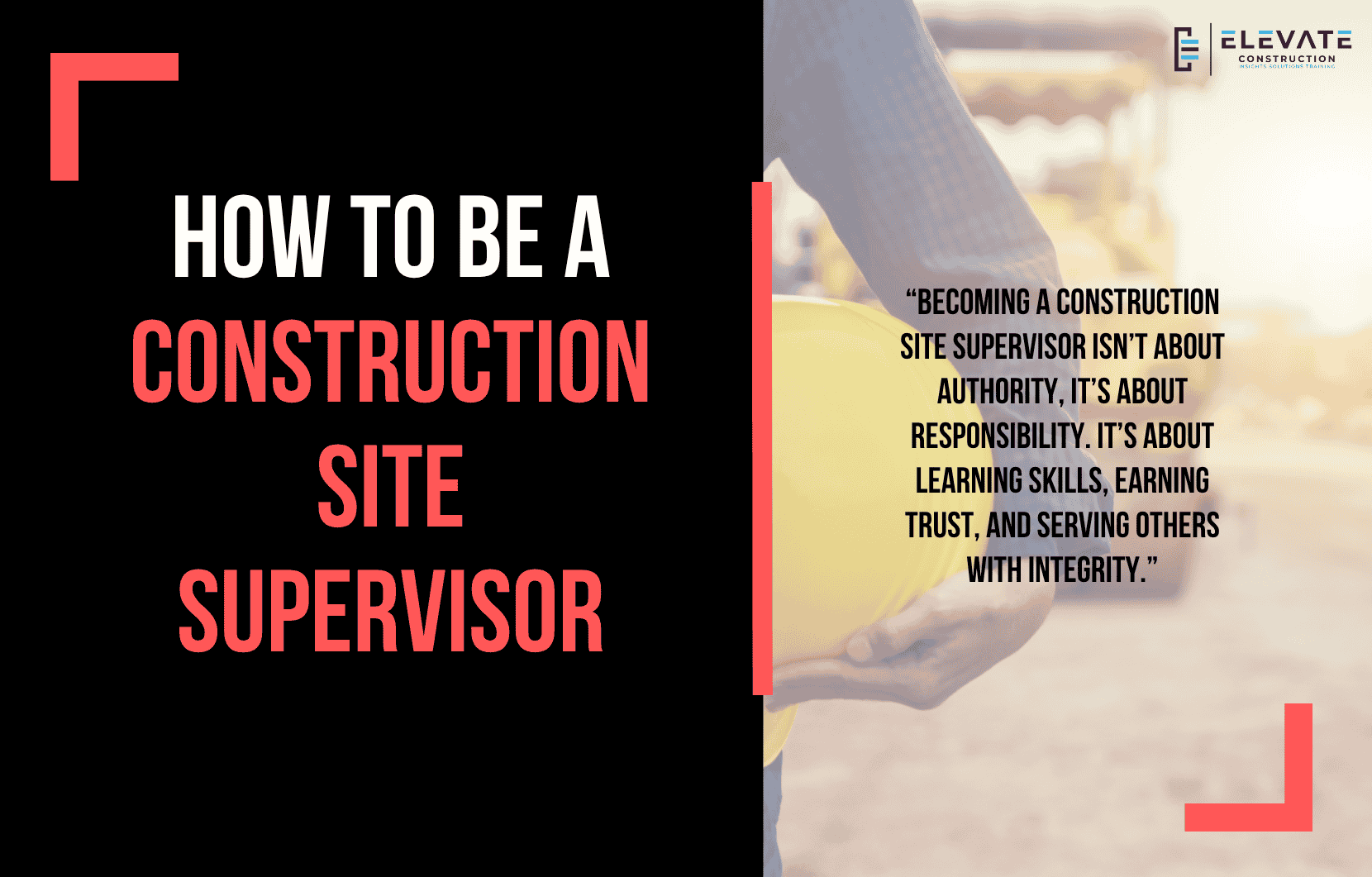
Becoming a construction site supervisor isn’t about authority, it’s about responsibility. It’s about learning skills, earning trust, and serving others with integrity.

If you remember nothing else from this blog, remember this:

Serve your people. Add value. Lead with care.

Do that, and you’ll not only become a great supervisor, you’ll become the kind of leader people want to follow.

If you want to learn more we have:

-Takt Virtual Training: (Click here)
-Check out our Youtube channel for more info: (Click here) 
-Listen to the Elevate Construction podcast: (Click here) 
-Check out our training programs and certifications: (Click here)
-The Takt Book: (Click here)

Discover Jason’s Expertise:

Meet Jason Schroeder, the driving force behind Elevate Construction IST. As the company’s owner and principal consultant, he’s dedicated to taking construction to new heights. With a wealth of industry experience, he’s crafted the Field Engineer Boot Camp and Superintendent Boot Camp – intensive training programs engineered to cultivate top-tier leaders capable of steering their teams towards success. Jason’s vision? To expand his training initiatives across the nation, empowering construction firms to soar to unprecedented levels of excellence.


On we go

Posted in All