Coaching – Cleanliness! – Implementation Series

Read 23 min

Are You Clean? How Cleanliness Reflects Your Mind and Runs Your Project

There is a telling question to ask yourself before you walk onto your project each morning: is it clean? Not presentable. Not acceptable. Clean. Because here is the truth most people in construction are not ready to hear: the state of your project is not a reflection of your trade partners or your workers. It is a reflection of you. What your project looks like is what is in your mind. And until that lands, nothing else in lean, scheduling, quality, or leadership will stick the way it needs to.

The Pain Nobody Talks About

Most superintendents know their project could be cleaner. They know it. But they explain it away with a thousand reasonable excuses: multiple trades working at the same time, materials arriving out of sequence, not enough manpower to keep up. The cords stay on the floor. The cut stations have no trash collection. The corridors become storage areas. The bathrooms become something nobody wants to walk into. And the project looks like a place where nobody is in charge, even when the schedule is technically on track.

The Failure Pattern

The failure pattern is not laziness. It is tolerance. Leaders who tolerate a messy project have, whether they realize it or not, decided that cleanliness is someone else’s responsibility or that it is a lower priority than whatever else is happening that day. That decision compounds. Trades follow the environment they are given. If cords are on the floor and nobody says anything, cords stay on the floor. If cut stations have no trash management, trash accumulates. The project becomes a physical record of every standard that was allowed to slip. And that record is visible to everyone: the owner, the trades, the inspectors, and the workers themselves.

The Superintendent Is Not the Problem

Here is what needs to be said plainly. This is not about shame. Nobody becomes a superintendent because they want to run a messy project. Most of the time, the standard was never set clearly, or it was set once and never reinforced, or the superintendent never had their awakening moment yet. The moment when something clicks and you realize that cleanliness is not a preference; it is a production strategy. That moment is different for everyone. But until it happens, a messy project is not a character flaw. It is a gap in the system that nobody closed.

The Story That Changed Everything

Jason Schroeder used to drive a gray Ford Ranger that smelled like ranch and fries. His wife Katie still teases him about it to this day. He was proud of that truck, and it was a mess. He was working for Hensel Phelps at the time, being trained by superintendents who pushed cleanliness repeatedly, but it had not fully landed yet.

That changed through a combination of experiences that hit at the same time. A project manager named Blake Christian walked Jason through the Cancer Center project over and over, pushing for a level of cleanliness that felt impossible to satisfy. Not because the project was dirty, but because Blake knew what remarkable actually looked like and would not accept anything below it. Around the same time, a general superintendent at Hensel Phelps shared a list, developed with another great superintendent named Dan Dignan, of warning signs that a project was in trouble. Near the top of that list: the job is not clean. Fifteen years of being pushed toward cleanliness, a project manager who refused to accept less than remarkable, and a veteran’s diagnostic list that put cleanliness as the first red flag. Something snapped. From that point forward, Jason became, in his own words, absolutely fanatical about cleanliness. And that fanaticism has supported his career ever since.

Why This Matters Beyond the Walk

A clean project is not just more pleasant to move through. It is a signal to everyone on site that someone is in charge and that standards are real. It is a safety environment where hazards are visible because nothing is buried under clutter. It is a lean environment where materials are where they belong, cords are off the floor, and workers are not navigating obstacles to do their jobs. And it is a cultural environment where the crew understands that the standard is the standard every day, not just when the owner is on site. Cleanliness is where lean becomes visible. You cannot run 5S, you cannot sustain standard work, and you cannot build flow without it. Clean is not the finish line. Clean is the starting line.

Your Project Is a Mirror of Your Mind

The concept Jason teaches is both simple and profound: your project is a physical representation of what is in your mind. What your desk looks like reflects the state of your thinking. What your truck looks like reflects how you manage details. What your project looks like reflects who you are as a leader. This is not a metaphor. It is a diagnostic tool. If your desk is cluttered, there is no space in your mind for new ideas. If it is disorganized, your thinking follows the same pattern. If it is full of outdated information, you are operating on a stale mental model. Your environment and your mind mirror each other, and the project is the largest and most visible version of that mirror.

This is why the 5S framework matters so deeply in construction. Sort means removing everything that does not belong. Set in Order means that everything has a defined place and gets returned to it. Shine means that the environment is clean enough that defects and hazards become immediately visible. Standardize means that the crew agrees on the method and applies it consistently. Sustain means that leaders protect the standard through reinforcement, not just inspection. None of those five steps is complicated. All of them require a leader who has decided that the standard is non-negotiable. That decision starts in the mind of the superintendent, and it shows up on the floor of the project.

Start Here on Your Next Walk

Before you apply any lean tool or production system to your project, run through these questions honestly:

  • Is every extension cord off the floor and clipped to columns or overhead framing?
  • Does every cut station have a trash can or gondola at the end of it?
  • Are materials on colored pallets, on wheels, or staged at point of use rather than sitting on the floor?
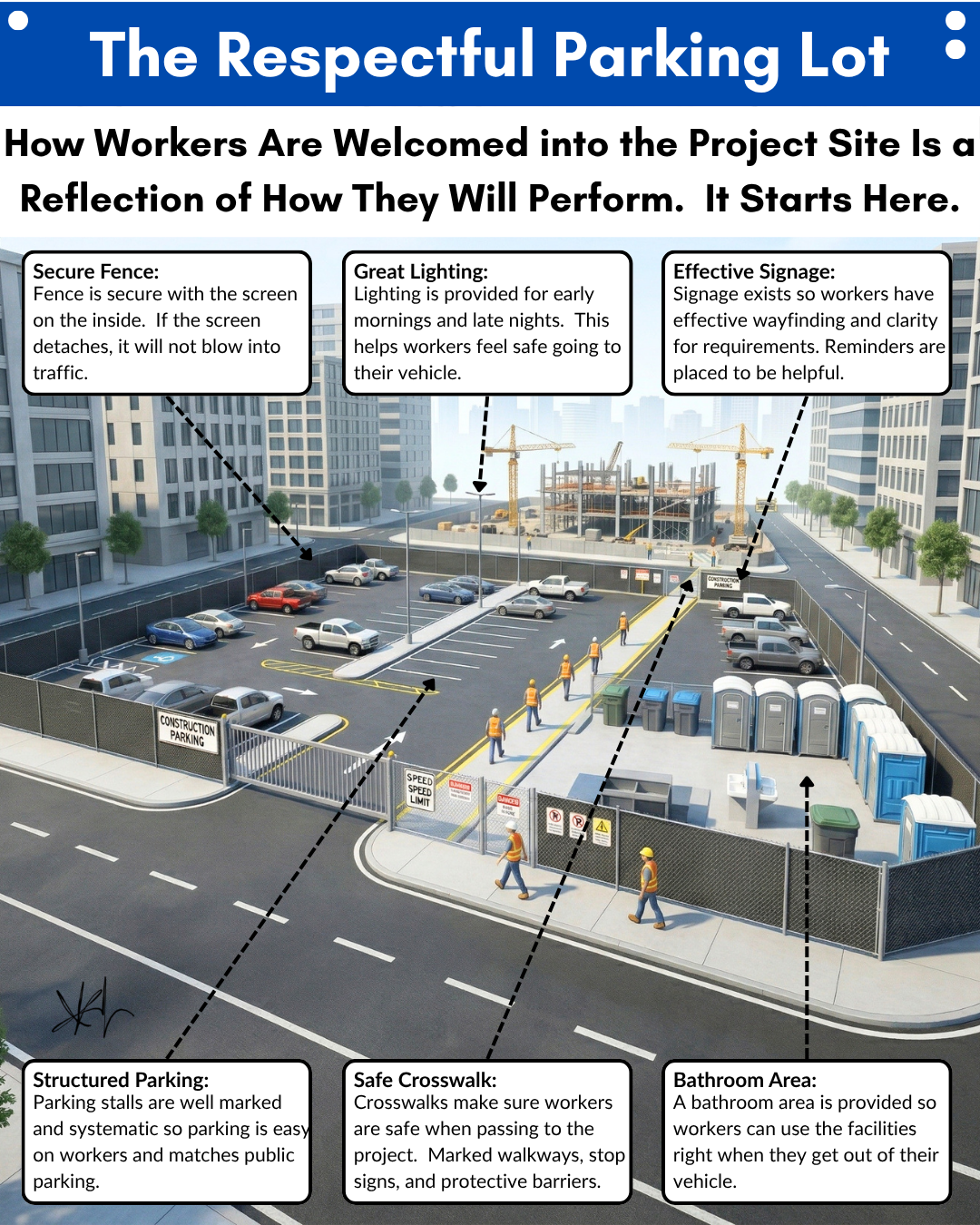
  • Are the bathrooms clean enough to reflect that workers are respected on this project?
  • Are corridors clear of staging that belongs in a laydown area?
  • Does your desk, your truck, and your office trailer meet the same standard you expect on the project floor?

If you cannot answer yes to those questions, the lean system you want to build does not yet have a foundation to stand on. Start with clean.

How You Do One Thing Is How You Do Everything

There is a famous commencement speech from a retired admiral, widely known by the title Make Your Bed, that has been viewed tens of millions of times. The argument is straightforward: make your bed in the morning and you have already accomplished the first task of the day. That one success creates momentum for the next. It sounds small. It is not small. It is the same argument Jason makes about cleanliness on the jobsite, and it points to the same truth. How you do one thing is how you do everything. The superintendent who keeps a clean desk, maintains a clean truck, and walks their project with fanatical eyes is the same superintendent who keeps their commitments, removes roadblocks before they hit the crew, follows through on every promise made in the weekly plan meeting, and runs projects that finish on time. These disciplines are not separate. They are expressions of the same standard applied in different places.

Built for People, Not Just Production

When a project is clean, something important happens to the people working in it. They feel the difference. A clean environment communicates that the people working there matter, that their safety is taken seriously, and that the leader running the project has things under control. That is what building people who build things actually looks like in practice. It is not a motivational poster. It is a clean bathroom, a cord clipped off the floor, and a superintendent who walks the project every morning with the same standard that Blake Christian walked with on the Cancer Center job. If your project needs superintendent coaching, project support, or leadership development, Elevate Construction can help your field teams stabilize, schedule, and flow.

Clean Your Room. Run Your Project.

The challenge is simple, and it starts before you arrive on site. Make your bed. Clean your truck. Clear your desk. Walk your project with eyes that see the standard for what it is. Because whatever you tolerate on the floor, you are tolerating in your mind. And whatever you clean up on the floor, you are cleaning up in your mind. As Jordan Peterson has written: clean your room before you try to change the world. The project is your room. Start there, and everything else becomes possible.

On we go.

FAQ

Why does cleanliness matter so much on a construction project?

A clean project is not just visually better. It is operationally better. When cords are off the floor, nobody trips. When materials are on pallets and staged at point of use, workers are not navigating clutter to do their jobs. When cut stations have trash management built in, the floor stays clear. Cleanliness is how hazards become visible, how lean systems become functional, and how the crew understands that the standard is real and will be enforced every day. A messy project is a project where production is slower, safety incidents are more likely, and quality is harder to control. A clean project is the environment where flow is actually possible.

What does the desk-to-project connection mean in practice?

The idea that your project reflects your mind is not abstract. It means that the habits you apply to your own immediate environment are the same habits you apply to the project. A superintendent with a cluttered, disorganized desk is managing their project with a cluttered, disorganized mind. A superintendent with a clean, organized, current workspace is managing from a place of clarity and control. The practical application is this: if you want to run a cleaner project, start by cleaning the spaces you control directly. The desk. The truck. The trailer. Those environments will train your eye and sharpen your standard, and that trained standard will show up in how you walk the floor.

What is the 5S system and how does it apply to construction?

5S is a lean framework for creating and sustaining a clean, organized work environment. Sort means removing everything that does not belong at the workstation or in the space. Set in Order means every item has a designated location and returns to it after use. Shine means the environment is clean enough that defects and hazards are immediately visible. Standardize means the crew agrees on the method and applies it without being reminded every single day. Sustain means leaders reinforce the standard through habits and walks, not just one-time pushes. In construction, 5S is what turns a busy jobsite into a controlled production environment where crews can install without fighting their surroundings to do it.

How do I handle trade partners who do not clean up after themselves?

Start by making the standard explicit before work begins. That means putting cleanliness expectations in the subcontractor orientation, posting the standard on site, and walking the floor with the same expectation every day. When you find a cord on the floor, address it immediately and respectfully, not as a personal failure but as a system gap that needs to be closed. If it continues, gather the items, bring them to a central location, and have a calm, direct conversation with the foreman. The approach is never emotional manipulation or public embarrassment. It is giving people the eyes to see the standard and the clear expectation that it will be met. Most trade partners will rise to a standard that is consistently enforced.

What is the connection between cleanliness and lean production systems like Takt?

They are directly connected. Lean production systems like Takt depend on visual control, predictable environments, and steady flow. None of those things are possible on a cluttered, disorganized site. When materials are staged incorrectly, crews waste time searching for what they need. When cords are on the floor, movement slows and safety risk increases. When zones are not clean between trade handoffs, the incoming trade absorbs the previous trade’s disorder into their own production time. Cleanliness is the physical foundation that makes every other lean tool functional. You cannot see deviations from standard work if the work environment itself is the deviation. Get the site clean first, and the lean systems that follow will actually work.

If you want to learn more we have:

-Takt Virtual Training: (Click here)
-Check out our Youtube channel for more info: (Click here) 
-Listen to the Elevate Construction podcast: (Click here) 
-Check out our training programs and certifications: (Click here)
-The Takt Book: (Click here)

Discover Jason’s Expertise:

Meet Jason Schroeder, the driving force behind Elevate Construction IST. As the company’s owner and principal consultant, he’s dedicated to taking construction to new heights. With a wealth of industry experience, he’s crafted the Field Engineer Boot Camp and Superintendent Boot Camp – intensive training programs engineered to cultivate top-tier leaders capable of steering their teams towards success. Jason’s vision? To expand his training initiatives across the nation, empowering construction firms to soar to unprecedented levels of excellence.
On we go

Standard Work & Foremen

Read 21 min

Are You Using Standard Work? Here’s What Taiichi Ohno Taught Me About the Field

Here’s a question that should bother every superintendent and foreman out there: how many times this week did a crew touch the same work twice? How many times did someone dig up pipe that was already in the ground, patch drywall that had already been hung, or run conduit a second time because the first run was wrong? If that’s happening on your project, you’ve probably blamed the workers. The experienced ones. The ones who should know better. Before you go any further, stop. That is not a people problem. That is a system problem, and it has a name: the absence of standard work.

The Pain Nobody Talks About

Walk most jobsites today and you will not find a standard worksheet posted at the workstation. You will not find a visual showing the correct installation sequence, the expected pace of the work, or how much material the crew needs at the point of work to stay moving. What you will find are capable, experienced people left to figure it out on their own every time, on every floor, on every project. Tribal knowledge is the system. Guessing is the standard. And nobody designed it that way on purpose. It just never got fixed.

The Failure Pattern

The pattern shows up the same way on every project where standard work is missing. Foremen inherit a culture that assumes workers already know, never encode the best method into anything visible, and then respond with frustration when quality is inconsistent. Superintendents push crews harder when the real problem is that nobody ever told the crew what right looked like. Variation spreads unchecked, rework accumulates, and the people closest to the work spend their days correcting errors that a visible standard would have prevented on the first day. That’s not a bad crew problem. That’s a system design problem.

The People Aren’t the Problem

I want to be direct about this because it matters. Workers are not the problem. Foremen are not the problem. When a crew goes out to install underground piping without a standard, they are working without a map. When they produce defective work, they are not failing they are surviving a system that was never designed to help them succeed. And here’s what I know to be true after years in the field: the most demoralizing thing you can do to a proud tradesperson is make them tear out something they already built. People who care about their craft hate rework. The system failed them; they didn’t fail the system.

What Taiichi Ohno Got Right

Taiichi Ohno wrote about this in the Toyota Production System, and when you read it through a construction lens, it hits different. He described how standard worksheets were posted prominently at every workstation, not as a bureaucratic exercise, but as the primary tool of visual control. He identified three elements that every standard work procedure must contain: cycle time, work sequence, and standard inventory. That combination was the operating system of the most disciplined production environment ever built. It wasn’t fancy. It was clear.

Two things jumped out when I worked through that chapter. First, that cycle time, work sequence, and standard inventory together give any worker at any time the information they need to install correctly and to know when something is wrong. Second, that the foreman’s primary job, according to Ohno, is to train. He said it plainly ,it should take only three days to train new workers in proper work procedures, and that the instructor has to actually take the hands of the workers and teach them. Not explain from a distance. Teach them, hands-on, until the sequence becomes muscle memory.

Why This Matters to the Schedule, the Quality, and the Families

Rework destroys schedules. It kills morale. It costs money that nobody budgeted for, and it creates a downstream ripple that every trade behind the defective work absorbs. But here’s what gets overlooked: when workers are fixing something they already built, they are going home late. That worker who is still on-site at 6:30 because the afternoon was consumed by tear-out is a parent, a spouse, a person whose family feels the weight of a system that didn’t protect their time. Quality at the source is not just a project metric. It is a respect strategy. Stable production protects people’s lives, not just the schedule.

Cycle Time, Work Sequence, Standard Inventory: How to Use All Three

Standard work in construction is the best-known method for a given installation, made visible and consistent. When these three elements are working together at the point of work, the crew has everything they need to execute correctly, and the foreman has a clear signal when something is drifting.

Cycle time is the pace. If you’re running a Takt wagon through a zone on an underground piping installation, what is the expected output per shift? That number belongs on the visual feature of workboard where every crew member can see it. When the crew is moving faster than the standard, something may be getting cut. When they’re slower, there’s a constraint to remove. Cycle time turns a vague sense of urgency into a measurable conversation, and it gives the foreman something real to manage instead of a gut feeling to chase.

Work sequence is the order in which the installation happens correctly. Not how it happens when people are in a rush, not how it happens when material is missing, but the standard sequence, built by people who know the work, with pictures on one side showing what correct installation looks like and steps on the other showing the order. This is where foremen earn their role not by working alongside the crew, but by building the standard, teaching it daily, and reinforcing it. When the sequence and key motions are clear, workers quickly learn to avoid redoing jobs. That’s not opinion; that’s what the research on production consistency tells us again and again.

Standard inventory is what keeps the work moving without stopping. The buffer of materials at the workstation not too much, not too little calculated to get the crew through the Takt period without waiting on deliveries. When that number lives on the feature of workboard, the water spider role stops being a guessing game and becomes a supply system. Material delays that blew up Takt time on last quarter’s project are anticipated this time, buffered, and managed before they hit the crew.

Together, these three elements create an environment where any worker can look at the standard, execute the work, and stop the work when something deviates. That stop-and-signal behavior is where quality at the source actually happens. You don’t inspect quality in at the end. You design the system so the defect never gets passed downstream in the first place.

Watch for These on Your Project

Before your next site walk, run through these questions:

  • Is there a visual standard cycle time, work sequence, and standard inventory posted at each major installation workstation?
  • Is the foreman teaching the sequence daily, hands-on, with workers at every experience level?
  • Do workers feel empowered to stop the work and signal the foreman when something deviates from the standard?
  • Does your feature of workboard include material buffers so crews aren’t waiting on deliveries?
  • Did the field team help build the standard, or did someone hand it down from the trailer?

If you can’t answer yes to most of those, the standard work isn’t functioning. It may exist on paper. But it’s not working in the field.

Built for People, Not Just Production

When crews have standard work, they are not guessing. They are not learning through failure on work that matters. They have a system built to help them succeed, and that system respects their skill and protects their time. The goal at Elevate Construction has always been to build people who build things. Standard work is one of the most direct ways to honor that commitment. It trains workers, stabilizes quality, keeps flow moving, and sends people home having done something they can be proud of the first time. If your project needs superintendent coaching, project support, or leadership development, Elevate Construction can help your field teams stabilize, schedule, and flow.

Get in the Ring and Stay There

Implementing standard work on a live project takes endurance. There will be pushback. Some foremen will think it’s extra work. Some trade partners will wonder why you’re handing them a card. Stay with it. As W. Edwards Deming observed, a bad system will beat a good person every time. The job is to fix the system, and standard work is one of the clearest, most proven fixes construction has available. Post the standard. Teach the sequence. Trust the workers. Build the environment where excellent work is the path of least resistance.

On we go.


FAQ

What is standard work in construction, and why does it matter?

Standard work is the best-known method for a given installation made visible, teachable, and consistent. In construction, it means having a posted visual at the point of work that shows the crew three things: the expected pace (cycle time), the correct installation order (work sequence), and how much material they need at the workstation to keep moving (standard inventory). Without it, every crew member figures it out differently every time, variation spreads, and rework is the result. With it, any worker can install correctly, spot a deviation, and signal for help before the defect gets passed to the next trade.

Why do experienced workers still produce inconsistent quality?

Because experience doesn’t automatically equal standard. A foreman with fifteen years in the trade carries the best method in their head, but that knowledge is invisible to the rest of the crew. Without a shared, visible standard, ten workers on the same crew may install the same item in ten different ways. Some of those ways produce defects, and nobody knows until the inspector or downstream trade arrives. The system failed them by never encoding the best method into something teachable and visible. That is a system design problem, not a people problem.

How does standard work connect to the Takt Production System?

They are inseparable in a high-performing production environment. Takt sets the rhythm and moves work packages through zones on a consistent schedule. Standard work defines what happens inside each work package. If a Takt wagon is moving through a zone on a three-day cycle but there is no standard work for the installation, crews will produce at inconsistent speeds and qualities, and the wagon will not flow. Standard work makes Takt real by ensuring that each crew can execute their package consistently within the Takt time. Without it, Takt planning is a nice-looking schedule and little else.

What is the foreman’s actual role in standard work?

The primary role is trainer. Ohno was direct about this: the foreman’s job is to teach the sequence and key motions until workers can install correctly without figuring it out on the fly. That means hands-on instruction, not explanation from a distance. It means being present at the workstation, teaching the standard, and creating an environment where stopping the work to call for help when something deviates is expected and supported. The foreman who is working alongside the crew all day instead of training them is doing valuable work in the wrong role.

What belongs on a standard work card for a construction crew?

At minimum: the cycle time for the work package expressed as expected output per shift or per day, the work sequence in order with pictures showing what correct installation looks like, and the standard inventory — the materials and buffers the crew needs at the point of work to keep moving. Beyond those three, add quality checkpoints, safety reminders, and a clear signal for when to stop and call the foreman. That card posted at the workstation is not overhead. It is the difference between a crew that guesses and a crew that wins every time.

If you want to learn more we have:

-Takt Virtual Training: (Click here)
-Check out our Youtube channel for more info: (Click here) 
-Listen to the Elevate Construction podcast: (Click here) 
-Check out our training programs and certifications: (Click here)
-The Takt Book: (Click here)

Discover Jason’s Expertise:

Meet Jason Schroeder, the driving force behind Elevate Construction IST. As the company’s owner and principal consultant, he’s dedicated to taking construction to new heights. With a wealth of industry experience, he’s crafted the Field Engineer Boot Camp and Superintendent Boot Camp – intensive training programs engineered to cultivate top-tier leaders capable of steering their teams towards success. Jason’s vision? To expand his training initiatives across the nation, empowering construction firms to soar to unprecedented levels of excellence.
On we go

The Enclosed Smoking Station System

Read 17 min

A Bin and a Sign Is Not a Smoking Area

Here’s the deal: most construction sites handle the smoking area the same way they handle every other worker comfort question minimally, reactively, and as late as possible. A trash can near the perimeter fence. A hand-painted sign. Sometimes a small overhang if the project team is feeling generous. And then everybody moves on to the real planning work, which apparently does not include the daily experience of the workers who will spend ten months on that site.

That standard communicates something. Not intentionally, but clearly. It says: we know you have needs, and we chose the cheapest possible response to them. That message does not build the kind of workforce trust and project pride that high-performing teams run on. And on the air quality side, it produces a secondary problem nobody planned for smoke migrating into work areas, across pedestrian paths, and toward nonsmoking workers going about their day.

Both problems are solvable. Neither requires significant investment. They just require someone to decide that the worker experience was worth designing for rather than accommodating at minimum compliance.

What the Industry Normalizes That It Shouldn’t

Walk the perimeter of most active construction sites and the smoking situation is immediately visible. Workers congregating at an unmarked area. No shelter. No seating. Smoke drifting back toward the building or across the access path. On cold or rainy days, breaks get cut short because there’s no protection from the weather. In summer heat, the area has no shade. Nobody thought about it as a designed space it emerged as whatever the leftover corner of the site allowed.

Jason Schroeder teaches that bathrooms are a Lean indicator the first signal of whether a project is truly Lean and truly respects the people building it. If facilities aren’t good enough for the project management team’s grandmother, they aren’t good enough for the workers. The same principle applies to every other amenity on the site. The standard you set for the break area, the lunch tent, the smoking station all of it tells the workforce how seriously you take the claim that people matter here.

The workers who smoke on your project are skilled professionals. They spend eight to ten hours a day doing physically demanding, technically complex work in conditions that most people would find exhausting. A designed break space with real shelter and clean air is not a reward. It is a baseline standard of care. The system failed them when it was never designed to meet that standard.

A Story About What a Designed Space Communicates

Early in my career I was on a project where a subcontractor foreman approached me about the smoking area. He wasn’t complaining. He was asking, almost apologetically, whether anything better was possible because his crew had nowhere to go during breaks that wasn’t either in the sun or near the building entrance where the smoke was causing complaints from other trades. His crew was one of the most productive on the project. They showed up early, stayed late, and hit every milestone in their phase plan. And for ten months, their break experience was a trash can next to a fence.

We moved the area, added a simple shelter, and put in proper seating. The reaction from that crew was completely disproportionate to the effort because the gesture wasn’t really about the bench. It was about being seen. When people feel cared for, they perform differently. Not because of the bench because of what the bench means about the people running the project.

What the Enclosed Smoking Station System Actually Provides

The enclosed smoking station in this post is a different approach from the ground up. It treats the smoking area as a designed system with specific functional requirements rather than an afterthought requiring minimal compliance.

The modular enclosure frame with clear panels creates a fully enclosed, visible, and weather-protected space. Workers can use it in rain, wind, or summer heat without the break being compromised by conditions. The clear panels maintain visibility and transparency the station is not a hidden corner, it is a professional, self-contained unit that communicates organizational standards at a glance. Internal benching seating gives workers a comfortable place to actually rest during the break rather than standing in an exposed area that discourages proper use.

The air purification system is where the technology makes the most meaningful contribution. A HEPA filter section captures harmful smoke particles at the source inside the enclosure. An activated carbon filter layer addresses odor. An exhaust fan draws contaminated air through both filter stages before releasing clean, filtered air outside. The result is that workers inside the station are not exposed to the full concentration of unfiltered smoke, and workers outside the station are not exposed to smoke migrating from an open area. Both populations are protected by design, not by hope.

Watch for these signals that your site’s smoking area is producing avoidable problems:

  • Smoke from the designated area migrating toward building entrances, active work zones, or break areas used by nonsmokers
  • Workers congregating in non-designated areas because the official area has no shelter or seating
  • Cold or wet weather causing breaks to be shortened or skipped because the area provides no protection
  • Air quality complaints from nonsmoking workers about proximity to unfiltered smoke drift

Why This Connects to the Total Worker Care Standard

Jason Schroeder’s framework for the general contractor’s responsibility is clear: the GC owes workers a safe, clean, stable, and human environment. That responsibility does not have exceptions for areas of the site that are uncomfortable to think about. Smoking is a legal activity. Workers who smoke have chosen a personal behavior that the project has no authority to prohibit on break time. What the project does have authority and responsibility over is the conditions in which that behavior occurs and whether those conditions are safe, organized, and respectful of the whole workforce.

The site power connection on the enclosed unit means setup requires no complex electrical work. Easy installation and mobile design means it can be repositioned as the project evolves and the active work areas shift the same principle applied to mobile material racks, safety compliance stations, and spider boxes. The amenity moves with the project rather than being fixed in a location that made sense on day one but is inconvenient by week eight.

All of this adds up to something that cannot be measured in a single line item but shows up across the entire project: the signal that leadership thinks about every worker’s experience. The signal that the environment was designed by people who asked, “what do workers actually need here?” before arriving at the minimum. That signal builds trust. And trust, as Jason Schroeder teaches, is the foundation of a workforce that sees as a group, knows as a group, and acts as a group instead of fifty separate subcultures coexisting on the same site.

If your project needs superintendent coaching, project support, or leadership development, Elevate Construction can help your field teams stabilize, schedule, and flow. That work includes the full picture of what the worker experience looks like from the gate to the lunch area to the smoking station to the zone.

Design Every Corner of the Worker Experience

Here is the challenge. Walk your current project during break time and look at where workers who smoke are going. Is there shelter? Is there seating? Is the area designed, or did it emerge by default into whatever corner was available? Is the smoke staying contained, or is it migrating toward other workers and work areas?

If what you find is a bin and a sign fix it before the next phase begins. The enclosed smoking station is a modular, mobile, simple-to-install solution that solves the problem completely. It is not the biggest investment a project will make. But the message it sends to every worker who uses it and every worker who walks past it is larger than its footprint suggests.

As Jason Schroeder teaches: “Respect for people is not soft it’s a production strategy.” Design every part of the worker environment to prove it.

On we go.

Frequently Asked Questions

What makes the enclosed smoking station different from an open smoking area?

It contains smoke within a filtered enclosure protecting users from full concentration exposure and preventing smoke from drifting toward nonsmoking workers, building entrances, or active work zones. It also provides weather-protected shelter and seating that an open area never does.

How does the air purification system work?

Contaminated air is drawn through a HEPA filter that captures smoke particles, then through an activated carbon filter that reduces odor, before being exhausted as filtered air by an internal fan. Both worker populations inside and outside the station are protected.

Why does the modular, mobile design matter on a construction site?

Construction work moves through phases and zones. A fixed smoking area that was convenient at mobilization may be inaccessible or near active work by month four. Mobile design means the station repositions with the project rather than creating a compliance problem as conditions change.

How does providing a proper smoking area connect to site health compliance?

An enclosed, filtered station provides implicit health compliance by containing smoke and preventing exposure to nonsmoking workers reducing air quality complaints, informal gathering in unauthorized areas, and the regulatory risk that comes from unmanaged smoke drift near occupied spaces.

Does this require special electrical installation?

No. The unit connects directly to standard site power with no complex installation required, making it immediately deployable as part of the initial site setup rather than a later addition that gets deferred indefinitely.

If you want to learn more we have:

-Takt Virtual Training: (Click here)
-Check out our Youtube channel for more info: (Click here) 
-Listen to the Elevate Construction podcast: (Click here) 
-Check out our training programs and certifications: (Click here)
-The Takt Book: (Click here)

Discover Jason’s Expertise:

Meet Jason Schroeder, the driving force behind Elevate Construction IST. As the company’s owner and principal consultant, he’s dedicated to taking construction to new heights. With a wealth of industry experience, he’s crafted the Field Engineer Boot Camp and Superintendent Boot Camp – intensive training programs engineered to cultivate top-tier leaders capable of steering their teams towards success. Jason’s vision? To expand his training initiatives across the nation, empowering construction firms to soar to unprecedented levels of excellence.
How Project Engineers Lead Meetings (Agendas, Accountability, and Results)

Read 22 min

How Project Engineers Lead Meetings: The Skills That Separate Good PEs from Great Ones

There is a version of a construction meeting that everybody has been to and nobody leaves feeling better for having attended. An agenda that exists in name only. A conversation that drifts between topics without landing anywhere. Notes that get emailed two days later and filed without being read. Assignments that are vague enough that nobody is sure whether they own them. And a follow-up meeting two weeks later that starts by revisiting everything the previous meeting was supposed to resolve.

That meeting is not neutral. It costs the project. Every hour a trade partner spends in a meeting that does not produce a clear decision is an hour they are not in the field. Every action that comes out of a meeting without a clear owner and deadline is an action that may or may not happen before the next meeting. And every meeting that produces notes instead of execution tools is a meeting that documented its own ineffectiveness.

A great project engineer becomes a meeting master before they get promoted. This is one of the specific skills that separates PEs who are ready for more responsibility from those who are not yet there. The discipline of running meetings well with preparation, focus, clear decision-making, and tight follow-through is a directly observable indicator of whether a PE is ready to take on the role of a PM.

What Goes in Before the Meeting Starts

The meeting is decided before it starts. Not the outcome but whether the outcome is likely. A PE who arrives to a meeting with the visuals ready, the BIM model open, the zone maps displayed, the logistics plan visible, and the production plan on screen has given the team everything they need to make real decisions in real time. A PE who shows up and then starts searching for documents while the trade partners wait has already wasted the first ten minutes and lost the energy of the room.

The agenda is not a list of topics. It is a sequenced set of decisions and actions that the meeting needs to produce. Every agenda item should have a purpose: what needs to be decided, who needs to weigh in, and what happens when it is resolved. Topics that are information-sharing without a decision or assignment attached to them belong in an email, not in a meeting.

Patrick Lencioni’s Death by Meeting framework introduces the concept of the lightning round a brief opening where each person shares something good happening in their work or on the project. It sounds soft. The effect is that the people in the room remember they are a team, not a collection of competing interests, and the meeting starts with connection rather than tension. A PE who brings that kind of intentionality to the opening of a meeting is not wasting time. They are investing in the quality of everything that follows.

Keeping the Meeting on Track Without Being Domineering

The PE’s job during the meeting is to keep the group moving toward decisions. Not to control the conversation. Not to prevent discussion. To recognize when discussion has run its course and bring it to a resolution “okay, who owns this?” or “let’s capture that decision and move forward” and to protect the agenda from the natural drift that happens in any group when strong opinions are present.

The tone that works here is a collaborative but clear one. “Hey, team, let’s bring this back to the agenda.” “We’ve got three more items to cover can we park that for follow-up?” “Who’s taking this action?” These are not aggressive redirections. They are respectful signals that the meeting has a purpose and the PE is responsible for protecting it. Trade partners and team members who have been in meetings run by a skilled PE will start trusting the meetings. They will come prepared because they know the meeting will actually use preparation. They will stay engaged because they know the discussion will produce something. And they will implement their assignments because they know follow-up will happen.

When a trade partner or team member needs to leave early, a skilled PE reorders the agenda to accommodate them without derailing the overall flow. That kind of flexibility noticing who needs what and adapting in real time is meeting intelligence that takes practice but produces enormous trust.

The Notes That Actually Matter

Here is the standard for meeting notes in a Lean production environment: if nobody will reference it, do not write it. The worst outcome from a meeting is a wall of raw text notes sitting in an email chain or a folder on the project management platform that nobody opens again until there is a dispute about what was decided. Those notes do not record communication. They record the ghost of communication that passed through a room and left no trace on the actual work.

Use AI note-takers to capture the raw transcript. Let the machine do that job. The PE’s job during the meeting is not to type furiously while half-listening it is to be fully present in the conversation, tracking decisions, identifying owners, and confirming assignments. After the meeting, the AI-generated notes can be reviewed and the relevant pieces can be placed in their permanent locations.

Permanent locations matter here. If the meeting was a trade partner preparation process meeting a buyout, a pre-mobilization meeting, a pre-construction meeting the information that came out of it goes into the installation work package, not into meeting minutes. The installation work package is the living document that the trade will actually use in the zone. Meeting minutes are an archive. Put the information where the crew will find it.

The Installation Work Package as the Measure of a Successful Pre-Con Meeting

The most important meetings a PE will ever run are the trade partner preparation process meetings: buyout, pre-mobilization, pre-construction, first-in-place inspection, follow-up inspections, and final closeout meetings. The pre-construction meeting in particular is where the quality of the PE’s meeting leadership becomes most visible.

A great pre-construction meeting ends with one thing: a single installation work package in the trade partner’s hands, with a single visual on the front cover that shows the crew exactly how to install their scope. Not a folder of documents. Not a summary email to be sent later. One package, highly visual, bulleted and concise, that consolidates everything the trade needs from the drawings, the specs, the owner’s requirements, the answered RFIs, and the submittal requirements into a form the foreman can carry into the zone.

If the pre-con meeting ends and the trade partner is leaving with a promise that the PE will send them something later, the meeting did not accomplish its primary purpose. The whole point of gathering that group in a room was to produce that package, in real time, collaboratively. A skilled PE has the visuals ready, pulls the key information as the meeting proceeds, and has a version of the IWP built or substantially complete before the meeting closes.

Assignments, Follow-Up, and the Buffer Between Meetings

Every meeting should end with a clear accountability list. Who owns what, by when, and in what system will it be tracked. Whether the team uses Microsoft Planner, Asana, ClickUp, a Scrum board, or any other task management tool is less important than the discipline of putting every assignment into the right system during or immediately after the meeting.

The PE should not run back-to-back meetings. A buffer between meetings even fifteen to twenty minutes is what allows the PE to close out the notes, enter the assignments into the tracking system, send any time-sensitive information, and confirm that the meeting produced what it was supposed to produce before the next one starts. A PE who goes from meeting to meeting without that buffer is batching the follow-up into a pile that gets done imperfectly or not at all. If the plan requires burnout to succeed, the plan is broken, not the people and a calendar without buffers is exactly that kind of broken plan.

The Eight Guidelines That Make PE Meetings Work

Every meeting a PE runs whether it is the weekly team meeting, the strategic planning and procurement session, an OAC, a BIM coordination meeting, or a trade partner preparation meeting should follow these eight guidelines:

  • The meeting has a clear purpose known to every attendee before it starts.
  • There is an agenda that sequences the decisions and actions needed to achieve that purpose.
  • The discussion stays on track, with the PE steering gently but consistently.
  • Decisions get captured as they are made, not reconstructed afterward from memory.
  • Every action has a specific owner, not a general “the team will handle it.”
  • Follow-up is built into the meeting’s close assignments entered, deadlines confirmed, next touchpoint established.
  • Information from the meeting goes into permanent, accessible locations the IWP for trade prep meetings, the task management system for action items, the appropriate folder for reference documents.
  • Meeting minutes become execution tools. Not notes. Tools that drive next steps.

Those eight guidelines are the structure. The PE’s skill is in bringing them to life in real time, in rooms with trade partners who have competing priorities and limited patience for process, in conversations that will occasionally drift and need to be brought back.

Building the PM Before the Promotion

Meeting mastery is not just a PE skill. It is one of the clearest signals that a PE is ready to step into a PM role. The ability to prepare, facilitate, decide, capture, assign, and follow up efficiently, respectfully, and consistently is the core of what makes a PM effective at the project business level. A PE who has run two hundred good meetings is a PE who has been practicing PM skills for the past year. That is the development path that produces the next generation of great project managers.

We are building people who build things. The PE who masters meetings is building the decision infrastructure that protects the whole team trades, superintendent, owner, and every worker who depends on the upstream decisions being made well and communicated clearly. If your project needs superintendent coaching, project support, or leadership development, Elevate Construction can help your field teams stabilize, schedule, and flow including the PE meeting mastery that turns every gathering into an execution tool.

A Challenge for Builders

Look at the last three meetings you ran or attended as a PE. Did each one start with a clear purpose and a prepared agenda? Did each one end with every action owned by a specific person with a specific deadline in a tracking system? Was the information produced in each meeting placed immediately into its permanent location the IWP, the task manager, the relevant folder rather than into meeting minutes that nobody will reference? If the answers are weak, the meetings are costing the project. Pick the next one and run it to the eight guidelines. The difference will be visible to the room.

As Jason says, “If the plan requires burnout to succeed, the plan is broken, not the people.”

On we go.

Frequently Asked Questions

What makes the installation work package the goal of a pre-construction meeting?

Because the pre-con meeting is where all the relevant information about a trade’s scope gets consolidated for the first time. A skilled PE uses that meeting to build the IWP in real time, so the trade leaves with one visual document covering drawings, specs, RFIs, owner requirements, and submittal needs not a promise that something will be sent later.

Why shouldn’t PEs take traditional meeting notes?

Because text notes that capture the conversation rather than the decisions are almost never referenced again. AI note-takers can handle the transcript. The PE’s job is to be present, capture decisions and assignments in real time, and immediately place them in their permanent locations task management systems for actions, the IWP for trade information, the procurement log for supply chain items.

What is the right structure for a meeting a PE is running?

Clear purpose, prepared agenda, discussion kept on track, decisions captured as made, every action assigned to a specific owner with a deadline, follow-up built into the close, information placed in permanent locations, and meeting minutes that function as execution tools rather than archives.

If you want to learn more we have:

-Takt Virtual Training: (Click here)
-Check out our Youtube channel for more info: (Click here) 
-Listen to the Elevate Construction podcast: (Click here) 
-Check out our training programs and certifications: (Click here)
-The Takt Book: (Click here)

Discover Jason’s Expertise:

Meet Jason Schroeder, the driving force behind Elevate Construction IST. As the company’s owner and principal consultant, he’s dedicated to taking construction to new heights. With a wealth of industry experience, he’s crafted the Field Engineer Boot Camp and Superintendent Boot Camp – intensive training programs engineered to cultivate top-tier leaders capable of steering their teams towards success. Jason’s vision? To expand his training initiatives across the nation, empowering construction firms to soar to unprecedented levels of excellence.
Communication Skills for Project Engineers (How to Run a Job Without Chaos)

Read 20 min

Communication Skills for Project Engineers: Why Clarity Is a Production Requirement

Every project has a version of this conversation. The trade partner is standing in their zone, missing a piece of information. They call the PE. The PE says “it’s on Procore.” The trade opens Procore and finds that the relevant information is spread across a drawing set, two specification sections, a meeting minute from six weeks ago, an answered RFI that got posted somewhere in the RFI log, and a change order that may or may not have been communicated to the field crew. The trade does not know which of those items is current, how they interact, or where the actual answer they need is sitting.

The PE provided a location. The PE did not communicate. And the distinction between those two things is the gap between a project that flows and a project that fights itself every day.

What Bad Communication Actually Looks Like

There are specific phrases that signal a PE’s communication system is failing the trades. Not red flags necessarily some are orange, some yellow but none of them are green. Learn to recognize them before they become field stops.

“It’s on Procore.” The problem is that information in a project management platform is not consolidated. It is stored. Stored across dozens of folders, document types, and communication threads that the person who organized them can navigate and the person who didn’t cannot. Telling a trade partner their information is on Procore and expecting them to find it is not communication. It is delegation of a search task to someone who does not have the context to complete it efficiently.

“I told you in an email.” Email is one of the least effective communication mechanisms in the industry. It requires the recipient to find the right email among dozens of others received that day, parse the relevant information from the surrounding context, retain it until the moment they need it, and correctly apply it without the ability to ask a clarifying question in real time. Most of the time, they do not retain it correctly. Most of the time, they cannot find the specific email when they need it. And most of the time, the person who sent it believes communication happened when it did not.

“I’m sure you can find it.” This is condescension disguised as confidence. If the trade could find it easily, they would not have asked. The PE’s job is to get the trade the information they need in a form they can use, not to be confident they can figure it out on their own.

What Real Communication Produces

Real communication between a PE and a trade partner is not an event. It is a chain that runs from the beginning of the relationship through the final payment. Every link in that chain either builds clarity or erodes it.

The chain starts at scope clarity. The drawings and specs that govern the trade’s work should be complete and comprehensible enough that the trade understands what they are being asked to build. If there are ambiguities in the scope documents, those should be surfaced and resolved before the trade is asked to price the work, not discovered mid-installation. The PE’s role in buyout is not just to solicit bids it is to make sure the bid package is clear enough that the trade who wins the work understands what they won.

The contract follows from the scope. A fair contract with clearly identified inclusions and exclusions, a schedule of values that ties payment to the actual sequence and components of the installation, and risk allocation that reflects the actual distribution of risk on the project. This is not a legal document for protection it is a communication document that tells the trade what their working relationship with this project team looks like and what they can rely on.

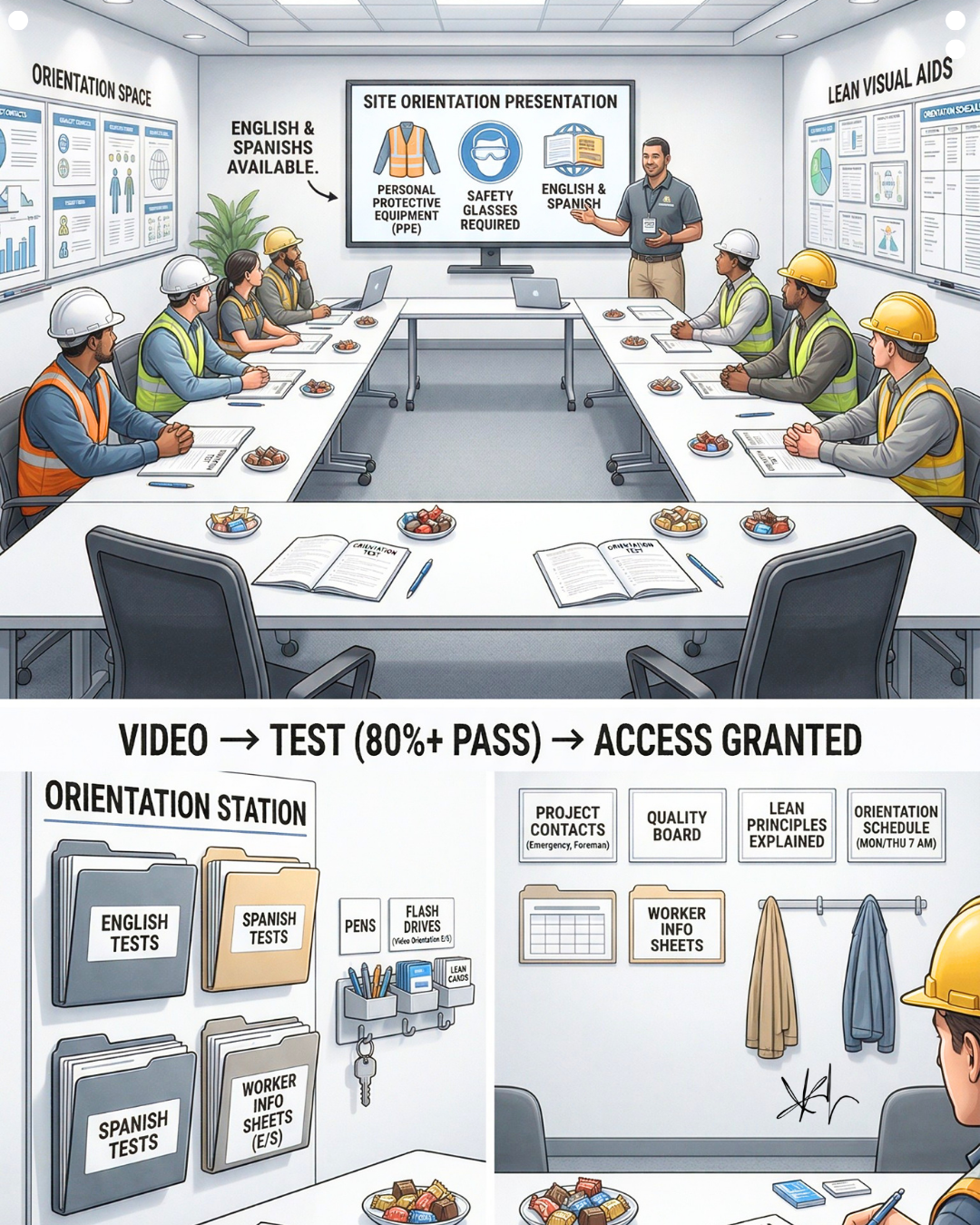
The pre-mobilization communication confirms what the trade needs to bring to the pre-construction meeting and what they need to have in place before they arrive on site. Not a long email. A clear, concise, bulleted list of specific requirements in one document. The trade shows up knowing what is expected of them because the PE told them directly and in a format they could actually absorb.

The pre-construction meeting itself should produce one document: a single, visual installation work package that consolidates everything the trade needs to know about their scope the key drawings, the relevant spec sections, the answered RFIs that affect their work, the owner’s specific requirements, the submittal requirements, and the initial zone sequence from the pull plan. Not a wall of text. Not a folder of documents to sort through. One consolidated, highly visual, bulleted document the foreman can carry into the zone and install from.

Visual Communication Over Verbal and Written

Here is a principle worth treating as non-negotiable: do not trust words, and do not trust words on text alone. Trust clear, identified, Lean visuals when it comes to communicating what needs to be built and how.

The human brain processes visual information far faster and retains it far more reliably than text. A drawing with clear callouts communicates installation requirements in seconds that a paragraph of specification language takes minutes to convey and the drawing leaves far less room for misinterpretation. An installation work package with a visual front page showing the crew what the finished work should look like in the zone is a communication tool the foreman can use in real time. A PDF spec section is a research document that requires training to navigate.

AI tools are increasingly capable of consolidating scattered information meeting notes, RFI answers, specification highlights, drawing callouts into summarized, readable formats. That is a tool available to PEs right now. Use it. The goal is always the same: one location, one document, one clear visual that gets the trade everything they need to install their scope without stopping to search.

The Communication Chain That Prevents Field Stops

When PE communication is working as a production system, the information flow from contract to zone completion looks like this:

  • Scope is clear in the bid documents before the trade prices the work, eliminating scope disputes that delay the project and consume PE time later.
  • The contract is fair, clear, and consistent with the schedule of values, so payment flows without renegotiation and the trade understands their obligations from day one.
  • The pre-construction meeting produces one installation work package per trade that consolidates all relevant information in one visual document.
  • The pull plan positions the trade correctly in the sequence so they understand how their zone flows into the next trade’s work and what their handoff commitment is.
  • RFIs that arise during the work get answered and communicated back to the field on a timeline driven by the construction sequence, not by the reviewer’s availability.
  • Conflicts between trades or between field conditions and design intent get resolved through direct conversation and updated documentation, not through email chains that nobody in the field ever reads.

That chain does not happen accidentally. It happens because a PE has designed a communication system that serves the trades rather than documenting activity for its own sake.

Warning Signs That Communication Is the Problem

Before the frustration compounds into a field stop, look for these signals that the PE’s communication is not reaching the crews:

  • Foremen are regularly calling the trailer for information that should already be in the work package more than occasionally means the IWP is incomplete.
  • Trade partners are finding contradictory information between drawings, specs, and RFIs because nobody has consolidated the current state into a single authoritative document.
  • The same question is being asked multiple times by multiple trades because the answer was communicated once through email and never made it into the IWP.
  • Meeting minutes are the primary vehicle for communicating decisions to the field, which means decisions are buried in a document nobody searches until there is a dispute.
  • The response to a trade’s information request references the project management platform without pointing to a specific, consolidated location.

Every one of those signals is a PE who is storing information rather than communicating it, and a field that is absorbing the cost.

Listening, Trust, and Conflict

Communication is not only outbound. A PE who communicates clearly but does not listen is missing half the job. Trade partners carry field intelligence that no drawing or specification contains they know where the design does not match the conditions, where the sequence creates a practical problem, where a material choice that looks fine on paper will be difficult to install in the real building. That intelligence only reaches the production system if the PE is accessible, responsive, and genuinely interested in what the trade is seeing.

Assume everybody is doing their best. Manage conflict professionally rather than defensively. Build trust between the office and the field so that information moves both directions freely from PE to trade and from trade back to the team. The office and the field are not separate cultures. They are parts of the same production system, and the PE is one of the primary bridges between them.

We are building people who build things. The PE who masters communication is building the information environment that allows the whole team to perform at their best because every foreman, every crew leader, and every worker has what they need, where they need it, in a format they can actually use. If your project needs superintendent coaching, project support, or leadership development, Elevate Construction can help your field teams stabilize, schedule, and flow including the PE communication standards that eliminate the information gaps that slow every project down.

A Challenge for Builders

Pick one trade partner on your current project and trace their information chain this week. Did they leave the pre-construction meeting with a single visual installation work package? Is that document current with all the RFIs, addenda, and clarifications that have come through since then? When they have a question, do they receive a clear, specific answer with a consolidated location or a reference to the project management platform and a suggestion to look around? The answer to those questions tells you how much the communication system is costing the production system.

As W. Edwards Deming said, “In God we trust. All others must bring data.”

On we go.

Frequently Asked Questions

Why is “it’s on Procore” not considered effective communication?

Because project management platforms store information across dozens of locations drawings, specs, RFIs, meeting minutes, change orders that the person who organized them can navigate and the trade trying to find a specific answer cannot. Communication means consolidating the relevant information into one clear, visual location the trade can use, not pointing to a platform and expecting them to search.

What should a trade partner have at the end of a pre-construction meeting?

A single installation work package that consolidates all the information they need to plan, build, and finish their scope key drawings, relevant spec sections, answered RFIs, owner requirements, submittal requirements, and their initial zone sequence from the pull plan. Highly visual, bulleted, without walls of text. One document, not a folder.

Why does the gap between office and field create communication failures?

Because when the office and field operate as separate cultures, information stops flowing freely in both directions. PEs stop listening to field intelligence because they are focused on documentation. Foremen stop surfacing problems because the PE is not accessible. Decisions get buried in meeting minutes that nobody in the field reads.

If you want to learn more we have:

-Takt Virtual Training: (Click here)
-Check out our Youtube channel for more info: (Click here) 
-Listen to the Elevate Construction podcast: (Click here) 
-Check out our training programs and certifications: (Click here)
-The Takt Book: (Click here)

Discover Jason’s Expertise:

Meet Jason Schroeder, the driving force behind Elevate Construction IST. As the company’s owner and principal consultant, he’s dedicated to taking construction to new heights. With a wealth of industry experience, he’s crafted the Field Engineer Boot Camp and Superintendent Boot Camp – intensive training programs engineered to cultivate top-tier leaders capable of steering their teams towards success. Jason’s vision? To expand his training initiatives across the nation, empowering construction firms to soar to unprecedented levels of excellence.
Supply Chain Management for Project Engineers (Materials, Procurement, and Logistics Explained)

Read 20 min

Supply Chain Management for Project Engineers: How Materials Get to the Zone on the Right Rhythm

A construction project stalls in two ways. The first way is visible crews in a zone with nothing to install, waiting for materials that should have been there yesterday. The second way is invisible a supply chain that nobody tracked carefully enough to catch the delay before it hit the field, so the first way becomes inevitable. Every material-related field stop on any project has a supply chain decision or a supply chain non-decision somewhere upstream of it. The project engineer is the person responsible for making sure that upstream chain is never the reason the field stops.

This is not a purchasing role. It is not a vendor management role. It is a production system role. The supply chain is as much a part of the Takt plan as the zone sequence and the trade flow, and it has to be managed with the same discipline, the same tracking rigor, and the same forward-looking orientation. The PE who manages supply chains reactively who follows up when materials are late rather than getting ahead of lead times before they become problems is a PE who will consistently find themselves explaining field stops that were entirely preventable.

Design, Buyout, and Procurement as One Production System

The most important reframe in supply chain thinking is this one: design, buyout, and procurement are not separate phases that happen before construction. They are interdependent threads of the same production system that runs alongside and feeds the field work. If those threads are not linked to the actual construction sequence to the Takt plan, the zone structure, the trade handoffs the materials will arrive on a procurement calendar rather than on a construction rhythm. Those two things are not the same.

The production sequence works backward from required-on-job date. The PE starts with when the crew needs the material in the zone, works backward past site buffers to the on-site arrival date, then past delivery time to the dispatch date, past fabrication lead time to the release of the purchase order, past the approval cycle to when the submittal needs to be approved, past the GC and architect review time to when the submittal needs to be submitted, past the trade partner’s preparation time all the way back to the buyout date.

Every link in that chain has a duration and a dependency. When all of those durations are mapped against the Takt plan and tracked on a procurement log, the PE knows exactly when every action needs to happen to keep the supply chain from becoming the critical path. That knowledge is not static it updates every week as the field progresses, as lead times shift, and as new information changes the picture. The procurement log is a living document that reflects current reality, not a spreadsheet frozen at preconstruction that nobody looks at again until something arrives late.

The Strategic Planning and Procurement Meeting

The mechanism that keeps this system running is the strategic planning and procurement meeting a weekly session attended by the PM, the superintendent, and the project engineer. This is not a status meeting. It is a forward-looking session that reviews the procurement log against the production plan, confirms that buffers are set correctly, identifies any supply chain items at risk of missing their required-on-job dates, and activates recovery actions before the problem reaches the field.

The questions this meeting answers every week: What is due on site in the next four to six weeks? Is everything on track to arrive on time with the required buffer? Are there submittals that need to be expedited? Are there purchase orders that have not been released yet against a lead time that is already consuming its buffer? Are there fabrication issues that the vendor has flagged? What recovery options exist for anything that is slipping?

Fifteen major recovery strategies are available when a supply chain item gets behind expedited shipping, alternate vendors, substitute products, phased deliveries, adjusted zone sequencing, scope split orders, and several others. But those strategies only work when the slip is identified early enough to deploy them. A PE who discovers a supply chain problem the week before the material is needed has almost no recovery options. A PE who identifies the same problem six weeks out has many. The difference between those two situations is the quality of the tracking system and the consistency of the weekly review.

Never Wait to Start Procurement

This is the principle that separates PEs who consistently resource projects well from those who are always catching up. You do not wait to start procurement activities until the design is complete, the trades are contracted, or the schedule is finalized. You start from day one with the best information available, and you refine continuously as more information becomes available.

Think of it as successive coats of paint. The first coat is a rough procurement framework built from AI assistance, team experience, and whatever project information exists identifying the categories of long-lead items likely to be on this project type and starting to estimate the lead time exposure. The second coat adds a macro-level Takt plan that defines the rough construction sequence and the required-on-job dates for major material categories. The third coat brings in the vetted plan, the team’s specific knowledge, and the preliminary trade partner input. From there, each additional coat of information executed contracts, approved submittals, vendor confirmations, updated lead times makes the procurement picture more accurate and more specific.

At every stage, the PE is tracking. At every stage, the PE is advancing the procurement activities that can be advanced with the information available. There is no point in a project where waiting to start is the right answer. If you do not have the design, use AI to identify the categories of risk. If you do not have the trade partner contracted, use your experience and your team’s knowledge to estimate lead times. If you do not have the vendor quotes, use benchmark data. Start, and refine. Never wait.

The long-lead items in particular cannot wait. Curtain wall, switchgear, fire pump assemblies, elevators, specialty tile from overseas vendors these are the items that have sunk projects that were perfectly managed in every other respect. Every commercial project has something that needs to be released early. Every project has always had something like this. The PE who identifies that item in preconstruction and starts the procurement chain before anyone else thinks it is necessary is the PE who protects the field from the most expensive kind of material stop.

Warning Signs That the Supply Chain Is Getting Ahead of the PE

Before a material delay becomes a field stop, watch for these signals that the supply chain management system needs to be tightened:

  • The procurement log was built at the start of the project and has not been updated in more than two weeks.
  • A long-lead item’s submittal has not been submitted yet, and the lead time calculation shows it is already consuming the buffer.
  • The strategic planning and procurement meeting is being skipped or shortened because “things are going fine.”
  • Trade partners are reporting delivery schedule changes to the superintendent rather than to the PE, because the PE is not in regular contact with the vendors.
  • Materials are arriving on site without a scheduled material inspection, going directly to wherever they can be staged rather than into a managed queuing area.

Every one of those signals is a supply chain that has started running ahead of the person responsible for managing it. The recovery is always possible. But the later it starts, the fewer options remain.

Receipt, Inspection, and Kitting: The Last Mile of Supply Chain

Getting materials to the job site is not the end of the supply chain. It is the handoff into the last mile of the delivery system receipt, inspection, and kitting and the PE is responsible for making sure that last mile works as well as the procurement chain that preceded it.

An advanced queuing area receives materials as they arrive on site. The PE conducts a material inspection to confirm the delivered items match what was ordered, are in the correct quantities, and are undamaged. Then the materials get Lean-kitted by zone organized so that the telehandlers and forklifts can take each zone’s materials directly to the zone, rather than distributing everything to a central staging area that creates additional movement and re-sorting downstream. Packaging materials dunnage, pallets, cardboard get broken down and removed at the queuing area so they do not travel to the zone and create waste there.

What arrives at the zone is exactly what that crew needs for their work package. Not everything that was delivered to the site. Not the zone’s materials mixed with three other zones’ materials. The right materials, in the right quantity, for the right work package, delivered at the right time. That is just-in-time delivery at the zone level, and it is the downstream end of everything the procurement log, the submittal tracking, and the weekly supply chain review were designed to produce.

We are building people who build things. The project engineer who manages the supply chain as a production system who starts early, tracks fanatically, recovers proactively, and completes the delivery by kitting materials to zones at the right rhythm is building the environment in which every crew can perform at their best. If your project needs superintendent coaching, project support, or leadership development, Elevate Construction can help your field teams stabilize, schedule, and flow including the supply chain discipline that keeps materials arriving just in time, every time.

A Challenge for Builders

Open your current project’s procurement log this week. For every long-lead item, trace the chain backward from required-on-job date. Is every required action on track? Is the submittal submitted and in the right review stage? Is the purchase order released against the fabrication lead time? Are the buffers intact? If any item is consuming its buffer without a recovery plan in place, that item is already a risk to the schedule. Activate a recovery strategy this week while options still exist.

As W. Edwards Deming said, “Without data, you’re just another person with an opinion.”

On we go.

Frequently Asked Questions

Why should procurement start before design is complete or trades are contracted?

Because long-lead items require action far upstream of when they’re needed in the field, and waiting for design completion before starting procurement means the lead time window is already closing before anyone has acted. Starting with AI assistance and best available information, then refining continuously, is always better than waiting for certainty that will arrive too late.

What is the strategic planning and procurement meeting and who attends?

It is a weekly forward-looking session attended by the PM, superintendent, and project engineer that reviews the procurement log against the production plan, confirms buffers are intact, identifies supply chain items at risk, and activates recovery before problems reach the field. It is one of the most important recurring meetings on any project.

What does “Lean kitting by zone” mean in supply chain delivery?

It means materials arriving on site are sorted at the advanced queuing area into zone-specific kits exactly what each crew needs for their work package so delivery to the zone is direct and precise. Telehandlers carry the zone’s materials to the zone, not a mixed pile from which the crew has to sort. Packaging is removed at the queuing area, not at the zone.

If you want to learn more we have:

-Takt Virtual Training: (Click here)
-Check out our Youtube channel for more info: (Click here) 
-Listen to the Elevate Construction podcast: (Click here) 
-Check out our training programs and certifications: (Click here)
-The Takt Book: (Click here)

Discover Jason’s Expertise:

Meet Jason Schroeder, the driving force behind Elevate Construction IST. As the company’s owner and principal consultant, he’s dedicated to taking construction to new heights. With a wealth of industry experience, he’s crafted the Field Engineer Boot Camp and Superintendent Boot Camp – intensive training programs engineered to cultivate top-tier leaders capable of steering their teams towards success. Jason’s vision? To expand his training initiatives across the nation, empowering construction firms to soar to unprecedented levels of excellence.
How to Become a CEO

Read 19 min

How to Become an Executive or a CEO: What It Really Takes

Holy cow. Holy cow. We’re at 400. We’re going to talk about how to become an executive or a CEO. Stay with us. Welcome everybody. Jason hopes you’re doing well. This is going to be like a three minute podcast. He just wants to do a little shout out for all of you who would, if you were in a meeting with him in a training and he asked you “Do you want to be a general superintendent or a project executive or an executive on the leadership team or the COO or the CEO of a company?” If you would raise your hand, he’s got some quick advice.

He’s covered some of these topics in the past. We can expand them in the future if you want to, but here are some things that you have to start doing because Jason cares about your career and he just wants to love you and support you. He just wants you to know that this is what it takes.

You Have to Start Remembering People’s Names

First of all, you have to start remembering people’s names. That’s self-explanatory. Jason knows what you’re thinking. You’re not good at it. God didn’t gift you with that. It’s not easy. Don’t care. You want to be a CEO or an executive. Let’s just say, if Jason says CEO, he means executive level leadership or an executive. You have to remember people’s names.

Second thing, you have to target reading a book a week. This is books like The One Thing or Focal Point or How to Win Friends and Influence People or The Road Less Stupid by Keith Cunningham. You have to start educating your mind and getting really sharp. Next one. Follow the steps to personal mastery. You can use Jason’s little system, his Four Bullets, or you can use something like what Brendan Burchard provides on his High Performance Habits book and podcasts and his events.

Jason’s is you have to have the clarity of where you want your life to go, a rich and a growth mindset, and you can look those graphics up, those books, Mindset by Carol Dweck or The Secrets of the Millionaire Mind. Then you have to have a killer personal organization system that allows you to conquer everything you should be doing, and a morning routine.

The reason he told you that is because your morning routine every day will focus you on being grateful for what you have and giving. You will never be a good CEO or executive and probably won’t even become a CEO or an executive if you don’t give first to the people around you.

Stop Doing the Doing and Start Doing the Leading

You need to start spending most of your time with people. You need to stop doing the doing and do as little of the doing as you possibly can and start doing the leading, the mentoring, the coaching, the guiding, the supporting, the loving. Start spending most of your time with people.

Also, start your training journey and professional development journey. This isn’t bragging. This is just passing along information. By the way, Jason’s the least of all leaders and mentors. There are business leaders and mentors and coaches out there that you can go find to get all the information and he encourages you to go get them.

Tony Robbins always says, and Jason agrees with him, you have to have the right mindset and you have to get a mentor. You have to find somebody who’s wildly successful and go spend time and be around them as much as you can. Totally agree.

But you need to start your training journey and Jason will just tell you because he can. From his journey, the first certification training he ever went to was the CM-BIM AGC certification. Then he did the CM-Lean. Then he did the Lean Construction certification. Then he went and did his Design Build Institute of America certification. He was like “Dang, I really like this.” Then he started doing the business. Actually, there were executive coaching sessions with Tony Robbins and some others. Then he went to a Tony Robbins event. Then he did a report. Then and then and then.

It went from, like Eric Thomas always says, it went from $1,000 to $3,000 to then $5,000. Now every year Jason spends $15,000 to $30,000 on professional development training for himself. Next year it’ll be $50,000. The year after that it’ll be $60,000. Maybe actually next year it’ll be $85,000 because there’s a platinum partnership that Tony Robbins has that he would totally sign up for if he had the money. You cannot underemphasize the importance of professional development. Start your journey now.

You Have to Campaign If You Want to Be Elected President

The other thing is advertising. It doesn’t matter. Jason will give you an example. George Bush, whether you like him or not, Bill Clinton, whether you like him or not, doesn’t matter. George Bush, and Jason remembers this as a little kid, didn’t really politic, didn’t really campaign, and wasn’t really out beating the streets. He thought that he should be elected just based on what people knew he was doing. Bill Clinton out there connecting with people, jamming out, campaigning, doing his thing. Who won? Bill Clinton.

You cannot become an executive or a CEO and not advertise and let people know what you’re doing and let people know where you are and what’s going on and show up at public events and connect with people and be a part of charities and do these things. You have to be able to do that and be known to your people. You have to campaign if you want to be elected president.

The other thing is you have to be good with finances. You have to be able to learn that whether you like it or not. If you didn’t go to business school, go look up the Keith Cunningham 4-Day MBA. Is it 4-day or 5-day? Jason thinks it’s a 4-day, could be a 5-day MBA. Anyway, if you don’t get it with 4-day, put in 5-day. He thinks it’s the 4-Day MBA program with Keith Cunningham. Go learn finances, accounting, business, and get those basics.

The Universe Will Conspire to Put You in Position

Last and most importantly, if you want to become a CEO or an executive, take care of your family, your health, your spirituality, your finances, your growth, and make sure your entire life is balanced. But most especially, take care of your family.

When you have these things in place, the universe, God, whatever you believe, will conspire to put you into positions where you can affect a larger amount of people with a greater amount of influence doing the most important things. If your project needs superintendent coaching, project support, or leadership development, Elevate Construction can help your field teams stabilize, schedule, and flow.

FAQ

Q: Why do I have to remember people’s names to become a CEO?

You have to start remembering people’s names. That’s self-explanatory. You’re thinking you’re not good at it. God didn’t gift you with that. It’s not easy. Don’t care. You want to be a CEO or an executive. You have to remember people’s names. You need to start spending most of your time with people. You need to stop doing the doing and do as little of the doing as you possibly can and start doing the leading, the mentoring, the coaching, the guiding, the supporting, the loving. Start spending most of your time with people.

Q: How much should I invest in professional development?

You need to start your training journey and professional development journey. From Jason’s journey, the first certification training he ever went to was the CM-BIM AGC certification. Then he did the CM-Lean. Then he did the Lean Construction certification. Then he went and did his Design Build Institute of America certification. Then executive coaching sessions with Tony Robbins and some others. It went from $1,000 to $3,000 to then $5,000. Now every year Jason spends $15,000 to $30,000 on professional development training for himself. Next year it’ll be $50,000. The year after that it’ll be $60,000. You cannot underemphasize the importance of professional development. Start your journey now.

Q: Why do I need to advertise and campaign to become an executive?

George Bush didn’t really politic, didn’t really campaign, wasn’t really out beating the streets. He thought that he should be elected just based on what people knew he was doing. Bill Clinton out there connecting with people, jamming out, campaigning, doing his thing. Who won? Bill Clinton. You cannot become an executive or a CEO and not advertise and let people know what you’re doing and let people know where you are and what’s going on and show up at public events and connect with people and be a part of charities and do these things. You have to be able to do that and be known to your people. You have to campaign if you want to be elected president.

Q: What are the steps to personal mastery I need to follow?

You have to have the clarity of where you want your life to go, a rich and a growth mindset (you can look those graphics up, those books, Mindset by Carol Dweck or The Secrets of the Millionaire Mind), then you have to have a killer personal organization system that allows you to conquer everything you should be doing, and a morning routine. Your morning routine every day will focus you on being grateful for what you have and giving. You will never be a good CEO or executive and probably won’t even become a CEO or an executive if you don’t give first to the people around you.

Q: What’s most important if I want to become a CEO or executive?

Last and most importantly, if you want to become a CEO or an executive, take care of your family, your health, your spirituality, your finances, your growth, and make sure your entire life is balanced. But most especially, take care of your family. When you have these things in place, the universe, God, whatever you believe, will conspire to put you into positions where you can affect a larger amount of people with a greater amount of influence doing the most important things.

On we go.

If you want to learn more we have:

-Takt Virtual Training: (Click here)
-Check out our Youtube channel for more info: (Click here) 
-Listen to the Elevate Construction podcast: (Click here) 
-Check out our training programs and certifications: (Click here)
-The Takt Book: (Click here)

Discover Jason’s Expertise:

Meet Jason Schroeder, the driving force behind Elevate Construction IST. As the company’s owner and principal consultant, he’s dedicated to taking construction to new heights. With a wealth of industry experience, he’s crafted the Field Engineer Boot Camp and Superintendent Boot Camp – intensive training programs engineered to cultivate top-tier leaders capable of steering their teams towards success. Jason’s vision? To expand his training initiatives across the nation, empowering construction firms to soar to unprecedented levels of excellence.
On we go

Supply Chain Madness

Read 37 min

The Difference Between Pushing and Driving: Why Urgency Without Capacity Is Useless

Jason is out in the front of his house. What time is it? It’s 4:17. It’s going to be a beautiful day. He’s looking at some purple, orange, green, and red beautiful Halloween lights on his tree sitting next to a skeleton in his other front yard, lots of pumpkins on a chair, front yard chair. Got some pumpkins, some scary spooky things, a spider, some spider webs, and he’s got bats hanging above him. Anyway, super fun.

Hope you’re all ready for the holidays. Anyway, he’s out here. He doesn’t know if you can hear the crickets but it’s beautiful. Sometimes he loves to just come out here and have a nice peaceful morning until somebody like him starts up a podcast and starts yammering. But anyway, so beautiful and he’s ready to talk today.

On a podcast the other day, Jason was talking about building capacity and the difference between that and pushing. He realized there was a mistake in his philosophy there that a lot of superintendents really connect with the concept of pushing, but he’d like to define that in two different ways in the sense that the superintendents that really have drive and urgency aren’t pushers, they’re drivers. He likes the two little analogies there.

Japanese Train Attendees Push People Into Trains

Let Jason give you an analogy of pushing if that’s okay. If you look at the subway or the train stations in Japan, it’s kind of funny some of the things that they do. They’ll have guards there or in some cases they’ll have attendees or guards and people will just stack up in front of the train and these guards will push them into that train and just really jam pack everybody in there.

If you ever want to check out a really cool YouTube video, go ahead and type in “Japanese attendees pushing people onto trains” or however you want to search that. It’s really kind of funny. Now Jason hopes it is safe. He hopes it’s not unsafe, but it’s true. It’s like a real thing.

When they push people on there, not only are they having a lot of really strenuous contact, but you’re not really getting too much more bang for your buck and you’re cramming so many people in there. It can’t be safe from just a personal space, a transmission of disease, an appropriate “Hey, who’s doing what” situation and then exiting the train. Jason doesn’t even know if those trains are designed for the capacity there, but he really likes the thought of that when pushing.

Or if you have a bottleneck and you pretend like you have a bottleneck on the side. Jason thinks he did this on LinkedIn. Imagining like a bakery bag that has frosting in it or like a Tapatio bottle. Have you ever tried to push frosting, especially if it wasn’t soft, through a small nozzle? It’s a nightmare. Just imagine that pushing. Then you talk about driving. Driving is where you’re actually at the wheel, focused, looking forward, going the right speed and staying between the lines. You’re staying in your lane.

Now when somebody’s not driving, they’re in the passenger seat. They’re victims of circumstance. They’re going at the pace of somebody else. They’re not actively looking at the road. They’re not actively looking at the parameters. They’re literally just being brought. Jason likes the thought: you don’t want to be a passenger on a project site. You do want to drive, but you don’t want to push.

Pushing Makes You Go Slower

Let Jason go back to the concepts that he talked about the other day and posted on LinkedIn. When you’re pushing, you’re doing things like this:

  • Throwing manpower at the problem
  • Throwing money at the problem
  • Making workers work too fast and too long
  • Working with unsafe and unclean conditions
  • Working with too much dependency
  • Not having enough time in the schedule
  • Having too large or too small batch sizes (meaning they’re too large or too small)
  • Working in an improper sequence
  • Moving start dates up without preparation
  • Throwing materials at the problem
  • Becoming frantic so you can prove to your boss that you’re working hard

Those are all concepts of pushing and they’re only going to make you go slower.

Now building capacity, this is what Jason would call driving. He had put a list here:

  • Removing roadblocks
  • Installing it right the first time (we’re between the lanes, we’re paying attention to the road, we got our foot on the gas, we’re going the right speed and we’re moving forward)
  • Aligning and managing procurement
  • Keeping a consistent rhythm
  • Keeping it clean, safe and organized
  • Improving team health and stability
  • Taking more time to prepare and make work ready
  • Increasing communication
  • Optimizing bottlenecks and increasing flow

Jason put in here “building capacity” but you just as well could have put in here “driving.” There’s a sense of urgency that we absolutely have to have anywhere we go.

A Superintendent Without a Sense of Urgency Is Ineffective to the Point of Uselessness

Let Jason share with you one more little segment. This is from the book Elevating Construction Superintendents. This is step number 15, Drive with Urgency. This is talking about a superintendent but this could apply to anyone.

A superintendent without a sense of urgency is ineffective to the point of uselessness. Superintendents must keep pace with the project to finish on time. Superintendents are the timekeepers, the drivers and the ones who keep everyone accountable to follow a certain rhythm on the project. Their role is to pull all aspects of the project into the dimension of time. And without that crucial awareness, a supervisor cannot excel.

It is the superintendent’s job to bring everything on the project into the aspect of time. As a director coaching a team, Jason remembers when the team was six weeks behind schedule and finishing concrete. The field director told them they needed to begin a swing shift for concrete crews and rodbusters to pick up the time the very next day.

“Do you have any response from the team why they couldn’t do this?” the field director asked. “If we decide now and implement tomorrow, it will be done. Then we will be on our way to picking up the rest of the time.”

After this suggestion, the team still did not exhibit the urgency to drive the situation but rather focused more on their fears and apprehensions. On the field director’s next visit, he had some choice but appropriate words for the project team when he said “We’re doing this tomorrow. What do you guys not understand?”

As they started giving excuses, the local lead superintendent committed to get the ball rolling and within 24 hours had rodbusters and a crew of carpenters to come in at night with the appropriate rigging and equipment. The project projections immediately went from six weeks behind to two weeks behind with the prospect of also getting back the additional two weeks.

Success in warfare has never been associated with long waiting. The quote from General Patton is appropriate for this topic. A good plan violently executed today is better than a perfect plan executed next week.

We must have a sense of urgency at work. There are things that we overthink, situations that we overanalyze, and plans that we try to over perfect in construction. This means that we frequently lose valuable time, losing days to save hours.

Superintendents who have not found a sense of urgency and do not feel the responsibility to finish on time hinder the project in incalculable ways. These supervisors are among those who fail on their performance reviews, get stuck in their role, and are not ready for the next promotion.

Immerse yourself in your schedule for at least 30 minutes every day. Everything brought to your attention by your trade partners and others in meetings should be checked against your schedule to ensure you have the indispensable sense of urgency to get the work done on time. Also, practice coming out of the ground quickly on projects when you only have a few trades on site. Don’t overthink and overanalyze unless it’s very high risk.

Get the consensus of the group once you have a good enough plan and make sure you move forward with drive and urgency. Intentionally practice this on a continual basis. Become creative on how you can gain ground and move things forward as long as it doesn’t interrupt the flow.

For every question on site, ask if the situation is being given the appropriate amount of urgency. Most importantly, when the problem arises on site, do not delay fixing it. Do what needs to be done. Remove that person, add that other person to the conversation, order those materials, demolish the defective work, do whatever needs to be done, and do not wait.

Expediency is associated with success in warfare and in construction. If you can properly learn how to instill a daily sense of urgency and passion and drive in your role, you will obtain success because you will not be hindered by the consequences of delay. You will have a balanced life and be effective as you supervise because things are not piling up and burning you out. You will finish projects earlier because you authoritatively and intelligently take advantage of certain situations which do not bring the project out of flow. You will gain time and contingencies on the project and it will serve you later when mistakes arrive. You will be able to overcome and adapt.

That’s the end of the section there. And Jason wants to say that he likes that part. He wrote the book but he looks back at it and he’s like “Ooh, I like this author.” A superintendent without a sense of urgency is ineffective to the point of uselessness. That is really just a 100% true point.

Drive with Urgency Means Preparing the Seven Conditions for Sound Activity

When we have a sense of urgency, we are doing the right things at the right time. Going back to another post that was posted the other day on LinkedIn. Jason has it right here. Seven conditions for a sound activity. We need to make sure:

  • Prior activities are planned
  • Construction design and information is ready
  • Materials and components are ready
  • Workers are prepared and trained
  • Equipment is maintained and prepared
  • Workspaces are made ready, cleaned, and they’re safe
  • External conditions, approvals, and permissions are given

So when we drive with a sense of urgency, we’re not pushing. We’re not doing those silly things that Jason talked about just a minute ago. We’re not doing the things that would cause the project to delay. We’re actually doing the things that will prepare our work, those seven conditions.

When somebody thinks about going fast, they’re like “Oh, I’m going to push. I’m going to throw manpower, throw money at the problem, make workers go too fast, do out of sequence work, have things scheduled with not enough time, too large or too small of batch sizes, working in an improper sequence, moving start dates up.”

If somebody finishes on Thursday, “I’m going to move the succeeding task up to Friday.” Get them out of sequence and put them into a large amount of variation. Throw materials at the problem, becoming frantic.

No, that’s not what that means. What it means is that if the contractor finished on a Thursday, instead of moving that other contractor, the succeeding contractor up on a Friday, you will drive with urgency, meaning you will make sure that nobody takes that situation complacently. You will lead, you will drive, you will encourage, you will oversee, and you will ensure that this gets done, that the activities happening on Monday have all of the conditions of satisfaction met to start that work.

They have their preparations, they have their layout, they have their information, they have their lift drawings, they have their quality meetings, they have their submittals approved, they have all of their materials stocked and staged and ready to go, the area is clean, contractors are out of there.

Anybody Can Push But Only the Best Can Drive with Urgency

When Jason talks about driving with urgency, it’s not pushing other people. He didn’t say push, he didn’t say cram everybody into that rail car, he didn’t say cram that frosting through that nozzle onto that cake and push. He said create capacity and creating capacity takes that drive, takes that urgency, because only the really true builders can get out there and see what needs to be done to prepare and create that capacity and do it on time.

Here’s the thing: anybody can push when everybody’s frantic and freaking out, but only the best can drive with urgency as a self-motivated system, meaning that somebody is a self-starter, self-motivated, they have that urgency intrinsically within themselves. They don’t need somebody else, they don’t need some external condition, they don’t need some emergency to have that drive.

Jason’s saying the best builders have that drive intrinsically and they use that drive not for pushing but for creating capacity. Meaning let’s make sure that we have that procurement log, let’s make sure we’re finishing our systems, let’s make sure we’re doing defect correction systems, let’s make sure we have the drive and the urgency to stay within the lanes and keep driving forward with cleanliness, organization and safety, that we’re implementing zero tolerance, that we’re grading contractors, that we’re updating the schedule, that we’re following our huddle systems, that we’re following the quality process, that we’re really having great wonderful conversations with our last planners and the last planner system, making sure that work is prepared and that we’re having more intelligent conversations.

The other thing that Jason would say is that great teams are built when they follow those five behaviors of trust, conflict, goal-setting, accountability and performance, that they have a strenuous performance goal that’s magnetizing that team. And that you have a multiplier leader. Now you need that goal for the team because everybody needs to follow that goal, but the leader, the great builders will have that urgency intrinsically themselves.

Why Did We Get All This Time Just to Waste It?

One of the most annoying things that has ever happened to Jason in his career, which he failed at doing until they corrected it, was they started creating Takt plans in preconstruction with the project team, with the superintendent, and they got the team the right amount of time. And then certain teams, without a builder, without that drive and that urgency, they’d get complacent. They’d be like “Oh, we got time. We can eat into the buffers.” If you eat into all your buffers now, you’re going to get into a crash landing anyway. So why did we go get all of this time just so we could waste it?

Jason thinks that’s probably where some of our owners are coming from. They’re like “Yeah, no, you want the six weeks? No, I’m not giving it to you. Just deal with it.” And you’re in this crash landing situation. He thinks they do that because they want to know that people have a sense of urgency and drive.

What we have to do, the current condition, is we have to get out of the situation where people are victims and they are more like animals. They are things to be acted upon and get them into the human victor mindset, where they are things to act. They are humans that will act upon their circumstances and create stability.

Get out of the “I’m a victim. I am only shaped by my circumstances. I have to have an owner push me. And I’m going to use that urgency and drive to freak out.” We have to get from that to “I am a victor. I control the circumstances. I am not acted upon. I don’t need some external force to make me have drive and urgency. And I’m going to drive the right way with preparation, with flow and with capacity.”

Jason definitely wants to demonize the word pushing a little bit and enable and encourage the word drive. He really just prays and wishes and hopes and encourages everybody to have that good amount of drive in life because it really does a lot for us. How we do one thing is how we do everything.

There are times where we need to drive when we’re relaxing and there’s times when we need to drive when we’re at work. When Jason’s driving and relaxing, he’s in Hawaii or on a vacation, having date night. He’s driven the circumstances and created the capacity and the stability to have his phone off and to be totally focused with his wife or doing whatever he’s doing.

When he’s driving at work, they’re encouraging and working with the team, they’re encouraging and creating healthy environments. They’ve got decorations up in the trailer, they’ve got good morale, they’ve got good teaming, they’ve got open office spaces, they’ve got great huddle systems and there’s this time clock, there’s this beat on the rhythm and there’s this energy.

That’s probably the last thing that Jason would say: when people drive with urgency, they do it with positive, wonderful, loving and exciting energy. It’s like Disneyland. And when people push, it’s coercive and negative and just destructive and stressful and icky.

Jason would like to ask all of us to stop pushing and start driving with positive energy. If your project needs superintendent coaching, project support, or leadership development, Elevate Construction can help your field teams stabilize, schedule, and flow.

FAQ

Q: What’s the difference between pushing and driving?

Pushing is like Japanese train attendees cramming people into trains or trying to push frosting through a small nozzle. When you’re pushing, you’re throwing manpower at the problem, throwing money at the problem, making workers work too fast and too long, working with unsafe and unclean conditions, working with too much dependency, not having enough time in the schedule, having too large or too small batch sizes, working in an improper sequence, moving start dates up without preparation, throwing materials at the problem, becoming frantic so you can prove to your boss that you’re working hard. Those are all concepts of pushing and they’re only going to make you go slower. Driving is where you’re actually at the wheel, focused, looking forward, going the right speed and staying between the lines. You’re staying in your lane.

Q: What does it mean that a superintendent without a sense of urgency is ineffective to the point of uselessness?

Superintendents must keep pace with the project to finish on time. Superintendents are the timekeepers, the drivers and the ones who keep everyone accountable to follow a certain rhythm on the project. Their role is to pull all aspects of the project into the dimension of time. Without that crucial awareness, a supervisor cannot excel. Superintendents who have not found a sense of urgency and do not feel the responsibility to finish on time hinder the project in incalculable ways. These supervisors are among those who fail on their performance reviews, get stuck in their role, and are not ready for the next promotion. A good plan violently executed today is better than a perfect plan executed next week.

Q: What are the seven conditions for sound activity that driving with urgency prepares?

Prior activities are planned, construction design and information is ready, materials and components are ready, workers are prepared and trained, equipment is maintained and prepared, workspaces are made ready, cleaned, and safe, and external conditions, approvals, and permissions are given. When we drive with a sense of urgency, we’re not pushing. We’re actually doing the things that will prepare our work, those seven conditions. If the contractor finished on Thursday, instead of moving that succeeding contractor up on Friday, you will drive with urgency, meaning you will make sure that the activities happening on Monday have all the conditions of satisfaction met to start that work.

Q: Why do teams with buffer time get complacent and waste it?

Certain teams without a builder, without that drive and that urgency, get complacent. They’re like “Oh, we got time. We can eat into the buffers.” If you eat into all your buffers now, you’re going to get into a crash landing anyway. So why did we go get all of this time just so we could waste it? That’s probably where some of our owners are coming from. They’re like “Yeah, no, you want the six weeks? No, I’m not giving it to you. Just deal with it.” They do that because they want to know that people have a sense of urgency and drive. Only the best can drive with urgency as a self-motivated system. The best builders have that drive intrinsically and they use that drive not for pushing but for creating capacity.

Q: How is driving with urgency different from being frantic?

Anybody can push when everybody’s frantic and freaking out, but only the best can drive with urgency as a self-motivated system, meaning somebody is a self-starter, self-motivated, they have that urgency intrinsically within themselves. They don’t need somebody else, they don’t need some external condition, they don’t need some emergency to have that drive. When people drive with urgency, they do it with positive, wonderful, loving and exciting energy. It’s like Disneyland. When people push, it’s coercive and negative and just destructive and stressful and icky. We have to get from “I’m a victim” to “I am a victor. I control the circumstances. I don’t need some external force to make me have drive and urgency. I’m going to drive the right way with preparation, with flow and with capacity.”

On we go.

If you want to learn more we have:

-Takt Virtual Training: (Click here)
-Check out our Youtube channel for more info: (Click here) 
-Listen to the Elevate Construction podcast: (Click here) 
-Check out our training programs and certifications: (Click here)
-The Takt Book: (Click here)

Discover Jason’s Expertise:

Meet Jason Schroeder, the driving force behind Elevate Construction IST. As the company’s owner and principal consultant, he’s dedicated to taking construction to new heights. With a wealth of industry experience, he’s crafted the Field Engineer Boot Camp and Superintendent Boot Camp – intensive training programs engineered to cultivate top-tier leaders capable of steering their teams towards success. Jason’s vision? To expand his training initiatives across the nation, empowering construction firms to soar to unprecedented levels of excellence.

On we go

Supply Chain Madness

Read 44 min

What We Can Do in Our Current Economy with the Supply Chain Crisis

Jason has good news. Well, maybe it’s just good news for him, but they were able to in a real rush set up their recording studio over there at the Field Verified offices with Brian Milter. They’re starting to record those really nice videos.

Tomorrow afternoon, it’s been a big push for them. They are wanting to reach more people through those videos. By the way, they work with Nicholas Modig with Construction Excellence and the wonderful people at Lean Communications in Norway to scale lean information and specifically training for construction.

If you’re ever interested in Lean Fundamentals courses, Operational Transformation courses, any of the courses they have in construction for Lean Fundamentals or for the Integrated Production Control System or Takt Planning, please let Jason know.

Why he’s telling you this is that not a lot of free time right now. He just got done probably with three months being on the road, as you know, and it’s been nice to be a little bit back at home, back on his time zone and be setting things up. They’re ready to go but he’s now doing a podcast on the way home but he was like “Dang it! They’re not going to take another podcast from me with the background noise.” But the traffic is so bad that he thinks he can pull this off. So if you hear a bump or something, he is driving but it wasn’t so noisy that he thought it’d be a problem.

Really appreciate all of you. The podcast numbers are through the roof. There’s so many people providing positive feedback and listening to these podcasts. Jason attempts to make them quick, 18 minutes to the point. Here’s the information. Go. Please let him know how he can improve them.

But boy, he tells you what, they’re at around on average like 700, 800, 900, sometimes even a thousand people listening a day to the podcast now. It’s because you are sharing this information and really helping them. Boy, does he appreciate it. You’re fantastic and he loves you.

The Panic Is What Causes Supply Chain Problems

This is what Jason needs everybody to do. He wants everybody to listen to him and glean the right things from this and you leave whatever you don’t want. We are in and entering in a supply chain crisis that literally nobody can do anything about. Jason did a podcast the other day on why it was happening. And it’s true.

The franticness, the panic is what causes these supply chain problems, especially when there’s a ripple. Now when you have COVID-19, there’s going to be a ripple because factories shut down. Then once you see a little bit of scarcity, everybody starts to panic and go mad. We saw that when COVID-19 hit with the supermarkets and toilet paper. It’s not just-in-time deliveries that’s the problem. It’s the panic. It’s the attitude.

Jason’s not even saying that we don’t have to respond to it. If everybody’s panicking, you have to panic too to get out the exit door. If everyone else is panicking with materials, you have to panic too. So he gets it. He’s not condemning you. He just wants to make sure that everybody knows what the actual reason is.

Katie also researches the news, not for Jason but for herself, but she always keeps him up to date. She was like “We are about to enter in a supply chain crisis the likes of which we’ve never seen.” Now for people that are wondering about this, dude, there’s nothing you can do about it. It’s just happening. So the question is, should you go push and kill people on construction projects? No, we need to get better at this and we need to get more transparent with the owner.

It’s going to be hard to get steel. It’s going to be hard to get joists. It’s going to be hard to get metal decking. It’s going to be hard. All the things. But some of those are forced errors and some of those are unforced errors. Meaning some of that is inevitable variation and some of that is not inevitable variation.

This is what Jason would really like to ask the entire industry to do right now as a favor to him and as a favor to you and as a favor to the vendors and as a favor to everybody in construction so that we can level this as much as we possibly can. He’s going to give you some practical advice. This is what we need to do.

If you’re a superintendent, a PM, a senior PM, a project executive, a project director, a field director, general superintendent, owner of a business, whatever, this is our plan. Let’s go ahead and sit down and talk as friends.

Your Submittal Register Is NOT a Procurement Log

We need to implement on a mass scale procurement logs in a very intentional way. Now let Jason be clear about something. Your Procore, Prolog, CMIC, whatever other system you’re using, submittal register systems is not a procurement log. Let him just be clear about that.

You can in your submittal register in those applications put a due date, but for the most part it tracks the project management items only. Here are the categories that Jason cares about. He wants required on job. He wants the material inventory buffer. He wants the actual shipment duration. He wants the fabrication duration. He wants the approvals and queuing duration. He wants to know how long the actual approvals take for all parties, including the designers. He wants to know how long it takes to actually submit that. He wants to know how long it takes to actually design and put together the shop drawings and any of the information that’s actually going to queue up the material release. So that is not a submittal register. What he’s talking to you about is a procurement log.

Those procurement logs, really Jason’s never seen better ones anywhere other than Excel. Somebody would be like “Well you can’t run multiples.” Yes you can. Okay, so calm down. Just calm down. If you want to find a software, if you want to do this in Smartsheet, or if you want to program something, fine. Go do it. He’s just saying in Excel it’s a jamming system. If you want to do something better, great. He loves you. Send it to him and he’ll publish it on the Lean Takt YouTube channel for everybody to see and they’ll praise you. What he’s saying though is people think that because they have a submittal register that everything’s fine. It’s not fine. It’s not fine.

What we have to do, whether you’re using CPM, God forbid, or if you’re using Takt planning, thank God, you need to know your required on job dates for everything. You can have a good schedule put together, Jason’s telling you, in schematic design. You can have a Takt plan, and that’s the genius of the system, have a Takt plan put together in schematic design.

So here we go. If you have that, then all you have to do is piece out all the required materials. Now are you going to track drywall? Maybe, maybe not. Are you going to track screws? No, probably not. Okay, but are you going to track light fixtures? Yes. Are you going to track millwork? Yes. Are you going to track exterior curtain wall? Yes. Are you going to track critical pieces of equipment for mechanical and commissioning? Yes. All of those things need to be distilled down from the specifications and in coordination with the trade partners right away.

90% of Projects Have No Idea What Their Financial Projections Are

If Jason goes to a job, first things he asks: Do we have a Takt plan? Do we have our procurement log? Has somebody gone through these specs? Are we queued up with a 90-day schedule ready to go so that we can mobilize this project? Do we have a financial projection sheet so that we know what kind of deal we’re signing up for at a GMP?

Jason swears to you, as God is his witness, without any irreverence, when he travels around this industry, 90% of the projects, the project managers and the PXs, they have no idea what their financial projections are. They have no idea the status of all of their procurement and they have no project controls. Guys and gals, this is project management 101. We have to have these things.

Jason went to a job that was halfway through. “Where’s your procurement log?” “Yeah, we don’t have one. The trade partners take care of it.” What? “Yeah, where are your financials?” “Oh yeah, we do kind of a project status report every month.” “Well, what about your status of your contingency?” “Oh, we don’t know.” “What about potentials? What about your exposure log?” “We don’t know.” “What about the difference between your lump sum self-perform contract and your overall budget? What’s remaining?” “We don’t know, but we have this sheet that tells us.” “Okay, what does the sheet mean?” “Well, we don’t know how to read it.” What? What are we talking about here?

Okay, so Jason needs that procurement log. You need, we need that procurement log up and running. He doesn’t care if we got to work 12-hour days for a couple weeks and go against this whole team balance and health personal organization system thing, we need to get that done. And he needs all of those required on job dates plugged in from the master schedule. You need that, rather.

The Buffer Column Is the Second Most Important

Once those dates are in there, the second most important column is the buffer. Now you can, in short order, in your fresh eyes meeting especially, identify the increased buffer durations for any of these items. So if you’re like “Oh, just-in-time doesn’t work.” Well, you’re wrong. And then second of all, what you need to do is put your buffer time in there and it will increase the overall planning queue and that will give you the overall correct duration when you should release the materials.

Okay, so that buffer column, if you’re dealing with drywall, maybe drywall’s only increased two weeks. Maybe if it’s underground pipe and structures, maybe it’s increased by eight weeks and you put eight weeks in that buffer time. If you have a problem with exterior curtain wall and that’s a real big problem with glazing for some reason, maybe it’s 12 weeks. Whatever it is, whatever has increased from a needed buffer time duration because of COVID-19, buffer time and quantity amount because of COVID-19, we need to put that in that log.

Then comes, and you don’t just guess on this, you ask the trade partners. This is phone calls. This is phone call 101. How long, sorry if you hear Jason’s turn signal here, how long will it take to actually ship that stuff? Does it come through a port? Do we need a buffer for the port?

One quick sidebar here is that a lot of the supply chain delays are still from the Suez Canal, from the Los Angeles ports being understaffed and boats waiting, and from just delivery companies not being able to ship things and because the prices to ship things by boat have doubled, quadrupled, multiplied by 10 or 20 times the original price. So we have supply chain problems not just from freaking out in panic and batching but also from basically just the supply chain logistics not being able to get it where we need to.

We really need to look at each individual time duration and if it used to be like “Okay, we’re shipping this and it took, let’s just say it came from China and it took 10 weeks.” Well, is that still with the Suez Canal and the Los Angeles ports? Is that still the same case or is it literally going to take 20 weeks? Make sure you have the right delivery duration. Make sure you have the right fabrication duration. Do not be afraid to call those people.

You Can’t Do Everything All at Once

Then you get back to the approvals. Now here’s the thing, when somebody says “Let’s just order everything all at once, send it through all at once, get the submittals done all at once, blah blah blah all at once.” Hey, Jason loves the idea of having it done before construction but you can’t do it all at once. You’re going to overburden the designers. You’re going to make a mistake in reviewing the submittals. We have to have some common sense here.

What you’re going to do is put together your procurement log and let Jason go through these categories one more time. If you need this log he’ll send it to you. But you’re going to have:

  • The required on job date
  • The material inventory buffer duration
  • The delivery duration
  • The fabrication duration
  • The queuing duration, which is from the time it’s approved to when it actually starts to be fabricated (what is the queuing duration?)
  • The approvals including the architect and any other owner and contractor approvals
  • The time that it takes to queue that and to design the shop drawings and the submittals

And to get all of that done. So that is the whole system. Jason needs that done for every single submittal with accurate durations and then you’re going to start to see what the earliest ones that should populate are. Best thing to do if you’re using Excel is do conditional formatting. So when the dates populate, meaning you have a column that says the duration and then it calculates the date the next column. Duration date, duration date, duration date. So you’ll have points of release, point of release dates, all through this procurement log throughout the entire system. If you do conditional formatting you can tell the cell to highlight red if the current date is past the targeted date when that point of release should have been happening. That’s really where we are with this.

Build a Realistic Schedule You Can Sell to the Owner

Now when you use that log you’ll have all these cells queuing up red. If this log is done and populated the right way you can actually filter all the items so you know what you should work on first and start working through that at a faster rate than the needed approvals. But it is still leveled. Meaning that you have to work on first things first.

The other thing you can do is if you and your risk analysis and your fresh eyes meeting have identified that certain activities are really high impact because of the dependency the project has upon them or the level of risk, you can highlight the description of those in red and show that to the owner.

Now here’s where it becomes remarkable. If you’ve gotten all the best data, that procurement log will help you build a realistic schedule that you can sell to the owner. It will help you to build a realistic schedule in preconstruction. It will tell you when you can realistically start and so you have data for the owner but you also have a baseline.

So now that you have a baseline, now every week instead of just being like “Mr. and Mrs. Owner, yeah the trade called me and said it’s going to be 14 weeks late blah blah blah we’re behind schedule” and the owner’s like “What?” Instead of doing that and asking them to just blindly trust you, which they shouldn’t because if you don’t have a procurement log you have no idea what the original target was anyway, but really if you have a baseline then you can talk to the owner and say “Hey, we all went through this, we did the research, we knew what the supply chains were doing at the time but it’s fluctuated. So now when I change this buffer duration or the delivery duration or the fabrication duration from 14 weeks to 16, not only do you have an Excel template that tracks these things, proves that we went from the best knowledge and that it changed, but also it’s visible to the owner so they know what’s going on.”

So then you can tell them “All right, these are our options. We can split it out in a cruise. We can expedite. We can change materials.” Whatever. But in the OAC meeting instead of “Oh everything’s going okay, I’ll just absorb the impacts, we have no idea where we are with materials and blah blah blah,” instead of doing that be like you’re going through every list. Here’s what we’re dealing with procurement this week. Here’s where we’re dealing with procurement next week. And you decide and work through it as a team and you do not absorb things blindly together.

No problem with procurement belongs to you alone. It belongs to the entire team. So that’s the case. Now you’re going to get rid of for the most part the unforced errors, the not inevitable variation, so that all that’s left is the forced errors and the inevitable variation, the things that were going to happen no matter what that you have zero control over.

But how much better will the owner look upon you if you have reduced and removed the not inevitable problems, the things that you can control, that you could see, that you could plan, that you could level? Jason cautions you to not just rubber stamp the submittals and throw it out because you’re in a rush. What good is the materials that come at the end of a long supply chain if they come out wrong and you can’t use them anyway? We have to have common sense with this.

This Is Emergency Status: Four Things We Need to Do

These are the things that we need to do. Please, every job, everybody, every contractor, everybody in the United States, we need you right now to have a procurement log on every project up and running. This is emergency status. It’s not “Oh that was a good podcast, I’m going to share it with somebody.” No. It’s sit in your room with leadership and find a scalable method where you can ensure that in two weeks every project has those as tools and that you’ve provided supplemental training and that it is a condition of employment. That is what we absolutely need to do.

The other thing is we have to start weekly procurement reviews with the entire project team that reviews every single item, every single aspect of procurement as it relates to the project. That’s item number two.

Item number three, we need to have 15-minute project manager with the rest of the team, with the superintendent, project management, basically 15-minute daily team standing huddles that are talking about these things and removing roadblocks on a daily basis and aligning procurement as one of the top priorities.

The only other things that you can do is to make sure that in your quality process and your submittal reviews that you install it right the first time. You cannot start pushing and releasing materials that you’re not sure is coordinated and right and let it show up at the last minute wrong and then be in a world of mess. You have to give yourself that little bit of time to review it. You have to swarm when you need to swarm and you have to still level even if the queuing dates will be early.

Now the last thing that Jason’s going to ask everybody to do, because there’s still a bunch more to this procurement system but he wants to give you the bare minimum, is that we have to 100%, 1 million thousand billion percent, we have to get these schedules and procurement logs done as soon as possible, no later than schematic design.

If you think Jason’s crazy, watch this. You will not get your elevator. You will not get your glass. You will not get your tile. You will not get these long lead items unless you know whether or not you have to release those early with design-build or design-assist trade partners early on. If you don’t have a schedule with that procurement log at least high level early on, then you have no idea which trade partners you have to bring on early in preconstruction to actually make the schedule. That’s item number four.

Let’s see if Jason can remember these because he is driving. He’s driving safely but:

One: He needs a procurement log on every project.

Two: He needs a weekly procurement meeting with the entire project management team every project.

Three: He needs every day the teams working in a 15-minute standup huddle removing roadblocks from the field where procurement is a major issue, major item, major topic that we’re covering.

And then finally, four: He needs the Takt plan and the procurement log set up no later than the end of schematic design so that we can figure out our strategy in preconstruction and set up the rest of the job for success.

Jason hopes this podcast has been really helpful because man is it so important, or woman is it so important, like it’s just a big deal. We have to get ahead of this because we’re about to see, we think it’s bad now, we’re about to see a supply chain crisis the likes of which we haven’t even thought of before. If your project needs superintendent coaching, project support, or leadership development, Elevate Construction can help your field teams stabilize, schedule, and flow.

FAQ

Q: Is my submittal register the same as a procurement log?

No. Your Procore, Prolog, CMIC, whatever other system you’re using, submittal register systems is not a procurement log. You can in your submittal register in those applications put a due date, but for the most part it tracks the project management items only. What you need is: required on job date, material inventory buffer duration, delivery duration, fabrication duration, queuing duration (from the time it’s approved to when it actually starts to be fabricated), approvals including the architect and any other owner and contractor approvals, and the time that it takes to queue that and to design the shop drawings and the submittals. That is not a submittal register. That’s a procurement log.

Q: What are the categories I need in my procurement log?

Required on job date, material inventory buffer duration, delivery duration, fabrication duration, queuing duration (which is from the time it’s approved to when it actually starts to be fabricated), approvals including the architect and any other owner and contractor approvals, and the time that it takes to queue that and to design the shop drawings and the submittals. You need that done for every single submittal with accurate durations. Best thing to do if you’re using Excel is do conditional formatting so the cell highlights red if the current date is past the targeted date when that point of release should have been happening.

Q: Why do 90% of projects have no idea where they are?

When Jason travels around this industry, 90% of the projects, the project managers and the PXs, they have no idea what their financial projections are. They have no idea the status of all of their procurement and they have no project controls. He went to a job that was halfway through. “Where’s your procurement log?” “We don’t have one. The trade partners take care of it.” “Where are your financials?” “We do kind of a project status report every month.” “What about your status of your contingency?” “We don’t know.” “What about potentials? Your exposure log?” “We don’t know.” This is project management 101. We have to have these things.

Q: How does a procurement log help me build a realistic schedule?

If you’ve gotten all the best data, that procurement log will help you build a realistic schedule that you can sell to the owner. It will help you build a realistic schedule in preconstruction. It will tell you when you can realistically start and so you have data for the owner but you also have a baseline. Now every week instead of saying “The trade called me and said it’s going to be 14 weeks late,” you can say “We all went through this, we did the research, we knew what the supply chains were doing at the time but it’s fluctuated. When I change this buffer duration or delivery duration from 14 weeks to 16, not only do you have an Excel template that tracks these things and proves we went from the best knowledge and that it changed, but also it’s visible to the owner.”

Q: What are the four emergency actions we need to take right now?

One: Procurement log on every project. Two: Weekly procurement meeting with the entire project management team every project. Three: Every day the teams working in a 15-minute standup huddle removing roadblocks from the field where procurement is a major issue, major item, major topic. Four: Takt plan and procurement log set up no later than the end of schematic design so we can figure out our strategy in preconstruction and set up the rest of the job for success. This is emergency status. Sit in your room with leadership and find a scalable method where you can ensure that in two weeks every project has those as tools.

On we go.

If you want to learn more we have:

-Takt Virtual Training: (Click here)
-Check out our Youtube channel for more info: (Click here) 
-Listen to the Elevate Construction podcast: (Click here) 
-Check out our training programs and certifications: (Click here)
-The Takt Book: (Click here)

Discover Jason’s Expertise:

Meet Jason Schroeder, the driving force behind Elevate Construction IST. As the company’s owner and principal consultant, he’s dedicated to taking construction to new heights. With a wealth of industry experience, he’s crafted the Field Engineer Boot Camp and Superintendent Boot Camp – intensive training programs engineered to cultivate top-tier leaders capable of steering their teams towards success. Jason’s vision? To expand his training initiatives across the nation, empowering construction firms to soar to unprecedented levels of excellence.

On we go

Our Industry Improves with Field Engineering

Read 44 min

You’re Never Going to Have a Great Superintendent Program Unless You Have This

Jason is driving to set up a recording studio so he can set up and record online videos for clients and for future online courses. He’s been doing a superintendent boot camp for the last couple of days and it was amazing. Now unfortunately he is driving so you get to listen to a little bit of background noise and he really apologizes for that.

He’s just finding less time where he’s sitting somewhere and has just time. But he’s committed to this podcast and staying on schedule. He loves everybody on the other end of this. He’s been researching and thinking about this topic for quite some time. Let him take you through the whole story here.

The Field Engineering Methods Manual Changed My Life

Wes Crawford is a professor emeritus at Purdue University. He taught at Purdue for a number of years in the construction department and he would teach construction surveying and layout and some other courses. He’s also a registered surveyor. Fantastic man. He wrote the book, the Field Engineering Methods Manual. It’s actually called Construction Surveying Layout: A Field Engineering Methods Manual. The company Hensel Phelps, great company, they put a cover on it and they just call it the Field Engineering Methods Manual.

Jason was able to read this book when he was a field engineer at Hensel Phelps and it changed his life. He has told everybody multiple times that he was on the way to getting fired and he read that book in addition to one more, the scriptures actually, to get ethics and morality. And then the Field Engineering Methods Manual to learn how to be a worker, a professional, and it changed everything. He went from almost getting fired to training all the way across the United States like literally within a series of months and it was fantastic. Absolutely fantastic.

Jason gained a love for that book and started a professional relationship with Wes Crawford back at that time, calling him and interfacing with some of the boot camps that he started, quite frankly. They called them more of a mastermind or training than an actual boot camp. There would be somebody, actually a really fun friend of his back in the day, Carrie Cela, used to come out and do a day and a half training. Then Wes Crawford would come out and do another day and a half or two days and then finish it up with some really good concepts.

That’s where Jason learned how to be a professional builder, not just field engineer. That’s where he learned how to be a superintendent. That’s where he learned how to be a construction manager. Fast forward. Jason taught at Hensel Phelps for seven years all the way around the country and focused on field engineering. He taught and actually went to project sites one on one. Then he created a website with online videos. He thinks they still have those videos. He hears people from Phelps all the time saying “Hey, I know you. I went through your training videos” and he’s like “I don’t know you, but nice to meet you.” So the legacy of those videos have continued.

They actually designed a software and paid for it and had it made that did coordinate geometry. Jason made Excel sheets that he still has actually that do radial staking, as-built points, and traversing using the compass rule. They developed a lot of these things and they only got 30% saturation in a field engineering or professional builder or whatever you would call it, an assistant superintendent level saturation from a knowledge standpoint.

The Field Engineer Boot Camp Was Born in the Desert

Jeff Stewart, a general superintendent, said “Jason, why don’t you take these kids out into the wilderness, out into the desert and have them build something and lay it out.” That’s where the field engineer boot camp was born. They’ve perfected that. Jason thinks he’s run that camp like 18 times. They are geniuses at that camp. They have field engineers read three books, go through the Field Engineering Methods Manual, go through online video content, and then do two masterminds and they can be virtual or in person.

Then they come for the week of their life and actually get to lay out a building or at least two footings in a building from two points based on a set of plans. They learn how to be some of the best builders that money can buy or train or recognize. It’s great because they learn team dynamics. They learn how to be a professional. They learn how to get rid of their fears. They learn the basic habits. They learn how to study and learn early and be addicted and love learning early. They learn what it takes to be a master builder and to focus on quality and detail and components and they leave there on fire.

Some of these field engineers, whether they’re at Hensel Phelps or they’re at Oakland or any of these companies that actually do them, the Turners and the Kiewits of the world, the Skanska of the world, these builders that actually get these experiences to get real fundamental training early on, three, four or five years later they’re running jobs and they’re remarkable. Absolutely killing it, crushing it. Jason knows people that in 2018 in the beginning of the year went through a field engineer boot camp. They’re absolutely crushing it now. He knows of a guy right now running an $80 million job because he got the fundamentals as a field engineer.

This is where you learn:

  • Professional development
  • Personal organization
  • How to use technology
  • How to visualize construction plans
  • How to read construction documents
  • How to act and communicate
  • How to keep a to-do list
  • The basics of quality and quality at the source
  • How to create lift drawings and to interpret drawings

Jason could just keep going on and on.

It’s Not Technology or Philosophy That Will Fix This Industry

Here’s why he’s telling you all this. Jason did another superintendent boot camp. He’s done more superintendent boot camps this year than he ever thought he would. Sold more superintendent books and done more talks about superintendents than he ever thought he would. He loves it. People love the Elevate Construction Superintendents book. People love and are raving fans for the superintendent boot camp. People love the masterminds. The one he did in Norway virtually, they love it. And it’s still not what’s going to fix this industry.

Jason keeps telling people that it’s not going to be technology. It’s not going to be some new method. It’s not going to be some philosophy, even lean unless you interpret lean as learning. It’s not going to be anything like that that fixes the industry. It’s going to be the fundamentals. It’s going to be when our builders start keeping to-do lists again. It’s going to be when our builders stop wasting time again. It’s going to be when our builders start creating flow in their schedules again. It’s going to be when our companies, our builder companies, start having superintendents and project managers pre-plan their projects and pre-construction again. It’s going to be when we stabilize our projects again with cleanliness, organization and safety.

This is when it’s going to get remarkable again. How do we get back to those basics? How do we get back to that stability? How do we get back to that respect? How do we get back to the fundamentals of how to actually be a builder? How do we get back to the fundamentals of communication? How do we get back to the fundamentals of quality?

The answer in Jason’s mind, and he’s thought about this a lot, is to correct the situation right out of the gate when somebody becomes a foreman or when they’re transitioning from a foreman to a professional, meaning a salaried position. Foreman is a professional hourly position. Jason’s talking about a professional salary position. When they make that transition, when somebody’s hired out of college, when somebody’s just hired, that is when we need to grab folks and give them the wonderful, beautiful training that they deserve.

Doctrines of Salvation in Construction vs. High Priest Topics

If somebody said “Hey, Jason, I love this podcast. Where did this podcast come from?” It didn’t come from him being a superintendent. It didn’t come from him being a director. He could have started Elevate Construction and could have started training and could have started all of the things he’s doing now 15 years ago. In fact, he remembers his brother-in-law, Jake Wilden, they were down at the Whole Foods World Headquarters and they both worked for Hensel Phelps and they actually had a sponsor. This guy was rich. He was from church and he was a professional entrepreneur. They just happened to meet him and he was like “Hey, I’ll provide the funding. You go get this business started and I want to reap a certain percentage, like 30% once you’re up and running. I believe in this.”

They were going to start a business back then. Why were they able to start a business 15 years ago just like they would be today? Because they had read the Field Engineering Methods Manual and knew all of the successful keys to construction. They knew everything they needed to know. They knew the gospel of construction, meaning the fundamentals of salvation in construction. Those religious people listening will know what Jason’s talking about. There are certain doctrines of truth in the world or in religion. There are certain doctrines of salvation. If you’re a Christian person, you only need to know about faith, repentance, humility, and service. Those are doctrines of salvation. Those are the basics. Those are the fundamentals. When you start talking about other things or the creation of the world or this or that, those might be true but they’re not crucial to your salvation.

There are also doctrines of salvation in construction. The doctrines of salvation in construction are, like Jason said:

  • To-do lists
  • Organization
  • Working with a team
  • Quality control
  • Fundamentals of safety and cleanliness
  • How to create flow in schedules

The other stuff, when we talk about finances, which are an outgrowth, when we talk about negotiation for project managers, when we talk about projections, when we talk about risk analyses, all of these other things, they’re true but they’re not doctrines of salvation.We’re starting to focus more on the doctrines than the doctrines of salvation.

There’s a joke. Back in the day when Jesus was alive, whether you believe in Him or not, He was a historical figure. Back in the day there were these high priests. They would talk about all of these complex things and these issues and how many steps you could walk on Sunday and all of these things. They weren’t talking about the fundamental doctrines of kindness, of charity, of love. They were talking about “Can I walk forward or backwards on the Sabbath day?” They were getting into the weird high priest topic.

Anytime somebody says “Oh, that’s a high priest topic,” that means these are people that are attempting to either make it more complex than it needs to be or they’re focusing on the true but non-essential doctrines, or what somebody would call the advanced concepts, and they might be ignoring the fundamentals. In construction, we’re doing the same thing. We’re taking the high priest route and we’re like “Oh, let’s go talk about continuous improvement. Oh, let’s go talk about IPD. Oh, let’s go talk about all these things.” Jason wishes you would talk about those things but they’re not doctrines of salvation.

This you ought to have done and not to have left the other undone. Meaning that if you have a job that’s engaging in integrated project delivery or if you’re going to go implement Scrum or if you’re going to go implement continuous improvement, all of these high priest doctrines, you need to have the doctrines of salvation implemented first, which is cleanliness, organization, safety, flow in construction, flow in your schedule, how to build the team, quality. These are the fundamentals.

Why Superintendents Should Not Be Doing Layout

When Jason was thinking about it the other day, he laments sometimes because companies call him and they’re like “Jason, I want the superintendent boot camp. I want the learning. I want the lean.” And he’s like “Yes, yes, I love it.” And he cringes a little bit and he says “And what you have to start doing is continually recruiting, hiring and training and start a killer, absolutely murderously killer, wonderful field engineer program.”

Nobody knows what field engineer means. Well, some people do. A field engineer is the equivalent of a really high level foreman or an assistant superintendent or a project engineer with a field focus. A field engineer is somebody that goes out there and learns the fundamentals of building. Let Jason say a couple things. A superintendent should not be doing a few things when they’re actually focused on their projects.

Number one, they shouldn’t be doing the things that a general foreman should be doing. A general foreman, as a part of the general conditions, should be taking care of traffic control, SWPPP, dust protection, the calling off of dumpsters for trash removal, all of the fundamental logistical items that keeps a project running. A superintendent should not be worried about that, especially on larger projects. That is delegated to a very confident foreman who is learning in his or her role that needs that kind of organizational practice.

A superintendent should be keeping the ship in orbit, seeing the future, allocating manpower, aligning procurement, and really managing that schedule and planning and preparing work. That’s what the superintendent does. There’s another thing that a superintendent should not have to do day in and day out because he or she is focused on the schedule. Those tasks that the superintendent should not have to focus on are:

  • The creation of lift drawings
  • Doing layout
  • Double-checking every component on the project site
  • Doing pour checks and in-wall inspections

Now let Jason clarify. A superintendent will come out with a field engineer when we’re ready to pour that wall and pull a tape and check that lift drawing and verify the embeds and do a final sign-off every time. That’s the only way we’re going to start to get things right.

But the legwork, the lift drawings, the research, the integration of the submittals, the actual snapping of the lines on the wall, a superintendent has no business doing that. A superintendent has no business running and getting stuff at Home Depot.

A superintendent has to be seeing the future, planning the work, making sure that everything is in line and ready to go, and making sure that all resources that are needed are actually on the job site: the material, the information, the manpower, the equipment.

How Are We Going to Fix This Industry?

How are we going to fix this industry? Number one, we’re going to get field engineers in a field engineer program and create capacity for our superintendents so they can implement lean and IPD and all of these wonderful systems. The other thing is we are going to train future superintendents and we are going to train all of these construction professionals in a way that they will be able to run remarkable jobs.

If we say “Hey, I don’t like that projects are finishing behind schedule, I don’t like that projects these days are dirty, I don’t like that there’s a lack of respect,” Jason’s not saying that we should blame ourselves and feel guilty, but did we train anybody? In 2007, 8, 9, 10, when the economy crashed, were we hiring? Did we pause and train? Or did we just throw our hands up? Now all of our really great general superintendents are retiring.

Jason’s seeing in most of our companies, and he loves it, like “Hey, if you’re qualified, get it done.” But most of our general superintendents are 36 or 39 or 32. We used to have the really experienced, build the Empire State Building kind of general superintendents around the industry that knew how to create flow that knew the fundamentals of organization that knew that a clean job was a good job.

And they’re gone. They’re mostly gone. They’ve either retired or they’ve done something else or they’ve said construction is not for me anymore. We stopped hiring in 2007, 8, 9, 10 and now we’re in trouble and we don’t have anybody to pass it on.

That’s why Jason’s doing his best to take the distilled information from them and passing it along to you. But the point is, and he’ll just say this: you’re never going to have a great superintendent program unless you have a great field engineer program.

Why Field Engineers Do Survey and Lift Drawings

There’s a couple of things. Why do field engineers create lift drawings? It’s not to provide coordination drawings to the field. It’s literally so that the field engineer and the builder can learn the building and the plans and so they can find problems in the drawings before they build it. And then third and final goal for lift drawings is to actually create a lift drawing for people to use in the field.

Why do field engineers do survey? People are like “Oh, we don’t need survey.” No, no, no. Field engineers do survey for some very specific reasons:

  • So they can mentally, neurologically program their mind to think in a coordinate geometry system
  • So they can in the future interact with BIM and 3D and visualize the plans in BIM and visualize the plans in 3D
  • So they can actually understand the tolerances
  • So they can know the fundamentals of actually piecing something together from a quality standpoint

You’re not going to build anything right in your building unless it’s laid out right. Why do they do survey? So they can learn how to be a builder.

Jason would very seriously question if a superintendent can really be that good of a builder if they don’t understand X, Y, and Z, if they don’t understand the basics of coordinate geometry, if they don’t understand how to translate construction dimensions and measurements into a 3D image, if they can’t visualize the drawings, if they can’t go out there and piece together components and actually know how to build.

You learn that as a field engineer when doing layout and control. Can you be a great builder if you’ve never had to be in the front lines with safety and quality? If you’ve never had to go out there and measure embeds, actually create a lift drawing and then transform that from the spiritual, conceptual world to an actual physical world. Can you be a true builder if you haven’t ever been able to do that?

This Is a Rally Cry: Get These Systems in Place

What Jason’s saying is for companies, this is a rally cry, we have to get these systems in place. You don’t have to use the Jason Schroeder field engineer boot camp method but we have to get back to that book. A couple of recommendations. To get away from the industry norm of us not training great builders, project managers, and superintendents:

  • We have to start using that book, the Field Engineering Methods Manual
  • We have to get down to the basics
  • We have to understand that respect and stability come before total participation and continuous improvement
  • We have to understand that if we’re ever going to be effective, we have to have builders actually have the time to spend time in a builder position
  • We have to have builders actually spend time visualizing plans and learning quality
  • We have to give people time to actually do these things

Because here’s what’s happening. You’re hiring these people from foreman level or from school or from wherever or from the industry. And you’re saying “Go run work.” And they become finger pointers and they become security guards and they don’t know what they’re doing.

A superintendent project manager position is not a builder position. It’s a coordinating and a leader position. How can people coordinate if they don’t know how to be personally organized? How can they coordinate if they don’t know how to build what they’re coordinating? How can they actually lead if they don’t know the fundamentals of what a builder does?

Jason’s not criticizing these people. He’s saying he loves them and we should love them. The first thing we should do is implement fundamental field engineer builder programs inside our companies. That is how we’re going to shift this industry in addition to Takt planning, in addition to lean principles, in addition to everything else. But it starts there.

Jason’s just hoping that we can get our focus back eventually and he can plant a seed and enough people can listen to this podcast for this topic and say “You know what, Jason’s right. I’m going to start dabbling with it.”

And then after you start the program, one, two, three, four years after, he wants you to be like, because it will happen: “Oh my gosh, these are the best builders that I’ve ever seen. They’re coming from the ranks of the field engineering program. We’ve never had builders like this. This is absolutely fantastic and amazing.”

That’s when you’ll get it. You’ll strengthen your programs and things will really start to get remarkable. If your project needs superintendent coaching, project support, or leadership development, Elevate Construction can help your field teams stabilize, schedule, and flow.

FAQ

Q: What are the doctrines of salvation in construction?

To-do lists, organization, working with a team, quality control, fundamentals of safety and cleanliness, how to create flow in schedules. When we talk about finances, negotiation for project managers, projections, risk analyses, all of these other things, they’re true but they’re not doctrines of salvation. We’re starting to focus more on the doctrines than the doctrines of salvation. If you have a job engaging in IPD or implementing Scrum or continuous improvement, all of these high priest doctrines, you need to have the doctrines of salvation implemented first: cleanliness, organization, safety, flow in construction, flow in your schedule, how to build the team, quality.

Q: Why do field engineers create lift drawings?

It’s not to provide coordination drawings to the field. It’s literally so that the field engineer and the builder can learn the building and the plans and so they can find problems in the drawings before they build it. And then third and final goal for lift drawings is to actually create a lift drawing for people to use in the field. A superintendent project manager position is not a builder position. It’s a coordinating and a leader position. How can people coordinate if they don’t know how to be personally organized? How can they coordinate if they don’t know how to build what they’re coordinating?

Q: Why do field engineers do survey?

Field engineers do survey for very specific reasons: so they can mentally, neurologically program their mind to think in a coordinate geometry system, so they can in the future interact with BIM and 3D and visualize the plans in BIM and visualize the plans in 3D, so they can actually understand the tolerances, so they can know the fundamentals of actually piecing something together from a quality standpoint. You’re not going to build anything right in your building unless it’s laid out right. Why do they do survey? So they can learn how to be a builder.

Q: What should superintendents NOT be doing?

Superintendents should not be doing things that a general foreman should be doing: traffic control, SWPPP, dust protection, calling off of dumpsters for trash removal, all the fundamental logistical items that keeps a project running. Superintendents should not have to do the creation of lift drawings, doing layout, double-checking every component on the project site, doing pour checks and in-wall inspections day in and day out. Superintendents should be keeping the ship in orbit, seeing the future, allocating manpower, aligning procurement, and really managing that schedule and planning and preparing work.

Q: How are we going to fix this industry?

Get field engineers in a field engineer program and create capacity for our superintendents so they can implement lean and IPD and all of these wonderful systems. Train future superintendents and all of these construction professionals in a way that they will be able to run remarkable jobs. You’re never going to have a great superintendent program unless you have a great field engineer program. We have to start using the Field Engineering Methods Manual. We have to get down to the basics. We have to understand that respect and stability come before total participation and continuous improvement.

On we go.

If you want to learn more we have:

-Takt Virtual Training: (Click here)
-Check out our Youtube channel for more info: (Click here) 
-Listen to the Elevate Construction podcast: (Click here) 
-Check out our training programs and certifications: (Click here)
-The Takt Book: (Click here)

Discover Jason’s Expertise:

Meet Jason Schroeder, the driving force behind Elevate Construction IST. As the company’s owner and principal consultant, he’s dedicated to taking construction to new heights. With a wealth of industry experience, he’s crafted the Field Engineer Boot Camp and Superintendent Boot Camp – intensive training programs engineered to cultivate top-tier leaders capable of steering their teams towards success. Jason’s vision? To expand his training initiatives across the nation, empowering construction firms to soar to unprecedented levels of excellence.

On we go

    Related Books

    The First Planner System: The Project Planning System for Executives, Project Managers, and Superintendents in Pre-construction - Book 2
    Pull Planning For Builders: How to Pull Plan Right, Respect People, and Gain Time (The Art of the Builder)
    The Ten Improvements to Production Planning: What Lean Builders Can Do To Improve Short Interval Planning (The Art of the Builder)

    Related Books

    The First Planner System: The Project Planning System for Executives, Project Managers, and Superintendents in Pre-construction - Book 2
    Built to Fail: Why Construction Projects Take So Long, Cost Too Much, And How to Fix It

    Related Books

    The First Planner System: The Project Planning System for Executives, Project Managers, and Superintendents in Pre-construction - Book 2
    The 10 Myths of CPM: How The Critical Path Method Systematizes Disrespect for People
    Calumet "K"

    faq

    General Training Overview

    What construction leadership training programs does LeanTakt offer?
    LeanTakt offers Superintendent/PM Boot Camps, Virtual Takt Production System® Training, Onsite Takt Simulations, and Foreman & Field Engineer Training. Each program is tailored to different leadership levels in construction.
    Who should attend LeanTakt’s training programs?
    Superintendents, Project Managers, Foremen, Field Engineers, and trade partners who want to improve planning, communication, and execution on projects.
    How do these training programs improve project performance?
    They provide proven Lean and Takt systems that reduce chaos, improve reliability, strengthen collaboration, and accelerate project delivery.
    What makes LeanTakt’s training different from other construction courses?
    Our programs are hands-on, field-tested, and focused on practical application—not just classroom theory.
    Do I need prior Lean or takt planning experience to attend?
    No. Our programs cover foundational principles before moving into advanced applications.
    How quickly can I apply what I learn on real projects?
    Most participants begin applying new skills immediately, often the same week they complete the program.
    Are these trainings designed for both office and field leaders?
    Yes. We equip both project managers and superintendents with tools that connect field and office operations.
    What industries benefit most from LeanTakt training?
    Commercial, multifamily, residential, industrial, and infrastructure projects all benefit from flow-based planning.
    Do participants receive certificates after completing training?
    Yes. Every participant receives a LeanTakt Certificate of Completion.
    Is LeanTakt training recognized in the construction industry?
    Yes. Our programs are widely respected among leading GCs, subcontractors, and construction professionals.

    Superintendent / PM Boot Camp

    What is the Superintendent & Project Manager Boot Camp?
    It’s a 5-day immersive training for superintendents and PMs to master Lean leadership, takt planning, and project flow.
    How long does the Superintendent/PM Boot Camp last?
    Five full days of hands-on training.
    What topics are covered in the Boot Camp curriculum?
    Lean leadership, Takt Planning, logistics, daily planning, field-office communication, and team health.
    How does the Boot Camp improve leadership and scheduling skills?
    Yes. You’ll learn how to run day huddles, team meetings, worker huddles, and Lean coordination processes.
    Who is the Boot Camp best suited for?
    Construction leaders responsible for delivering projects, including Superintendents, PMs, and Field Leaders.
    What real-world challenges are simulated during the Boot Camp?
    Schedule breakdowns, trade conflicts, logistics issues, and communication gaps.
    Will I learn Takt Planning at the Boot Camp?
    Yes. Takt Planning is a core focus of the Boot Camp.
    How does this Boot Camp compare to traditional PM certification?
    It’s practical and execution-based rather than exam-based. You learn by doing, not just studying theory.
    Can my entire project team attend the Boot Camp together?
    Yes. Teams attending together often see the greatest results.
    What kind of real-world challenges do we simulate?
    Improved project flow, fewer delays, better team communication, and stronger leadership confidence.

    Takt Production System® Virtual Training

    What is the Virtual Takt Production System® Training?
    It’s an expert-led online program that teaches Lean construction teams how to implement takt planning.
    How does virtual takt training work?
    Delivered online via live sessions, interactive discussions, and digital tools.
    What are the benefits of online takt planning training?
    Convenience, global accessibility, real-time learning, and immediate application.
    Can I access the virtual training from anywhere?
    Yes. It’s fully web-based and accessible worldwide.
    Can I access the virtual training from anywhere?
    Yes. It’s fully web-based and accessible worldwide.
    What skills will I gain from the Virtual TPS® Training?
    Macro and micro Takt planning, weekly updates, flow management, and CPM integration.
    How long does the virtual training program take?
    The program is typically completed in multiple live sessions across several days.
    Can I watch recordings if I miss a session?
    Yes. Recordings are available to all participants.
    Do you offer group access or company licenses for the virtual training?
    Yes. Teams and companies can enroll together at discounted rates.
    How does the Virtual TPS® Training integrate with CPM tools?
    We show how to align Takt with CPM schedules like Primavera P6 or MS Project.

    Onsite Takt Simulation

    What is a Takt Simulation in construction training?
    It’s a live, interactive workshop that demonstrates takt planning on-site.
    How does the Takt Simulation workshop work?
    Teams participate in hands-on exercises to learn the flow and rhythm of a Takt-based project.
    Can I choose between a 1-day or 2-day Takt Simulation?
    Yes. We offer flexible formats to fit your team’s schedule and needs.
    Who should participate in the Takt Simulation workshop?
    Superintendents, PMs, site supervisors, contractors, and engineers.
    How does a Takt Simulation improve project planning?
    It shows teams how to structure zones, manage flow, and coordinate trades in real time.
    What will my team learn from the onsite simulation?
    How to build and maintain takt plans, manage buffers, and align trade partners.
    Is the simulation tailored to my specific project type?
    Yes. Scenarios can be customized to match your project.
    How do Takt Simulations improve trade partner coordination?
    They strengthen collaboration by making handoffs visible and predictable.
    What results can I expect from an onsite Takt Simulation?
    Improved schedule reliability, better trade collaboration, and reduced rework.
    How many people can join a Takt Simulation session?
    Group sizes are flexible, but typically 15–30 participants per session.

    Foreman & Field Engineer Training

    What is Foreman & Field Engineer Training?
    It’s an on-demand, practical program that equips foremen and engineers with leadership and planning skills.
    How does this training prepare emerging leaders?
    By teaching communication, crew management, and execution strategies.
    Is the training on-demand or scheduled?
    On-demand, tailored to your team’s timing and needs.
    What skills do foremen and engineers gain from this training?
    Planning, safety leadership, coordination, and communication.
    How does the training improve communication between field and office?
    It builds shared systems that align superintendents, engineers, and managers.
    Can the training be customized for my team’s needs?
    Yes. Programs are tailored for your project or company.
    What makes this program different from generic leadership courses?
    It’s construction-specific, field-tested, and focused on real project application.
    How do foremen and field engineers apply this training immediately?
    They can use new systems for planning, coordination, and daily crew management right away.
    Is the training suitable for small construction companies?
    Yes. Small and large teams alike benefit from building flow-based leadership skills.

    Testimonials

    Testimonials

    "The bootcamp I was apart of was amazing. Its was great while it was happening but also had a very profound long-term motivation that is still pushing me to do more, be more. It sounds a little strange to say that a construction bootcamp changed my life, but it has. It has opened my eyes to many possibilities on how a project can be successfully run. It’s also provided some very positive ideas on how people can and should be treated in construction.

    I am a hungry person by nature, so it doesn’t take a lot to get to participate. I loved the way it was not just about participating, it was also about doing it with conviction, passion, humility and if it wasn’t portrayed that way you had to do it again."

    "It's great to be a part of a company that has similar values to my own, especially regarding how we treat our trade partners. The idea of "you gotta make them feel worse to make them do better" has been preached at me for years. I struggled with this as you will not find a single psychology textbook stating these beliefs. In fact it is quite the opposite, and causing conflict is a recipe for disaster. I'm still honestly in shock I have found a company that has based its values on scientific facts based on human nature. That along with the Takt scheduling system makes everything even better. I am happy to be a part of a change that has been long overdue in our industry!"

    "Wicked team building, so valuable for the forehumans of the sub trades to know the how and why. Great tools and resources. Even though I am involved and use the tools every day, I feel like everything is fresh and at the forefront to use"

    "Jason and his team did an incredible job passing on the overall theory of what they do. After 3 days of running through the course I cannot see any holes in their concept. It works. it's proven to work and I am on board!"

    "Loved the pull planning, Takt planning, and logistic model planning. Well thought out and professional"

    "The Super/PM Boot Camp was an excellent experience that furthered my understanding of Lean Practices. The collaboration, group involvement, passion about real project site experiences, and POSITIVE ENERGY. There are no dull moments when you head into this training. Jason and Mr. Montero were always on point and available to help in the break outs sessions. Easily approachable to talk too during breaks and YES, it was fun. I recommend this training for any PM or Superintendent that wants to further their career."

    agenda

    Day 1

    Foundations & Macro Planning

    day2

    Norm Planning & Flow Optimization

    day3

    Advanced Tools & Comparisons

    day4

    Buffers, Controls & Finalization

    day5

    Control Systems & Presentations

    faq

    UNDERSTANDING THE TRAINING

    What is the Virtual Takt Production System® Training by LeanTakt?
    It’s an expert-led online program designed to teach construction professionals how to implement Takt Planning to create flow, eliminate chaos, and align teams across the project lifecycle.
    Who should take the LeanTakt virtual training?
    This training is ideal for Superintendents, Project Managers, Engineers, Schedulers, Trade Partners, and Lean Champions looking to improve planning and execution.
    What topics are covered in the online Takt Production System® course?
    The course covers macro and micro Takt planning, zone creation, buffers, weekly updates, flow management, trade coordination, and integration with CPM tools.
    What makes LeanTakt’s virtual training different from other Lean construction courses?
    Unlike theory-based courses, this training is hands-on, practical, field-tested, and includes live coaching tailored to your actual projects.
    Do I get a certificate after completing the online training?
    Yes. Upon successful completion, participants receive a LeanTakt Certificate of Completion, which validates your knowledge and readiness to implement Takt.

    VALUE AND RESULTS

    What are the benefits of Takt Production System® training for my team?
    It helps teams eliminate bottlenecks, improve planning reliability, align trades, and reduce the chaos typically seen in traditional construction schedules.
    How much time and money can I save with Takt Planning?
    Many projects using Takt see 15–30% reductions in time and cost due to better coordination, fewer delays, and increased team accountability.
    What’s the ROI of virtual Takt training for construction teams?
    The ROI comes from faster project delivery, reduced rework, improved communication, and better resource utilization — often 10x the investment.
    Will this training reduce project delays or rework?
    Yes. By visualizing flow and aligning trades, Takt Planning reduces miscommunication and late handoffs — major causes of delay and rework.
    How soon can I expect to see results on my projects?
    Most teams report seeing improvement in coordination and productivity within the first 2–4 weeks of implementation.

    PLANNING AND SCHEDULING TOPICS

    What is Takt Planning and how is it used in construction?
    Takt Planning is a Lean scheduling method that creates flow by aligning work with time and space, using rhythm-based planning to coordinate teams and reduce waste.
    What’s the difference between macro and micro Takt plans?
    Macro Takt plans focus on the overall project flow and phase durations, while micro Takt plans break down detailed weekly tasks by zone and crew.
    Will I learn how to build a complete Takt plan from scratch?
    Yes. The training teaches you how to build both macro and micro Takt plans tailored to your project, including workflows, buffers, and sequencing.
    How do I update and maintain a Takt schedule each week?
    You’ll learn how to conduct weekly updates using lookaheads, trade feedback, zone progress, and digital tools to maintain schedule reliability.
    Can I integrate Takt Planning with CPM or Primavera P6?
    Yes. The training includes guidance on aligning Takt plans with CPM logic, showing how both systems can work together effectively.
    Will I have access to the instructors during the training?
    Yes. You’ll have opportunities to ask questions, share challenges, and get real-time feedback from LeanTakt coaches.
    Can I ask questions specific to my current project?
    Absolutely. In fact, we encourage it — the training is designed to help you apply Takt to your active jobs.
    Is support available after the training ends?
    Yes. You can access follow-up support, coaching, and community forums to help reinforce implementation.
    Can your tools be customized to my project or team?
    Yes. We offer customizable templates and implementation options to fit different project types, teams, and tech stacks.
    When is the best time in a project lifecycle to take this training?
    Ideally before or during preconstruction, but teams have seen success implementing it mid-project as well.

    APPLICATION & TEAM ADOPTION

    What changes does my team need to adopt Takt Planning?
    Teams must shift from reactive scheduling to proactive, flow-based planning with clear commitments, reliable handoffs, and a visual management mindset.
    Do I need any prior Lean or scheduling experience?
    No prior Lean experience is required. The course is structured to take you from foundational principles to advanced application.
    How long does it take for teams to adapt to Takt Planning?
    Most teams adapt within 2–6 weeks, depending on project size and how fully the system is adopted across roles.
    Can this training work for smaller companies or projects?
    Absolutely. Takt is scalable and especially powerful for small teams seeking better structure and predictability.
    What role do trade partners play in using Takt successfully?
    Trade partners are key collaborators. They help shape realistic flow, manage buffers, and provide feedback during weekly updates.

    VIRTUAL FORMAT & ACCESSIBILITY

    Can I access the virtual training from anywhere?
    Yes. The training is fully accessible online, making it ideal for distributed teams across regions or countries.
    Is this training available internationally?
    Yes. LeanTakt trains teams around the world and supports global implementations.
    Can I watch recordings if I miss a session?
    Yes. All sessions are recorded and made available for later viewing through your training portal.
    Do you offer group access or company licenses?
    Yes. Teams can enroll together at discounted rates, and we offer licenses for enterprise rollouts.
    What technology or setup do I need to join the virtual training?
    A reliable internet connection, webcam, Miro, Spreadsheets, and access to Zoom.

    faq

    GENERAL FAQS

    What is the Superintendent / PM Boot Camp?
    It’s a hands-on leadership training for Superintendents and Project Managers in the construction industry focused on Lean systems, planning, and communication.
    Who is this Boot Camp for?
    Construction professionals including Superintendents, Project Managers, Field Engineers, and Foremen looking to improve planning, leadership, and project flow.
    What makes this construction boot camp different?
    Real-world project simulations, expert coaching, Lean principles, team-based learning, and post-camp support — all built for field leaders.
    Is this just a seminar or classroom training?
    No. It’s a hands-on, immersive experience. You’ll plan, simulate, collaborate, and get feedback — not sit through lectures.
    What is the focus of the training?
    Leadership, project planning, communication, Lean systems, and integrating office-field coordination.

    CURRICULUM & OUTCOMES

    What topics are covered in the Boot Camp?
    Takt planning, day planning, logistics, pre-construction, team health, communication systems, and more.
    What is Takt Planning and why is it taught?
    Takt is a Lean planning method that creates flow and removes chaos. It helps teams deliver projects on time with less stress.
    Will I learn how to lead field teams more effectively?
    Yes. This boot camp focuses on real leadership challenges and gives you systems and strategies to lead high-performing teams.
    Do you cover daily huddles and meeting systems?
    Yes. You’ll learn how to run day huddles, team meetings, worker huddles, and Lean coordination processes.
    What kind of real-world challenges do we simulate?
    You’ll work through real project schedules, logistical constraints, leadership decisions, and field-office communication breakdowns.

    LOGISTICS & FORMAT

    Is the training in-person or virtual?
    It’s 100% in-person to maximize learning, feedback, and team-based interaction.
    How long is the Boot Camp?
    It runs for 5 full days.
    Where is the Boot Camp held?
    Locations vary — typically hosted in a professional training center or project setting. Contact us for the next available city/date.
    Do you offer follow-up coaching after the Boot Camp?
    Yes. Post-camp support is included so you can apply what you’ve learned on your projects.
    Can I ask questions about my actual project?
    Absolutely. That’s encouraged — bring your current challenges.

    PRICING & VALUE

    How much does the Boot Camp cost?
    $5,000 per person.
    Are there any group discounts?
    Yes — get 10% off when 4 or more people from the same company attend.
    What’s the ROI for sending my team?
    Better planning = fewer delays, smoother coordination, and higher team morale — all of which boost productivity and reduce costs.
    Will I see results immediately?
    Most participants apply what they’ve learned as soon as they return to the jobsite — especially with follow-up support.
    Can this replace other leadership training?
    In many cases, yes. This Boot Camp is tailored to construction professionals, unlike generic leadership seminars.

    SEO-BASED / HIGH-INTENT SEARCH QUESTIONS

    What is the best leadership training for construction Superintendents?
    Our Boot Camp offers real-world, field-focused leadership training tailored for construction leaders.
    What’s included in a Superintendent Boot Camp?
    Takt planning, day planning, logistics, pre-construction systems, huddles, simulations, and more.
    Where can I find Lean construction training near me?
    Check our upcoming in-person sessions or request a private boot camp in your city.
    How can I improve field and office communication on a project?
    This Boot Camp teaches you tools and systems to connect field and office workflows seamlessly.
    Is there a training to help reduce chaos on construction sites?
    Yes — this program is built specifically to turn project chaos into flow through structured leadership.