
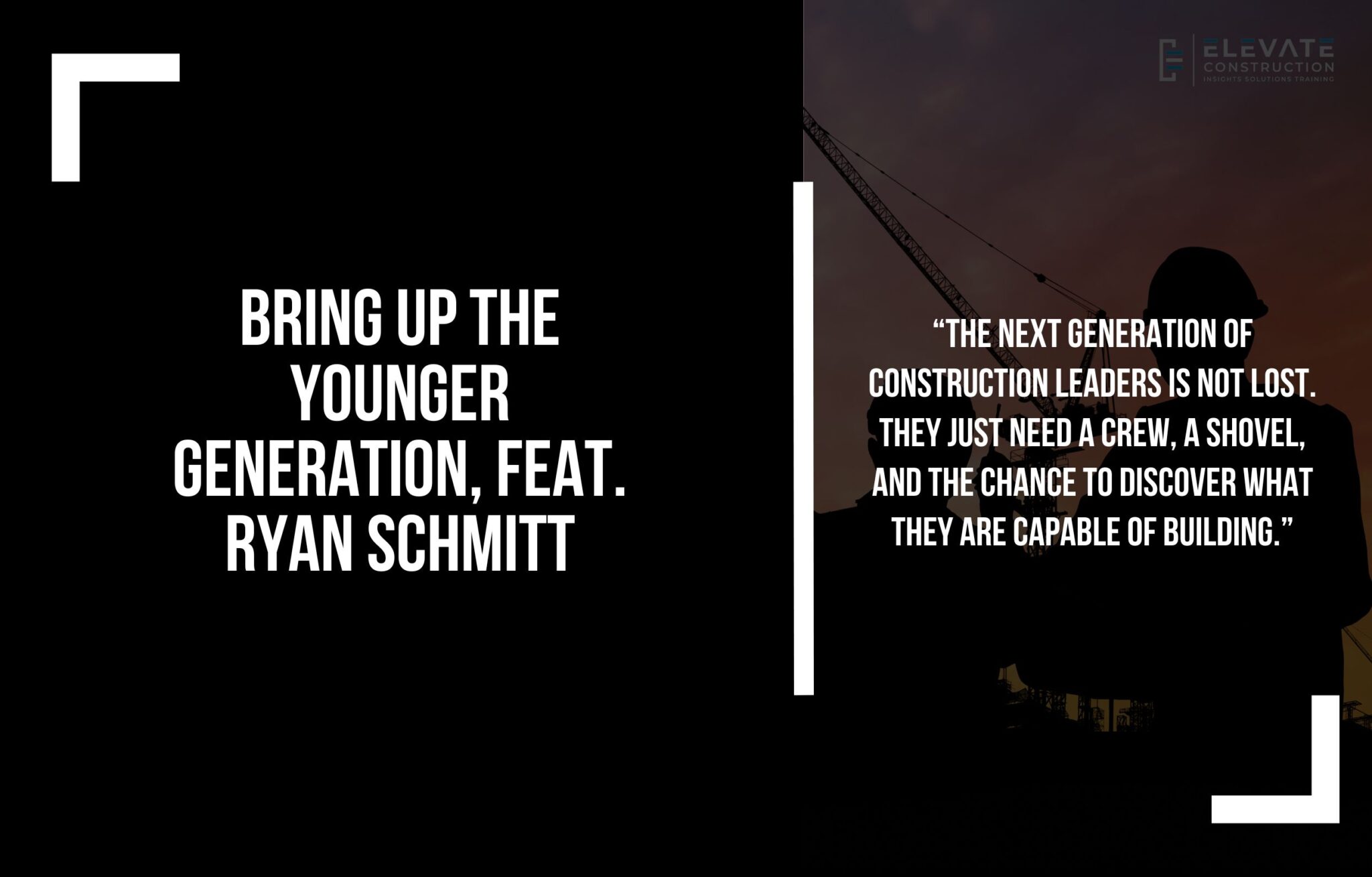
Building the Next Generation: What Happens When You Give Young People a Crew and Real Work
Something happens on a pipe crew that cannot be manufactured, scheduled, or taught in a seminar. It happens when a college kid shows up on the first day with soft hands and a vague idea of what work is, survives the first week, finds their rhythm by week three, and by the end of the summer cannot stop talking about the crew. Not about the money. Not about the task. About the people. About the foreman. About what it felt like to be exhausted at the end of a day and know that something got built. Ryan Schmidt, owner and president of Petty Coach Smith Civil Contractors in Florida, has watched this play out on more than one occasion. And the story is always the same: the young person never slept so hard, worked so hard, or talked more about any experience in their life.
The Problem Nobody Is Naming
The construction industry is facing a real challenge when it comes to the next generation, and it is not what most people think. It is not that young people are unwilling to work. It is that nobody is showing them what work actually feels like, what it offers, or where it can take them. The default assumption in many families, especially college-educated ones, is that physical labor is a step down. A fallback. Something you do before you figure out something better. So young people arrive at the workforce expecting that their education qualifies them to skip the part where they get dirty, and they miss the exact experiences that would have made them exceptional.
The Failure Pattern
The failure is in how the story around trade work has been told for decades. A generation of parents who worked hard and sacrificed said to their kids, essentially: I did this so you would not have to. And in doing so, they quietly communicated that the work they did was something to escape rather than something to value. Meanwhile, the kids who actually got on a crew discovered something that no college course had prepared them for: the sense of accomplishment that comes from building something real, the camaraderie of a team with shared stakes, and a deep respect for the people who do this work every single day. That discovery changes people. And too many young people are being kept from it by a narrative that was meant to protect them.
They Are Not the Problem
This is not a criticism of any generation. The parents who worked hard and wanted better for their kids were acting out of love. The young people who arrived on the jobsite not knowing what to expect were not entitled; they were inexperienced. And the workers and foremen who showed those young people what real work looked like were doing what this industry has always done: building people while they build things. The problem is a missing pathway between where young people start and where they could go, a gap in the system that nobody has closed clearly or consistently enough to make a difference at scale. That is what needs to change.
A Summer That Changes Everything
Ryan Schmidt has seen the pattern repeat enough times to trust it. College-age kids placed on pipe crews and punch-out crews come back from the experience having worked harder than they ever thought possible, and they cannot stop talking about it. Not about the job description. About shorty on the punch-out crew. About what the team accomplished together. About the satisfaction of looking at something at the end of the day that was not there at the beginning of it.
Jason Schroeder knows that experience from a different angle. He grew up working alongside Mexican nationals doing finished concrete in Southern California, being taught what hard work looked like by people who never made it complicated. At the end of those days, the best part was not the food from Del Taco. It was the table. It was sitting around with the crew, exhausted and satisfied, having built something together. That camaraderie, that sense of shared accomplishment, shaped him as much as any training or framework he has ever studied.
Ryan saw it again recently on a pipe crew his company was running. A laborer was tailing pipe out of a ditch and could explain, clearly and with genuine engagement, why his work that day mattered. He knew the pipe had to be in the ground by a specific date so paving could stay on schedule. He knew that because he had been included in a morning worker huddle where everyone on the site, from the newest laborer to the most seasoned equipment operator, got the same information and the same respect. That inclusion changed how he worked. That is what the next generation needs: not protection from hard work, but inclusion in something worth working hard for.
Why This Is Bigger Than One Summer
This matters because construction is building two things simultaneously: structures and people. Every young person who gets on a crew and discovers what hard work feels like, what a real team is, and what it means to respect the men and women who build America is a person who will carry something into every role they hold afterward. And the industry that gives them that experience is the industry they will want to contribute to, lead in, and eventually build a career within.
The stakes are high in both directions. A young person who is shielded from this experience may spend years chasing something that construction would have given them in a single summer: the sense of accomplishment, the respect for physical craft, and the understanding that the people doing the hardest work are often the sharpest and most capable people in any room. A young person who gets that experience early, and who is shown where it can lead, becomes one of the next generation of leaders this industry desperately needs.
Three Things That Make the Experience Stick
The morning worker huddle is the most concrete example Ryan describes as the thing that changes everything. When everyone on the job site stands in the same circle and gets the same information about what is being built and why today’s work matters, something shifts. The laborer knows the stakes. The equipment operator knows the sequence. The newest person on site and the most experienced person on site are treated with the same respect. That is not just a cultural gesture; it is a production strategy. People who understand why their work matters perform it differently.
Showing people a career path changes how they experience their entry-level work. Ryan’s company attaches defined levels, one through five, to every position, with specific skill sets and pay rates connected to each level. A laborer who knows that developing a particular skill advances them to the next level, and that the next level opens access to superintendent or field engineering tracks, is not just shoveling to survive. They are investing in a direction. That framing transforms the entry-level experience from a dead end into a starting line. The young person who might otherwise resist starting at the bottom suddenly sees it as the beginning of something worth pursuing.
Technology training is the third piece, and it is often the most overlooked. Ryan’s company recently spoke with a superintendent in his sixties who had never sent an email before joining their organization. Today he is navigating Microsoft Teams, Excel, and iPad-based production software. Those incremental successes build on each other and keep experienced people contributing at high levels long after their physical capacity begins to shift. The industry that invests in both ends of that spectrum, bringing young people into hard physical work and helping experienced workers grow into technical capability, is the industry that wins.
What to Build Into Your Company Starting Now
If you want to develop the next generation of construction leaders, these are the places to start:
- Run morning worker huddles that include every person on site and share the bigger picture of what is being built, why it matters, and how today’s work fits into the whole.
- Create defined career levels with attached skill sets and pay rates so that every person on your team can see the next step from where they are standing.
- Place young people on real crews doing real work, not supervised tasks, so the experience of accomplishment and belonging is genuine.
- Invest in technology training for field personnel at every experience level so that wisdom accumulated over decades can be applied in modern systems.
- Show up on the job site and genuinely recognize the work being done, because appreciation from a leader who means it is one of the most powerful things in construction.
Built for People, Not Just Projects
Building the next generation is not a talent pipeline strategy. It is a form of respect. It is saying to a 19-year-old who has never held a shovel: you are capable of more than you know, and we are going to give you the chance to find out. It is saying to a 60-year-old superintendent learning to use email for the first time: your wisdom matters and we are going to invest in helping you grow. Both of those commitments come from the same North Star. We are building people who build things. That does not change based on someone’s age, starting point, or experience level. If your project needs superintendent coaching, project support, or leadership development, Elevate Construction can help your field teams stabilize, schedule, and flow.
Get in the Ditch Before You Try to Lead It
Ryan Schmidt started at seven and a half dollars an hour cleaning out a pond after graduating with multiple degrees. He stumbled into construction and discovered a passion for an industry that builds real things with real people and requires you to solve both technical and human problems at the same time. He has learned more outside any academic institution than inside one, through reading, mentorship, and the work itself. Jason’s version of the same message is simple: get out there, get dirty, find out what real work feels like, and discover what the people doing it are actually made of. As Aristotle observed, we are what we repeatedly do. Excellence is not an act but a habit. Build the habit of hard work early, and everything else follows from there.
One, two, three. On we go.
FAQ
Why is hands-on crew experience so valuable for young people entering construction?
Because it delivers three things that cannot be manufactured in any other environment: accomplishment, camaraderie, and respect. When a young person works hard all day and can see what they built at the end of it, something changes in them. When they become part of a crew that depends on each other and celebrates finishing together, they discover what real teamwork means. And when they work alongside foremen and workers who carry decades of wisdom and skill, they gain a respect for trade work that reframes everything they thought they knew about what it means to be capable and successful. Those three things, once experienced, stay with a person permanently.
How do you connect with a younger generation that communicates differently than previous generations?
Ryan Schmidt’s answer to this question is the most honest one in construction: the younger generation wants to know the big picture, wants to feel part of something greater, and wants to be treated with respect. And so does everyone else. Those are not generational preferences; they are human ones. The companies that connect with young workers are the ones running inclusive morning huddles, sharing the why behind the work, giving people defined paths to grow into, and recognizing hard work genuinely and consistently. The generation gap in construction is largely a system gap. Close the system gap and most of the generation gap closes with it.
What is the value of a career level system for field workers?
A career level system transforms the experience of entry-level work by making progression visible and achievable. When a laborer knows that learning a specific skill advances them from level two to level three, and that level three opens a path toward foreman or superintendent responsibility, they are not just doing a job. They are building toward something. Ryan’s company attaches skill requirements and pay rates to each level, making the system transparent and fair. That transparency changes the entire dynamic of early career work. The person who once saw a shovel as a dead end now sees it as a step one, and step one with a clear path to step five is a very different thing to commit to.
How does the morning worker huddle change the culture on a jobsite?
It changes it by giving every person on site the same information and the same respect, regardless of their role or their tenure. When a laborer in a ditch knows why their work matters today, because the pipe needs to be done by a certain date so paving can stay on schedule, they work differently. They are not just completing a task. They are contributing to a system they understand. Ryan saw this directly on one of his job sites: a worker could explain the downstream impact of his own work because he had been included in the huddle where that information was shared. That inclusion is both a respect strategy and a production strategy, and it works for 20-year veterans and first-week laborers in exactly the same way.
Is a college degree necessary for a career in construction management?
No, and the data supports that more clearly than the cultural narrative does. Construction management careers offer income ranges that compete with and often exceed those in engineering disciplines. The work-life balance, especially for superintendents and project managers who build functional systems, can be more sustainable than design or technical engineering roles that require weekend output to meet deadlines. College is valuable, and Jason and Ryan both say so directly. But it is not the only path, and it is not inherently a better one. What matters is passion for the work, commitment to continuous learning, and the willingness to start somewhere real and build from there. The industry needs more people who believe that and act on it.
If you want to learn more we have:
-Takt Virtual Training: (Click here)
-Check out our Youtube channel for more info: (Click here)
-Listen to the Elevate Construction podcast: (Click here)
-Check out our training programs and certifications: (Click here)
-The Takt Book: (Click here)
Discover Jason’s Expertise:
Meet Jason Schroeder, the driving force behind Elevate Construction IST. As the company’s owner and principal consultant, he’s dedicated to taking construction to new heights. With a wealth of industry experience, he’s crafted the Field Engineer Boot Camp and Superintendent Boot Camp – intensive training programs engineered to cultivate top-tier leaders capable of steering their teams towards success. Jason’s vision? To expand his training initiatives across the nation, empowering construction firms to soar to unprecedented levels of excellence.
On we go