
Orientation Is Not a Checkbox. It’s a Foundation.
Here’s the deal: most construction orientation programs accomplish one thing documenting that they happened. A worker sits in a room, watches a video, signs a sheet, gets a sticker for their hardhat, and walks onto the project. Whether they understood a single thing that was covered is nobody’s business. The liability question was answered. The gate was opened. The actual preparation of that worker for the hazards, systems, expectations, and culture of the project they just joined? That part is assumed.
That assumption is where projects get hurt. Not metaphorically literally. A worker who cannot describe the site’s emergency egress plan, who didn’t understand the PPE requirements because the video was in a language they don’t speak fluently, who never learned the project’s zero-tolerance safety expectations that worker is on the floor with incomplete information in an environment that is actively dangerous. The system checked a box. The worker paid the cost.
What Passes for Orientation on Most Projects
Walk through the onboarding process on a typical commercial project and you’ll find a version of the same sequence. A generic safety video often in English only. A stack of forms to sign. A hardhat sticker distributed at the door. Workers processed in batches at mobilization week and then individually as subs add workers throughout the project, with no consistent tracking of who received what. And somewhere in that process, the key question that determines whether orientation actually worked does this worker understand what they just learned? is never asked.
Jason Schroeder teaches the steps to a safe site clearly: standards common to the group, consequences established, orientation and training available, visual reminders present, accountability at all levels, and no unsafe behaviors tolerated. Orientation and training are third on that list but they are only meaningful if they reach the worker. A training that wasn’t comprehended is not a training. It’s documentation. And documentation does not protect anyone.
I remember on a large healthcare project watching a near-miss investigation that traced back to a worker who had been on site for two weeks and had no knowledge of the specific hazard that almost injured him. He had attended orientation. He had signed the paperwork. But the content was delivered in English to a worker whose primary language was Spanish, and the test if there was one required a signature, not a correct answer. The system recorded that he was oriented. The system had not actually oriented him. The system failed him. He didn’t fail the system.
What a Verified Orientation System Looks Like
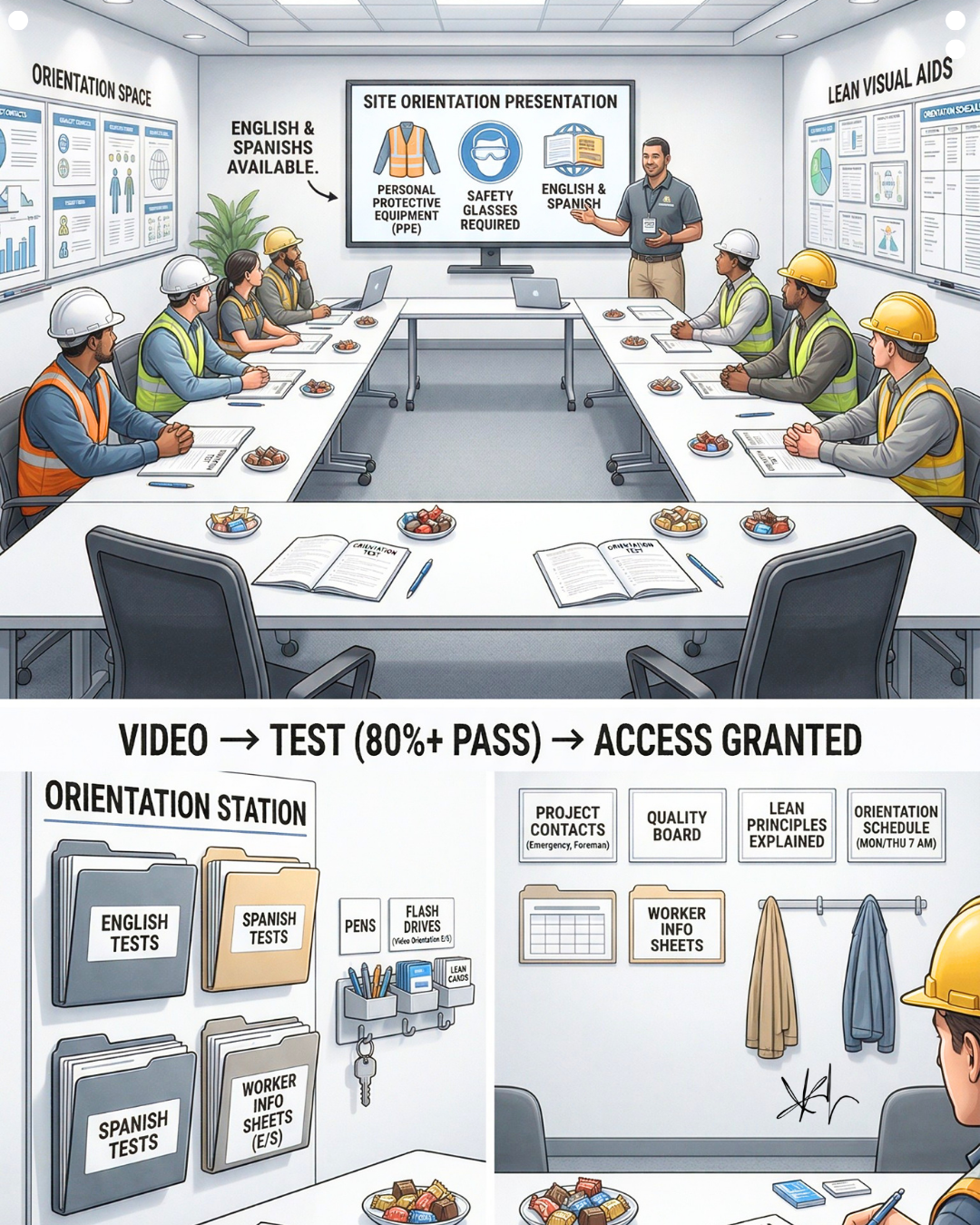
The image in this post shows what a complete, designed orientation system looks like when it’s built to actually prepare workers rather than just document their presence.
The orientation begins with a bilingual video presentation English and Spanish covering PPE requirements, site safety standards, emergency procedures, project expectations, and Lean principles. Both language tracks are complete and professional, not a secondary version where the Spanish track is shorter or covers less. Every worker, regardless of primary language, receives the same quality of information. That is not a small detail. It is the difference between an orientation that reaches every worker and one that effectively excludes a significant portion of the workforce from its own protection.
After the video, every worker takes a comprehension test. The threshold is 80% or higher not a signature, not a scan of a QR code, not a box checked by someone in the room. A test with correct answers that must be achieved before access to the site is granted. This is the quality gate that transforms orientation from a formality into a verified foundation. If a worker doesn’t pass, they receive additional instruction and test again. The point is not to filter people out. It is to make sure every person on the project has actually understood what they were taught.
Watch for these signals that your site orientation is functioning as a checkbox rather than a foundation:
- No comprehension verification workers sign and proceed regardless of retention
- Orientation delivered only in English on a project where a significant portion of the workforce is Spanish-speaking
- No consistent process for orienting workers who join after the initial mobilization wave
- Visual aids and project-specific information absent from the orientation space
- Workers unable to describe the emergency egress plan or site safety expectations during the first week on the floor
The Orientation Station: Making the System Visual and Organized
The orientation station shown in the post is where the system becomes physical. English tests and Spanish tests are organized and accessible in labeled folders. Worker information sheets in both languages are ready to distribute. Flash drives with the orientation video are on hand for individual delivery when needed. Lean cards and pens are available. Everything the orientation facilitator needs is at the station, organized, labeled, and replenishable.
The wall around the station extends the orientation environment beyond the video. Project contacts are posted. The quality board is visible. Lean principles are explained. The orientation schedule is displayed for the month so workers who are joining mid-project can see when the next session is and plan accordingly. The space communicates something before anyone sits down: this project is organized, this project is serious, and what you’re about to learn matters.
This is 5S applied to worker onboarding. Sort only what’s needed for the orientation process is at the station. Set in Order tests, info sheets, drives, and supplies each have a labeled home. Shine the space is clean and professional. Standardize the process is the same for every worker who passes through it. Sustain the station is restocked and maintained throughout the project. The discipline of 5S doesn’t stop at the gang box or the staging yard. It belongs in the orientation room too.
Why This Connects to the First Planner System
Jason Schroeder teaches that a lack of training becomes a constraint the most limiting factor in a team’s ability to produce. First planners can prevent this by providing adequate training and testing in orientation and onboarding to ensure crews are trained and not just warm bodies on a roster. That phrase not just warm bodies is the entire argument for verified comprehension. A worker who has been signed in but not actually prepared is a liability in three directions: to themselves, to the workers around them, and to the project’s safety record and culture.
The bilingual, verified orientation system resolves all three simultaneously. The worker who passes the 80% threshold and receives their access has demonstrated not just declared that they understand the environment they’re entering. That understanding is the foundation of every safety behavior, coordination decision, and cultural contribution they’ll make for the rest of the project. Everything downstream of orientation is better when orientation works.
If your project needs superintendent coaching, project support, or leadership development, Elevate Construction can help your field teams stabilize, schedule, and flow. Orientation is where that stability begins before the first worker steps through the gate into the active project.
Build the System That Actually Prepares Your People
Here is the challenge. Before your next phase of mobilization, evaluate your orientation process against one question: if a worker who attended your last orientation was asked to explain the emergency egress plan, the PPE requirements, and the site’s zero-tolerance policy in their primary language could they do it? If the answer is uncertain, the orientation process needs a redesign.
Add the bilingual video. Build a comprehension test with an 80% minimum. Set up the orientation station with organized, labeled materials in both languages. Post the project contacts, quality board, and Lean principles on the wall. Track who attended, when, and whether they passed. And for workers joining mid-project, run the same process a trade joining week eight deserves the same quality of preparation as trades who mobilized in week one.
Orientation should be a foundation, not a formality. Design it like the most important thing you do before anyone sets foot on the floor because it is.
As Jason Schroeder teaches: “Standards common to the group, consequences established, orientation and training available.” Build the orientation that makes all three possible.
On we go.
Frequently Asked Questions
Why is a bilingual orientation essential rather than optional?
Because a worker who cannot fully understand the orientation content in their primary language has not been oriented they’ve been documented. Both language tracks must be complete and equivalent, not a shortened secondary version.
What is the 80% comprehension threshold and why does it matter?
It’s the minimum score required on the post-video test before site access is granted. It ensures workers have actually retained the critical information rather than simply completing the motion of attending.
How should the orientation station be maintained throughout the project?
Like any 5S system restocked regularly, labeled clearly, and checked on a cadence to ensure tests, info sheets, and flash drives are current and available for workers joining at any project phase.
What happens if a worker doesn’t pass the comprehension test?
They receive additional instruction on the areas they missed and test again. The goal is preparation, not exclusion workers need the chance to actually understand what they’re being asked to learn.
How does this orientation system connect to onboarding workers who join mid-project?
The same process applies regardless of when a worker joins. The orientation schedule posted at the station shows upcoming sessions, and the station materials are always ready for individual sessions when new workers arrive outside of the scheduled group orientation.
If you want to learn more we have:
-Takt Virtual Training: (Click here)
-Check out our Youtube channel for more info: (Click here)
-Listen to the Elevate Construction podcast: (Click here)
-Check out our training programs and certifications: (Click here)
-The Takt Book: (Click here)
Discover Jason’s Expertise:
Meet Jason Schroeder, the driving force behind Elevate Construction IST. As the company’s owner and principal consultant, he’s dedicated to taking construction to new heights. With a wealth of industry experience, he’s crafted the Field Engineer Boot Camp and Superintendent Boot Camp – intensive training programs engineered to cultivate top-tier leaders capable of steering their teams towards success. Jason’s vision? To expand his training initiatives across the nation, empowering construction firms to soar to unprecedented levels of excellence.