
Your Project Speaks to Workers Before They Ever Clock In
Here’s the deal: the first impression a worker gets of your project happens in the parking lot. Not in the morning huddle. Not at the gate. Not when they pick up their badge and their sticker. It happens the moment they pull in, before they’ve spoken to a single person on the project team. And what they see in that first sixty seconds tells them something about the people running this job whether anyone thought about them before they arrived, whether the environment was designed with them in mind, or whether they were an afterthought that showed up on the mobilization checklist somewhere after temporary power and gate hardware.
Most parking lots on most construction projects tell the same story. Unmarked stalls that crowd up chaotically every morning. Fencing screen loose and flapping, or missing entirely on sections. No lighting for the electrician who arrives at 5:45 AM in winter. No clearly marked path from the parking area to the site entry. Workers parking as close to the site as they can because nobody designated a system. And the first thing they do every morning is navigate a space that feels like it wasn’t designed for humans.
That feeling doesn’t stay in the parking lot. It follows workers through the gate, down to the floor, and into the work. It sets a tone and the tone it sets is that this project wasn’t built for people.
What the Absence of Design Communicates
The parking lot is a Lean indicator in the same way that bathrooms are a Lean indicator. Jason Schroeder teaches that bathroom quality clean, well-maintained, adequate in number is the first signal of whether a project is truly Lean and truly respects the workers building it. If facilities aren’t good enough for the project management team’s grandmother, they aren’t good enough for workers. That same standard applies to the parking area. If you wouldn’t want your own mother walking through it alone at 6 AM in the dark, across unmarked pavement, looking for a bathroom while avoiding forklifts, it isn’t good enough for your workforce.
I was on a large commercial project years ago where the parking situation had been left completely undesigned. Workers drove in, found whatever space they could, and walked however they needed to walk to get to the gate. Within three weeks, there was a near-miss in the lot when a delivery truck came in through the same entrance workers were using on foot. Nobody had designed separate pathways. Nobody had thought about pedestrian and vehicle conflict in the one area of the site that sees the most traffic every single morning. By the time we redesigned the lot marked stalls, separated crosswalk, stop sign, lighting the trades had already formed an opinion about this project that took weeks of intentional effort to rebuild.
The system failed them. They didn’t fail the system.
What a Respectful Parking Lot Is Actually Built Around
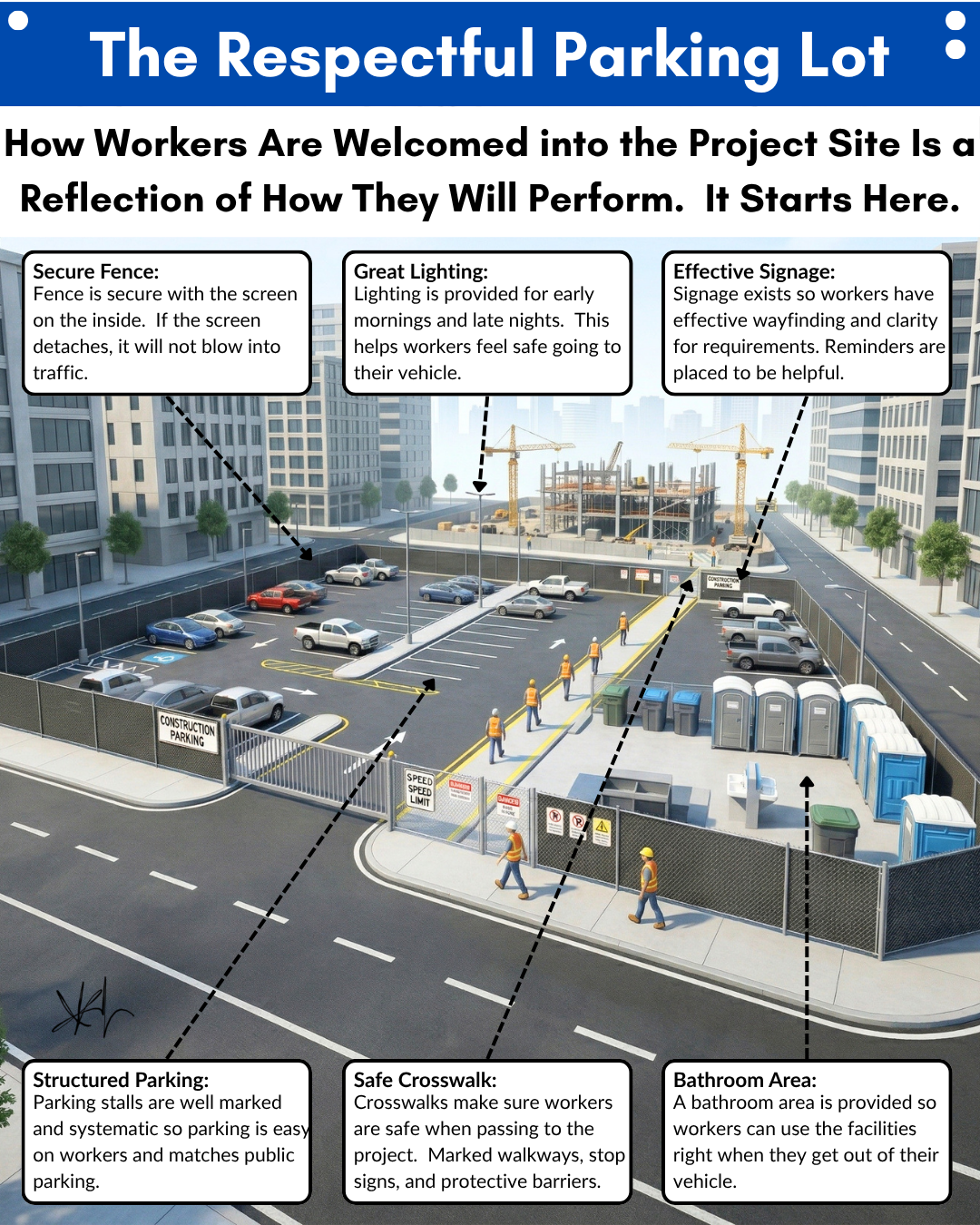
The image in this post shows what a designed, intentional parking area looks like when it’s built with the same care applied to the rest of the project. Each element serves a specific function. Together, they communicate that someone thought about the worker’s experience before mobilization day.
Structured, well-marked stalls make parking easy and systematic matching the experience workers expect from any well-run public facility. When workers pull into a clearly delineated lot, they don’t have to make a decision about where to go. The decision was made for them. That small removal of friction at the start of the day is not trivial. It’s the first data point in their assessment of whether this project is organized and worth their best effort.
Secure fencing with screens properly attached on the inside is both a safety measure and a maintenance statement. Screen attached on the interior side cannot blow into traffic if it detaches a simple design decision that protects the public and eliminates the daily visual of ragged, sagging fence that signals a project nobody is maintaining. A clean, secured fence line says the standard here is upheld daily, not just at setup.
Great lighting changes the experience of the parking lot completely for the workers who arrive earliest and leave latest. The electrician who arrives at 5:45 AM should not feel unsafe walking to their vehicle in the dark. The pipefitter who works late to complete a zone handoff should not have to navigate an unlit parking area at the end of a ten-hour day. Lighting is inexpensive to run. Its absence is not neutral it communicates that the project team didn’t think about the full arc of a worker’s day.
Watch for these signals that the parking area has not been designed on your project:
- No marked stalls, resulting in chaotic and variable parking conditions every morning
- Fence screen loose, missing, or attached on the exterior where it can catch wind and blow into traffic
- No lighting for early morning or late evening use
- Workers and vehicles sharing the same entry point without a separated crosswalk or pedestrian path
- No bathroom area at the lot workers must walk significant distance to find facilities upon arrival
The Safe Crosswalk and the Bathroom at the Gate
The safe crosswalk between the parking area and the site entry is not optional on any project with significant daily worker traffic. Marked walkways, stop signs, and protective barriers separate the pedestrian path from vehicle movement and make the conflict point visible and controlled before it becomes an incident. Every morning, dozens or hundreds of workers make that crossing. The cost of designing it thermoplastic markings, a stop sign, a few bollards is negligible. The cost of not designing it is a struck-by incident that was entirely predictable from the day the site was established.
The bathroom area at the lot is a small detail that carries significant dignity. The first thing a worker should be able to do when they arrive is use the facilities not walk across the site hunting for a porta-potty, not wait until they’ve found their foreman and gotten directions, not start the day with a basic human need unmet. Bathrooms at the parking area are available immediately, before orientation, before the morning huddle, before the gate. That availability says: we thought about your whole arrival, not just the production part of it.
Effective signage throughout the parking area rounds out the system. Workers should never have to guess where to go, what the requirements are, or how to navigate from the lot to the site entry. Clear, maintained signage at logical decision points means every worker including someone arriving for their first day on the project can orient and move without asking anyone for directions. Signage is the parking lot’s version of the visual area board: information at the place where people need it, without requiring a conversation to access it.
Why the Parking Lot Is a Leadership Statement
The culture of any organization is shaped by the worst behavior the leader is willing to tolerate. And the reverse is equally true: the highest standard the leader enforces becomes the project’s culture. A parking lot that is structured, lit, fenced, signed, and equipped with a safe crosswalk and accessible bathrooms communicates a leadership standard before a single supervisor speaks a single word to a single worker. It says: this project is organized. This project was designed before you arrived. You matter to the people running this job and the evidence is right here, in the parking lot, before you’ve even clocked in.
Jason Schroeder teaches that winning over the workforce means making sure workers have good bathrooms, a good lunch area, and are treated with respect communicated daily. The parking lot is where that daily communication begins. If your project needs superintendent coaching, project support, or leadership development, Elevate Construction can help your field teams stabilize, schedule, and flow. That stability begins before the gate in the space workers navigate every single morning.
Design the Parking Lot Like You Design the Zone
Here is the challenge. This week, walk the parking area for your current or upcoming project and look at it with fresh eyes. Ask whether a worker arriving for the first time would feel welcomed, safe, and cared for. Is there lighting? Are the stalls marked? Is there a clear crosswalk with a stop sign between the lot and the site entry? Is the fence secure and maintained? Is there a bathroom available within steps of where workers park? Is there signage that tells them exactly where to go?
If the honest answer to any of those questions is no fix it before the next shift. The parking lot is not where the project team goes. It’s where the workforce goes. Design it for them, not as an afterthought.
As Jason Schroeder teaches: “Respect for people is not soft it’s a production strategy.” It starts in the parking lot, every morning, before anyone picks up a tool.
On we go.
Frequently Asked Questions
Why should the parking lot be treated as part of the project design?
Because it’s the first environment workers experience every day before the huddle, before orientation, before the floor. A disorganized, unsafe, or poorly maintained lot sets a tone that affects morale, safety perception, and the discretionary effort workers bring to the project.
What makes a crosswalk “safe” in a construction parking context?
Thermoplastic or marked walkway lines, a stop sign that requires vehicles to halt before crossing, and protective barriers or bollards that physically separate the pedestrian path from vehicle traffic not just paint, which depends entirely on driver attention.
Why does bathroom placement at the lot matter?
The first thing a worker needs upon arrival should be immediately available. Having to walk across the project to find a porta-potty before the day even starts is a small indignity that compounds across the full project tenure and communicates that basic needs were not designed for.
How does parking lot design connect to workforce culture?
Workers form their initial impression of a project in the first moments of arrival. A structured, clean, lit, and accessible lot signals organizational care. That signal affects how workers engage with the project, participate in systems, and extend discretionary effort throughout the day.
What is the minimum standard for parking lot lighting on a construction project?
Sufficient illumination to allow workers to navigate safely to and from their vehicles during early morning mobilization and late-shift departure typically LED area lighting on poles at the lot perimeter, maintained throughout the project duration.
If you want to learn more we have:
-Takt Virtual Training: (Click here)
-Check out our Youtube channel for more info: (Click here)
-Listen to the Elevate Construction podcast: (Click here)
-Check out our training programs and certifications: (Click here)
-The Takt Book: (Click here)
Discover Jason’s Expertise:
Meet Jason Schroeder, the driving force behind Elevate Construction IST. As the company’s owner and principal consultant, he’s dedicated to taking construction to new heights. With a wealth of industry experience, he’s crafted the Field Engineer Boot Camp and Superintendent Boot Camp – intensive training programs engineered to cultivate top-tier leaders capable of steering their teams towards success. Jason’s vision? To expand his training initiatives across the nation, empowering construction firms to soar to unprecedented levels of excellence.