
Caution Tape Is Not a Barrier. It’s a Warning That No Barrier Exists.
Here’s the deal: the most dangerous safety equipment on most construction sites is caution tape. Not because it harms anyone directly. Because it creates the illusion that a hazard is controlled when it isn’t. A few cones, a sagging line of yellow plastic, and an open hole behind it and every person walking past that setup believes, at some level, that the problem has been addressed. It hasn’t. The tape says “caution.” The hole says nothing. And the gap between what we communicate and what we actually protect is where people get hurt.
Caution tape was never engineered to prevent access. It was designed to communicate the existence of a hazard a visual cue, nothing more. It sags. It dislodges in wind. It offers no physical resistance to a distracted worker, a person carrying material, or anyone who simply doesn’t see it in low-light conditions. And because it is so common, so easy to deploy, and so visually recognizable as a “safety measure,” it has been normalized as actual protection in an industry that should know better. That normalization is not a compliance problem. It’s a leadership problem.
What Happens When Tape Becomes the Standard
Walk any active construction floor during rough-in phase and you’ll find the same picture repeated across multiple zones: penetrations protected by a few wraps of caution tape between orange cones. Elevator shafts with a rope line. Roof openings with stakes and string. The visual says “protected.” The physics says “open.” And for most of those setups, what prevents a fall is not the barrier it’s the worker’s attention. And attention is not a fall protection system.
Jason Schroeder teaches clearly: you are responsible for safety on your project. Not delegated. Not distributed. Owned. The superintendent is the guardian of the project’s safety standard, and whatever happens on the job whatever level of protection is provided or withheld happens because leadership allowed it. If the standard for an open hole on your project is two cones and caution tape, that standard was set by the superintendent. If a worker goes down, the tape will not answer for it.
This is not a criticism of the workers who put the tape up. They used what they were given and followed the practice they observed. The system failed them. They didn’t fail the system.
A Story That Makes the Physics Clear
I was on a project once where we had a series of floor penetrations for large conduit runs through three floors. The openings had been covered and marked, and for a while, the covers held. Late in the project during a high-traffic push week, one of the cover boards got moved by a material delivery and wasn’t replaced immediately. Someone put up caution tape across the opening while it waited for a new cover. The tape lasted about forty minutes before foot traffic in the adjacent corridor dislodged one side of it and it dropped across the opening at ankle level. By the time I came through on my zone control walk, the tape was on the floor, one cone was five feet from the hole, and three workers had walked past that opening without a functioning barrier between them and a twelve-foot fall.
Nobody fell. But the lesson was not that tape can work if you’re careful. The lesson was that tape cannot work at all, because it depends on conditions staying exactly as placed in an environment that is actively and constantly changing. Rigid barriers do not make that assumption. They hold.
What Proper Engineering Delineation Actually Does
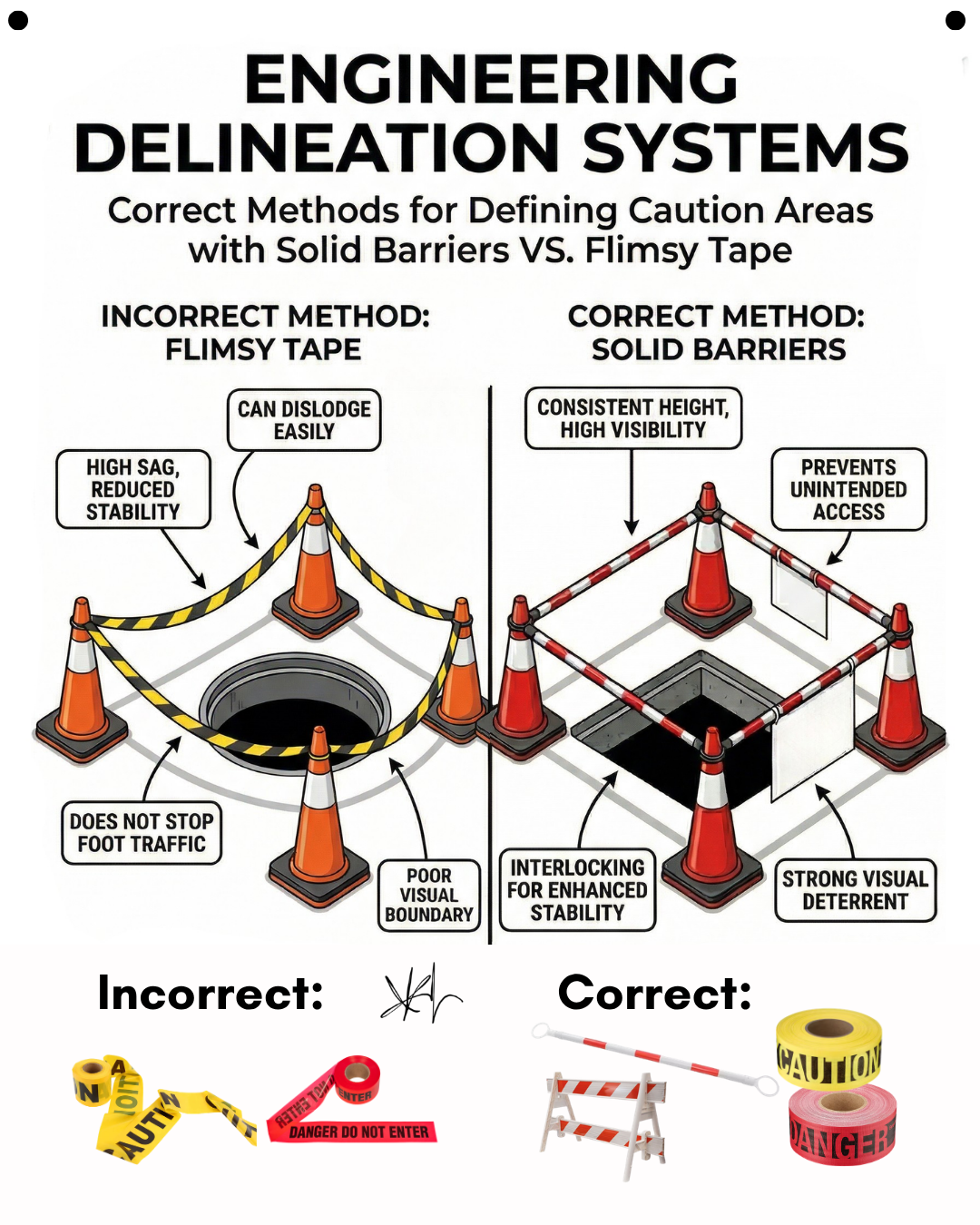
The image in this post shows the contrast clearly. On the left, flimsy tape: high sag, reduced stability, easy to dislodge, does not stop foot traffic, poor visual boundary. On the right, solid barriers: consistent height and high visibility, interlocking stability, prevents unintended access, strong visual deterrent. The engineering difference is real and measurable. Interlocking rigid panels do not sag. They do not dislodge in wind. They do not drop to ankle level when someone clips them walking past. They provide genuine physical resistance to unintentional contact.
The visual deterrent function is also significantly stronger with rigid systems. A person carrying materials who cannot see the opening beneath them will walk into caution tape. The same person will stop at a rigid barrier because the barrier occupies physical space, holds consistent height, and registers as an obstacle before the person is close enough to be in danger. The barrier does not depend on attention. It works without it.
Here are signals on your project that delineation is providing an illusion of safety rather than actual protection:
- Open floor penetrations protected only by tape between cones, with no rigid physical boundary
- Tape that sags below knee height or has dropped to floor level in any active zone
- Barriers that would not resist foot pressure from a worker walking into them carrying material
- Elevator shaft openings protected by ropes or string rather than interlocking rigid panels
- Any hazard protection that depends on workers seeing and remembering to avoid an area
The Hierarchy of Controls Applied to Delineation
The hierarchy of hazard controls places engineering controls above administrative controls and personal protective equipment. Caution tape is an administrative control at best it communicates a hazard but does not eliminate or contain it. Rigid interlocking barriers are an engineering control they physically prevent access and do not depend on worker behavior or attention to function. The hierarchy exists for a reason. Engineering controls work consistently. Administrative controls work only as long as conditions, attention, and compliance hold simultaneously. On an active construction site, those three things rarely hold for long.
Jason Schroeder’s zero tolerance policy on safety is grounded in exactly this principle. It’s not punitive. It’s respectful. When someone is observed being unsafe, they are removed from the situation not as punishment, but because their safety and their family’s stability is worth more than the discomfort of enforcing the standard. The same logic applies to delineation. Installing rigid barriers instead of tape is not more complicated or significantly more expensive. It is the leadership decision that says: the people working around this hole deserve protection that actually works, not protection that looks like it works.
Why Upgrading the Standard Is a Leadership Decision, Not a Budget Decision
The cost difference between caution tape and engineered rigid barriers is not the barrier to implementation on most projects. Rigid delineation panels are not prohibitively expensive. They are reusable, relocatable, and available from standard safety suppliers. The real barrier is habit. Tape has always been the practice. Nobody has been held accountable for it specifically. The incidents it almost prevented were near-misses that never got attributed to inadequate delineation. And because the problem stays invisible until someone falls through it, the practice never gets challenged.
The culture of any organization is shaped by the worst behavior the leader is willing to tolerate. If the project superintendent walks past caution tape over an open hole and says nothing, that project’s safety standard now includes caution tape over open holes. If the same superintendent stops, documents the condition, and requires a rigid barrier before the next shift begins that project’s standard is now different. The difference is not equipment. It is leadership.
If your project needs superintendent coaching, project support, or leadership development, Elevate Construction can help your field teams stabilize, schedule, and flow. Safety is the foundation of that stability and it starts with the physical systems put in place before the first worker enters a hazardous zone.
Audit Your Delineation This Week
Here is the challenge. Walk every floor of your active project this week and look specifically at every floor penetration, shaft opening, roof edge, and excavation perimeter. At each one, ask a single question: if a worker who was not paying attention walked directly toward this opening, would the barrier stop them?
If the answer is caution tape, the answer to the question is no. Replace it before the next shift. Rigid interlocking barriers, properly placed at consistent height, with no sag and no gap that’s the standard. It’s not complicated to install. It’s not expensive relative to the risk. And it communicates to every worker on the project that the people running this job have designed the environment to protect them, not just to warn them.
“Caution” should be more than a word printed on plastic. It should be backed up by a physical system that does what the word promises.
As Jason Schroeder teaches: “If leaders truly care about workers, they will fix unsafe situations immediately.” This week, make the delineation on your project match that standard.
On we go.
Frequently Asked Questions
What is the difference between caution tape and engineered delineation barriers?
Caution tape is an administrative control that communicates a hazard but provides no physical resistance. Rigid interlocking barriers are an engineering control that physically prevents unintentional access regardless of worker attention or environmental conditions.
Why do rigid barriers perform better in active construction environments?
Because they don’t depend on conditions staying exactly as placed. Tape sags, dislodges in wind, and drops with foot contact. Rigid panels interlock for stability, maintain consistent height, and remain functional even when workers or equipment move through adjacent areas.
Is engineered delineation significantly more expensive than caution tape?
No. The cost difference between caution tape and rigid barriers is small. Rigid panels are reusable and relocatable across the project, making their cost per use lower over time than tape that gets replaced every time it’s disturbed.
How does the hierarchy of controls apply to floor penetration protection?
The hierarchy places engineering controls above administrative controls. Rigid barriers that physically prevent access are engineering controls. Caution tape is at best an administrative control it depends on worker attention rather than preventing the hazard.
What is the superintendent’s responsibility for delineation standards on the project?
Total ownership. Whatever protection level exists on the project reflects what the superintendent has accepted. Walking past inadequate delineation without corrective action sets that inadequate level as the project standard.
If you want to learn more we have:
-Takt Virtual Training: (Click here)
-Check out our Youtube channel for more info: (Click here)
-Listen to the Elevate Construction podcast: (Click here)
-Check out our training programs and certifications: (Click here)
-The Takt Book: (Click here)
Discover Jason’s Expertise:
Meet Jason Schroeder, the driving force behind Elevate Construction IST. As the company’s owner and principal consultant, he’s dedicated to taking construction to new heights. With a wealth of industry experience, he’s crafted the Field Engineer Boot Camp and Superintendent Boot Camp – intensive training programs engineered to cultivate top-tier leaders capable of steering their teams towards success. Jason’s vision? To expand his training initiatives across the nation, empowering construction firms to soar to unprecedented levels of excellence.