
Here’s the deal. Want to know if a team is serious about Lean? Look at their break area. Not the jobsite. Not the trailer walls covered in schedules. The coffee station. If a team cannot keep cups, pods, and filters stocked with a simple visual system, how is that same team going to flow the actual work? The break area is small, low-stakes, and almost nobody is watching it closely. That makes it the single best test of whether Lean principles actually live in a team’s habits, or whether they only show up where someone might be grading the performance.
Short answer: A Lean break area applies the same tools you use on the jobsite to the trailer coffee station: point-of-use storage, kanban reorder lines, a two-bin system, standard locations, and min and max inventory levels. Because almost nobody is watching it, the break area is the best test of whether Lean lives in a team’s habits. It is also a daily message of respect for the crew.
The Pain of a Break Area Nobody Designed
Picture a typical jobsite trailer kitchen without any deliberate system behind it. Supplies get bought in whatever quantity seemed reasonable at the time, stored wherever there happened to be space, and used until they run out, at which point someone discovers the shortage the hard way, usually at six in the morning when the whole crew wants coffee and there are no pods left. Cleaning supplies sit mixed in with snacks. Nobody knows at a glance whether the filters are running low, because nothing in the space signals that information until the moment the box is actually empty.
This is a small, low-consequence version of exactly the same failure pattern that shows up everywhere else on a project with no inventory discipline: a connex box with no labeled bins, or a material laydown area with no staging plan. The stakes here are genuinely tiny: a missed cup of coffee rather than a missed schedule milestone. But the pattern is identical, and that is exactly the point. A team that cannot solve this version of the problem, in a space this forgiving, is unlikely to be quietly solving the much harder version of the same problem somewhere less visible.
The Failure Pattern
The failure pattern is assuming that Lean discipline applies to the places people are actually watching and does not need to apply anywhere else.
A trailer break area receives almost no scrutiny on most projects. Nobody audits the coffee station. No inspector checks whether the supply bins are labeled. No owner representative walks through and grades the kanban system on the snack shelf. Precisely because nobody is watching, this space becomes a clean, honest test of whether a team’s Lean habits are genuine or performative. A team that only applies organization and standard work where an audience exists is a team that has learned to perform Lean rather than practice it, and that distinction matters enormously once the schedule gets tight and nobody has time to perform anything.
The Team Didn’t Fail. Nobody Pointed Lean at the Coffee Station.
When a break area runs chaotically (supplies missing, nobody quite sure where anything lives), the instinct might be to dismiss it as simply not a priority, understandably, given everything else competing for a team’s attention on an active project.
That dismissal misses something important. A disorganized break area is not evidence that the team does not care about Lean. It is evidence that nobody has yet applied the same thinking they already use everywhere else to this one small, overlooked corner. The same crew running a disciplined Takt plan and a well-labeled connex box has simply never turned that identical thinking toward the coffee station, because nobody told them this space deserved the same attention. Once someone does, the fix is fast and nearly free, because the principles are already familiar. The gap was never caring. It was scope.
What Does a Lean Break Area Contain?
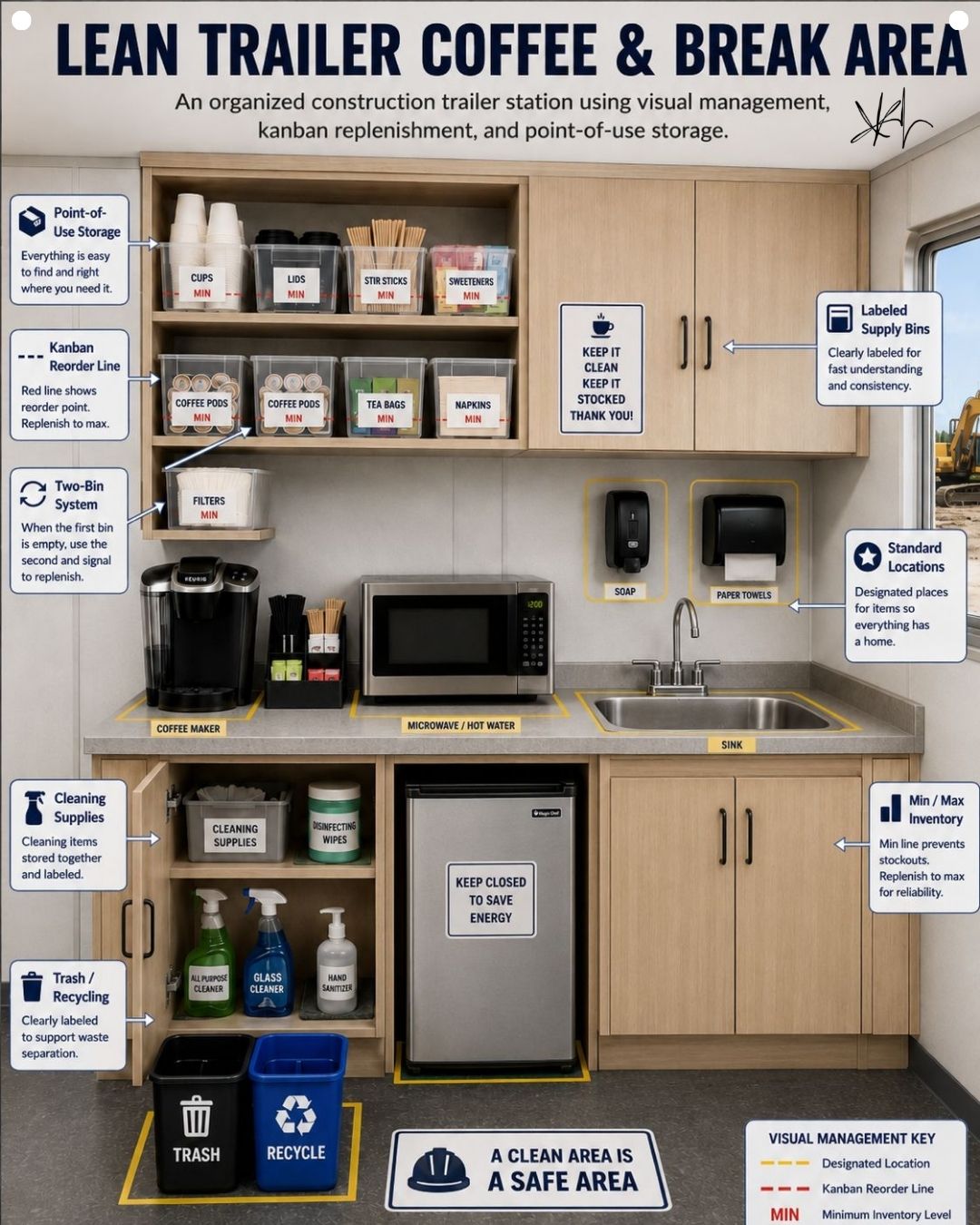
- Point-of-use storage puts everything right where it is needed, with no hunting required. Cups, lids, stir sticks, and sweeteners each have their own labeled bin, positioned directly above the coffee maker rather than scattered across whatever shelf had room. This is the exact same principle behind the Lean Connex Box applied at a much smaller scale: every item has a home, and the home is close enough to the point of use that retrieval never interrupts the actual task.
- Kanban reorder lines give a simple, visual signal for when to replenish. A red line drawn directly on a bin tells anyone looking at it, instantly, whether that item needs restocking, with no guessing and no need to actually dig to the bottom of a container to check remaining quantity. This removes the single most common failure mode in any informal supply system: the shortage that only becomes visible the moment it is already a problem.
- The two-bin system solves the same problem from a different angle. When the first bin empties, the second bin is already there, ready to use immediately, and emptying the first bin becomes the signal to restock before the second bin runs out too. This creates a built-in buffer against exactly the kind of six-in-the-morning coffee crisis that otherwise catches a team by surprise on the one morning everyone was counting on it being there.
- Standard locations mean every item has a designated, taped, and labeled home, so a new crew member or a visitor to the trailer can find anything without asking. This single element removes the dependency on tribal knowledge. It is the same dependency I have written about before in the Lean Connex Box practice, where only the people who happen to already know where things are can actually find them quickly.
- Min and max inventory levels prevent the stockout crisis directly, with a visible minimum line signaling exactly when to replenish and a maximum level that prevents the opposite problem: overstocking supplies that then clutter the space and complicate the visual system everyone is relying on.
None of This Is About Coffee
Here is the part that actually matters. None of this is about coffee. It is about respect. When a builder walks in cold, tired, and early, and everything is stocked, labeled, and ready, that is a message. It says we thought about you before you got here.
This connects directly to the Construction Worker Care Hub, which I have written about before. A crew member’s physical experience on a project (whether they have what they need, when they need it, without friction) is not separate from how seriously the project takes production. It is the same discipline, applied to the person rather than only to the work. A team that designs a coffee station this carefully is demonstrating, in a tiny, low-stakes way, exactly the same care it hopefully extends to the much higher-stakes decisions about safety, staging, and schedule.
Lean is love in action, and love shows up in the small stuff. That line captures something genuinely important about why this particular practice deserves attention rather than dismissal as a minor or even trivial example. A system built around someone else’s comfort, even in a space as small as a coffee station, is a visible, daily demonstration that this project actually cares about the people working on it, not just the deliverable they are producing.
A Clean Area Is a Safe Area
A clean area is a safe area. A stocked area is a cared-for area. These are not separate claims stitched together for effect. They describe the same underlying mechanism running through every practice I have written about here, from the Lean Display Area to the Lean Gangbox to the connex box itself. A space that is organized, labeled, and visually managed signals a standard, and that standard tends to spread outward from wherever it starts. A team that maintains this discipline in its break area is far more likely to maintain the same discipline in spaces that actually matter for safety and production, because the habit of noticing and correcting small degradation is the same habit everywhere it shows up.
Why Start Lean in the Break Area?
If a builder who never studied Lean can learn to see waste in a coffee bin, anyone on the team can learn to see it too. This is the most practical, most accessible starting point available for teaching Lean thinking to a crew that has never formally studied it. The break area asks nothing of anyone beyond basic observation and a willingness to label a few bins. There is no technical barrier, no software, no capital investment beyond a handful of containers and some tape.
Starting here, in the space with the lowest stakes and the easiest fix, builds the exact muscle a team needs before applying the same thinking somewhere harder. A crew that has practiced noticing waste and designing a simple visual system in a break room is a crew genuinely better prepared to notice the same patterns in a connex box, a laydown yard, or a Takt zone, because the thinking does not change with the scale of the problem, only the stakes.
Our LeanTakt team starts exactly here when introducing Lean to a new team, in the smallest, most forgiving space available, because the principles that organize a coffee station and the principles that organize a production system are the identical principles, taught at a scale where mistakes cost nothing and the lesson lands fast.
How Do You Build a Lean Break Area?
So here is the challenge. Walk your own trailer break area and ask honestly whether it reflects the same discipline your team applies everywhere else on the project. Label a few bins. Draw a kanban line. Set up a simple two-bin system for whatever runs out most often. Watch how quickly the crew notices and starts maintaining it on their own.
Taiichi Ohno had people stand in one spot and watch until they could see the waste, and a break area is exactly the kind of space most teams never stop to watch.
Bottom line: Start small, start where people take their breaks, and then watch the same thinking spread to everywhere else that actually matters.
If your project needs superintendent coaching, project support, or leadership development, Elevate Construction can help your field teams stabilize, schedule, and flow.
Want tools to help you set this up? Check out our templates page.
On we go.
FAQ
Is building a Lean break area really a good use of a superintendent’s limited time?
The time investment is small (a few labeled bins and a kanban line drawn once), and the return is twofold. The crew gets a reliable, stocked break area, and the team practices the exact same Lean thinking it needs everywhere else, in a space with essentially zero risk if the first attempt is imperfect.
How does a two-bin system actually work in practice for something like coffee pods?
Two identical bins sit side by side, both stocked with the same item. The crew uses from the first bin exclusively until it empties, at which point that empty bin becomes the visual signal to restock, while the second, still-full bin is immediately available with no interruption in supply. The person restocking simply refills the empty bin and it becomes the new second bin in the rotation.
What is the actual purpose of a kanban reorder line if someone could just check whether the bin looks low?
A visual line removes subjectivity and delay. Checking whether a bin looks low requires someone to actually stop and look closely, and different people will judge low differently. A clear red line marked at a specific fill level means anyone glancing at the bin, even briefly, gets the same unambiguous signal, which is exactly the point of visual management applied at any scale.
Does this level of organization actually connect to anything that matters on a project, or is it purely a morale gesture?
Both. The practical function (never running out of basic supplies) saves real time and avoids a genuinely disruptive morning crisis. The deeper function (demonstrating that the project thought about the crew’s comfort before they arrived) builds the same kind of trust and care behind the Construction Worker Care Hub I have written about before. Neither function depends on the other, but they reinforce each other well.
How does this connect to the Lean Connex Box and Lean Display Area?
All three apply the identical underlying principles: point-of-use storage, labeled standard locations, and visual signals for replenishment, at different scales and to different kinds of materials. The connex box organizes tools and construction materials. The display area organizes jobsite information and safety signage. The break area organizes the small daily comforts a crew depends on. The thinking transfers completely across all three, which is exactly why starting with the smallest, lowest-stakes version builds a skill the team can then apply everywhere else.
People Also Read:
What Is 5S and How It Applies to Construction
Clean, Safe, and Organized: The Foundation of a High-Performing Job Site
Lean Heaven feat. Paul Akers
If you want to learn more we have:
-Takt Virtual Training: (Takt Virtual Training)
-Check out our YouTube channel for more info: (Elevate Construction on YouTube)
-Listen to the Elevate Construction podcast: (Elevate Construction Podcast)
-Check out our training programs and certifications: (Training Programs and Certifications)
-The Takt Book: (The Takt Book on Amazon)
Discover Jason’s Expertise:
Meet Jason Schroeder, the driving force behind Elevate Construction. As the company’s Founder and COO, he’s dedicated to taking construction to new heights. With a wealth of industry experience, he’s crafted the Field Engineer Boot Camp and Superintendent Boot Camp – intensive training programs engineered to cultivate top-tier leaders capable of steering their teams towards success. Jason’s vision? To expand his training initiatives across the nation, empowering construction firms to soar to unprecedented levels of excellence.