
The Gang Box Is Telling You How This Project Runs
Here’s the deal: when I walk a jobsite and open a gang box, I know within thirty seconds how the project is being managed. Not from the schedule. Not from the pull plan. From the gang box. If tools are piled in random layers, consumables are mixed with hardware, and nobody can find a specific bit without a full excavation of the box that tells me the crew is starting every task already behind. Not because of anything they did wrong. Because the system they were handed was never designed to support them.
The gang box is low-hanging fruit. It is the single most accessible place to implement 5S on any construction project, and it is consistently the most neglected. Everybody upgrades the schedule, the meeting system, the zone boards. Then they hand the crew a disorganized box and expect them to move at full production pace from minute one.
What a Disorganized Gang Box Actually Costs
Most project teams never calculate the real cost of a disorganized gang box because it distributes itself invisibly across every workday. A journeyman opens the box and spends ninety seconds finding a screwdriver that should have been in the top tray. A helper grabs a tool from the wrong section and doesn’t return it. An end-of-day pack-up becomes a ten-minute scramble because nothing has a designated home. A tool goes missing not because anyone took it, but because it had nowhere to return to and ended up buried. The company buys a replacement. The cycle repeats.
Multiply ninety seconds of searching by six workers by five tasks per day. That’s more than an hour of productive installation time consumed by tool retrieval on a single crew every single day. It never shows up in a cost code. It never gets attributed to system design. It just gets called “how construction goes.” It isn’t how it has to go.
Jason Schroeder teaches that gang boxes are the lowest hanging fruit for 5S in construction the most obvious, most accessible place to start building the discipline of organized environments. How many times, he asks, have we seen really wonderful people, educated people, skilled craftspeople forced to rummage around in a disorganized gang box? The answer is: on almost every project. And not because those people don’t care. Because nobody designed a better system for them. The system failed them. They didn’t fail the system.
A Story About What It Changes
Early in my career I worked alongside a journeyman electrician who had the most organized gang box I had ever seen. Shadow board on the lid with every hand tool silhouetted in its location. Color-coded bins for consumables by type. A small whiteboard on the front for Lean issues and part requests. A daily 5S checklist clipped to the inside of the lid. His apprentice could find anything in the box in under ten seconds. His morning setup took three minutes. His end-of-day pack-up took four. He never bought a replacement tool during the project because nothing got lost.
I watched the crew working out of the box next to his. Same project, same scope, different system. They spent the first fifteen minutes of every morning rummaging and reorganizing before they could start. They replaced two drills during the project because nobody knew where they had gone. By week eight, the box had become a liability something to work around rather than a system to work from. Neither crew did anything differently in terms of skill or intention. The difference was entirely in the design of the environment they were handed.
What the Lean Gang Box Is Built Around
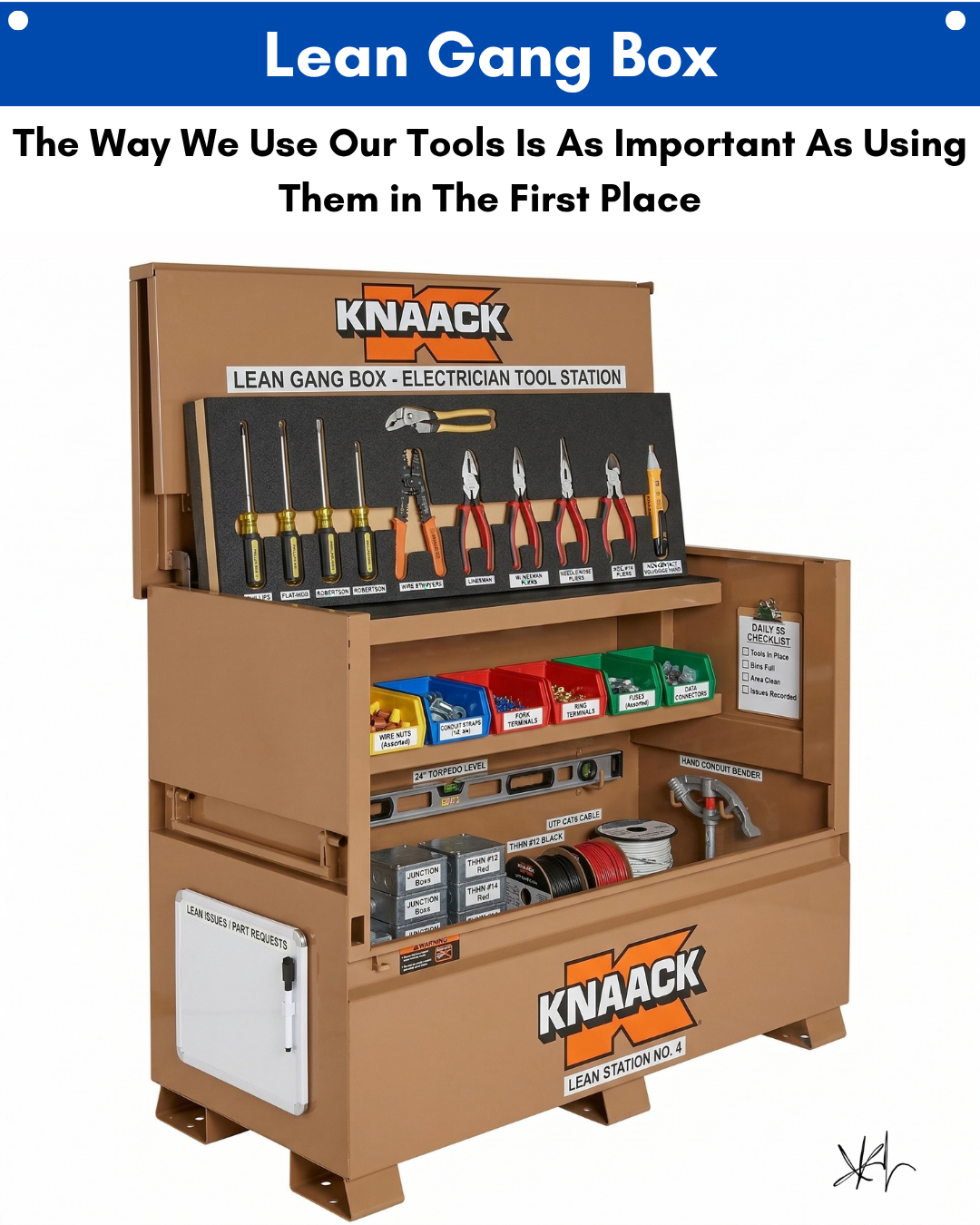
The image in this post shows what 5S looks like when it’s applied seriously to a Knaack gang box a Lean Station designed from the inside out for electricians. Every element has a specific function, and the function is always the same: make the right behavior the easiest behavior, and make the absence of any tool immediately visible.
The shadow board on the lid panel holds hand tools screwdrivers, pliers, lineman’s pliers, wire strippers, and specialty items each outlined in foam so its silhouette is visible the moment the lid opens. When a tool is in place, you see the tool. When it’s missing, you see the shadow. That gap is the visual signal. No counting required. No asking around. The missing tool announces itself. This is Set in Order made physical the principle that everything needed has a defined place that makes absence visible without any additional effort.
The labeled multi-bin system below the shadow board handles consumables by type wire nuts by size, connectors by gauge, tape by application, labels and tags in their own bin. Color-coding differentiates categories at a glance. Every bin is labeled so a helper who is new to the project can find the right connector in under ten seconds without asking the journeyman who is mid-task. The knowledge required to locate materials is built into the box, not stored in someone’s head.
Watch for these signals that a gang box needs a 5S redesign on your project:
- Tools from one task end up in the wrong tray or buried under other items by the next morning
- Consumables from different categories are mixed in the same bin with no organization
- Morning setup takes more than five minutes before productive work can begin
- Tools go missing mid-project and get replaced without anyone knowing where the original went
- A new worker or helper cannot locate what they need without asking for directions
The Daily 5S Checklist and the Lean Whiteboard
Two elements of the Lean Gang Box that most teams skip and shouldn’t are the daily 5S checklist and the whiteboard for Lean issues and part requests.
The daily 5S checklist is a brief, visual morning routine: is the shadow board complete, are the bins organized by category, is the box clean, are consumables at sufficient levels to complete today’s scope? It takes two minutes. It ensures that the box starts every day at its standard, not at whatever condition it was left in the previous afternoon. Without the checklist, the box degrades. With it, the standard is self-reinforcing.
The whiteboard serves two functions. First, it captures part requests specific consumables or tools running low that need to be ordered before the crew runs out. Instead of a worker discovering mid-task that the right connector is gone, the request is on the board before it becomes a problem. Second, it captures Lean issues anything the crew observed that slows production, creates waste, or could be improved. This is how the improvement culture reaches the tool level. Paul Akers teaches: fix what bugs you. The whiteboard is where “what bugs you” gets documented and acted on instead of forgotten.
Why the Way We Use Tools Is as Important as Using Them
There is a deeper principle behind the Lean Gang Box that goes beyond productivity metrics. When a skilled craftsperson opens a box and finds everything in its place, clean, labeled, and ready the work itself feels different. There is pride in the standard. There is confidence in the system. There is a quiet signal that the company cares about the quality of the environment they’re working inside. That emotional dimension is not soft. It is a production driver that no scheduling system can replicate. People who take pride in their tools take pride in their work. And people who work in a system designed to support them feel respected by that system.
If your project needs superintendent coaching, project support, or leadership development, Elevate Construction can help your field teams stabilize, schedule, and flow. The Lean Gang Box is where that culture becomes tangible where 5S stops being a concept on a poster and starts being the standard every crew member works from, every day.
Set the Standard Before the First Crew Arrives
Here is the challenge. Before your next phase mobilizes, set a gang box standard for every trade on the project. Shadow boards for hand tools. Labeled, color-coded bins for consumables. A daily 5S checklist on the lid. A whiteboard for issues and requests. Require the standard before the box goes into service. Inspect it weekly on the zone control walk. When you find a box that isn’t meeting the standard, sit down with the foreman and help them fix it rather than writing a note and moving on.
Do that for thirty days and measure how much time the crew spends searching versus installing. The difference will tell you everything you need to know about whether the system was worth designing.
Paul Akers said it best: “Fix what bugs you.” The disorganized gang box has bugged every skilled tradesperson who has ever opened one. It doesn’t have to. Design the box. Set the standard. Let the crew win from minute one.
On we go.
Frequently Asked Questions
What is a Lean Gang Box and how is it different from a standard toolbox?
It’s a gang box organized around 5S principles shadow boards for hand tools, labeled bins for consumables, a daily checklist, and a Lean whiteboard so every tool has a home and every absence is immediately visible.
Why does the shadow board matter more than just organizing tools?
Because it makes missing tools visible without counting. When a tool is present, you see the tool. When it’s gone, the shadow tells you instantly before the task starts, not after you’re already mid-task and need it.
What should the daily 5S checklist on the box include?
Shadow board completeness, bin organization, consumable levels for today’s scope, and cleanliness of the box interior. It takes two minutes and ensures the standard is maintained rather than degrading over the project.
How does the Lean whiteboard prevent mid-task shortages?
It captures part requests before consumables run out when a bin runs low, the request goes on the board immediately so the order happens before the crew is stopped by a shortage.
How long does it take to set up a Lean Gang Box properly?
One half-day of intentional setup before the crew mobilizes cutting foam, labeling bins, mounting the shadow board, and laminating the checklist. The time returns within the first week of use.
If you want to learn more we have:
-Takt Virtual Training: (Click here)
-Check out our Youtube channel for more info: (Click here)
-Listen to the Elevate Construction podcast: (Click here)
-Check out our training programs and certifications: (Click here)
-The Takt Book: (Click here)
Discover Jason’s Expertise:
Meet Jason Schroeder, the driving force behind Elevate Construction IST. As the company’s owner and principal consultant, he’s dedicated to taking construction to new heights. With a wealth of industry experience, he’s crafted the Field Engineer Boot Camp and Superintendent Boot Camp – intensive training programs engineered to cultivate top-tier leaders capable of steering their teams towards success. Jason’s vision? To expand his training initiatives across the nation, empowering construction firms to soar to unprecedented levels of excellence.