
The Lean Connex Box: How Visual Storage Design Stops Crews From Hunting for What They Need
The average tradesperson spends thirty or more minutes a day looking for tools and materials. Multiply that across a crew of ten. Multiply it across a year. That is not a tool problem. That is a system problem, and most projects have never named it as one.
Here is the deal. Nobody budgets time for hunting. It does not appear on the schedule, it does not show up in a report, and nobody logs it as lost productivity. It just happens, quietly, every day, absorbed into the normal rhythm of the work until it feels like a permanent tax on every task rather than a solvable design problem. The Lean Connex Box is what happens when someone stops accepting that tax and builds a system that removes it.
The Pain of Thirty Minutes Nobody Tracks
Picture the connex box on a typical project. Bins stacked without labels. Fasteners mixed with fittings mixed with whatever got thrown in during the last cleanup. Tools scattered across shelves with no organization logic beyond whoever put them there last. Material staged directly on the floor because there was no shelf space cleared for it. PPE somewhere in the back, behind three boxes nobody has opened in months.
A crew member needs a specific fitting. They walk to the connex, open the door, and start searching. Five minutes pass. They find something close but not quite right. Another two minutes confirming it will not work. They ask a coworker who thinks they saw the right one somewhere on the left side. Another three minutes. Eventually they find it, or they give up and drive to the supply house, which turns a ten minute search into a forty minute round trip.
That single search cost real time, but the larger cost is what it did to the task. The work stopped. The rig sat idle. The momentum of the day broke. And this happens not once but multiple times daily, for every person on the crew, on every project running an unmanaged connex box. Thirty minutes a day per person is not an exaggeration. It is what happens when storage has no system and everyone is left to search rather than retrieve.
The Failure Pattern
The failure pattern is treating the connex box as a container rather than a system.
A container just holds things. It does not care where anything is, whether it has a label, whether it is the right quantity, or whether anyone can find it without searching. Most jobsite storage operates exactly this way. Materials and tools accumulate over the life of the project, get shuffled around as space runs out, and settle into whatever arrangement happens to exist on any given day. Nobody designed that arrangement. It assembled itself from convenience decisions made under time pressure, the same way any unmanaged space assembles itself.
The problem compounds because unmanaged storage does not stay static. It gets worse. Every time someone searches for an item and cannot find it, they either buy a duplicate, which adds clutter and cost, or they give up and improvise, which creates its own inefficiency downstream. Every time an item gets put back in a different location than where it was found, the system loses a little more coherence. Left unmanaged, a connex box degrades continuously for the life of the project, and by month six it can take longer to find something than it did in week one.
They Didn’t Fail the System
When a crew member spends fifteen minutes hunting for a tool, the instinct is to think they should be more organized, more efficient, more on top of their inventory. That instinct misses what is actually happening.
No individual crew member designed the connex box. No individual crew member decided that fasteners and fittings should be mixed together, or that PPE should be behind three unopened boxes, or that material should sit on the floor instead of a shelf. Those conditions existed before that crew member ever opened the door, and they will exist for the next person who opens it too. The search time is not a personal inefficiency. It is the predictable output of a storage system that was never designed, only accumulated.
Blaming the crew member for the search time is blaming the symptom. The actual problem is upstream, in the absence of a visual management system that would have made the item easy to find regardless of who was looking for it or how well they happened to remember where things were.
What the Lean Connex Box Actually Builds
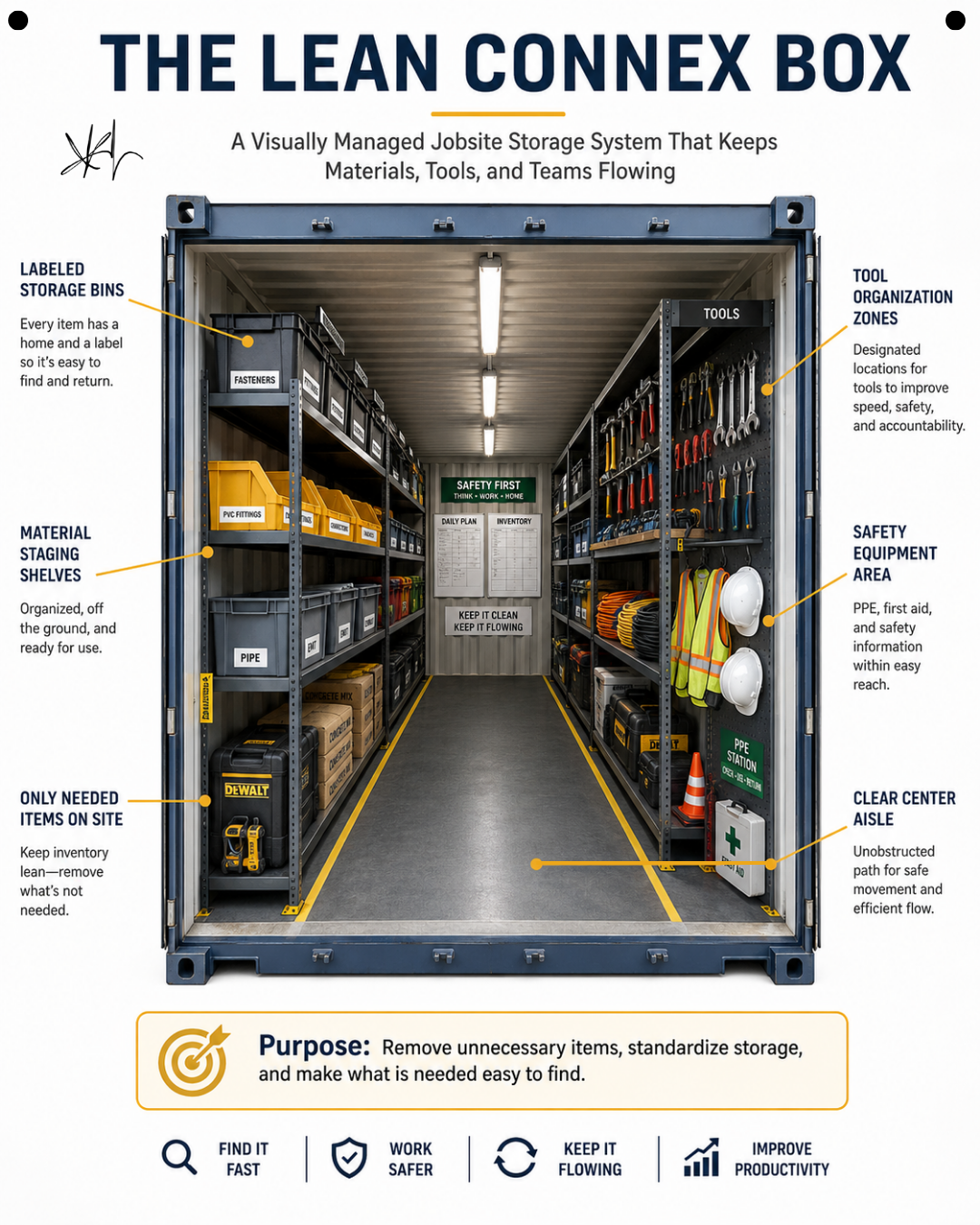
The Lean Connex Box is built around one governing idea. Everything needed should be easy to find, and everything not needed should not be there at all. That second half of the idea matters as much as the first, because a storage system cluttered with unnecessary items is nearly as slow to search as one with no organization at all.
Labeled storage bins give every item a home and a label, which means retrieval does not depend on memory. Anyone on the crew, including someone who has never opened that connex box before, can find what they need by reading the label rather than searching by trial and error. That single design decision removes the dependency on tribal knowledge that most unmanaged storage systems rely on without anyone realizing it.
Material staging shelves keep supplies organized, off the ground, and ready to grab. Material on the floor is material that gets damaged, gets in the way, and takes longer to locate because it is not positioned at eye level in a predictable spot. Shelving is a small investment that pays back every time someone retrieves material without having to dig through a pile.
Tool organization zones create designated locations that improve speed, safety, and accountability simultaneously. When a tool has a specific place, a missing tool is immediately visible, which means lost or misplaced tools get caught and addressed instead of quietly becoming a recurring cost. A designated zone also means the crew member using a tool knows exactly where to return it, which keeps the system from degrading over time the way unmanaged storage inevitably does.
A safety equipment area keeps PPE and first aid within easy reach rather than buried behind other materials. In an emergency, the difference between PPE that is immediately accessible and PPE that requires a search is not a convenience question. It is a response time question, and response time matters most exactly when nobody has time to search.
A clear center aisle keeps the path through the connex unobstructed, supporting safe movement and efficient flow. A connex box with material and tools encroaching into the walking path is a connex box where every retrieval trip involves navigating around obstacles, which slows every transaction and increases the risk of an incident in a confined space.
And only what is actually needed stays on site. Keeping inventory lean and removing what is not needed is not a minor housekeeping detail. It is the discipline that keeps the whole system searchable. Every unnecessary item on a shelf is an item someone has to look past to find the item they actually need, and that accumulated clutter is what turns a well-organized system back into a scavenger hunt over time if nobody protects the standard.
The Real Cost of an Unmanaged Connex Box
Thirty minutes a day per person, across a crew of ten, is five hours of lost productive time every single day. Across a five day week, that is twenty-five hours. Across a year on a long-duration project, the number becomes large enough that it would show up as a major line item if anyone tracked it the way they track material costs or equipment rental.
Nobody tracks it, because it never presents itself as a single event worth logging. It presents itself as a hundred small interruptions distributed across the crew and the calendar, each one too small to escalate, all of them together large enough to represent one of the most significant unaddressed sources of waste on the project. That is exactly the kind of waste Lean thinking is built to find: invisible not because it is small, but because it is distributed.
Signals Your Connex Box Needs a Redesign
Walk your storage setup and look for these patterns:
- Crew members regularly asking each other where an item is instead of retrieving it independently
- Duplicate purchases of tools or materials that likely already exist somewhere on site
- Material sitting on the floor rather than staged on shelving
- A center aisle that requires stepping over or around items to move through the space
- PPE or safety equipment that takes more than a few seconds to locate
Each of these signals a system gap, not a crew failing, and each one is closable with the same visual management principles that built the Lean Connex Box in the first place.
Why This Belongs on Every Jobsite
Lean thinking is often associated with manufacturing, where visual management, standardized storage, and waste elimination have been formalized for decades. Construction has been slower to adopt the same discipline in its own storage and staging practices, in part because a jobsite feels more chaotic and less controllable than a factory floor.
That distinction does not hold up under scrutiny. A connex box is a fixed, controllable space, exactly the kind of environment where visual management principles apply cleanly. The same discipline that organizes a manufacturing storeroom organizes a jobsite connex box, and the payoff is the same: less time searching, more time producing, and a safer, cleaner environment for everyone using the space.
This connects directly to the broader discipline of staging and workface planning that keeps a Takt-driven project flowing. A crew that starts every task with materials and tools easy to find is a crew that maintains the rhythm the schedule depends on. A crew fighting an unmanaged connex box is a crew losing rhythm in exactly the way that compounds across zones and phases. If your project needs superintendent coaching, project support, or leadership development, Elevate Construction can help your field teams stabilize, schedule, and flow. Jason Schroeder and the LeanTakt team build visual management systems like the Lean Connex Box because the discipline is transferable, the investment is small, and the return compounds every single day the project runs.
Redesign the Box Before the Waste Compounds
Here is your challenge. Walk your connex box today and time how long it takes to find three random items a crew member might need. If any of those searches take longer than thirty seconds, you have found your waste. Label it, stage it, zone it, clear the aisle, and remove what is not needed.
Taiichi Ohno said it plainly: “Costs do not exist to be calculated. Costs exist to be reduced.” The cost of an unmanaged connex box is not calculated on any report your project produces. It is real, it runs every day, and it is entirely within your control to reduce. Go reduce it.
On we go.
FAQ
How much time does a poorly organized connex box actually cost a project?
At thirty minutes per person per day across a crew of ten, the cost is roughly five hours of lost productive time daily, or twenty-five hours a week. Across the life of a long-duration project, that adds up to a significant and entirely avoidable loss that most projects never formally track because it arrives as distributed friction rather than a single visible event.
What is the first step in converting an unmanaged connex box into a Lean Connex Box?
Remove everything and sort it into three categories: needed regularly, needed occasionally, and not needed at all. Remove the third category from the site entirely. That single step, done before any labeling or shelving work begins, prevents the new system from being cluttered with the same unnecessary items that made the old system slow to search.
Who should be responsible for maintaining the system once it is built?
Assign one person as the owner of the connex box standard, with the expectation that they do a brief weekly check to confirm labels are intact, items are in their designated zones, and no unnecessary material has accumulated. Shared responsibility for a shared space tends to produce the same slow degradation that created the original problem, so a single owner with clear accountability is more effective than an informal expectation that everyone will maintain it.
If you want to learn more we have:
-Takt Virtual Training: (Click here)
-Check out our Youtube channel for more info: (Click here)
-Listen to the Elevate Construction podcast: (Click here)
-Check out our training programs and certifications: (Click here)
-The Takt Book: (Click here)
Discover Jason’s Expertise:
Meet Jason Schroeder, the driving force behind Elevate Construction IST. As the company’s owner and principal consultant, he’s dedicated to taking construction to new heights. With a wealth of industry experience, he’s crafted the Field Engineer Boot Camp and Superintendent Boot Camp – intensive training programs engineered to cultivate top-tier leaders capable of steering their teams towards success. Jason’s vision? To expand his training initiatives across the nation, empowering construction firms to soar to unprecedented levels of excellence.