
Finding Your Cheese in a Changing Industry
In this blog, I want to share a powerful concept inspired by the book Who Moved My Cheese? a reminder that our industry has changed, our “cheese” has moved, and the old ways that once made us successful no longer work. Lean practices, modern training, and new thinking aren’t moving the cheese; they’re showing us where it went so we can succeed again. Everything we learn helps us reorient toward a new standard and embrace the change needed to thrive.
This blog focuses on the 14 Principles of the Toyota Way and how deeply they apply to construction. These principles changed my entire understanding of how we build, lead, and remove waste. They don’t just help us work better they help us see problems clearly instead of hiding them, so that continuous improvement can thrive.
Understanding Lean Beyond the Last Planner System
Many people wonder what lean really means. They’ve heard many definitions, tried pieces of it, or assumed it might fade away like a passing trend. But lean is not a fad. It is a complete philosophy that extends far beyond the Last Planner System. Lean reaches into how we think, how we stabilize work, how we grow people, how we respect teams, how we solve problems, and how we create flow. Lean focuses not on economies of scale, but on economies of time, seeing and solving problems, and building stable, predictable systems where teams can win. Taiichi Ohno said it best: “Having no problems is the biggest problem of all.” Lean is about surfacing problems, not hiding them, so we can eliminate waste and continuously improve. If we respect people, create stability, and embrace improvement, we’re living lean.
The 14 Principles of the Toyota Way and How They Apply to Construction
- Base decisions on long-term philosophy: Optimize the whole, not just short-term gains. Flow must matter more than quick financial wins.
- Create continuous process flow: Flow exposes roadblocks instantly. Without flow, chaos hides all problems.
- Use pull systems to avoid overproduction: Let one trade pull the next into the area with clean, finished work and clear handoffs.
- Level the workload work like the tortoise: Clean and steady always wins. Chaos hides issues and destroys quality.
- Build a culture of stopping to fix problems: Quality at the source is everything. Stop, fix it now, and never push defects downstream.
- Standardize tasks and processes: Standardization is the foundation of improvement and empowerment. Without consistency, nothing can improve.
- Use visual controls so no problems are hidden: Visual systems make quality, safety, and production instantly clear to everyone.
- Use only reliable, tested technology: Technology should serve people not overburden them or slow them down.
- Grow leaders who understand the work: Leaders must model the philosophy, teach it, and live it every day.
- Develop exceptional people and teams: Train, coach, build trust, resolve conflict, and create cohesive teams through intentional effort.
- Respect and challenge partners and suppliers: Help vendors improve just like internal teams. Flow only works if everyone is aligned.
- Go and see for yourself: Get into the field. Study the work. Lead with eyes, not just reports.
- Make decisions slowly, implement quickly: Think deeply with the team then execute with urgency.
- Become a learning organization: Reflect constantly and improve relentlessly. Reflection drives growth.
These principles transformed the way I ran projects. We printed each principle on laminated sheets and hung them in the trailer so the team saw them every day. Trades referenced them, challenged us with them, and lived them. They shaped our culture and decision-making.
Applying These Principles to Today’s Construction Problems
Right now, the industry is full of habits that hide problems: batching, overstaffing, faking reports, pushing workers together, relying on bad technology, and ignoring training. These behaviors belong to the old maze where our cheese used to be. They don’t work anymore.
Our solution is to apply lean principles aggressively:
- Use tact planning to generate flow and surface problems early.
- Use quality at the source to stop defects immediately.
- Use training as a strategy, not an afterthought.
- Build people first, because teams build projects not schedules or software.
When these principles become part of your culture, everything changes. You work less while accomplishing more. You reduce chaos, waste, and rework. You go home earlier. You create stable systems where people thrive and find joy in the work.
Lean enables us to create construction projects that feel like Disneyland clean, organized, predictable, stable, safe, and magical. And it enables us to build careers that are fulfilling, balanced, and deeply meaningful.
On we go
Key Takeaway
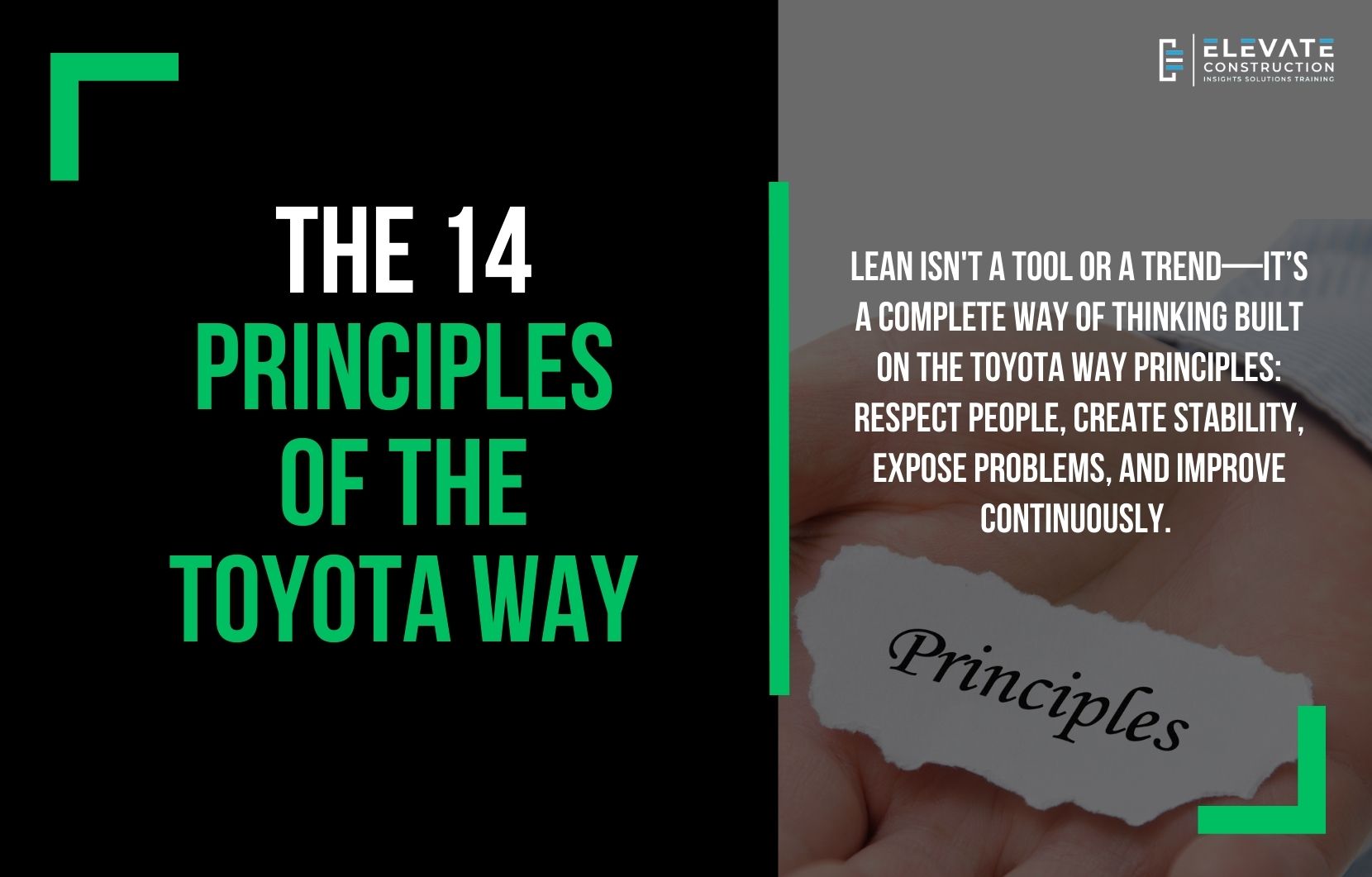
Lean isn’t a tool or a trend it’s a complete way of thinking built on the Toyota Way principles: respect people, create stability, expose problems, and improve continuously. When you build your projects and your teams on these principles, you don’t just increase productivity you transform the culture, elevate people, reduce chaos, and create the stable environment needed to build remarkable projects and remarkable lives.
If you want to learn more we have:
-Takt Virtual Training: (Click here)
-Check out our Youtube channel for more info: (Click here)
-Listen to the Elevate Construction podcast: (Click here)
-Check out our training programs and certifications: (Click here)
-The Takt Book: (Click here)
Discover Jason’s Expertise:
Meet Jason Schroeder, the driving force behind Elevate Construction IST. As the company’s owner and principal consultant, he’s dedicated to taking construction to new heights. With a wealth of industry experience, he’s crafted the Field Engineer Boot Camp and Superintendent Boot Camp – intensive training programs engineered to cultivate top-tier leaders capable of steering their teams towards success. Jason’s vision? To expand his training initiatives across the nation, empowering construction firms to soar to unprecedented levels of excellence.
On we go