
What Project Managers Should Shield the Team From (and What They Must Not)
There’s a phrase I hear all the time on job sites:
“This is just a lot of change for the job site team.”
Usually, it’s said with good intentions. The project manager is trying to “protect” the project delivery team. They don’t want people overwhelmed. They don’t want morale to drop. They don’t want the team frustrated.
But here’s the problem: we’re mixing two very different categories of “change.”
Some change is toxic. Some change is necessary. Some variation should be blocked. Some variation must be embraced. If we don’t sort those categories correctly, we end up doing the opposite of what we intended: we shield teams from growth, and we expose them to waste.
This episode is Jason Schroeder making that distinction as clearly as he can, because it impacts the quality of the work, the health of the team, and the long-term capability of the organization.
The “Too Much Change” Complaint: Why It Shows Up on Every Job
Human beings will complain when things change.
That’s not negativity. That’s wiring. Jason explains that as soon as something changes, your brain will automatically generate resistance:
- “It’s too expensive.”
- “We don’t have the people.”
- “We don’t have the time.”
- “My boss isn’t doing it, why should I?”
- “It doesn’t apply to me.”
That’s normal. Just like we’re wired to be fearful, we’re wired to be resistant to change. The mistake is treating that initial resistance as a reason to stop improving.
If we “sympathy vote” the team into stagnation just because the brain complains, we are not protecting people. We are limiting them.
Change Isn’t the Enemy: Variation Is
Jason makes a statement that’s worth repeating:
“Change is not the problem. It’s certain types of variation that are bad.”
Think about what we build. If you’re building a stadium, a museum, a hospital, an airport, a school, or a complex commercial building, everything is different. Different assemblies. Different conditions. Different constraints. Different sequences. Difference is normal in construction.
The reason construction can still work is because we have standard systems for dealing with that difference. We use repeatable planning routines. We use standard approaches for layout, safety, quality, production control, and coordination.
The problem is when process change shows up without a standard way to handle it. That’s when variation becomes destructive. That’s when things start to take longer. That’s when people get overloaded and quality suffers.
That’s also why a project manager has a real responsibility: to filter harmful variation out of the system.
What a PM Should Shield the Team From: Toxic Variation in the System
A project manager should absolutely shield the project delivery team from toxic variation.
Jason gives clear examples. If there are excessive owner changes, shield the team. If there is a toxic owner, shield the team. If change orders are out of control and you need resources, shield the team and add support. If there’s RFI churn that keeps dumping uncertainty into the field, shield the team and stabilize the inputs.
This is not about hiding reality. It’s about controlling the inputs so the team can execute with stability. That is respect for people. That is leadership.
Symptoms of Toxic Variation to Shield the Team From
Here are the patterns Jason is pointing to when he says “shield the team”:
- Owner driven changes that constantly disrupt the plan
- Toxic interactions that create fear, drama, or emotional chaos
- Excessive change orders without added resources
- Too many RFIs and unresolved information churn
- Overburden and unevenness created by bad upstream decisions
- External noise that forces the team to react instead of build
Toxic variation isn’t “hard work.” Toxic variation is waste entering the system and being dumped on the people.
Owner Chaos, Excessive Changes, and RFIs: How to Protect the Field Without Hiding Reality
A good project manager doesn’t pretend the chaos isn’t happening.
A good project manager absorbs it, filters it, and converts it into stable execution conditions for the field. That might mean consolidating changes before releasing them. That might mean pushing back on the owner until there is clarity. That might mean protecting the superintendent from constant re direction. That might mean adding resources to cover the demand being created.
Shielding is not avoidance. Shielding is system design.
And it’s one of the most indispensable roles a great project manager plays.
What a PM Must Never Shield the Team From: Learning, Training, and Growth
Here’s the core point of the episode.
Project managers should never shield their teams from:
- growing
- learning
- reading
- training
- improving
- implementing the base systems needed for the job
If a project manager tries to keep the team “comfortable” by refusing to implement the core systems, refusing to train, refusing to learn, refusing to improve, and refusing to upgrade the way the team runs meetings and production control, the project gets stuck in mediocrity.
And it will waste more time than it ever “saved” by avoiding change.
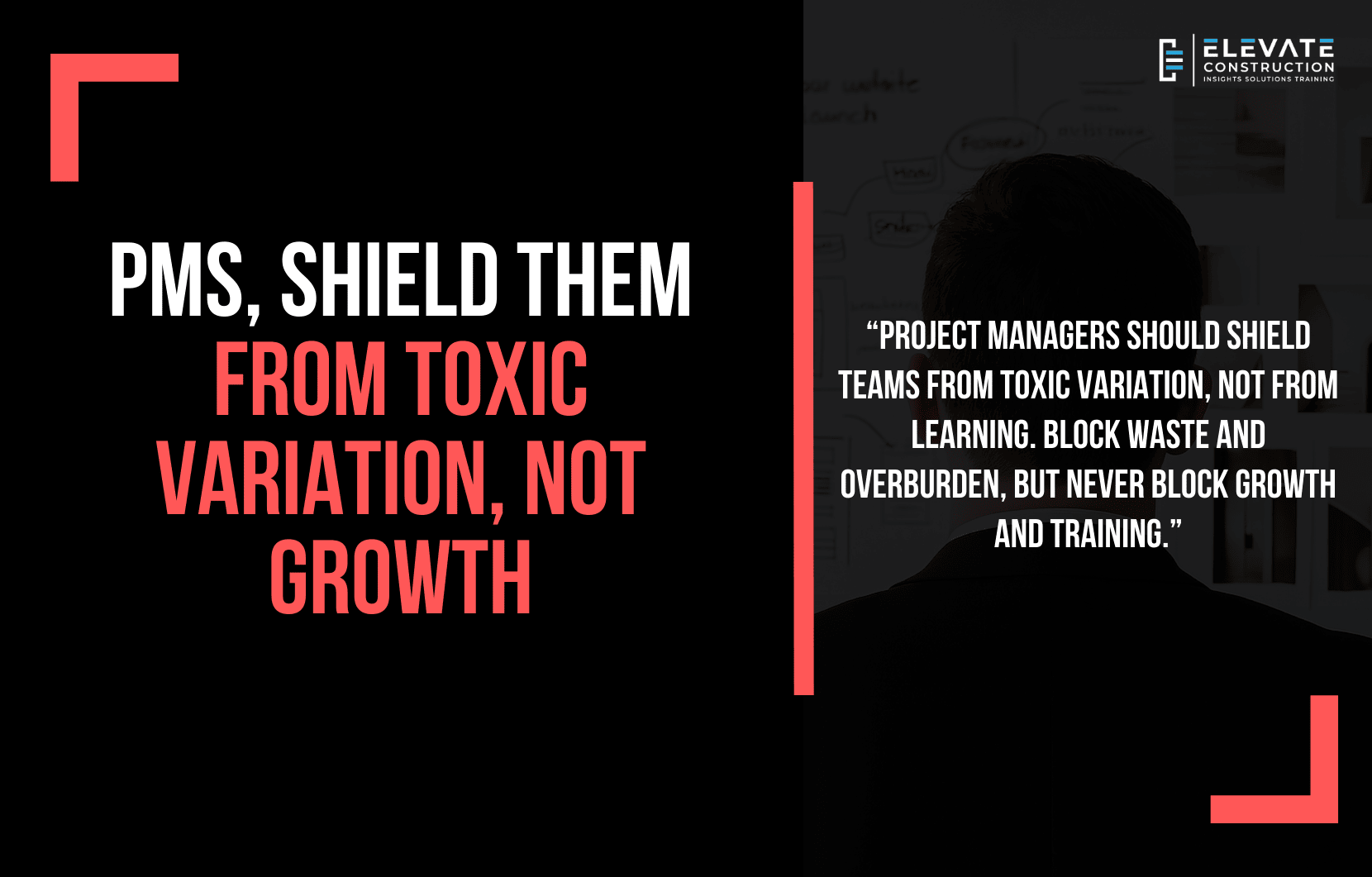
Jason frames it clearly: toxic external variation should be excluded, but internal growth variation must be allowed. If we block the growth, we block excellence.
Growth Variation You Must Not Block
This is the kind of “change” that looks hard at first, but pays back forever:
- Implementing the base meeting cadence and production control system
- Doing a book challenge, reading challenge, or learning routine
- Training that helps the field execute the plan with confidence
- Coaching that increases capability and consistency
- Continuous improvement work that upgrades the process
- Standard systems that reduce firefighting and chaos
This is not “extra.” This is the pathway out of waste.
Base Systems Aren’t Optional: Why “Shielding” Becomes Mediocrity
Many teams lose years because they never install the basics.
They don’t want the discomfort of change. They avoid training because it feels like “too much.” They avoid upgrading meetings because it feels like “a lot.” They skip the core systems and try to compensate with effort.
But effort doesn’t create flow. Systems do.
When we don’t implement base systems, we don’t avoid variation. We increase it. We create bigger rework cycles. We create more stress. We extend durations. We burn people out.
If the plan requires burnout, the plan is broken.
Distress vs Eustress: The Kind of Pressure That Builds People
Jason makes a key distinction: distress is toxic, but stress can be good.
Distress is when you are criticized, pressured, pushed, or overloaded without support. Distress damages people and damages performance.
Eustress is positive stress. It’s when the team rallies toward a challenge they can rise up to. It’s when learning and growth happen with support. It’s when the project needs the team and the team steps up together.
Project managers must learn to shield teams from distress while not protecting them from eustress. Growth requires challenge. The key is that the challenge is supported and meaningful.
The PM’s Real Role: Remove Toxicity, Build Capability
Jason gives project managers a clear shout out: a good project manager is indispensable.
But the job is not to keep the team from feeling uncomfortable. The job is to remove toxic inputs and build capability inside the team.
That means:
- filter owner chaos
- stabilize information flow
- protect the team from waste and overburden
- and then push learning, training, and improvement intentionally
This is how you protect people and still raise the bar.
Japan’s Pattern: Why “People, Process, Quality” Beats Money and Goals
Jason references a key refrain from Paul Akers during the Japan trip:
“Why is Japan, Japan? Training.”
And he highlights the focus:
People. Process. Quality.
Not money and goals first. Those outcomes come after. The way to rise to excellence is to build people and build process so quality becomes predictable.
If we want to rise to operational excellence, we must stop shielding teams from learning and start shielding them from waste.
The PM Decision Filter: Shield or Share?
Here is a simple decision filter that matches the message in the transcript:
- If it’s waste, overburden, or unevenness, shield the team and stabilize it.
- If it’s training, growth, learning, and base system implementation, do not block it.
- If it’s toxic inputs, absorb it, filter it, and protect the field.
- If it’s positive change, lead it, support it, and train toward it.
This is how you protect people and still improve.
If your project needs superintendent coaching, project support, or leadership development, Elevate Construction can help your field teams stabilize, schedule, and flow.
Conclusion
Project managers are not the problem. Confusion about what to shield teams from is the problem.
Shield your team from toxic variation. Shield them from waste. Shield them from overburden. Shield them from unevenness that will grind them down.
But never shield them from learning.
FAQ
What should a project manager shield the team from?
A project manager should shield the team from toxic variation like owner chaos, excessive changes without support, RFI churn, and any wasteful overburden that destabilizes flow and increases stress.
Is change bad on a construction project?
Not inherently. Construction is full of difference and change. The problem is harmful variation without a standard way to manage it, which increases duration and creates instability.
What should a project manager not shield the team from?
A project manager should not shield the team from training, learning, implementing base systems, and continuous improvement. Those are positive changes that build capability and reduce waste long term.
What’s the difference between distress and good stress?
Distress is toxic pressure, criticism, and overburden without support. Positive stress is a challenge the team can rise to with clarity, training, and support, leading to growth and improvement.
Why does Jason mention Japan and training in this context?
Because the pattern emphasized is people, process, and quality. Training is a core driver of excellence, and teams should be protected from waste, not from growth.
If you want to learn more we have:
-Takt Virtual Training: (Click here)
-Check out our Youtube channel for more info: (Click here)
-Listen to the Elevate Construction podcast: (Click here)
-Check out our training programs and certifications: (Click here)
-The Takt Book: (Click here)
Discover Jason’s Expertise:
Meet Jason Schroeder, the driving force behind Elevate Construction IST. As the company’s owner and principal consultant, he’s dedicated to taking construction to new heights. With a wealth of industry experience, he’s crafted the Field Engineer Boot Camp and Superintendent Boot Camp – intensive training programs engineered to cultivate top-tier leaders capable of steering their teams towards success. Jason’s vision? To expand his training initiatives across the nation, empowering construction firms to soar to unprecedented levels of excellence.
On we go