
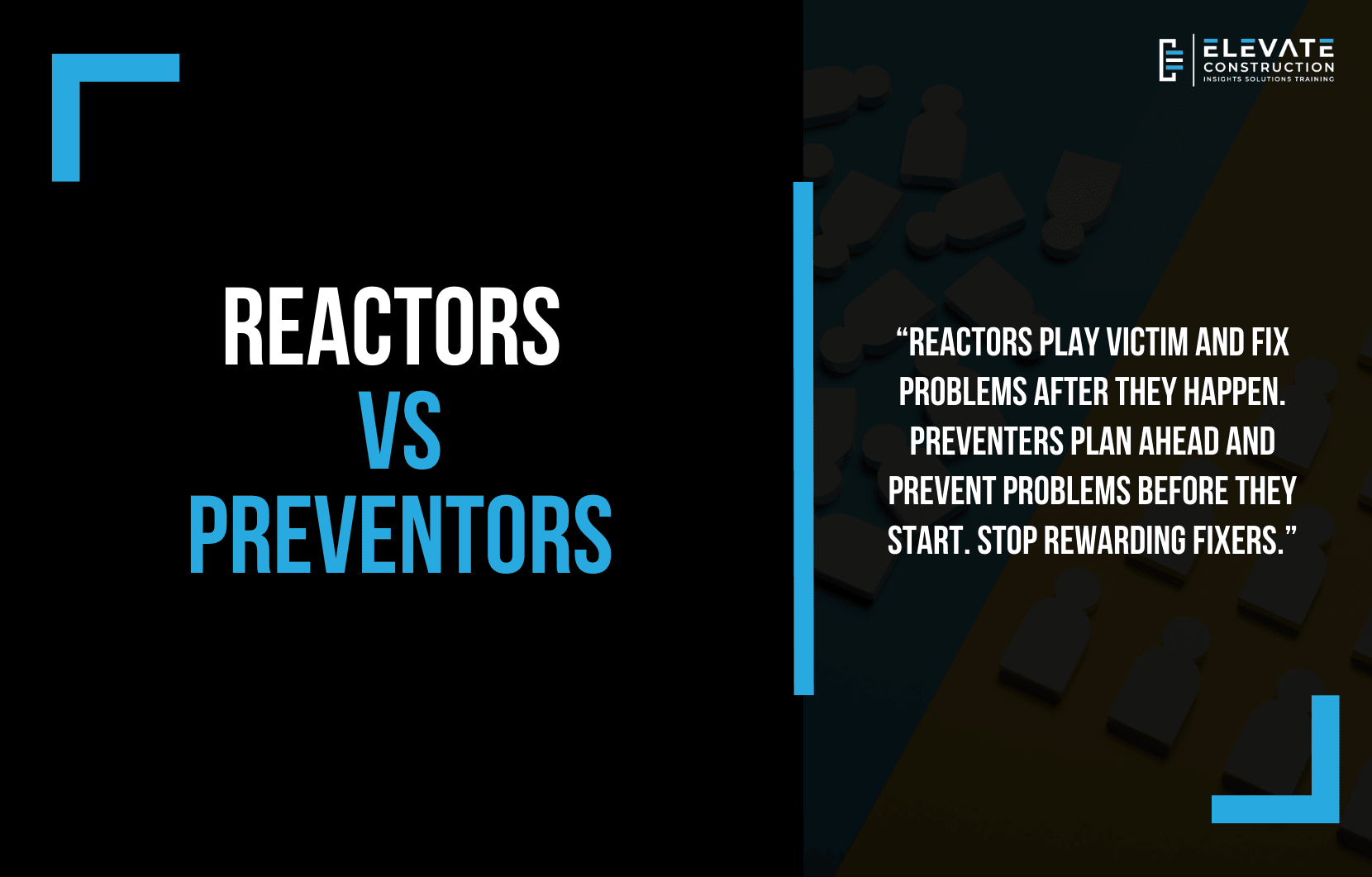
Reactors Versus Preventers (Stop Rewarding Fixers)
I want to comment on our mindset. It’s a very interesting thing that we have to be really dedicated to, and it’s the difference between being a reactor versus a preventer, and you could also say a victim versus a victor.
Here’s the key, and actually this is not a bad analogy that I’m about to give you. I just watched Coach Carter. I love movies like that because Patton, the 1970s movie Patton, and then Coach Carter are examples of the kind of discipline and tenacity you have to have in order to run a project well.
And one of the things I noticed was that a lot of basketball teams will be lax with their pre-preparation, their practice, and then they’ll hope for the best that the players can just magically pull one through the knothole during a game and be able to outplay the other team just as a one-off. And that wish thinking is so destructive.
Let me explain the difference between reactors and preventers.
The Pain of Reactor Victim Mentality
Here’s what happens when you’re a reactor. You don’t prepare. You wait for problems. And when problems happen, you react. You play victim. You blame someone else. You document the delay. You write the cure notice. You file the claim. And you say, “It’s not my fault. It’s the owner’s fault. It’s the designer’s fault. It’s the trade’s fault.” And you never ask: Why didn’t we prevent this?
And there’s so many institutions and systems and universities and schools that teach people to be professional victims. Teach project managers instead of getting out ahead of procurement to be good at documenting and being the victim. Teach legal departments and risk departments, instead of learning how to build the job properly and prevent a court case and be about prevention, actually get good at fighting in arbitration and fighting in an actual court case. Instead of preventing the loss of money through good pre-construction planning and through beefing up your pre-planning systems, the business unit leaders will get good at finding ways to strategically write down their gross profit, write down projects, and somehow make up for profits from other parts of the business.
I could just keep going on and on. Or instead of teaching superintendents how to plan properly out ahead, teaching them to always play the victim and be in a CPM world where we’re always crying poor boy and playing the victim that we didn’t have enough time and we don’t have enough design, always blaming it on somebody else, always passing the buck, always shedding risk, always never being accountable. And I just want to make it very very clear that this is a mindset.
The Reactor Mindset (Victim Examples)
You’ve got to ask yourself if you are reacting to a submittal. Let me even give you a really good analogy. Let’s say your trade partners come out and you’re about to submit a cure notice. Even that is victim mentality. Why did we not get ahead of it? Why did we not have two trades on the line to do this work? Why did we not have a contract clause to where we own the materials in case we did have to supplement? Why did we not interview the trade partner? Why did we not visit their projects ahead of time? Why did we not interview the foreman? Why did we not pre-qualify better? Why are we not grading contractors and only allowing A players to repeat bid our projects?
Even that, something that’s like, “Oh yeah, that’s a normal legal action to take.” Well, it’s a victim behavior. Why did we not get ahead of it? Now if you’ve done everything you can possibly do or had the capacity to do or knew to do and you still have to do it, that’s one thing. But if that’s what you’ve been trained to do and that’s what most of your corporate trainings are about, they’re training you to be the victim instead of the victor.
And the main reason why CPM is still more popular and preferred over systems like Takt is because it fits better with the victim blame somebody else mentality. It’s easier to blame somebody else with CPM. It’s harder to blame it in Takt because Takt requires the right environment and the right rhythm and for the general contractor and trades to all do their job including owners and designers. It is a non-blame system. It is an “oh crap we see immediately” and it’s an accountability system that prevents it. So this is all because of the victim mentality.
The Preventer Mindset (Coach Carter Example)
In the movie Coach Carter with one of my favorite, if not my favorite actor Samuel L. Jackson, he has them run suicides and do push-ups and do disciplined practice, and I think it’s the Richmond Oilers is the team, and he’s like, “When we play, we’re always driving forward, we’re going to play the Richmond Oilers way, we’re not going to play somebody else’s ball, we’re going to play our ball.” And it all comes from preparation so that they’re never having to become a victim.
And that in scene where at the end Coach Carter says, “We’re not going to play their ball, we’re going to play our ball, and we’re going to go out there, and they’re going to be a part of our game because we’re going to be driving the entire time,” that only comes from preparation. And so I thought it was a really neat analogy. If you don’t prepare, the only thing you can do is be a victim.
Here’s what preventers do:
- They prepare and plan ahead: They get out ahead of procurement, host pull plans effectively, track their risk and opportunity register every week and realize opportunities, and learn constantly instead of reacting to problems after they happen.
- They create the right environment: They host the pre-construction meeting effectively, do great lookahead and weekly work planning, do daily planning in the afternoon foreman huddle, create work packages with their trades, and have a queued up and well-operating supply chain.
- They drive forward and make others react to them: When game time comes, they play their ball. They don’t react to the other team. They make the other team react to them. That’s a preventer. That’s a victor.
If your project needs superintendent coaching, project support, or leadership development, Elevate Construction can help your field teams stabilize, schedule, and flow.
The Value of Preventers Versus Reactors
And so the key is that, and I don’t mean to be negative, I’m just trying to paint a picture. A reactor project manager and superintendent is not worth one penny of their salary. A preventer superintendent PM is worth three times the normal going rate. And I’m not trying to get everybody in trouble. You’re probably not going to be able to go ask for a raise and get it right away. But I’m just saying from a value perspective, that’s what it is.
I don’t care to pay for, I care about the person that may be a victim to this, but I don’t care to pay for or to work with ever under any circumstances a reactor victim wannabe builder. All true builders are preventers. And if you ever have to fix a job, don’t brag about it. If you ever have to go recover a job, don’t brag about it. If you ever have to ask somebody to recover a job, you thank them kindly and say, “This never happened and we’re not doing this again.” We should stop rewarding fixers because we need to start rewarding preventers.
The Ernest Shackleton Story (Why We Praise the Wrong Things)
There’s a really neat story. I once heard a story about Ernest Shackleton. He was an explorer in the Antarctic and he had funding and publicized his event, but Norwegian whalers at different ports on his way told him to turn back. They said, “The ice is worse than it’s ever been. Turn back. You’re not going to make it.” And he ignored it.
And then in the Weddell Sea, his ship, which I believe is called the Endurance, buckled under the pressure of the ice. Like literally the sea turned to ice and he had to work with his men for two years. Think about that. Two years of freezing and struggle and isolation. Two years to keep them alive. Eventually he ordered them onto boats to go out I think to Elephant Island. And they had to stay there, I believe, for at least eight months while he went on lifeboats, like 14-foot lifeboats, and crossed all the way to connect with civilization north of the Antarctic. And they barely survived. They got frostbitten, they had panic, they passed out, and magically he saved all of his men because of his leadership in the crisis.
And so, you know, that’s when you get Hollywood movies and praise and famous stories and everybody’s like, “Oh, Ernest Shackleton, the hero.” But here’s the thing, why are we praising that? Why did he ever put his men in that situation? And then you consider other explorers like Roald Amundsen. He led an expedition, paused when needed, and reached the south pole without any injuries or shipwrecks. We’ve got to stop this nonsense in construction.
Here’s the lesson. We praise Shackleton the fixer. We praise the hero who saved his men from a crisis he created by ignoring the warnings. But we don’t praise Amundsen the preventer. We don’t praise the explorer who planned, prepared, paused when needed, and reached the south pole without any injuries or shipwrecks. That’s the problem. We reward the wrong people.
A Challenge for Builders
Here’s what I want you to do this week. Ask yourself: Am I a reactor or a preventer? Am I playing victim or victor? When problems happen, do I blame someone else? Or do I ask, “Why didn’t we prevent this?” Do I get ahead of procurement? Do I host pull plans effectively? Do I track my risk and opportunity register every week? Do I learn constantly? Do I prepare so I can drive forward instead of react?
Stop being a reactor. Stop playing victim. Stop blaming someone else. Stop waiting for problems and then documenting delays. Start being a preventer. Start planning ahead. Start preparing. Start driving forward. Start playing your ball, not someone else’s ball. As we say at Elevate, reactors play victim and fix problems after they happen. Preventers plan ahead and prevent problems before they start. Stop rewarding fixers. Reward preventers.
On we go.
Frequently Asked Questions
What’s the difference between a reactor and a preventer?
Reactors wait for problems, then react, play victim, and blame someone else. Preventers plan ahead, prepare, and prevent problems before they start. Reactors fix jobs. Preventers never need fixing.
Why is submitting a cure notice a victim behavior?
Because it means you didn’t prevent the problem. Why didn’t you have two trades on the line? Why didn’t you pre-qualify better? Why didn’t you interview the foreman? Cure notices are reactive, not preventive.
Why is CPM more popular than Takt?
Because CPM fits the victim mentality. It’s easier to blame someone else with CPM. Takt requires everyone to do their job. It’s a non-blame accountability system that prevents problems instead of documenting delays.
What do preventers do differently?
They get ahead of procurement. They host pull plans effectively. They track risk and opportunity registers weekly. They host great pre-construction meetings. They do lookahead and weekly work planning. They create work packages with trades. They prepare.
Why do we praise Ernest Shackleton instead of Roald Amundsen?
Because we reward fixers instead of preventers. Shackleton ignored warnings, put his men in crisis, then heroically saved them. Amundsen planned, prepared, paused when needed, reached the south pole without injuries. We praise the wrong people.
If you want to learn more we have:
-Takt Virtual Training: (Click here)
-Check out our Youtube channel for more info: (Click here)
-Listen to the Elevate Construction podcast: (Click here)
-Check out our training programs and certifications: (Click here)
-The Takt Book: (Click here)
Discover Jason’s Expertise:
Meet Jason Schroeder, the driving force behind Elevate Construction IST. As the company’s owner and principal consultant, he’s dedicated to taking construction to new heights. With a wealth of industry experience, he’s crafted the Field Engineer Boot Camp and Superintendent Boot Camp – intensive training programs engineered to cultivate top-tier leaders capable of steering their teams towards success. Jason’s vision? To expand his training initiatives across the nation, empowering construction firms to soar to unprecedented levels of excellence.
On we go