
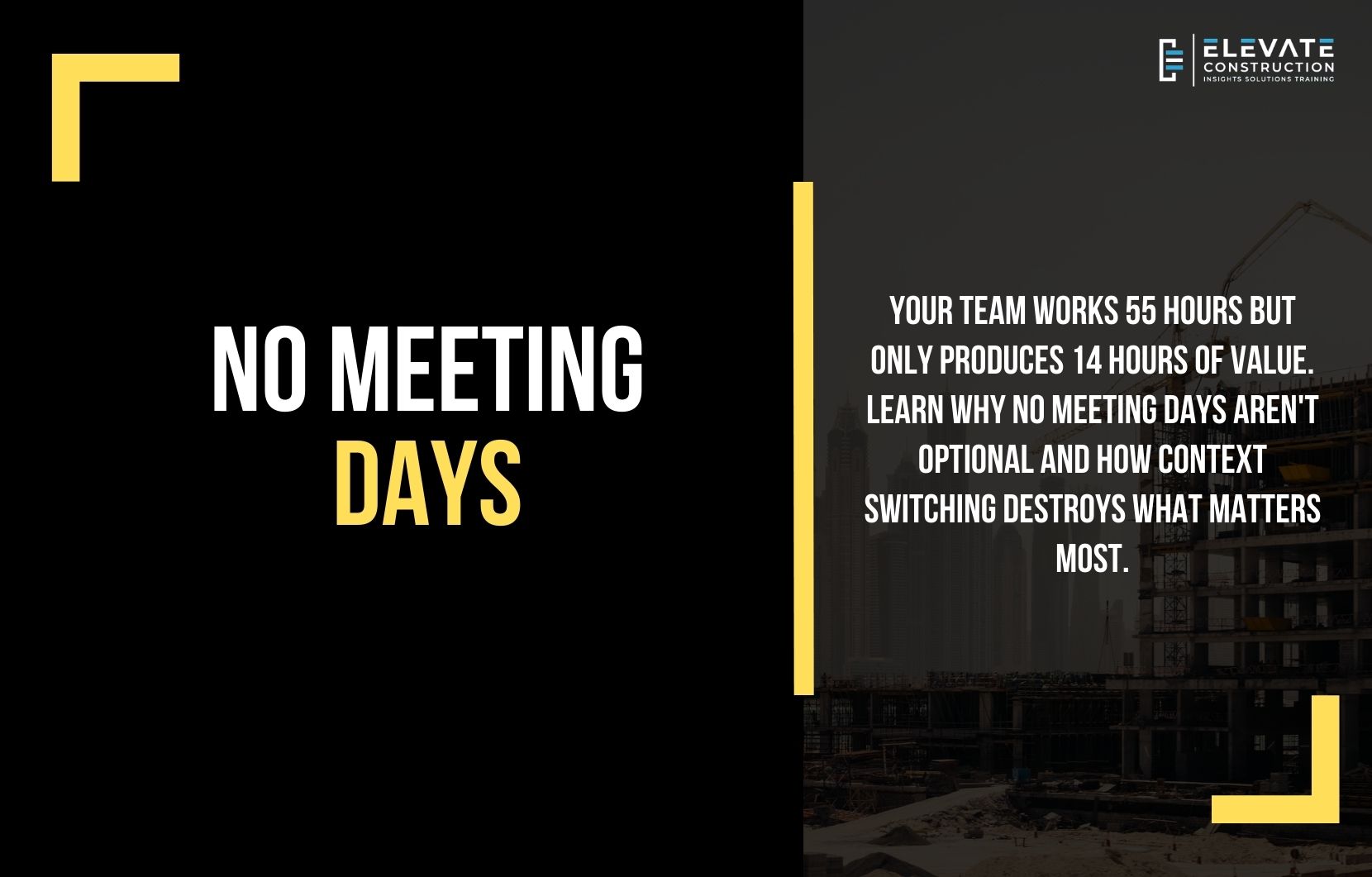
Your Team Is Working 55 Hours and Producing 14 Hours of Value
Here’s the calculation that should terrify every construction leader: Your project engineer works 55 hours per week. After you account for meetings, context switching, unnecessary work that could be outsourced, answering interruptions, and babysitting complex project management systems, that engineer gets 12 to 14 hours of actual production work done. Not per day. Per week. You’re paying for 55 hours and getting 14 hours of value. The other 41 hours evaporate into waste that nobody tracks and everyone accepts as normal.
Think about what that means for your projects. The people responsible for submittals, RFIs, coordination, and field support spend 75 percent of their time on activities that don’t produce value. They’re not lazy. They’re not inefficient. They’re drowning in meetings, context switches, and interruptions that prevent them from focusing long enough to actually complete work. And your response is typically to add more people to compensate for the productivity loss instead of eliminating the waste that’s destroying everyone’s capacity.
This isn’t theoretical. I calculated this at a cancer center project by analyzing meeting systems, context switching patterns, and necessary but non-value-add work that could be outsourced. The math is brutal but accurate. And every project engineer reading this knows exactly what I’m talking about because they live this reality every week. They show up Monday morning with a task list, get pulled into meetings and interruptions all week, and finish Friday wondering why nothing got done despite working exhausting hours.
The Pain of Constant Interruption Disguised as Collaboration
You’ve experienced this frustration as a project engineer or superintendent. You start working on a submittal that requires focus and technical review. Five minutes in, someone stops by with a question. You answer, refocus, and get back into the submission. Ten minutes later, a meeting reminder pops up. You attend a coordination meeting that could have been an email. You return to your desk, try to remember where you were in the submittal, and just as you’re regaining focus, your phone rings with a field question that takes twenty minutes to resolve.
That’s what happens when organizations confuse activity with productivity. They schedule meetings constantly because meetings feel like work. They encourage open communication that becomes constant interruption. They create complex systems that require multiple people to touch every task. And they wonder why nothing gets finished despite everyone being busy all the time. Because being busy doesn’t mean being productive when 75 percent of time evaporates into waste.
The context switching alone destroys productivity in ways most leaders don’t understand. Research shows it takes 5 to 15 minutes to switch mental context from one task to another. For people who struggle with focus, it can take 30 minutes. Every time you stop working on a submission to answer a question, attend a meeting, or handle an interruption, you lose at least 5 to 15 minutes of cognitive capacity just getting back into flow state. Those minutes add up to hours, which add up to the 41 hours per week that disappear.
Here’s a chart that Felipe Engineer showed me from his Scrum training that quantifies this perfectly. When you work on one project with full focus, you get 100 percent productive time. Two simultaneous projects drops you to 40 percent each with 20 percent waste. Three projects: 20 percent each with 40 percent waste. Four projects: 10 percent each with 60 percent waste. Five projects: 5 percent each with 75 percent waste. The waste isn’t just additive. It’s exponential as context switches compound.
The System Creates Meeting Culture That Destroys Focus
Here’s what I want you to understand. The construction industry systematically creates meeting cultures that destroy the focus time required for actual production work. We schedule coordination meetings, owner meetings, corporate meetings, safety meetings, BIM meetings, and status meetings until calendars are blocked solid. We convince ourselves these meetings are necessary collaboration when most could be eliminated, shortened, or handled asynchronously without destroying everyone’s capacity to think.
After discovering the 12 to 14 hour reality at the cancer center, I started recommending no meeting days to every client. And yes, you still have the morning worker huddle and afternoon foreman huddle. But for coordination meetings, owner meetings, office meetings beyond the daily 15 minute team huddle, there are no meetings. It’s a production day where people are expected to come in and do focused work. And it transforms productivity immediately.
Even in my own business, I experience this pattern. Monday, Tuesday, Wednesday filled with meetings and travel, I accomplish some things but customers wonder where I am. Thursday and Friday as production days with no meetings, I get completely caught up. Every week, teams need at least one or two production days with no meetings where they focus and execute the work that meetings supposedly coordinate.
The resistance to no meeting days reveals what organizations really value. People say “I have corporate safety visiting certain days and need to accommodate them.” No, you don’t. Corporate positions exist to support you. You need to take care of your team first. “But our owner requires weekly meetings.” Your owner needs to be managed. No owner, whether they know it intentionally or not, wants you to fail based on their demands. They’ve paid you and expect you to do what’s right. Tell them respectfully that you need two days as no meeting days for success, then negotiate how to restructure and still create remarkable experiences for them.
Here’s what no meeting days look like practically:
- Typically scheduled Wednesdays and Fridays, but adapt to project needs
- Morning 15 minute huddle and afternoon foreman huddle continue for field operations
- Zero coordination meetings, BIM sessions, owner meetings, or corporate visits unless genuine emergency
- Everyone focuses on production work using one piece flow, finishing tasks before switching context
- Outsource everything possible to keep teams small and focused on work only they can do
- Corporate support schedules around production days, not the reverse
- Owners get educated that these days protect project success, not prevent collaboration
The pushback reveals broken priorities. I’ve seen companies whose mission statements talk about creating remarkable experiences or happy environments. But those experiences only apply to customers at the expense of employees. The best companies take care of their people first, and happy people take care of customers. That’s how it actually works. Companies that prioritize customers first will burn projects to the ground trying to finish for the customer at the expense of employees, resources, and families.
Why Focus Time Isn’t Optional For Production
Let me walk you through why no meeting days transform productivity beyond just reducing meeting time. First, they eliminate the context switching waste that destroys cognitive capacity. When people know Wednesday is a production day, they batch deep work for that day instead of trying to squeeze focus between meetings. They finish tasks completely using one piece flow instead of working on five things 5 percent each with 75 percent waste.
Second, they create predictability that enables planning. Project engineers know they can schedule technical reviews, submittal work, and coordination drawing reviews for production days when they’ll have uninterrupted time to think. They stop trying to do complex work in 20 minute increments between meetings, which is where errors happen and quality suffers.
Third, they force organizations to question which meetings actually matter. When you can’t schedule meetings two days per week, you quickly discover which ones were essential and which were just habits. Most coordination can happen asynchronously through collaborative tools. Most status meetings can be replaced with visual management systems. Most owner meetings can be consolidated into the days when meetings are allowed.
Fourth, they protect team capacity by outsourcing non-value-add work. When you’re serious about production days, you identify work that’s necessary but doesn’t require your team specifically. At DPR, we used V Construct for RFI posting, distribution, drawing updates, punch list collection, and tracking work that project engineers and managers didn’t need to do personally. Keep your team small and focused on value-add work. Outsource everything else at reasonable cost so your expensive talent isn’t wasted on administrative tasks.
If your project needs superintendent coaching, project support, or leadership development, Elevate Construction can help your field teams stabilize, schedule, and flow. We work with builders who understand that focus time isn’t a luxury. It’s how you get 40 hours of production from a 55 hour week instead of just 14.
Even in integrated project delivery big rooms, they have production pods, breakout areas, and places where teams go to focus. They have clusters for design sprints with smaller teams. At DPR’s Phoenix office, the open workspace builds culture and communication. But production pods are spaces where if you’re inside, you’re expected to be left alone to focus. They even have nap rooms where mothers can nurse, people can take phone calls privately, or someone exhausted can rest. There’s a balance between collaboration and focus. No meeting days formalize that balance.
The principle is simple: balance and stability. Teams cannot be filled with waste, cannot be overburdened, and cannot work unevenly to the detriment of schedules and families. Master builders anticipate and manage the balance and stability of teams constructing projects. That includes protecting them from meeting overload that destroys their capacity to produce.
The Challenge: Implement No Meeting Days Starting Next Week
So here’s my challenge to you. Implement no meeting days starting next week. Pick two days, typically Wednesday and Friday. Synchronize with corporate and tell them their support needs to cater to your production needs, not disrupt them. Have the conversation with your owner explaining that these days protect project success. Then stick with it for at least six weeks and measure the difference.
Track how much production work actually gets completed on meeting days versus no meeting days. Ask your team how focus time affects quality, stress, and ability to go home at reasonable hours. Watch what happens when people can finish tasks completely instead of context switching between five things with 75 percent waste. The results will prove that no meeting days aren’t optional if you want sustainable productivity.
Create meeting matrices and signage that formalize no meeting days. Make it visible to everyone including corporate and owners. Protect these days with the same vigor you protect safety requirements. Because focus time is about protecting people from the burnout that comes from working 55 hours while only producing 14 hours of value.
Right now your team gets 12 to 14 hours of production time per week. With no meeting days, you could get 24 or 28 hours. That difference transforms project performance and team welfare. It lets people go home instead of working endless hours compensating for waste. It produces better quality because people have time to think instead of rushing between interruptions. And it proves you value people enough to protect their capacity instead of just extracting their time.
As Peter Drucker wrote, “There is nothing so useless as doing efficiently that which should not be done at all.” Most meetings shouldn’t be done at all. Stop doing them efficiently and start protecting the focus time that creates actual value.
On we go.
Frequently Asked Questions
What if a corporation insists on meeting during our no meeting days?
Corporate exists to support project success, not prevent it. Educate them that no meeting days protect productivity that makes their goals achievable. If they resist, show them the 12 to 14 hour data and ask if they want to fix the problem or keep creating it.
Won’t owners refuse to accommodate no meeting days?
Most owners care about project success more than meeting frequency. Explain that these days ensure the team has capacity to deliver what the owner actually wants, quality work on time. Frame it as protecting their investment, not limiting their access.
How do we handle genuine emergencies that require meetings on production days?
Genuine emergencies are rare and obviously warrant breaking the rule. But examine whether issues labeled “emergencies” are actually just poor planning or lack of discipline. Most urgent items can wait one day until the next meeting day.
What if our calendar is already full and we can’t find two full days without meetings?
Then your schedule proves the problem exists and no meeting days are essential. Cancel and consolidate ruthlessly. Most meetings can be eliminated, shortened, or handled asynchronously. Protecting focus time requires saying no to requests that destroy it.
Won’t no meeting days reduce collaboration and create information silos?
Collaboration happens in the meetings you keep and through asynchronous tools. What reduces collaboration is exhausted people with no capacity to think clearly because constant meetings prevent them from doing work that meetings supposedly coordinate. Focus time enables better collaboration, not worse.
If you want to learn more we have:
-Takt Virtual Training: (Click here)
-Check out our Youtube channel for more info: (Click here)
-Listen to the Elevate Construction podcast: (Click here)
-Check out our training programs and certifications: (Click here)
-The Takt Book: (Click here)
Discover Jason’s Expertise:
Meet Jason Schroeder, the driving force behind Elevate Construction IST. As the company’s owner and principal consultant, he’s dedicated to taking construction to new heights. With a wealth of industry experience, he’s crafted the Field Engineer Boot Camp and Superintendent Boot Camp – intensive training programs engineered to cultivate top-tier leaders capable of steering their teams towards success. Jason’s vision? To expand his training initiatives across the nation, empowering construction firms to soar to unprecedented levels of excellence.