
Respect for People: The Foundation That Makes Lean Construction Work
Most construction companies say they value people. Walk the average jobsite for one day and you will see the truth. Not because the people are bad. Not because the leaders do not care. But because the system they inherited was designed around a different assumption entirely that people are costs to control, not capacities to develop. And until that assumption changes, every Lean tool you implement is building on sand.
The Pain That Lives on Every Jobsite
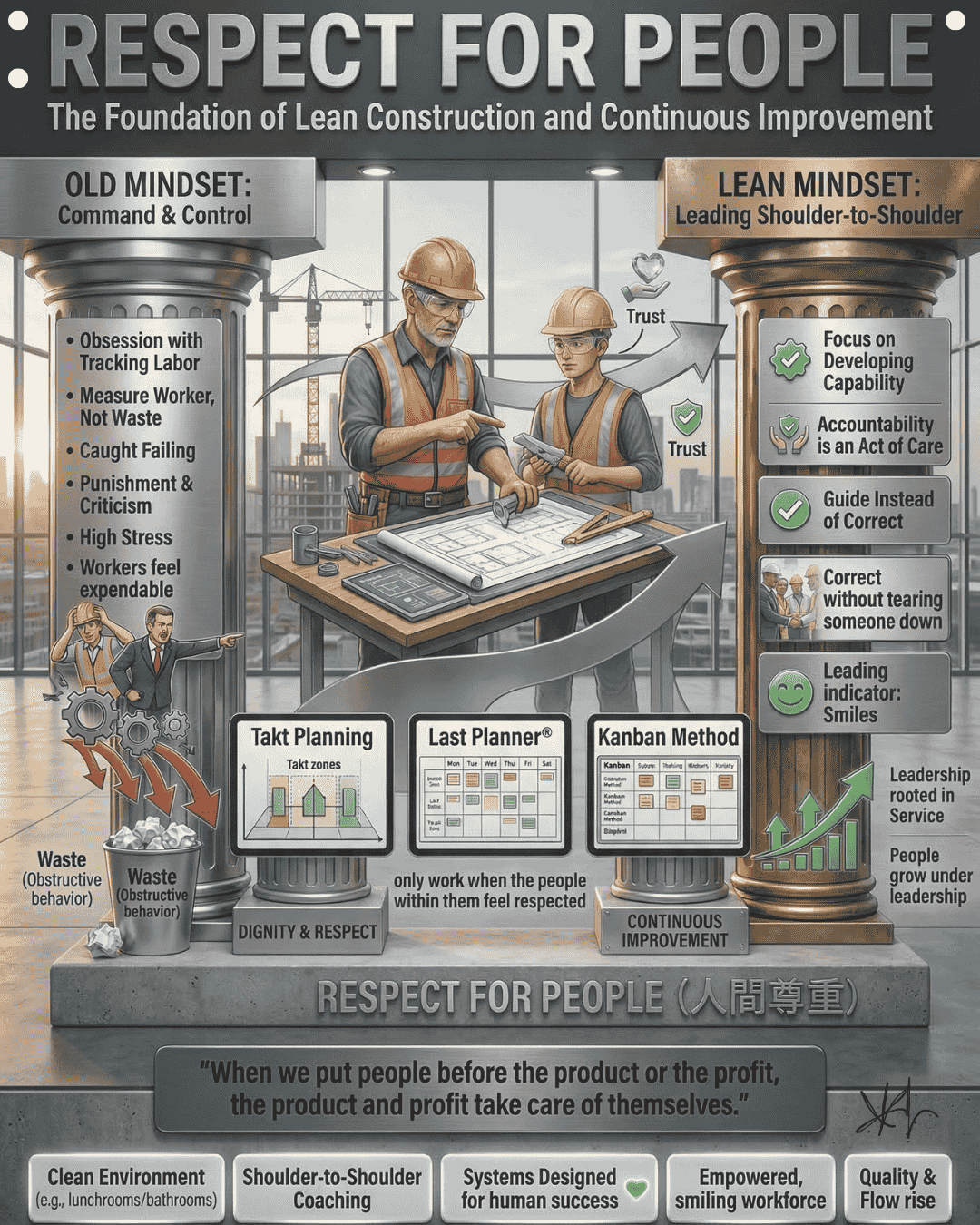
Here is the pattern that plays out on projects running under the old command-and-control mindset. Labor gets tracked obsessively as a cost rather than as a capacity. Workers get measured instead of the waste in the system getting measured. People are caught failing rather than being set up to succeed. Leadership shows up through pressure, criticism, and stress. And the results are predictable. Turnover is high. Quality suffers. Schedules slip. People disengage. The team stops bringing problems to the surface because the surface is not safe.
The painful part is that this is not a malicious system. Most of the leaders perpetuating it were trained inside it. They were told that tight control and high pressure are what drive results. Nobody ever stopped to ask what the workers were experiencing on the receiving end of that philosophy, or what it was doing to the quality of their thinking, their commitment, and their willingness to give the project their best.
The Failure Is in the System, Not the People
When turnover is high, the instinct is to ask what is wrong with the people leaving. When quality suffers, the instinct is to ask who made the mistake. When schedules slip, the instinct is to push harder. Every one of those instincts is pointing in the wrong direction. The correct question is always: what in the system made this outcome inevitable? The workers showed up to an environment built around catching them failing instead of helping them succeed. The foremen operated in a culture that punished problems instead of surfacing and solving them. The system failed them. They did not fail the system.
A Story That Changed How I See Leadership
I have been on jobsites where the morning worker huddle was the most respected fifteen minutes of the day. Where workers knew what was happening, knew the safety focus, knew the plan, and knew that if they had a problem, raising it would result in action not blame. On those projects, something remarkable happens. Workers start improving things without being asked. Foremen start surfacing roadblocks before they become crises. The team begins to function as one social group instead of a collection of separate subcultures waiting for the shift to end.
I have also been on jobsites where none of that was true. Where workers felt expendable, where feedback loops ran in one direction only, and where the only leading indicator anyone measured was labor cost per hour. On those sites, you could feel the tension from the parking lot. The system was telling people every single day that they did not matter, and those people responded exactly the way you would expect anyone to respond to that message.
The difference between those two experiences is not the workers. It is not even the schedule. It is whether respect for people is structural on that project, embedded in the environment, the meetings, the coaching, and the expectations or whether it is a laminated value statement on the trailer wall that nobody takes seriously.
What the Lean Mindset Actually Looks Like
The shift from command-and-control to Lean leadership is not about being softer or lowering expectations. It is about understanding what actually produces results. The Lean mindset develops capability instead of demanding output. It treats accountability as an act of care setting clear expectations, following through consistently, and doing it with dignity rather than humiliation. It guides instead of corrects, meaning the goal is to improve the process, not to shame the person. And critically, it fixes systems rather than blaming people, because in a healthy Lean environment, when something goes wrong, the first question is always what in the system allowed that to happen.
Here is what changes when this mindset takes hold on a project:
- Trust between trades and leadership rises measurably
- Stress levels drop because people are not hiding problems
- Flow improves because roadblocks surface early when they can still be solved
- Quality rises because workers bring their best thinking instead of just their hands
These are not soft outcomes. They are production outcomes. They show up in the schedule health, the punch list count, the safety record, and the morale of the team as they carry it across the finish line. Respect for people is not a values statement. It is a production strategy.
Why Tools Fail Without This Foundation
Takt Planning, Last Planner, and the Kanban Method are powerful systems. I believe in them deeply and have seen them transform projects. But here is something I want every builder reading this to understand clearly: those tools only work when the people within them feel respected. A Takt plan on a project where workers do not trust leadership becomes a schedule that trades quietly ignore. A Last Planner pull session on a project where foremen are afraid to surface constraints becomes a room full of optimistic commitments that nobody intends to keep. The tool is only as strong as the cultural foundation it sits on.
Lean tools require honest input, real commitment, and the willingness of every person on the project to surface what is actually happening in the field. None of that is possible in a command-and-control environment. You will not get people’s best thinking when they do not feel safe giving it. And without their thinking, you do not have continuous improvement. You have compliance and compliance produces mediocrity, not excellence.
Connecting to the Mission
At Elevate Construction, the phrase we come back to is this: we build remarkable people who build remarkable things. That is not a slogan about construction. It is a belief about the sequence. You build the person first. The person builds the project. When people are developed, respected, and given systems that support them, quality and flow are the natural consequence. Families are protected because the workers building the project are protected. Schedules hold because the teams running them are stable. Safety improves because people feel safe enough to stop and say something when something is wrong.
This is what the image at the top of this post is really saying. Clean environments, shoulder-to-shoulder coaching, systems designed for human success, an empowered and smiling workforce those are not perks. They are the foundation that everything else stands on. If your project needs superintendent coaching, project support, or leadership development, Elevate Construction can help your field teams stabilize, schedule, and flow.
A Challenge Before Your Next Project Meeting
Walk your project today and ask yourself the honest question. Not the version you would say in a leadership meeting. The real one: do the people on this site feel respected? Not just employed. Not just managed. Respected. Do they have clean facilities? Do they know the plan? Do they feel safe raising a problem? Does leadership show up shoulder to shoulder, or does it show up to inspect and correct?
When we put people before the product or the profit, the product and profit take care of themselves. That is not idealism. That is the most practical truth in construction. Build the foundation right, and everything you stack on top of it will hold.
On we go.
Frequently Asked Questions
What does “respect for people” actually mean on a construction site?
It means creating an environment where workers have clean facilities, clear plans, and a leadership team that develops capability rather than just demanding output. Respect is structural it shows up in how the site is run every single day.
How is accountability compatible with a respect-for-people culture?
Accountability in a Lean culture is an act of care, not punishment. It means setting clear expectations and addressing performance with dignity, because treating people as capable adults who deserve clarity is the most respectful thing a leader can do.
Why do Lean tools fail when the culture is command-and-control?
Because tools like Takt Planning and Last Planner depend on honest input from the field. When people do not feel safe surfacing problems, the tools become theater instead of production control.
What is the difference between guiding and correcting?
Guiding focuses on improving the process so the same mistake does not repeat. Correcting focuses on the individual who made it. The first produces learning and loyalty. The second produces defensiveness.
How do you know if respect for people is actually embedded in your project culture?
Watch the leading indicators: do foremen surface problems proactively, is the site clean, and does the team move together as one group? When those things are true, respect is structural not just a value on a poster.
If you want to learn more we have:
-Takt Virtual Training: (Click here)
-Check out our Youtube channel for more info: (Click here)
-Listen to the Elevate Construction podcast: (Click here)
-Check out our training programs and certifications: (Click here)
-The Takt Book: (Click here)
Discover Jason’s Expertise:
Meet Jason Schroeder, the driving force behind Elevate Construction IST. As the company’s owner and principal consultant, he’s dedicated to taking construction to new heights. With a wealth of industry experience, he’s crafted the Field Engineer Boot Camp and Superintendent Boot Camp – intensive training programs engineered to cultivate top-tier leaders capable of steering their teams towards success. Jason’s vision? To expand his training initiatives across the nation, empowering construction firms to soar to unprecedented levels of excellence.
On we go