
Why Great Projects Communicate Through the Environment, Not Just Meetings
Here’s the deal: most construction sites are full of information and empty of visibility. The plan exists. The logistics are mapped. The weekly work plan was coordinated in a meeting. The benchmark locations are in the drawings. The valve shut-off is documented somewhere. But ask a journeyman walking onto a floor for the first time where the hoist staging is, what the key handoffs are this week, or where the benchmark is set for their zone and the answer is usually a trip to the trailer, a phone call to the foreman, or a shrug.
That gap between information existing and information being accessible is one of the most underestimated productivity problems in construction. The cost is invisible because nobody tracks it. But across every trade, every floor, and every day of a project, the time burned chasing down basic information adds up to a number that would make most project teams uncomfortable. And more than the time, it signals something deeper: the system was not designed to serve the worker. It was designed to serve the people who already know everything.
The Way Most Sites Are Built
Walk a typical mid-size commercial project and you’ll see the same pattern. The plans are in the superintendent’s trailer. The logistics layout is in a PDF that was shared in an email two months ago. The weekly work plan is a printout that maybe made it to the foreman’s folder, maybe didn’t. The contact information for the mechanical coordinator is in someone’s phone. The delivery windows for the week are being tracked in a meeting note that two people on the floor have never seen.
Meanwhile, the electrician on the fourth floor is trying to figure out where his zone starts and the drywall crew ends. The plumber is wondering if the valve shut-off on the east wall is the one from the RFI or the original drawing. The ironworker’s helper just arrived from a different project and has never seen this floor before.
All of this is happening in real time while the project clock is running. And the system that could have answered every one of those questions clearly, in seconds, without a phone call was never put in place. The system failed them. They didn’t fail the system.
The Environment Can Be the Communication System
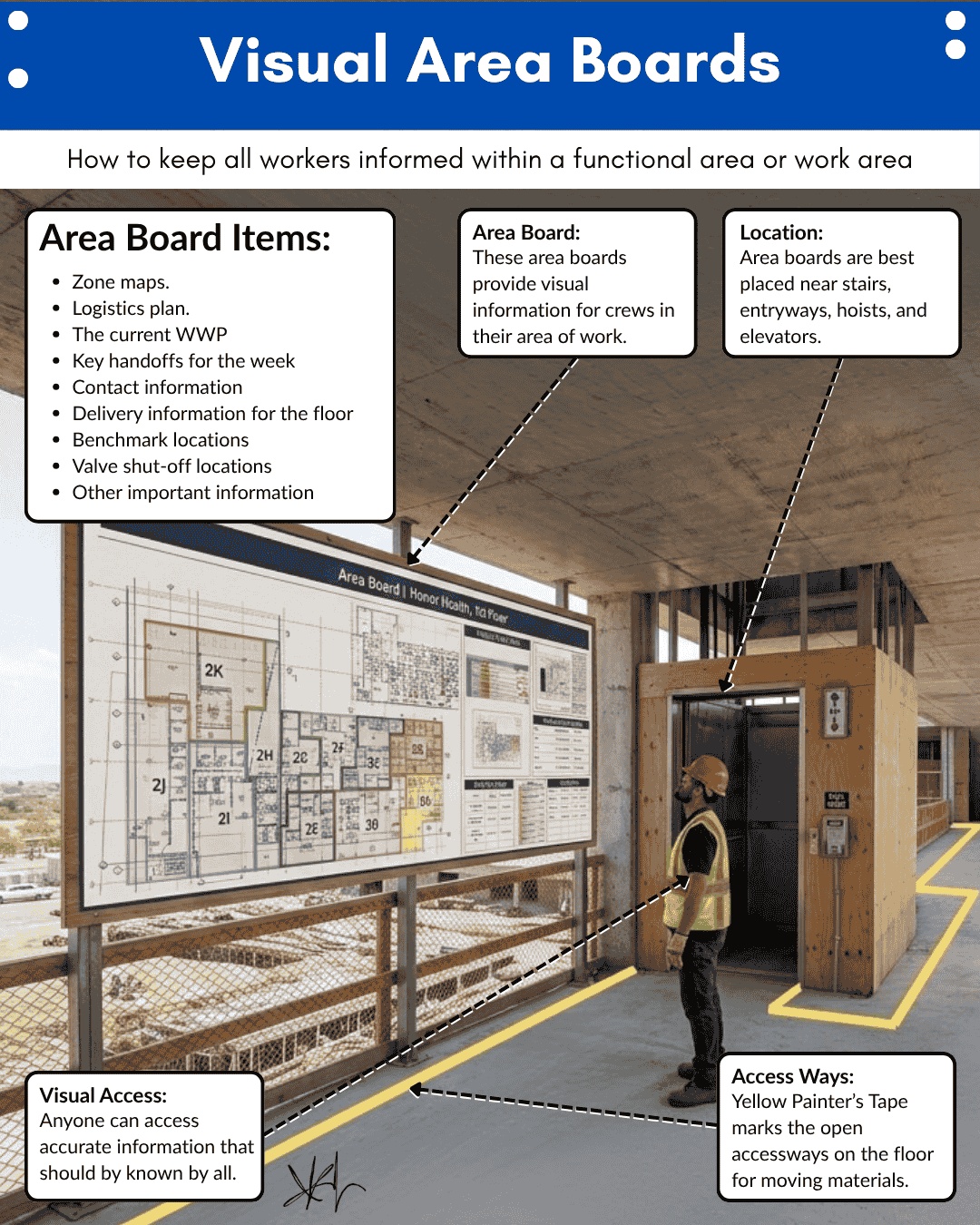
The concept behind Visual Area Boards is simple and powerful: put the most important project information at the place where the work is happening, in a format anyone can read in seconds, without needing to ask anyone for it.
These are typically four-by-eight boards placed in every functional area of the project near stairs, hoists, entryways, and elevator cores exactly where workers enter a floor and begin orienting themselves to the work ahead. The placement is intentional. Anyone stepping off the hoist or walking through an entryway should be able to stop, look left, and immediately understand the zone they’re entering, the work happening that week, and the key information they need to be effective.
What lives on those boards matters as much as where they’re placed. Zone maps show the spatial layout of the area so trades understand boundaries and flow. The current weekly work plan shows commitments from trade to trade what’s being done this week, where, and in what sequence. Logistics plans show delivery information for the floor, where materials will land, and what access routes are active. Key handoffs for the week make coordination visible so trades know exactly when and where they hand off to the next team. Contact information, benchmark locations, and valve shut-off locations round out the board so that any worker on that floor has the operational information they need to do their job without disrupting anyone else to get it.
The yellow painter’s tape marks on the floor below the board complete the picture designating open accessways for moving materials so traffic flow around the board and the hoist remains clear and intentional.
Watch for these signs that your project is running on invisible information rather than a designed communication environment:
- Workers frequently asking foremen for basic orientation information when entering a floor
- Coordination mistakes that trace back to trades not knowing the weekly handoff sequence
- Benchmark or shut-off errors because field workers couldn’t locate the documented standard
- New arrivals from other projects spending 20 to 30 minutes getting oriented before they can begin
Teaching the Framework: Visual Management Makes Problems Visible
Jason Schroeder teaches visual management as a core Lean principle a work environment that is self-ordering, self-explaining, self-regulating, and self-improving because of visual devices. The key phrase is total participation. When everyone can see the plan, see the roadblocks, and see the standard, total participation becomes possible. When they can’t see it, they guess. And in construction, guessing is where rework, stacking, coordination failures, and safety incidents are born.
The Visual Area Board is one of the most direct expressions of that principle at the floor level. It asks a simple question of every project: is the information the crew needs available where the crew is? Not in the trailer. Not in a binder. Not in a meeting recap. Right there, in the zone, on the wall. If the answer is no, the project is asking workers to perform a treasure hunt as part of their daily work and nobody budgeted that time into the schedule.
The weekly work plan on the board deserves particular emphasis. When it’s posted on the floor and updated consistently, it does something that a plan in a meeting never can: it creates accountability at the point of production. A foreman walking the floor can see what was committed. A trade partner coming to coordinate a handoff can verify the sequence without scheduling a meeting. A superintendent doing a zone control walk can see the plan, see the work, and compare the two in real time. The information is not locked in a room. It’s living on the floor where the decisions are made.
Why This Connects to the Whole System
The Takt Production System depends on coordination between trades moving through zones on a defined rhythm. That rhythm lives or dies on whether the workers and foremen in each zone actually understand the plan the sequence, the handoffs, the spatial relationships between trades working in the same area. You can build the most precise Takt plan in the world and still watch it unravel at execution because the crew on the floor couldn’t see it.
Visual Area Boards are the bridge between the plan and the field. They’re how the Takt plan, the weekly work plan, and the logistics map stop being documents that exist in binders and start being tools the crew can use every day without a meeting. One of the most important things I learned early in my career is that production has far more to do with how well we get information to the crew than how fast they can install once they have it. The Visual Area Board is the system that solves that problem at scale across every floor and every zone.
This is also how you build a culture that improves itself. When workers can see the plan, they can engage with it, question it, and suggest improvements. When they can see the handoffs, they start protecting them without being told to. When zone maps are visual and accessible, crews naturally start aligning to them. The environment teaches the standard. If your project needs superintendent coaching, project support, or leadership development, Elevate Construction can help your field teams stabilize, schedule, and flow. That work starts with building the environment to communicate for you.
Build the Jobsite That Speaks
Here’s the challenge I want to leave you with. Walk your project this week and ask one question at every floor entry point: if a worker stepped off the hoist right now for the first time, could they answer these five questions without asking anyone? What zone are they in? What is being built this week? Who is handing off to whom and when? Where do materials for this floor land? Where is the benchmark? If your project can’t answer those five questions visually at the point of entry, the environment is not communicating. And everything that the environment isn’t communicating is being handled by phone calls, meetings, and guesswork instead.
Good projects communicate through meetings. Great projects communicate through the environment itself. The jobsite that speaks clearly to every worker who walks onto a floor that’s what LeanTakt and Elevate Construction are working to build across the industry, one floor board at a time.
As the great management thinker W. Edwards Deming said: “You can’t manage what you can’t measure, and you can’t measure what you can’t see.” Put the information on the wall. Let the environment lead.
On we go.
Frequently Asked Questions
What is a Visual Area Board and where does it go?
A Visual Area Board is typically a four-by-eight board posted in every functional area of a project, near stairs, hoists, entryways, and elevator cores. It holds zone maps, logistics plans, the current weekly work plan, key handoffs, contact information, delivery data, benchmark locations, and valve shut-off locations everything a worker needs to orient to the floor without asking anyone.
How is the Visual Area Board different from a huddle board?
A huddle board supports the morning worker huddle and is managed by the project team or general contractor. The Visual Area Board is a permanent floor-level reference tool accessible to any trade, any time. Its purpose is ambient it makes the environment informative for everyone, not just those who attend a specific meeting.
How does the Visual Area Board support the Takt Production System?
Takt depends on trades coordinating handoffs and moving through zones on a defined rhythm. The weekly work plan on the board makes those commitments visible at the point of production. Workers and foremen can see the sequence, verify handoffs, and align to the zone plan without a meeting keeping the Takt rhythm intact where it matters most.
How often should the board be updated?
The weekly work plan should be updated every week, aligned to the trade partner weekly tactical meeting. Zone maps and logistics information should be updated whenever the floor layout or delivery plan changes. A board that isn’t current is worse than no board at all because it creates false confidence and misinformation.
What does yellow painter’s tape on the floor near the board accomplish?
The tape marks designated accessways for moving materials through the area near the hoist and entryways. It makes traffic flow visual so workers and equipment aren’t guessing how to navigate around staging areas, deliveries, and active work zones keeping the floor organized and the access paths clear by design.
If you want to learn more we have:
-Takt Virtual Training: (Click here)
-Check out our Youtube channel for more info: (Click here)
-Listen to the Elevate Construction podcast: (Click here)
-Check out our training programs and certifications: (Click here)
-The Takt Book: (Click here)
Discover Jason’s Expertise:
Meet Jason Schroeder, the driving force behind Elevate Construction IST. As the company’s owner and principal consultant, he’s dedicated to taking construction to new heights. With a wealth of industry experience, he’s crafted the Field Engineer Boot Camp and Superintendent Boot Camp – intensive training programs engineered to cultivate top-tier leaders capable of steering their teams towards success. Jason’s vision? To expand his training initiatives across the nation, empowering construction firms to soar to unprecedented levels of excellence.
On we go