
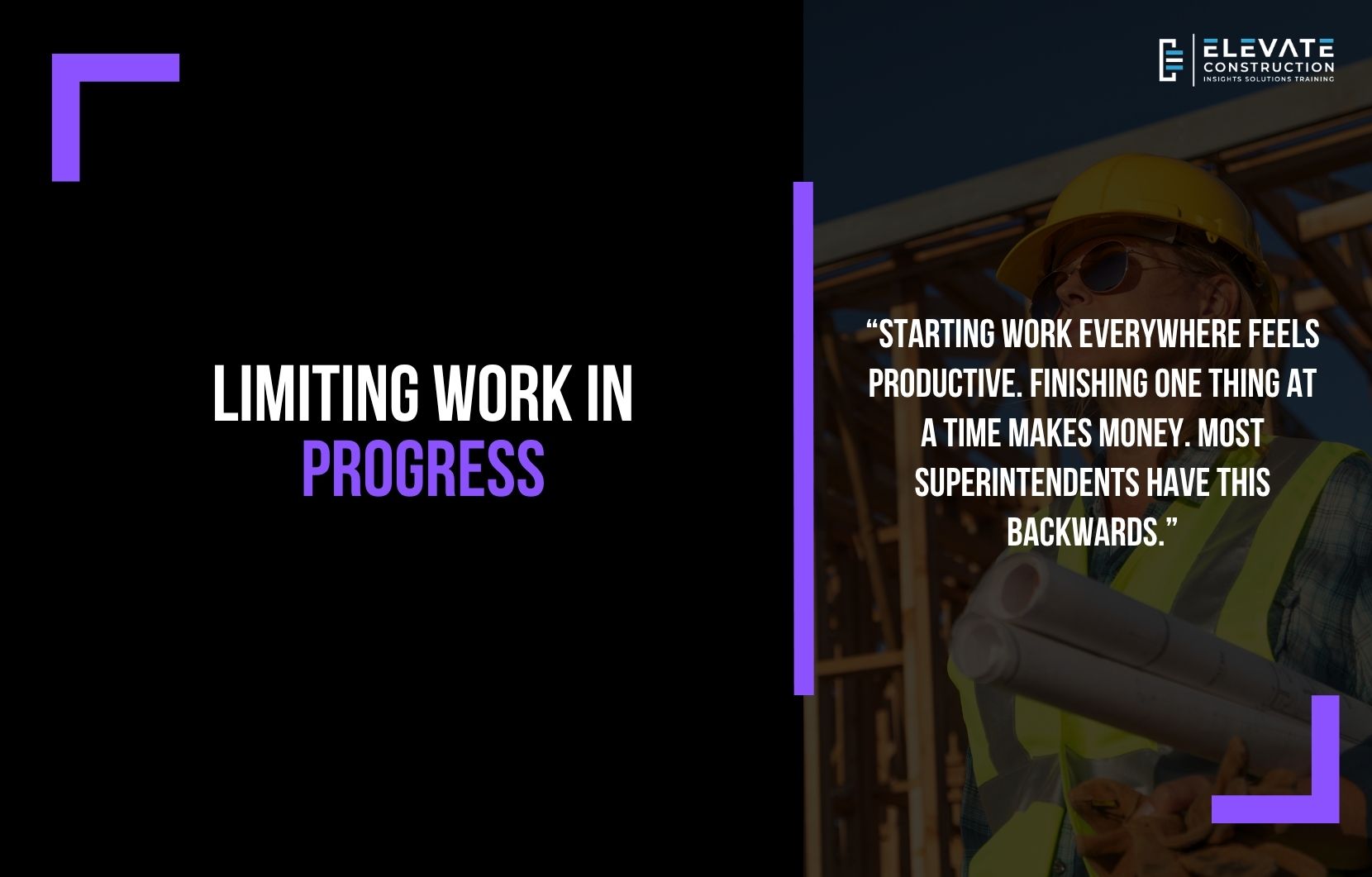
The Counterintuitive Truth About Work in Progress: Why Batching Kills Profits and One-Piece Flow Saves Them
You walk the jobsite. Grading happening on five hundred acres. Paving crews dispatched to three different areas. Interior framing started on all four floors. Mechanical rough in six zones. Everybody working. Everybody busy. The project looks productive. And you’re losing money on every single one of those decisions. I know this makes superintendents defensive. I know it sounds counterintuitive. I know you’ve been doing it this way for twenty years and projects always get finished. But here’s the question nobody wants to answer: at what cost?
The Problem Hiding Behind the Busyness
Here’s what I see on most projects. A superintendent sits in the trailer. The phone rings constantly. Fifteen people walk in asking questions. A paving crew shows up but inspections aren’t ready. Trucks are already dispatched. Plants are committed. The super says “I don’t know what to tell you, you’re gonna have to deal with it.” Someone needs procurement information. An emergency pops up in the field. Problem after problem.
Then that same superintendent sits down and says “We don’t have a problem. There’s no reason we need advanced scheduling or last planner system.” The chaos is so normal they can’t even see it anymore. Walk any project in America and you’ll see the same pattern. Work started everywhere. Multiple areas open at once. Crews jumping between zones. Materials piled up waiting. Superintendents pushing trades to advance in every direction possible. And everyone justifies it with the same logic: economies of scale, keeping crews busy, making the site look productive.
But here’s what that logic misses. Your trade partners are losing incredible amounts of money. You made your normal nine percent margin when you could have made fifteen or twenty. You broke even on the job when flow would have created real profit. You finished the project, but you burned out your people, damaged relationships with trades, and left margin on the table.
The System That Taught Us to Batch Everything
This isn’t about lazy superintendents or bad decisions. This is about an industry that’s been conditioned to confuse busyness with productivity. We learned to batch work because it looks faster. Fold all the papers at once. Stuff all the envelopes at once. Lick all the stamps at once. It feels efficient. The person doing it looks busy. Everyone watching thinks they’re getting done sooner.
But they’re not. One-piece flow beats batching every single time. Fold one paper, stuff it, lick it, stamp it, move to the next. Get that piece of work to the customer faster. Don’t create piles of work in progress waiting for the next step. The same principle applies on jobsites. Grade the whole site at once, it feels productive. But now you’re maintaining five hundred acres of dirt. You’re running water trucks daily. You’re managing SWPPP across the entire area. You’re regrading pads when they get damaged. You’re dealing with rain exposure across massive areas. You’ve created work in progress everywhere with no flow. The system failed us. It didn’t fail the workers.
A Story That Proves the Point
I learned this from a general superintendent years ago. He told me about a Tucson project that wasn’t going well. When he took over, everybody was doing everything, rushing in a mad frenzy, working everywhere at once. The project was failing financially and in every other material aspect.
The first thing he did? He sent everybody home for a couple of days. Got a plan together. Brought them back one by one in order, in flow. Established flow on that project. He said “Jason, we recovered that project. We made a ton of money. Made the owner happy. They kept doing work on that campus after that. And the key was to establish flow, to stop working everywhere, and to work where we needed to work and hold the schedule.”
These concepts aren’t new. The general superintendents on billion-dollar projects, four-hundred-million-dollar projects, the legendary people who built the Empire State Building, they knew about flow. They knew about limiting work in progress. They knew about finishing as you go. They built primarily with these concepts and with scheduling systems like Takt planning.
Then the AGC adopted CPM thinking it was a good idea, and we started breaking the industry. Now superintendents on fifteen-million-dollar projects lecture people about how they have to push everything everywhere and run around with their heads cut off. It’s like watching someone who doesn’t know how to use a swing trying to teach someone else how to swing.
Why Excess Work in Progress Destroys Your Margin
When we don’t limit work in progress, when we don’t work in one-piece flow, we don’t just lose productivity from transitions and context switching. We create overproduction. And overproduction is the mother of all wastes. Here’s how it cascades. Overproduction creates excess inventory. Excess inventory requires transportation to move it around. Transportation creates extra motion. Motion and stretched capacity buffers create defects and quality problems. Defects create over-processing to fix them. All of that creates waiting. And waiting is where your money evaporates.
Think about the costs. Equipment sitting idle is ninety-five bucks an hour plus the burden labor rate. A crew waiting is three hundred to six hundred bucks an hour. Moving that pile of materials because it’s in the way is three thousand dollars out the window. That’s where you’re losing money. Not when the blade is grading or the loader is loading. In the in-betweens. In the chaos created by too much work in progress. Let me give you a specific example. A superintendent isn’t disciplined about one-piece flow. They see an open area on level two and tell a trade partner to start working there even though it’s not the next area in sequence.
What happens? The trade has to stretch their supervision to cover more work. They spread people thin which loses production. They’re less prepared so they don’t have all the materials staged. There’s more chaos. More quality problems. They start bringing more materials out which gets in other people’s way. Now there are more people and materials so costs go up and profits go down. They’re using more unqualified people and working more hours which loses productivity. Other contractors start sandbagging to protect themselves. The area gets done too early and sits there getting damaged. The team isn’t focused on planning or removing roadblocks or continuously improving. That superintendent who dispatched that person into that area too soon just created so much variation it’s hard to recover from. All because they couldn’t tolerate seeing an empty area.
Watch for These Signals That Work in Progress Is Out of Control
Your project has too much work in progress when:
- The site looks busy everywhere but nothing is finishing completely before moving to the next area
- Materials are piled in multiple locations waiting for installation instead of arriving just-in-time for the work sequence
- Trade partners are stretched across multiple zones instead of flowing through one area at a time with consistent crew sizes
- Superintendents justify starting work early because areas are open, not because the sequence and make-ready support it
- Teams are fighting fires constantly instead of proactively removing roadblocks because capacity is stretched too thin
The Framework: One-Piece Flow Over Batching
Once you understand that batching creates waste, the entire approach changes. You stop measuring productivity by how busy the site looks. You start measuring by how fast work flows through to completion. Here’s what that means in practice. If you have a mile of water line to install but can only install three hundred linear feet at a time, don’t grade the whole mile. Don’t put up traffic control for the entire length. Don’t water and maintain a mile of exposed dirt. Do it in phases. Grade just ahead of the pipe installation. Finish one section completely before opening the next.
If you have a five-hundred-acre site, don’t clear it all at once, remove all the stumps, do all the grubbing, and rough-grade everything simultaneously. Do it in phases. Finish as you go. Work in one-piece flow out ahead of the work. The pushback is always the same. “We have to bring out sixteen pieces of equipment to make it cost-effective. We can’t do it in phases.” That’s batching logic. Here’s one-piece flow logic: bring out fewer pieces of equipment with better-trained operators working in sequence. You’ll have less variation, better consistency, and lower costs because you’re not maintaining massive areas of work in progress.
Create a schedule that designs flow into it. Understand your throughput time, which is how long it takes work to run through barriers in a sequence. Reduce work in progress between those barriers as much as possible. Get work product through the system as fast as you can. Hold the schedule to the best extent possible. Limit the areas where contractors are working. You’ll have multiple contractors flowing through the building, but you don’t want your mechanical contractor working on all three floors in five different areas. You want them focused, working in flow at the same rate other contractors are working in their areas. This focuses resources and stabilizes crew counts and material inventory.
Understanding Buffers: Inventory, Capacity, and Time
When people hear me talk about one-piece flow and limiting work in progress, they hear “don’t bring any materials until the day you need them” and “never work ahead.” That’s not what I’m saying. Everything has buffers. If you’re telling me bar joists and corrugated metal decking are impossible to get, order it all, get it here, create that inventory buffer as soon as possible. If your curtain wall has a three-week risk profile, your inventory buffer might be three weeks. If it’s drywall and it’s pretty reliable, your inventory buffer might be one or two days. Bring materials just-in-time for the right inventory buffers based on actual risk.
Capacity buffers are even more critical. When a superintendent sees an empty area and tells a contractor to move in early, they’re not looking at the capacity of the company, the leadership, the crew. When we keep people in one-piece flow working consistently, they have mental capacity to plan and execute work, to make work ready, to prevent roadblocks. That increases quality and safety and makes money because it reduces interruptions.
When you stretch capacity by pushing work into too many areas, teams lose the ability to plan proactively. They’re fighting fires instead of preventing them. That’s where you lose margin. If your project needs superintendent coaching, project support, or leadership development, Elevate Construction can help your field teams stabilize, schedule, and flow.
When Overproduction Is High Risk Versus Low Risk
Not all early work is equally damaging. Understand the difference between high-risk and low-risk overproduction. High risk: when it can get rained on and damaged like interiors or site grading, when you have to maintain it constantly, when it’s weather sensitive, when it can get damaged easily, when it brings the team out of balance and prevents them from proactively removing roadblocks. That last one is the most overlooked. When producing something early destabilizes the team and prevents them from planning future work, that’s high risk even if it looks like you’re getting ahead.
Low risk: putting in a foundation early when the concrete contractor has capacity and wants to do it anyway, when you have the information and materials, when it’s fairly low risk and doesn’t require constant maintenance, when it stabilizes work that follows rather than creating variation. Compare the costs. Know what buffers you’re dealing with. Understand the risks. Make intentional decisions, not reactive ones based on seeing empty space.
Why This Matters Beyond Your Bottom Line
We’re not just building projects. We’re building people who build things. And when we create flow by limiting work in progress, we’re protecting workers from the chaos of jumping between areas, waiting for materials, and fighting fires caused by stretched capacity.
When superintendents push work everywhere at once, families suffer. Schedules slip because work isn’t finishing. Teams work weekends to catch up. Workers burn out because chaos is constant and planning is impossible. Trade partners lose money because they can’t maintain consistent crews or predict material needs.
This is respect for people in action. Not the soft version where we’re just nice to everyone. The production version where we design systems that let people succeed by giving them flow, consistent work, and the capacity to plan instead of react.
The Decision in Front of You
You can keep starting work everywhere because it looks productive. You can keep batching tasks because it feels efficient. You can keep pushing trades into open areas because you can’t tolerate empty space. You can keep justifying it with economies of scale and crew utilization. Or you can limit work in progress. You can work in one-piece flow. You can hold the schedule and finish as you go. You can create capacity buffers that let teams plan proactively instead of react constantly.
The projects that make real margin aren’t the busiest ones. They’re the ones where flow is protected, work in progress is limited, and teams have the capacity to finish one thing completely before starting the next. Edwards Deming understood this: “If you can’t describe what you are doing as a process, you don’t know what you’re doing.” Most companies can describe how busy their sites look. Almost none can describe their work in progress limits or their one-piece flow discipline. That’s the gap. Limit work in progress. Work in one-piece flow. Hold the schedule. Finish as you go. Flow is the key to lean. On we go.
Frequently Asked Questions
What’s the difference between one-piece flow and batching?
Batching means doing all of one task before moving to the next, like folding all papers then stuffing all envelopes. One-piece flow means completing one entire unit of work before starting the next, like folding, stuffing, licking, and stamping one envelope before touching the next. One-piece flow gets work to the customer faster with less work in progress.
How do you balance limiting work in progress with keeping crews productive?
Adjust crew sizes and equipment to match the flow sequence instead of bringing maximum resources to work everywhere at once. Smaller, consistent crews working in sequence with less variation produce better quality and lower costs than large crews jumping between multiple areas with stretched capacity.
When is it okay to work ahead or overproduce?
Low-risk situations: foundations when the concrete contractor has capacity, areas that don’t require maintenance or get damaged, work that stabilizes what follows. High-risk situations: anything weather-sensitive, areas that need constant maintenance, work that destabilizes the team and prevents proactive planning for future areas.
What are capacity buffers and why do they matter?
Capacity buffers are the mental and physical bandwidth teams have to plan, make work ready, and prevent roadblocks. When you stretch teams across too many areas, you eliminate capacity buffers and force them into reactive firefighting instead of proactive planning. That’s where quality and margin get lost.
How do you convince superintendents who believe batching and working everywhere is more efficient?
Run the envelope game simulation to demonstrate one-piece flow beats batching. Compare actual costs of maintaining massive work in progress versus working in sequence. Show data from recovered projects where limiting WIP and establishing flow created real margin. The proof is in the numbers, not the appearance of busyness.
If you want to learn more we have:
-Takt Virtual Training: (Click here)
-Check out our Youtube channel for more info: (Click here)
-Listen to the Elevate Construction podcast: (Click here)
-Check out our training programs and certifications: (Click here)
-The Takt Book: (Click here)
Discover Jason’s Expertise:
Meet Jason Schroeder, the driving force behind Elevate Construction IST. As the company’s owner and principal consultant, he’s dedicated to taking construction to new heights. With a wealth of industry experience, he’s crafted the Field Engineer Boot Camp and Superintendent Boot Camp – intensive training programs engineered to cultivate top-tier leaders capable of steering their teams towards success. Jason’s vision? To expand his training initiatives across the nation, empowering construction firms to soar to unprecedented levels of excellence.
On we go