
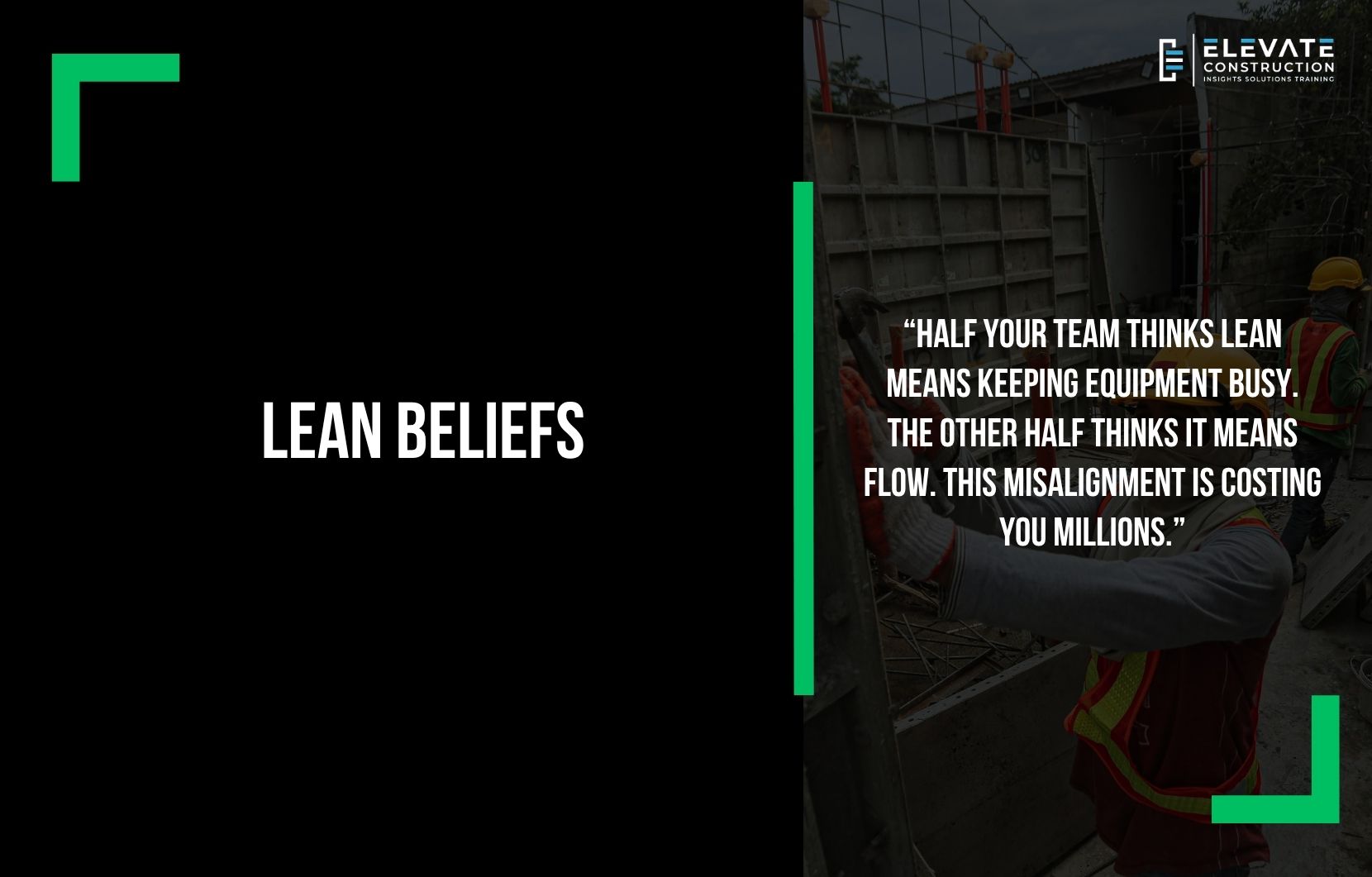
The Lean Beliefs That Make or Break Projects: Why Your Team Needs to Get on the Same Page Before Starting
Your superintendent schedules work to keep every piece of equipment running. Your project manager batches submittals to maximize office efficiency. Your trade partners load crews to maintain utilization. Everyone thinks they’re being lean. Everyone’s working hard. Everyone’s optimized their own piece. And the project is hemorrhaging money because nobody’s on the same page about what lean actually means.
Here’s what happens when teams aren’t aligned on fundamental beliefs. One person prioritizes resource efficiency while another prioritizes flow efficiency. One person thinks waste means idle equipment while another thinks waste means interrupted work. One person batches tasks for individual efficiency while another pushes for one-piece flow. Everyone uses the same words but means completely different things. The result? Chaos disguised as productivity. Systems working against each other. Money lost in the gaps between misaligned beliefs. Projects that look busy but don’t flow.
The Problem No One Wants to Name
Walk into any project meeting and listen to the conflicts that never get resolved. The superintendent wants to start work everywhere to keep crews busy. The scheduling consultant wants to limit work in progress. The trade partner wants to deliver all materials at once for efficiency. The lean advisor wants just-in-time delivery. Everyone argues. Nobody wins. The project suffers.
This isn’t about disagreement on strategy. This is about fundamental misalignment on what principles govern success. When your team doesn’t share core beliefs about flow, waste, respect for people, and how systems actually work, every decision becomes a battle. Every conversation rehashes the same arguments. Every improvement attempt gets sabotaged by someone operating from completely different assumptions.
Most teams never establish shared beliefs. They assume everyone understands lean the same way. They jump straight into tools and tactics without aligning on principles. Then they wonder why Last Planner doesn’t work. Why Takt planning creates conflict. Why continuous improvement stalls. Why the culture never shifts. The tools fail because the beliefs aren’t aligned. The system fails because people are operating from contradictory assumptions about how construction actually works.
The Field Reality: When Beliefs Collide
I recently worked with a team preparing to implement an integrated production control system. Before we started, I asked them to define lean. The answers revealed everything wrong with their approach. One superintendent said lean means keeping everyone working all the time, no idle resources, maximum utilization. A project manager said lean means eliminating waste by batching similar tasks together for efficiency. A trade partner said lean means delivering materials in bulk to minimize transportation costs. The owner’s rep said lean means finishing faster by working overtime when needed.
Every single answer was wrong. Or more accurately, every answer optimized one piece while destroying the whole. The superintendent’s focus on resource utilization would create work in progress everywhere. The project manager’s batching would delay information flow to workers. The trade partner’s bulk delivery would pile materials on site creating congestion. The owner’s overtime push would reduce productivity while inflating costs.
They weren’t aligned. They couldn’t be successful until they got on the same page about what principles actually govern construction productivity. About what flow means. About what waste looks like. About how systems work. About what respect for people requires.
Why Misaligned Beliefs Destroy Projects
When teams operate from different fundamental beliefs, the damage compounds in ways most people never track. Decisions that seem locally optimal destroy global flow. Systems designed for resource efficiency interrupt flow efficiency. Waste gets created in one area while being eliminated in another. Improvements in one department create problems in three others.
Think about how this plays out practically. If half your team believes keeping equipment busy is the priority, they’ll schedule work to maximize utilization. If the other half believes flow is the priority, they’ll limit work in progress and sequence carefully. These approaches are incompatible. One creates chaos the other is trying to prevent.
Or consider beliefs about waste. If someone thinks waste means idle time, they’ll push crews to stay busy even when work isn’t made ready. If someone else thinks waste means interruptions to flow, they’ll accept idle time to maintain proper sequence. The first person sees the second as inefficient. The second sees the first as destructive. Neither can succeed because they’re optimizing for contradictory outcomes.
The same pattern repeats everywhere. Beliefs about just-in-time delivery versus bulk ordering. Beliefs about batching versus one-piece flow. Beliefs about holding start dates versus advancing wherever possible. Beliefs about quality at the source versus pushing work down the line. Every misalignment creates conflict, waste, and lost margin.
Signals Your Team Isn’t Aligned on Lean Beliefs
Watch for these patterns that indicate fundamental misalignment:
- Team members use the same lean terminology but argue constantly about what it means in practice, revealing they’re operating from completely different definitions of core concepts
- Improvement efforts stall because half the team thinks the problem is one thing while the other half thinks it’s something else, and nobody realizes they’re not even diagnosing the same issue
- Tools like Last Planner or Takt planning get implemented but create more conflict than clarity because people are using the tools to optimize contradictory outcomes based on misaligned beliefs
- Meetings rehash the same arguments repeatedly without resolution because the real conflict is about unstated fundamental beliefs, not the surface-level decisions being discussed
The Framework: Core Beliefs That Must Align
Before implementing any lean system, your team must align on fundamental principles. Flow is the single most important condition we strive for in construction. Not busyness. Not utilization. Flow. It’s the path to increasing profits, employee satisfaction, customer delight, and reduced durations. Everything else serves flow.
Resource efficiency versus flow efficiency must be understood clearly. Resource efficiency maximizes the use of individual resources and attaches work to people, equipment, and crews. Flow efficiency focuses on the flow of work to the customer and attaches resources to flow units. We attempt both, but we always prioritize flow efficiency. This isn’t negotiable. This is the foundational choice that determines everything else.
Waste, overburden, and unevenness must be recognized as the enemies of flow. The eight wastes are overproduction, excess inventory, transportation, motion, defects, over processing, waiting, and not using the wisdom of the team. Overproduction and inventory are the mother and father of all other wastes. When we overproduce, we create inventory that must be transported, creating motion, causing defects, requiring over-processing, and generating waiting. Overburden happens when workers work too fast or systems are overutilized. Unevenness is variation that causes waste. All three destroy flow and must be eliminated.
The place of work governs where we focus. We don’t manage from reports at a distance. We observe at the place of work, close to the work, where people can see what winning looks like. Visual management makes problems visible so teams can see, know, and act together. Without this, continuous improvement becomes theoretical instead of practical.
Buffers are required for reality. We never plan for one hundred percent efficiency with materials, capacity, or time. Material buffers prevent waiting without creating excessive inventory. Capacity buffers acknowledge that equipment, workers, and systems need margin because things break down. Time buffers account for supply chain interruptions, weather, and adverse conditions. Without buffers, teams work in frenzied mode creating waste, pushing creates increases in manpower and material inventory, and profits decrease while costs increase.
One-piece flow and limiting work in progress are non-negotiable. Workers finish one piece or phase at a time from beginning to end instead of in batches. Flow units move from step to step on the shortest path to customers. The more work in progress, the more capacity gets consumed, so we always limit work in progress and finish as we go. Holding start dates, especially when multiple trades work in sequence, ensures just-in-time deliveries, encourages one-piece flow, and reduces work in progress.
Quality at the source means we notice defects, stop the work, correct the problem, and retrain crews before proceeding. We do not push bad work down the line. We fix things as we go. Pull means work and workers get pulled behind the preceding process once complete and done with quality. When pull doesn’t happen, crews get pushed on top of each other, slowing production and causing safety and quality defects.
Respect for people and resources governs everything. Everything we do must align with the highest standards of respect for people and respect for resources. We cannot be wasteful simply because we live in an economy of abundance. The definition of lean in construction is: respect for people and resources, stable environments with flow in a culture that sees and fixes problems, total participation with visual systems, and continuous improvement with fanatical quality. If your project needs superintendent coaching, project support, or leadership development, Elevate Construction can help your field teams stabilize, schedule, and flow.
The Practical Path Forward
Start by establishing shared language. Before implementing any system or tool, gather your team and define core terms together. What does flow mean? What is waste? What’s the difference between resource efficiency and flow efficiency? What does respect for people require? Get everyone aligned on definitions before moving forward.
Test beliefs through scenario discussion. Present common project situations and ask how the team would respond. If answers reveal misalignment on fundamentals, address it directly. Don’t move forward until beliefs align. The time spent establishing shared understanding prevents months of conflict later.
Teach principles before tools. Don’t jump to Takt planning or Last Planner without first teaching why flow matters, what waste looks like, how buffers work, why one-piece flow beats batching. Tools only work when people understand the principles the tools serve. Otherwise they use the tools to optimize the wrong things.
Make beliefs visible and reinforce them constantly. Post core principles in the trailer. Reference them in meetings. Use them to resolve disagreements. When someone wants to batch for efficiency, remind them we prioritize flow efficiency. When someone wants to keep equipment busy, remind them we attach resources to work, not work to resources. Constant reinforcement prevents drift.
Hold people accountable to shared beliefs. Lean cultures don’t succeed without accountability, sometimes radical accountability. If someone consistently acts against agreed-upon principles, address it directly. There can be no tolerance of dissension from systems that respect people and resources. Either get aligned or get out.
Why This Matters Beyond One Project
We’re not just building projects. We’re building cultures that either respect people and create flow or burn people out and create chaos. When teams align on lean beliefs, they create systems where workers succeed, families stay intact, and companies thrive. When teams stay misaligned, they create systems where heroic effort is required just to achieve mediocrity.
The construction industry is facing a gift disguised as a crisis. We don’t have enough workers. We don’t have unlimited resources. Inflation forces efficiency. Material constraints require better planning. This forces us to respect people and resources the way Japan had to on an island with limited resources and workers paid fifty-four times what they’re paid in China.
Companies that align on lean beliefs and implement systems based on flow will thrive. Companies that keep blaming people instead of fixing processes will fail. This isn’t theoretical. This is survival. The constraints are here. The question is whether you’ll respond by getting your team aligned on what actually works or keep fighting internal battles based on misaligned beliefs.
The Challenge in Front of You
You can keep assuming everyone on your team understands lean the same way. You can keep implementing tools without aligning on principles. You can keep having the same arguments without resolving the underlying belief conflicts. You can keep losing money in the gaps between misaligned understanding.
Or you can get your team on the same page. You can establish shared beliefs about flow, waste, respect, buffers, and how systems actually work. You can teach principles before deploying tools. You can create alignment that turns your team into a unified force instead of a collection of people working at cross-purposes.
The projects that succeed aren’t the ones with the best tools. They’re the ones where everyone shares core beliefs about what matters and why. Where flow is the priority everyone agrees on. Where waste is defined the same way by everyone. Where respect for people means the same thing to the superintendent and the project manager and the trade partner.
Perfect is easy. Good is hard. Mediocre is hard and destructive. Bad goes out of business. Although not always attainable in human systems, we strive for perfection and never settle. It’s the easiest way to run a project because you achieve self-sustaining systems.
Jeffrey Liker’s fourteen principles from The Toyota Way apply directly to construction. Base decisions on long-term philosophy. Create continuous process flow. Use pull systems. Level out workload. Build a culture of stopping to fix problems. Standardize as foundation for improvement. Use visual control. Grow leaders who understand the work. Develop exceptional people and teams. Respect partners and suppliers. Go and see for yourself. Make decisions slowly by consensus, implement rapidly. Become a learning organization through relentless reflection and continuous improvement.
These aren’t slogans. These are the beliefs that must align before any system can succeed. Get your team on the same page. Then watch what becomes possible. On we go.
Frequently Asked Questions
What’s the most common misalignment about lean beliefs?
Resource efficiency versus flow efficiency. Half the team optimizes individual resource utilization and keeps everyone busy, while the other half optimizes flow and accepts some idle time to maintain sequence. These approaches are incompatible and create constant conflict until teams align on prioritizing flow efficiency.
How do you get a team aligned on lean beliefs when people have different backgrounds?
Start with definitions before tools. Gather the team and define core terms together: flow, waste, respect, buffers, one-piece flow. Present scenarios and discuss responses. Address misalignment directly before moving forward. The time spent establishing shared understanding prevents months of conflict later.
What if someone on the team refuses to align with lean beliefs?
Hold them accountable with radical clarity. Lean cultures don’t succeed without accountability. If someone consistently acts against agreed-upon principles after clear teaching and discussion, address it directly. There can be no tolerance of dissension from systems that respect people and resources. Either align or exit.
Can you implement lean tools without first aligning on beliefs?
No. Tools fail when people use them to optimize contradictory outcomes based on misaligned beliefs. Last Planner fails when people batch for efficiency. Takt fails when people prioritize resource utilization over flow. Teach principles first, then tools work because everyone understands what the tools serve.
How do you know when your team is truly aligned on lean beliefs?
Decisions become faster and clearer because everyone operates from shared principles. Arguments shift from what to do to how to implement what everyone agrees matters. People self-correct when they catch themselves acting against shared beliefs. The culture reinforces alignment without constant supervision.
If you want to learn more we have:
-Takt Virtual Training: (Click here)
-Check out our Youtube channel for more info: (Click here)
-Listen to the Elevate Construction podcast: (Click here)
-Check out our training programs and certifications: (Click here)
-The Takt Book: (Click here)
Discover Jason’s Expertise:
Meet Jason Schroeder, the driving force behind Elevate Construction IST. As the company’s owner and principal consultant, he’s dedicated to taking construction to new heights. With a wealth of industry experience, he’s crafted the Field Engineer Boot Camp and Superintendent Boot Camp – intensive training programs engineered to cultivate top-tier leaders capable of steering their teams towards success. Jason’s vision? To expand his training initiatives across the nation, empowering construction firms to soar to unprecedented levels of excellence.
On we go