
Why Roadblock Removal Should Be Your Only Priority (And PPC Should Come Down Off Your Wall)
Your project tracks percent plan complete religiously. Every week, you measure what got done. You hold accountability meetings. You review variances. You ask why activities weren’t completed. You update the schedule. You report numbers to executives. And work keeps getting delayed. The same problems repeat. Materials arrive late again. RFIs sit unanswered again. Areas aren’t made ready again. Trades wait for information again. You’re measuring what didn’t happen without ever fixing what prevented it from happening.
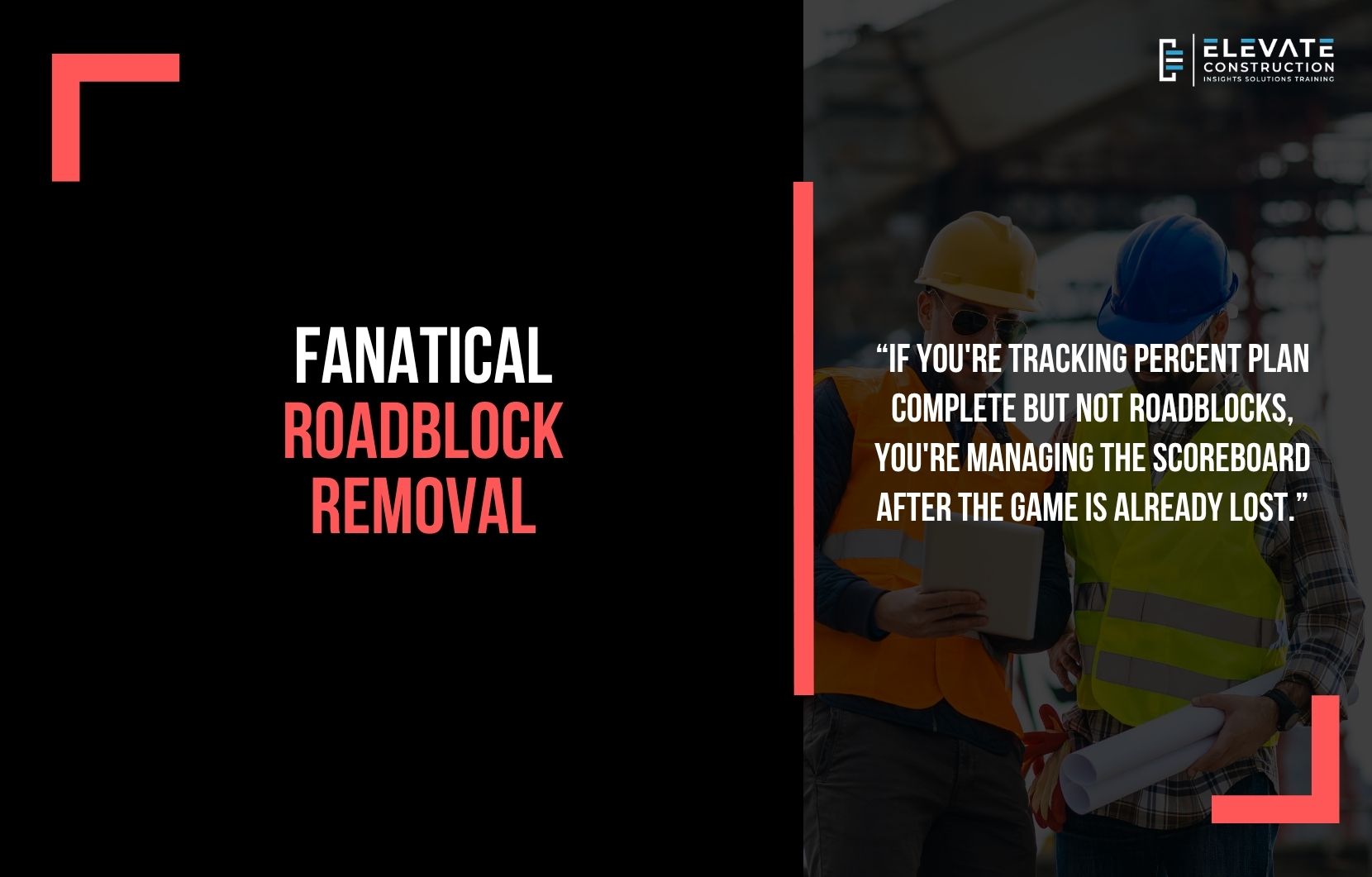
Here’s what you’re missing. Percent plan complete is a lagging indicator. It tells you the score after the game is already over. It measures outcomes without addressing causes. It tracks whether you won or lost without helping you win differently next time. Roadblock removal is a leading indicator. It identifies problems before they impact production. It clears the path for work before work starts. It makes work ready so flow can continue. It’s the difference between managing what already happened versus preventing what might happen. You’re optimizing the wrong metric. And until you shift focus from tracking completions to removing roadblocks, your project will keep fighting the same battles while wondering why nothing improves.
The Problem Hiding Behind All Those Metrics
Walk into any project meeting and watch what gets discussed. Percent plan complete from last week. Variance analysis. Why activities didn’t finish. What needs to catch up. How far behind schedule the project is running. Everyone focused on measuring what already happened. Then ask what’s being done to prevent next week from repeating this week’s problems. Ask how many roadblocks were identified and removed. Ask what system exists to surface problems before they impact production. Ask how the team is making work ready for what’s starting in the next six weeks.
Silence. Confusion. Maybe someone mentions they’re “working on it” or “following up.” But no system. No tracking. No fanatical focus on removal. Just vague assurances that people are handling things as they come up. Most projects treat roadblock removal as reactive problem-solving that happens when issues surface. Material didn’t arrive? Call the supplier. RFI didn’t get answered? Follow up with the architect. Area wasn’t made ready? Push crews to work around it. Every problem gets addressed individually, reactively, after it’s already caused delay.
What’s missing is a proactive system that identifies roadblocks before they impact production and removes them systematically as the highest priority. Instead of asking “why didn’t this get done last week?” the question becomes “what will prevent work from flowing next week and how do we remove it now?” Instead of tracking completions, you track removals. Instead of lagging indicators, you focus on leading indicators.
The Field Reality: When Roadblocks Stay Hidden
I’ve seen this pattern everywhere. Projects run visual scheduling systems. They use Last Planner. They do Takt planning. They create make-ready look-aheads. They hold weekly work planning meetings. And roadblocks still don’t surface until they’ve already caused delays. Here’s why. Trade partners don’t identify roadblocks until they’re committed to specific work at specific times. When you’re using CPM and telling trades to “follow the schedule,” they can’t see where they’re supposed to be or what they’re supposed to be doing. So when you ask “what are your roadblocks?” they say “I don’t know, we’ll just show up every day and figure it out.”
But when trades see the rhythm on a Takt plan in a visual scheduling system, when they participate in pull planning and create make-ready look-aheads, when they commit together to weekly work plans, they start bringing up issues. People don’t find reasons why they can’t get married unless somebody asks them to marry. Once someone’s committed, they start identifying problems. “Oh, I need materials here by Thursday or I can’t start Friday. I need this RFI answered or I don’t know what to install. I need layout before I can begin. This area needs cleaning before I can work safely.” Commitment surfaces roadblocks. Visual systems create commitment. Roadblock removal systems capture those surfaced problems and eliminate them before they impact production. Without all three pieces, you’re managing reactively instead of proactively.
Why This Matters More Than Percent Plan Complete
When you focus on percent plan complete without focusing on roadblock removal, you’re measuring the scoreboard without coaching the game. You know the score. You don’t know how to change it. You track outcomes without improving the system that creates outcomes. Think about what percent plan complete actually tells you. Did the work get done? Yes or no. That’s useful information. But it’s backward-looking. It tells you what already happened. It doesn’t tell you what prevented work from flowing. It doesn’t identify the roadblocks that caused delays. It doesn’t help you make different decisions next week.
Now imagine focusing on roadblock removal instead. Track the number of roadblocks found at any given time. Track the average time duration before each roadblock would have made an impact to production. Track the average time from identification to resolution. Make this a science. Become fanatical about it. Suddenly you’re managing leading indicators. You’re identifying problems before they cause delays. You’re clearing the path for work before work starts. You’re making work ready so flow can continue. You’re coaching the game instead of just reading the scoreboard.
The shift is profound. Instead of asking “what didn’t get done last week?” you ask “what roadblocks exist for next week’s work and how do we remove them now?” Instead of reacting to delays, you prevent them. Instead of tracking completions, you track removals. Instead of lagging indicators that tell you you’re losing, you focus on leading indicators that help you win.
The Framework: Building a Fanatical Roadblock Removal System
Roadblock removal must become the primary focus of your team. Not percent plan complete. Not schedule updates. Not variance analysis. Roadblock removal. If a project manager or superintendent asks “what’s my main job?” the answer is roadblock removal. If the project executive or general superintendent asks their main job, it’s roadblock removal. Create a visual roadblock map in a location where foremen and the project management team see it and huddle daily. This isn’t a spreadsheet hidden in the office. This is a visual board in the trailer or on the wall where everyone walks past it multiple times per day. Where it’s impossible to ignore. Where it creates urgency just by existing.
Track three critical metrics. First, the number of roadblocks found at any given time. How many are currently identified and waiting for removal? Second, the average time duration before each roadblock would have made an impact to production. How far ahead are you catching them? Third, the average time from identification to resolution. How fast are you removing them once identified? Use the six-week make-ready look-ahead to identify work that’s not ready and bring roadblocks to the surface. Don’t wait for problems to appear. Look ahead systematically at what’s starting in the next six weeks and ask what’s not ready. What materials haven’t been ordered? What RFIs haven’t been submitted? What layout hasn’t been completed? What coordination hasn’t happened? Surface these as roadblocks now, not when they impact production.
Ensure the team collects roadblocks in both the afternoon foreman huddle and the morning worker huddle. Foremen bring them from the field. Workers identify them at point of work. Everyone’s watching for problems that haven’t surfaced yet. Then bring them to the daily team huddle as the first priority. Not the third agenda item. Not something you get to if there’s time. First. Every day. Focus most efforts on removing roadblocks before implementing other systems on site. This is the foundation. Without it, everything else struggles. You can’t have continuous improvement without stable environments. You can’t have stable environments without roadblock removal. Make this your obsession before worrying about perfect Takt plans or advanced lean tools.
Signals Your Project Lacks Roadblock Removal Focus
Watch for these patterns that reveal you’re tracking completions instead of removing roadblocks:
- Meetings focus on why last week’s work didn’t finish instead of what will prevent next week’s work from flowing, keeping everyone reactive instead of proactive
- The same problems repeat weekly because nobody’s identifying and removing the root causes systematically, just reacting to symptoms as they appear
- No visible roadblock tracking exists, so nobody knows how many problems are waiting to impact production or how long they’ve been sitting unresolved
- Trade partners don’t bring up issues until work starts and problems surface, revealing they’re not committed to specific plans that would surface roadblocks early
The Practical System for Daily Removal
Here’s how this works in practice. Every project has problems. You need all of them to come to the surface. The afternoon foreman huddle collects roadblocks from trades. The morning worker huddle surfaces problems from the field. Then at eight or nine AM, have your fifteen-minute stand-up meeting with the project management team—PM, PEs, office engineers—where roadblocks found in huddles get brought to the team for removal on a daily basis. If you’re a PM with multiple jobs, this gives you the opportunity to check in with your people daily and clear the path for work. When systems like this exist and the PM, super, and executive all work daily to remove roadblocks, work gets made ready and flow continues throughout the project.
Escalate appropriately based on severity. Some roadblocks get handled at the location level. The foreman identifies it, the foreman removes it. Done. No escalation needed. Other roadblocks need superintendent and PM involvement. The problem’s bigger, requires coordination, needs office support. Escalate to that level. The most severe roadblocks need project executive, project director, or general superintendent involvement. These are the big problems that will destroy schedule if not removed immediately. Call in the big dogs. Widen your circle. Scale. Make sure you’re getting this done.
Think of it as three levels of response. Handle what you can at the location level. Escalate medium problems to superintendent and PM level. Bring major roadblocks to the executive team. The key is matching response to severity and moving fast at every level. Roadblocks don’t wait. Neither should removal. If your project needs superintendent coaching, project support, or leadership development, Elevate Construction can help your field teams stabilize, schedule, and flow.
Why This Changes Everything
We’re not just building projects. We’re clearing the path for workers so they can succeed. And when we focus on roadblock removal instead of completion tracking, we shift from reactive management to proactive leadership. Workers need to know every day what they’re building, how to install it, where to put it. They need materials, equipment, a clean and safe and organized environment. They need stability. Clearing work for workers in that kind of environment is where we make money. That’s where we protect families. That’s where we honor the craft.
Roadblock removal creates that stability. It removes the chaos before chaos impacts production. It eliminates the interruptions before they interrupt flow. It makes work ready so workers can focus on installation instead of problem-solving around missing information, late materials, and incomplete coordination. Companies that become fanatical about roadblock removal will dominate their markets. Companies that keep tracking percent plan complete without identifying and removing roadblocks will keep fighting the same battles wondering why nothing improves. This isn’t theoretical. This is survival. The projects that finish fast aren’t the ones with the best tracking systems. They’re the ones with the most aggressive roadblock removal.
The Challenge in Front of You
You can keep tracking percent plan complete. You can keep measuring what got done last week. You can keep holding accountability meetings about variances. You can keep managing the scoreboard after the game is over. You can keep reacting to problems instead of preventing them.
Or you can build a fanatical roadblock removal system. You can create visual tracking. You can collect roadblocks from foremen and workers daily. You can bring them to team huddles as the first priority. You can track how many exist, how far ahead you’re catching them, how fast you’re removing them. You can make this a science. You can shift from lagging indicators to leading indicators.
The projects that succeed aren’t the ones with the prettiest percent plan complete charts. They’re the ones where roadblock removal is the obsession. Where every level of leadership from foreman to executive focuses on identifying problems before they impact production and removing them systematically. Where make-ready means actually ready, not theoretically ready. Where flow continues because the path was cleared before work started.
Remember: roadblock removal systems are leading indicators. Tracking percent plan complete and other metrics are lagging indicators. You want both, but leading indicators drive lagging indicators, not the other way around. When you ensure work is made ready through fanatical roadblock removal, percent plan complete takes care of itself. When you only track completions without removing roadblocks, nothing improves no matter how much you measure. Call out a hit on roadblocks before they affect you. Make removal your obsession. Clear the path for work. Create flow. Protect your people by protecting their ability to succeed. On we go.
Frequently Asked Questions
What’s the difference between roadblock removal and regular project management?
Regular project management reacts to problems after they appear and impact production. Roadblock removal proactively identifies problems before they impact production and eliminates them systematically. It’s the difference between tracking what didn’t get done last week versus preventing next week from having the same problems. Leading indicators versus lagging indicators.
How do you get trade partners to actually identify roadblocks ahead of time?
Trade partners identify roadblocks when they’re committed to specific work at specific times in visual systems. When they can see the rhythm on Takt plans, participate in pull planning, and commit to weekly work plans, they start bringing up issues. People don’t find reasons why they can’t until they’re committed to when they will. Commitment surfaces roadblocks.
What metrics should you track for roadblock removal?
Track three critical metrics: number of roadblocks found at any given time, average time duration before each roadblock would have made an impact to production, and average time from identification to resolution. Make this a science. Track it daily. Make it visual. Become fanatical about improving all three numbers.
When should roadblocks get escalated versus handled locally?
Handle what you can at the foreman level without escalation. Escalate medium problems to superintendent and PM level when coordination or office support is needed. Bring major roadblocks that will destroy schedule to project executive or general superintendent level. Match response to severity and move fast at every level.
Can you focus on roadblock removal while still tracking percent plan complete?
Yes, but roadblock removal takes priority. Roadblocks are leading indicators that drive future performance. Percent plan complete is a lagging indicator that measures past performance. Track both, but focus most effort on identifying and removing roadblocks before they impact production. When you make work ready through removal, completions improve automatically.
If you want to learn more we have:
-Takt Virtual Training: (Click here)
-Check out our Youtube channel for more info: (Click here)
-Listen to the Elevate Construction podcast: (Click here)
-Check out our training programs and certifications: (Click here)
-The Takt Book: (Click here)
Discover Jason’s Expertise:
Meet Jason Schroeder, the driving force behind Elevate Construction IST. As the company’s owner and principal consultant, he’s dedicated to taking construction to new heights. With a wealth of industry experience, he’s crafted the Field Engineer Boot Camp and Superintendent Boot Camp – intensive training programs engineered to cultivate top-tier leaders capable of steering their teams towards success. Jason’s vision? To expand his training initiatives across the nation, empowering construction firms to soar to unprecedented levels of excellence.
On we go