
Why Waiting for Equipment to Break Is a Production Strategy Just a Terrible One
Every project team has a version of the same story. The excavator goes down on Tuesday morning. The operator noticed something off on Monday but figured it would hold. By the time the repair crew arrives Wednesday, two other trades are waiting on work that needed that machine to happen first. A half-day problem became a two-day cascade. The schedule absorbs it quietly and the team moves on, treating it as one of those things construction projects just deal with.
That pattern is not bad luck. It is a predictable outcome of a system that was designed to react rather than prevent. And the cost in schedule loss, crew downtime, rental overruns, and stress absorbed by the team is almost never measured accurately because it distributes itself across a dozen line items and a week of disruption that nobody attributes to the breakdown that started it.
The Way Most Projects Handle Equipment
Most construction projects treat heavy equipment the way most people treat a car they’re renting. They use it until something goes wrong, then they deal with it. The operator knows the machine best but rarely has a structured way to flag what they’re noticing before it becomes a failure. The superintendent knows when the equipment is critical to the path but rarely has visibility into its maintenance status. And the company managing the fleet is responding to breakdowns rather than preventing them because no system has been designed to do otherwise.
There’s no visual schedule showing when each machine is due for service. There’s no standard work checklist that the operator completes at the start of each shift so small issues are caught before they compound. There’s no root-cause tracking that shows which types of failures are recurring and what might be causing them. And when something breaks, the first instinct is to ask what the operator did wrong not what the maintenance system failed to prevent.
The operator didn’t fail the system. The system failed the operator.
A Story That Illustrates the Cost
I was on a civil project years ago where we had a critical crane operating during the most intensive phase of the work. The operator had been mentioning a hydraulic issue for days small symptoms, nothing dramatic. Nobody had a documented way to capture that, and there was no maintenance board that made the machine’s service history visible to the project leadership. When the crane went down hard during a pour, the consequences were significant: a delayed concrete placement, a scramble for a replacement crane, a full day of multiple trade crews at standstill, and rework on the partial pour. The post-incident conversation blamed the operator. The real story was that the system provided no mechanism to act on what the operator already knew.
That’s not a crane problem. That’s a system problem. And it’s one that a Total Productive Maintenance board is specifically designed to prevent.
What Total Productive Maintenance Actually Is
Total Productive Maintenance TPM is a Lean discipline that originated in manufacturing to eliminate equipment downtime through proactive, operator-led maintenance supported by a visible management system. The core idea is simple: equipment reliability is not a maintenance department problem. It is a shared system problem, and like all system problems, it requires visibility to solve.
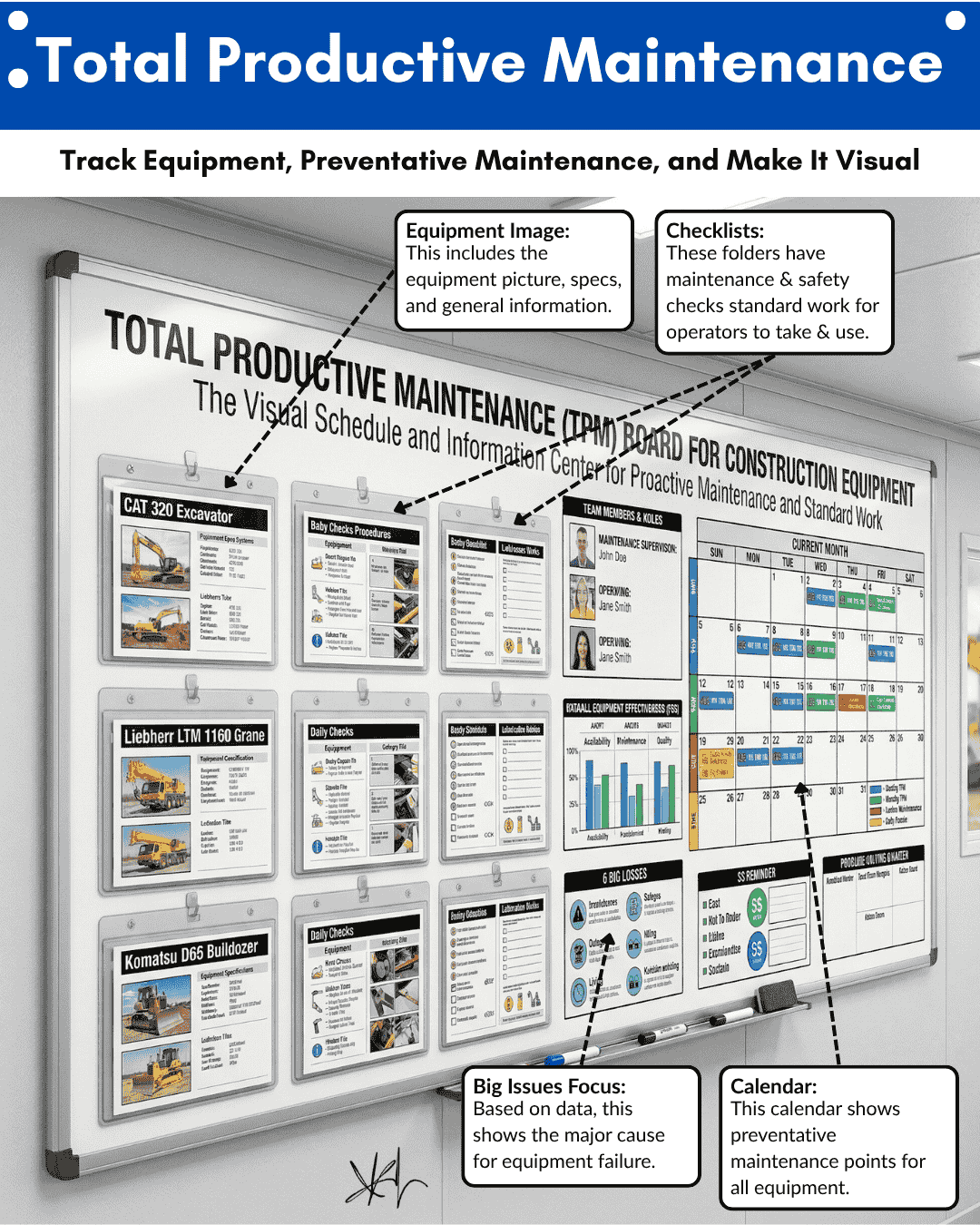
The TPM board shown in this post applies that discipline directly to construction equipment. Each major piece of equipment excavator, crane, bulldozer, and others has its own visual profile on the board that includes an equipment image, specifications, and general information so anyone on the project team knows exactly what machine they’re looking at and what its operational parameters are. This sounds basic, but on a multi-contractor project with rotating equipment and crews who have never worked with a specific machine before, that visual reference eliminates real confusion and real errors.
The operator checklists attached to each equipment panel are the most operationally critical element. These are standardized maintenance and safety inspection checklists that the operator takes and uses at the start of each shift. The checklist is not a formality. It is the daily observation loop that catches what the operator is already noticing the hydraulic level that’s slightly low, the noise in the turntable bearing, the brake response that feels different from yesterday. With a checklist, that observation becomes a documented signal. Without one, it stays in the operator’s head until it becomes a crisis.
Watch for these conditions on your project that indicate equipment is being managed reactively:
- No documented operator inspection routine for any piece of equipment
- Maintenance records that exist somewhere in the company but are not accessible or visible on the project
- Equipment breakdowns that trace to symptoms the operator had noticed but not reported through any formal channel
- No scheduled preventative maintenance windows built into the project production plan
- Breakdowns consistently attributed to operator error without root-cause analysis of the underlying system
The Preventative Maintenance Calendar and Root-Cause Tracking
The maintenance calendar on the TPM board makes the service schedule for all equipment visible to the entire project team in the same place they look at everything else. This is not a reminder in someone’s phone or a spreadsheet on a fleet manager’s computer in the home office. It’s on the wall, on the project, where the people operating and depending on that equipment can see it every day. Scheduled service becomes a production event with a date, not a vague future activity that gets deferred when the schedule is tight.
That last point matters enormously. Preventative maintenance windows get deferred on most projects because nobody has designed them into the production plan. The excavator is critical to the phase. There’s no visible signal that service is due this week. The foreman needs the machine running. The service gets pushed two more weeks. And then the machine goes down hard at the worst possible moment not because the maintenance team was negligent, but because the system had no visual mechanism to protect the service window from production pressure.
The root-cause tracking section of the board is where the system becomes self-improving over time. When an equipment issue occurs, it gets documented. When patterns emerge the same component failing on the same machine type, the same failure mode recurring across projects the board reveals them. This is how a project team stops treating every breakdown as a one-off bad event and starts treating equipment reliability as a system they can improve. You can’t manage what you can’t see. The board makes the data visible.
Why This Is a Lean Question, Not Just a Maintenance Question
Jason Schroeder teaches visual management as a core Lean principle a work environment that is self-ordering, self-explaining, self-regulating, and self-improving because of visual devices. When everyone can see the plan, see the roadblocks, and see the standard, total participation becomes possible. Equipment maintenance is no different. When the service calendar is visible, when the operator checklist is standardized, when root causes are tracked, the entire team can participate in equipment reliability instead of leaving it invisible until something breaks.
The Takt Production System depends on the train of trades moving through zones on a defined rhythm. Equipment is part of that rhythm cranes, excavators, telehandlers, and hoists are the physical infrastructure that enables material flow, zone transitions, and production sequencing. When a critical piece of equipment goes down unexpectedly, it doesn’t just pause one activity. It stalls the zone, affects the handoff to the next trade, burns buffer, and compresses the schedule for everyone downstream. A breakdown that looks like a maintenance problem is actually a production problem, a safety problem, and a people problem all at once.
Stable equipment means stable production. Stable production means predictable schedules. Predictable schedules mean crews go home on time. And crews going home on time is not a peripheral benefit of better maintenance it is the whole point of building better systems.
Respect for People Starts with Reliable Tools
There is a human story inside the equipment maintenance conversation that almost never gets told. The operator sitting in a machine that they know is declining is not having a neutral experience. They’re managing a risk that the system handed them without acknowledgment. They’re making judgment calls about when to push through and when to stop. They carry that uncertainty through the day, through the pour, through the lift and then come home carrying the knowledge that if something goes wrong, the first question will be what they did wrong, not what the system failed to prevent.
Giving that operator a standard checklist, a visible maintenance calendar, and a documented channel to flag what they’re observing is not bureaucracy. It’s respect. It says: your observations matter. Your knowledge of this machine is valued. We built a system that captures what you know and acts on it before it becomes a crisis. If your project needs superintendent coaching, project support, or leadership development, Elevate Construction can help your field teams stabilize, schedule, and flow. Building systems that protect the people doing the work from the gate to the connex box to the equipment panel is what that work looks like in practice.
Build the Board. Build the System. Build Reliability.
Here is the practical challenge. Identify the three pieces of equipment most critical to your current production phase and ask: does every operator have a standardized daily inspection checklist? Is the preventative maintenance schedule visible to the project team in a central location? When this equipment has had problems in the past, was the root cause documented in a way the team can learn from? If the answer to any of those questions is no, the system is relying on the machine to outlast the project and the operator’s vigilance to catch what the system can’t.
Build the TPM board. Start with visual profiles and checklists for your critical equipment. Add the maintenance calendar. Begin tracking issues and root causes. That board will return its investment the first time it catches a developing problem before it becomes a breakdown and it will pay dividends across every project that uses it after that. Great builders don’t just manage projects. They build systems that make success repeatable. Sometimes that starts with a board on the wall.
On we go.
Frequently Asked Questions
What is Total Productive Maintenance and how does it apply to construction?
Total Productive Maintenance is a Lean discipline that prevents equipment downtime through proactive, operator-led inspection supported by a visible management system. In construction, it means giving operators standard daily checklists, displaying preventative maintenance schedules visually on a project board, and tracking equipment issues and root causes so patterns can be identified and addressed before breakdowns occur.
Why is the operator daily checklist the most important element of the system?
The operator spends more time with the machine than anyone else and notices the earliest warning signs of failure sounds, responses, fluid levels, behaviors that are subtly different from normal. Without a structured checklist, that knowledge stays in the operator’s head and rarely reaches the project team in time to act.
How does a visible maintenance calendar prevent service deferral?
When preventative maintenance dates are visible on the project board, service windows become known production events that foremen and superintendents plan around not vague future activities that can be quietly deferred. Without visibility, service gets pushed when equipment is critical to the plan. With a visible calendar, the team can coordinate around the service date the same way they coordinate around a concrete pour or a crane pick.
What does root-cause tracking accomplish over time?
Root-cause tracking turns individual breakdowns into collective learning. When failure modes are documented and reviewed, patterns emerge the same component failing repeatedly, the same machine type underperforming in a specific operating condition, the same maintenance gap causing recurring downtime.
How does equipment reliability connect to the Takt Production System?
Equipment is part of the production infrastructure that the Takt rhythm depends on. Cranes, excavators, and telehandlers enable zone transitions, material delivery, and scope completion on the schedule the trade sequence requires. An unexpected equipment failure stalls the zone, delays the handoff to the next trade, burns production buffer, and compresses the schedule for everyone downstream.
If you want to learn more we have:
-Takt Virtual Training: (Click here)
-Check out our Youtube channel for more info: (Click here)
-Listen to the Elevate Construction podcast: (Click here)
-Check out our training programs and certifications: (Click here)
-The Takt Book: (Click here)
Discover Jason’s Expertise:
Meet Jason Schroeder, the driving force behind Elevate Construction IST. As the company’s owner and principal consultant, he’s dedicated to taking construction to new heights. With a wealth of industry experience, he’s crafted the Field Engineer Boot Camp and Superintendent Boot Camp – intensive training programs engineered to cultivate top-tier leaders capable of steering their teams towards success. Jason’s vision? To expand his training initiatives across the nation, empowering construction firms to soar to unprecedented levels of excellence.
On we go